How OEM and ODM Services Simplify Embedded Hardware Development
The development of embedded hardware encompasses considerably more than merely selecting a processor and designing a circuit board. Organizations must orchestrate hardware architecture, PCB design, component selection, operating system integration, interface development, prototyping, testing, and manufacturing. Addressing these stages in isolation can substantially increase engineering demands, prolong development cycles, and create integration complications.
OEM and ODM services facilitate the simplification of embedded hardware development by consolidating hardware engineering, customization, system integration, and manufacturing support into a more unified workflow. Rather than establishing every component and production capability internally, organizations can collaborate with a specialized embedded hardware partner to create products that satisfy their technical and commercial objectives.
For enterprises developing smart home control panels, industrial touch displays, IoT gateways, embedded computing boards, and intelligent terminals, OEM and ODM collaboration can deliver a viable approach from product conception through production.
This article delineates how OEM and ODM services function, their distinguishing characteristics, and how organizations can leverage them to streamline embedded hardware development.
1. What Are OEM and ODM Services in Embedded Hardware Development?
OEM and ODM represent two prevalent business models employed in electronics manufacturing. Both facilitate the development of customized embedded products; however, they typically differ in the extent of design responsibility assigned to each party.
What Is OEM in Embedded Hardware?
OEM is the acronym for Original Equipment Manufacturer. In an OEM engagement, the client typically furnishes the product design, technical specifications, or a predetermined hardware architecture, whereas the manufacturing partner fabricates the hardware in accordance with the established requirements.
Contingent upon the project scope, OEM services may encompass:
- PCB assembly and PCBA manufacturing
- Electronic component sourcing
- Hardware production and assembly
- Product testing and quality control
- Manufacturing documentation
- Production support for customized electronic devices
OEM services prove advantageous for enterprises that possess an existing product design or established technical specifications but require manufacturing capabilities and engineering assistance to commercialize the product.
What Is ODM in Embedded Hardware?
ODM is the acronym for Original Design Manufacturer. In an ODM engagement, the manufacturing partner assumes a more substantial role in product design and development.
Dependent upon the supplier’s technical capabilities and the negotiated scope of work, ODM services may encompass:
- Hardware architecture planning
- Processor and motherboard selection
- Customized PCB and carrier board design
- Interface and peripheral integration
- Hardware prototyping and verification
- Operating system adaptation and software integration
- Product customization for specific applications
ODM services prove beneficial for organizations that possess a product concept or application requirement but lack the comprehensive engineering resources necessary to develop the hardware independently.
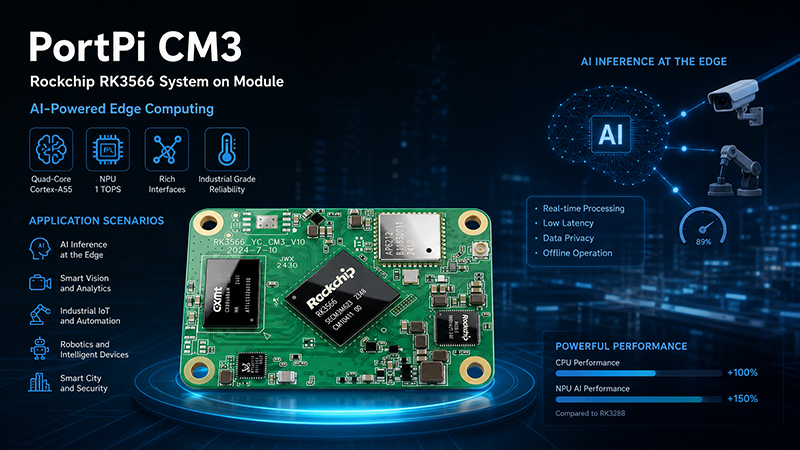
PortPi 3A
Single Board Computer
OEM vs. ODM: What Is the Difference?
| tem | OEM Services | ODM Services |
|---|---|---|
| Initial design | Usually provided or defined by the customer | More design work is handled by the supplier |
| Hardware development | Based on agreed customer specifications | May include product architecture and custom design |
| Customization | Manufacturing and specified product variations | Hardware, interfaces, and other agreed design changes |
| Typical customer | Businesses with an established design | Businesses needing additional design and engineering support |
| Main objective | Manufacture a specified product | Develop and manufacture a product solution |
The precise allocation of responsibilities differs according to the supplier and contractual agreement. Organizations must establish clarity regarding design ownership, source-code access, documentation, intellectual property, testing responsibilities, and production rights prior to commencing a project.
2. How OEM and ODM Services Simplify Hardware Design
Hardware design represents one of the most challenging phases of embedded product development. Engineers must evaluate processing performance, power consumption, board dimensions, thermal behavior, peripheral interfaces, component availability, and manufacturing constraints.
An OEM or ODM partner can facilitate the coordination of these requirements.
For instance, an organization developing an intelligent control terminal may require a processor, touchscreen interface, Ethernet connectivity, serial communication, and an appropriate power design. Rather than overseeing each hardware component independently, the organization can collaborate with a supplier to assess an existing platform and determine the modifications necessary for the intended product.
Depending on the project scope, this undertaking may encompass:
- Selecting an appropriate computing platform
- Configuring RAM and eMMC storage
- Designing a carrier board for the necessary interfaces
- Integrating display, audio, and communication functions
- Adapting the hardware to the product enclosure
- Reviewing component availability and manufacturing requirements
A well-defined development process facilitates the reduction of preventable design modifications and strengthens coordination between hardware engineering and production.
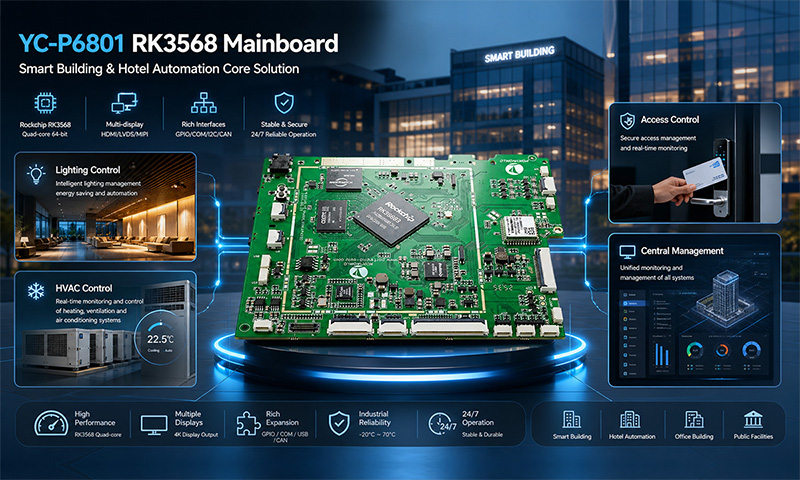
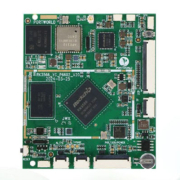
YC-P6802 RK3568 Mainboard
3. Accelerated Product Development Utilizing Established Hardware Platforms
Constructing a complete embedded computing board from the ground up demands considerable engineering resources. For certain applications, leveraging an existing compute module or motherboard serves as a more cost-effective foundation.
A compute module consolidates essential computing elements onto a single compact board, whereas a carrier board delivers application-specific connectivity and power distribution capabilities. By adopting a proven computing platform, development teams can allocate greater engineering resources toward implementing the distinctive features that differentiate their product.
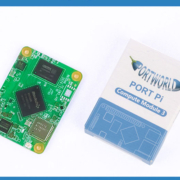
For instance, Portworld provides the PortPi CM3 Compute Module, which utilizes the Rockchip RK3566 architecture. Based on available product specifications, it incorporates a quad-core Arm Cortex-A55 processor, Mali-G52 graphics processing unit, flexible RAM and eMMC storage configurations, and compatibility with Android and multiple Linux-based operating systems.
The PortPi 3A Single Board Computer operates on the Rockchip RK3568 architecture and is engineered for development and embedded computing purposes.
Contingent upon the specific application requirements and platform compatibility considerations, organizations may customize peripheral hardware, incorporate additional components, and modify the software configuration rather than engineering all computing elements independently.
This methodology proves advantageous for intelligent display systems, industrial control terminals, Internet of Things devices, and comparable embedded applications.
4. Customized Motherboard and PCBA Development
Standard development boards frequently prove inadequate for commercial and industrial applications without substantial modifications. These sectors typically demand specialized connectors, precise mechanical dimensions, dedicated communication interfaces, particular power input specifications, or tailored peripheral arrangements.
OEM and ODM services address these requirements through the development of customized motherboards and PCBA solutions.
Potential customization initiatives may encompass:
Custom PCB design: Modifying the board configuration, physical dimensions, connector placement, and component positioning to align with the product’s mechanical and electrical specifications.
Interface integration: Incorporating or modifying supported interfaces including Ethernet, USB, UART, RS232, RS485, I2C, and display connectivity options.
Power design: Assessing input voltage parameters, power conversion efficiency, protective mechanisms, and overall system power requirements.
Peripheral integration: Integrating compatible peripherals such as displays, touchscreen panels, imaging devices, sensor systems, audio equipment, and external control modules.
PCBA manufacturing: Fabricating and assembling electronic components onto the PCB in accordance with the finalized design specifications and manufacturing standards.
The ultimate interface configuration is determined by the chosen processor architecture, motherboard design specifications, and intended product configuration. All interfaces must be validated against the corresponding hardware documentation prior to commencing production activities.
5. Operating System and Software Integration
Embedded hardware components must function seamlessly with the software executing on them. Processor compatibility alone does not ensure that an operating system, driver, or application will operate correctly on a customized board.
Software integration encompasses selecting an appropriate operating system, modifying drivers, setting up peripherals, and testing the application against the target hardware platform.
Prevalent operating system selections for embedded initiatives include:
- Android: For products requiring an Android application framework or graphical user interface.
- Ubuntu: For development platforms and applications that leverage its Linux ecosystem advantages.
- Debian: For embedded applications constructed within a Debian-based Linux framework.
- Buildroot: For constructing a tailored Linux distribution incorporating selected modules.
The optimal selection depends on processor compatibility, accessible software distributions, driver availability, application specifications, memory constraints, and long-term support strategies.
As an illustration, a touchscreen control interface may necessitate dependable display functionality, touch responsiveness, network connectivity, and rapid application initialization. An IoT gateway may prioritize communication protocols and peripheral device drivers.
Collaborating with a hardware vendor possessing expertise in both board engineering and software integration facilitates the identification of compatibility concerns prior to commercial production.
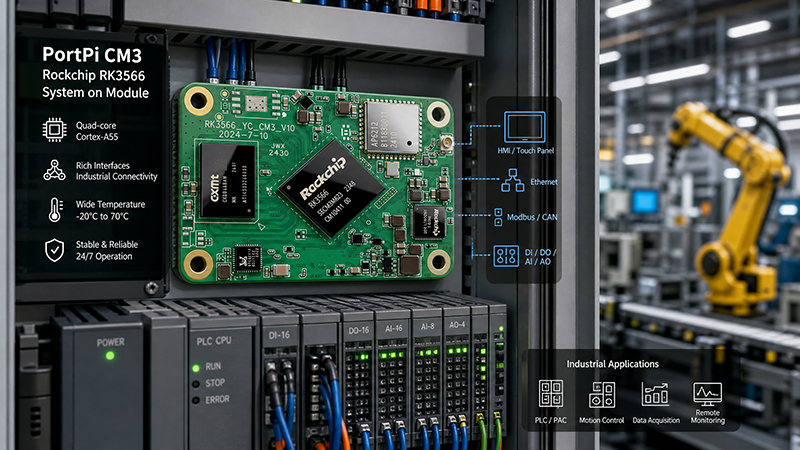
PortPi CM3 Industrial Control
6. Prototype Testing and Production Preparation
While a prototype represents a significant achievement, a circuit board that functions successfully in a laboratory setting does not necessarily meet the requirements for commercial production.
Prior to initiating large-scale manufacturing, the integrated hardware and software platform must be thoroughly assessed under realistic operational conditions.
The validation methodology may encompass the following elements, contingent upon the specific product:
- Power-on verification: Validating initial startup performance and electrical stability.
- Interface testing: Verifying connectivity with display systems, sensing devices, control mechanisms, and peripheral equipment.
- Software validation: Assessing operating system performance, device drivers, and application functionality.
- Thermal evaluation: Assessing temperature performance under anticipated operational loads.
- Reliability testing: Determining system stability throughout prolonged operation and pertinent environmental scenarios.
- Manufacturing verification: Confirming assembly specifications, quality control procedures, and production documentation requirements.
Original Equipment Manufacturer (OEM) and Original Design Manufacturer (ODM) collaborators may facilitate coordination of these procedures as defined within the project agreement.
Conducting preliminary assessments can identify structural deficiencies before they propagate to larger manufacturing runs. The particular assessments necessary are determined by the product’s intended operational context and relevant regulatory or industry standards.
7. Facilitating Product Customization and Scalable Manufacturing
Embedded products frequently require distinct configurations tailored to specific customer requirements or regional markets. A single hardware platform may necessitate multiple memory specifications, varied interface arrangements, or sector-specific software implementations.
A customization-focused supplier can assist organizations in assessing these configuration options and establishing a structured product lineup.
Based on the platform architecture, customization may encompass:
- RAM and eMMC storage alternatives
- Carrier board and connector modifications
- Display dimensions and interface integration
- Network and serial communication alternatives
- Operating system and software customization
- PCBA assembly and product integration
- CKD/SKD manufacturing arrangements, where applicable
For instance, a smart terminal developer may require one variant featuring Ethernet and RS485 connectivity for building automation systems and an alternative configuration with supplementary peripheral interfaces for industrial deployment.
Each configuration must be evaluated for technical compatibility, manufacturing feasibility, and quality assurance protocols. Customization possibilities are platform-specific and should be validated with the supplier prior to project initiation.
PortPi CM3 Industrial Control
8. Selecting an Appropriate OEM/ODM Embedded Hardware Supplier
Choosing an appropriate manufacturing partner represents a critical decision, as embedded hardware development encompasses extensive technical and production considerations that extend over time.
Prior to commencing a project, it is advisable to assess the following criteria.
Technical Competencies
Determine whether the prospective supplier possesses the capability to facilitate all relevant development phases, including processor evaluation, circuit board design, printed circuit board assembly, component integration, operating system configuration, and prototype validation.
Industry Knowledge and Solution Portfolio
Identify suppliers with demonstrated expertise in the specific hardware category applicable to your application, such as processing modules, embedded computing boards, display-integrated systems, industrial control devices, or Internet of Things infrastructure.
Adaptability and Modification Capacity
Verify which specifications are subject to modification, encompassing RAM capacity, data storage options, connection ports, communication protocols, physical board specifications, firmware settings, and structural compatibility.
Technical Documentation and Assistance
Establish clarity regarding whether the engagement encompasses delivery of circuit diagrams, connectivity specifications, application programming resources, production guidelines, and supplementary technical materials. The availability of such documentation is contingent upon contractual terms and intellectual property considerations.
Production Standards and Quality Assurance
Inquire regarding prototype validation procedures, production quality management systems, and the availability of comprehensive testing and quality documentation.
Future-Oriented Product Strategy
Evaluate component supply continuity, version control procedures, ongoing software support, and the supplier’s capacity to accommodate expanding production demands.
A dependable partnership necessitates transparent technical dialogue and a mutually defined allocation of obligations, transcending mere cost competitiveness per unit.