RK3568 vs. RK3588 for Multi-Screen Display Applications
Multi-screen display technology is playing an increasingly important role in commercial and industrial applications. Products ranging from digital signage and interactive kiosks to industrial control systems and smart transportation terminals often need to operate several displays at the same time.
Yet embedded processors vary in how many screens they can support, which resolutions they can drive, and how well they handle graphics workloads.
The Rockchip RK3568 and RK3588 are two widely used platforms for embedded display applications. Although both provide multiple display interfaces, they differ substantially in CPU performance, GPU capabilities, video processing, and display architecture.
Which platform is better suited to multi-screen applications? Compare their capabilities and learn how to select the right option for your project.
1. RK3568 vs. RK3588: Key Specifications
The RK3568 is a quad-core application processor designed for industrial and commercial embedded systems. The RK3588 is a higher-performance platform designed for demanding multimedia, AI, and computing applications.
Here is an overview of their main specifications.
| Specification | RK3568 | RK3588 |
|---|---|---|
| CPU | Quad-core Cortex-A55 | 4× Cortex-A76 + 4× Cortex-A55 |
| CPU frequency | Up to 2.0GHz | Up to 2.3GHz (A76) |
| GPU | Mali-G52 2EE | Mali-G610 MP4 |
| NPU | Up to 1 TOPS | Up to 6 TOPS |
| Video decoding | Up to 4K60 | Up to 8K60 |
| Video encoding | Up to 1080P60 | Up to 8K30 |
| HDMI output | HDMI 2.0 | HDMI 2.1 |
| Other display interfaces | eDP, MIPI DSI, LVDS, RGB, EBC | eDP, DP, MIPI DSI, HDMI |
| Multi-screen capability | Multiple display outputs, configuration-dependent | Advanced multi-screen architecture |
| Typical applications | Industrial HMI, smart terminals, commercial displays | High-resolution signage, multi-screen systems, AI displays |
Specifications describe the SoC’s capabilities. Actual display outputs, supported resolutions, and the number of screens that can operate simultaneously depend on the motherboard design, connector configuration, display routing, and software support.
2. Display Output Capabilities: How Many Screens Can They Support?
The number of screens a processor can drive at the same time is among the first factors to consider when developing a multi-screen product.
However, the number of physical display interfaces does not necessarily match the number of independent display pipelines.
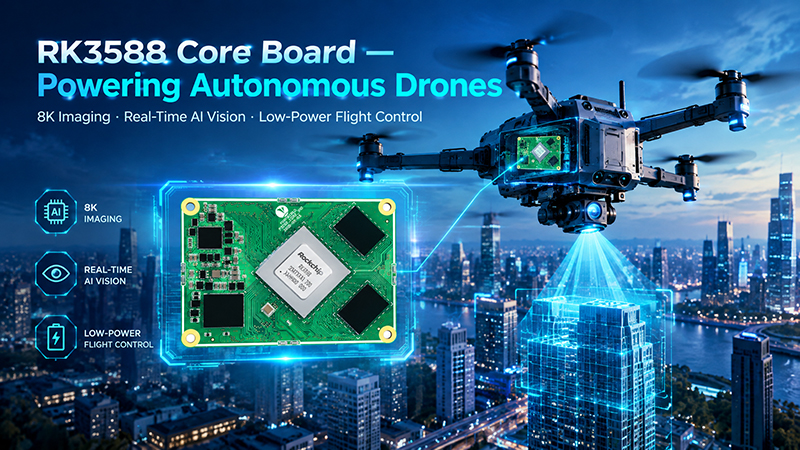
RK3588 Core Board- Drone Application Scene
RK3568: Suitable for Standard Multi-Screen Applications
The RK3568 supports several display interfaces, including:
- HDMI 2.0
- MIPI DSI
- eDP
- LVDS
- RGB
- EBC
Its display architecture allows multiple outputs to operate simultaneously. According to the RK3568 datasheet, up to three displays can be used at once with supported interface combinations.
This makes the RK3568 suitable for applications such as:
- Dual-screen industrial HMI systems
- Commercial information terminals
- Interactive kiosks
- Smart retail displays
- Embedded control systems with separate operator and information screens
For instance, an industrial machine may use one screen for equipment controls and another for production data. An RK3568-based platform may suit this setup if the necessary outputs are implemented on the board.
Developers should nevertheless confirm the specific interface and resolution combinations. Some display interfaces share internal resources or physical connections and therefore may not be able to operate independently at the same time.
RK3588: Built for More Demanding Multi-Screen Systems
RK3588 features an advanced display architecture with multiple video output interfaces and support for high-resolution displays.
Available display interfaces include:
- HDMI 2.1
- DisplayPort
- eDP
- MIPI DSI
With supported configurations, the platform can deliver output at resolutions up to 8K@60Hz and use multiple display pipelines to drive screens simultaneously.
This makes RK3588 well suited to applications that require:
- Multiple independent display areas
- High-resolution commercial signage
- Multi-screen control rooms
- Interactive digital signage
- Advanced information kiosks
- Multi-display industrial workstations
For instance, a commercial display system may need to present different content on several screens at once. RK3588 offers greater processing capacity and display resources for this type of workload.
The number of displays that can operate simultaneously depends on display-controller allocation, interface combinations, board routing, and BSP configuration. An 8K output may also use resources that would otherwise serve another display pipeline.
3. GPU Performance: Why It Matters for Multi-Screen Displays
Supporting multiple displays involves more than connecting additional cables. The processor must render graphics, coordinate visual content, and run the application’s user interface.
This is where the GPU plays an important role.
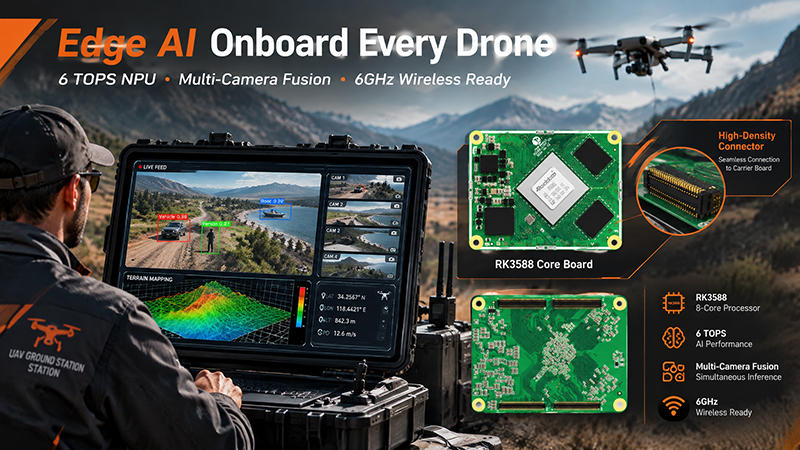
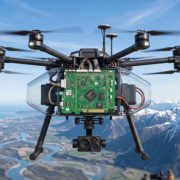
RK3588 Drone Application Scene
RK3568: Mali-G52 GPU
The RK3568 features an ARM Mali-G52 2EE GPU.
It supports graphics technologies such as OpenGL ES, Vulkan 1.1, and OpenCL 2.0, depending on driver and software support.
The GPU is well suited to:
- Standard touchscreen interfaces
- Industrial dashboards
- Menu-driven applications
- Basic animations
- Commercial information displays
- Lightweight interactive content
These capabilities meet the needs of many embedded display products.
For applications focused on presenting equipment status, charts, text, images, and standard interface elements, the RK3568 offers a practical balance of computing resources and system complexity.
RK3588: Mali-G610 MP4 GPU
The RK3588 features the more powerful Mali-G610 MP4 GPU.
Depending on the software stack, it supports advanced graphics technologies such as Vulkan and OpenGL ES.
Its enhanced graphics performance is beneficial for:
- Complex graphical user interfaces
- Applications running on multiple independent displays
- High-resolution visual content
- Advanced animations and transitions
- 3D visualization
- GPU-accelerated multimedia applications
For example, a multi-screen digital signage system may need to present high-resolution videos, animated content, and interactive graphics across several displays.
For workloads like these, the RK3588 offers greater graphics-processing headroom.
4. Video Decoding: Essential for Digital Signage and Commercial Displays
Multi-screen applications frequently require video playback. A processor may need to decode multiple video streams while keeping the user interface responsive and smooth.
RK3568: 4K Video Decoding
Under supported conditions, the RK3568 offers hardware decoding of H.264, H.265, and VP9 video formats at resolutions up to 4K60.
It is well suited to:
- 4K advertising players
- Commercial information displays
- Interactive kiosks
- Video-based industrial monitoring
- Standard digital signage systems
For applications with moderate video-processing requirements, the RK3568 can be an effective choice.
RK3588: 8K Video Processing
The RK3588 offers more advanced multimedia capabilities.
Its video decoder supports formats such as H.264, H.265, VP9, AV1, and AVS2, with decoding up to 8K60 in supported configurations.
It also provides hardware video encoding for H.264 and H.265 at resolutions up to 8K30.
This makes the RK3588 a stronger choice for:
- High-resolution digital signage
- Multi-channel video playback
- Advanced commercial display systems
- Video walls
- AI-enabled visual terminals
However, decoding several video streams simultaneously is not the same as decoding a single 8K video. Real-world performance depends on the codec, resolution, frame rate, memory bandwidth, decoder resources, and software implementation.
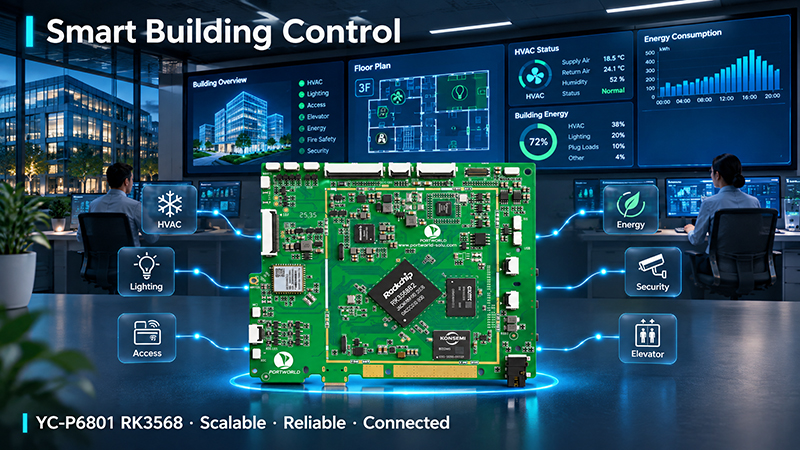
YC-P6801 Smart Building Control
5. RK3568 vs. RK3588 for Different Multi-Screen Applications
Choosing the right processor depends on the display system being developed.
Industrial HMI and Machine Control
Industrial equipment may need two screens: one for operator controls and another for real-time machine data.
RK3568 is a suitable choice for standard dual-screen industrial HMI systems.
RK3588 is a better fit when an application needs several independent displays, advanced visualizations, or additional on-device AI processing.
Digital Signage and Advertising Players
Digital signage systems often integrate video playback, advertising content, scheduling software, and remote management.
RK3568 supports standard commercial display systems with moderate resolution and graphics requirements.
RK3588 is better suited to high-resolution signage, multi-screen advertising players, and more demanding multimedia applications.
Retail Kiosks and Interactive Terminals
Interactive kiosks may use one display for customer interaction and another for advertising or supplementary information.
RK3568 can power many conventional kiosk designs.
For larger interactive systems with multiple displays, complex graphics, or demanding application software, RK3588 provides greater performance flexibility.
Transportation Information Systems
Transportation hubs may need to present timetables, route details, advertisements, and passenger announcements on multiple screens.
RK3568 supports many common information-display applications.
RK3588 is a better fit for systems that combine several high-resolution displays with video playback and sophisticated visual content.
Video Walls and Control Rooms
Video-wall deployments require careful planning for resolution, synchronization, content distribution, and display scaling.
RK3588 offers greater processing power and display capabilities for advanced multi-screen applications.
However, installations with numerous physical panels may still need external video processors, display controllers, or multiple synchronized computing devices. A single SoC should not be presumed to support every possible video-wall configuration.
6. Power Consumption and Thermal Design
Performance matters, but power use and heat output are also important factors when selecting hardware.
RK3568: A Practical Choice for Standard Display Systems
Manufactured on a 22nm process, the RK3568 features four Cortex-A55 CPU cores.
For standard HMI and commercial display workloads, it provides adequate computing capacity without the more advanced hardware architecture of the RK3588.
Potential benefits include:
- Suitable performance for standard display applications
- Moderate system complexity
- Flexible integration into embedded hardware
- A practical platform for continuous commercial use
- RK3588: Greater Performance for More Demanding Workloads
The RK3588 is manufactured on an 8nm process and combines four Cortex-A76 cores with four Cortex-A55 cores.
Its more powerful CPU, GPU, and multimedia capabilities make it suitable for complex applications involving multiple screens.
However, intensive graphics processing, high-resolution video decoding, and AI inference can raise power consumption and heat output.
The overall system should include suitable power regulation, heatsinking, airflow, and thermal monitoring.
| Factor | RK3568 | RK3588 |
|---|---|---|
| Processing requirements | Standard embedded applications | High-performance embedded applications |
| Graphics workload | Basic to moderate | Moderate to demanding |
| Video processing | Up to 4K60 decoding | Up to 8K60 decoding |
| System power budget | Generally easier to manage for lighter workloads | Requires more careful evaluation under heavy workloads |
| Thermal design | Suitable for many compact embedded products | More attention needed for sustained high workloads |
| Best fit | Standard multi-screen displays | High-resolution and complex multi-screen systems |
There is no universal power-consumption figure for either processor. Actual power usage depends on the board design, connected screens, memory, peripherals, workload, and cooling solution.
For a meaningful comparison, developers should measure complete boards under identical idle, normal-operation, and peak-load conditions.
7. How to Choose Between RK3568 and RK3588
Before choosing a processor, establish the specific requirements of your multi-screen system.
Consider these factors:
1. Number of independent screens
Identify how many screens must operate at the same time, and whether they need to display separate content or mirror one image.
2. Display resolution
A system driving several 1080p screens has different requirements from one supporting multiple 4K displays or an 8K output.
3. Video playback requirements
Determine how many video streams the system must decode simultaneously, along with their codecs, resolutions, and frame rates.
4. Graphics complexity
Basic menus and dashboards need fewer graphics resources than animated interfaces, 3D visualizations, or complex multimedia content.
5. Software requirements
Confirm whether the application requires Android, Ubuntu, Debian, or another Linux distribution. Check that display drivers, compositor support, and BSP configurations are available as well.
6. Hardware interfaces
Review the physical display connectors provided by the motherboard. Although a processor may support HDMI, eDP, MIPI DSI, and DisplayPort, the completed board may expose only some of these interfaces.
7. Power and thermal requirements
Account for the enclosure, ambient temperature, continuous operating hours, and cooling method.
Quick Selection Guide
| Application requirement | Recommended platform |
|---|---|
| Standard dual-screen HMI | RK3568 |
| Industrial information terminals | RK3568 |
| Basic multi-screen digital signage | RK3568 |
| Multiple high-resolution displays | RK3588 |
| 4K/8K commercial display systems | RK3588 |
| Complex graphics and animations | RK3588 |
| Advanced multimedia applications | RK3588 |
| Multi-screen AI-enabled terminals | RK3588 |
As a general guideline, select RK3568 for projects that need standard multi-screen capabilities and moderate computing performance. Choose RK3588 when the system calls for higher display resolutions, greater graphics capacity, advanced video processing, or expanded AI features.
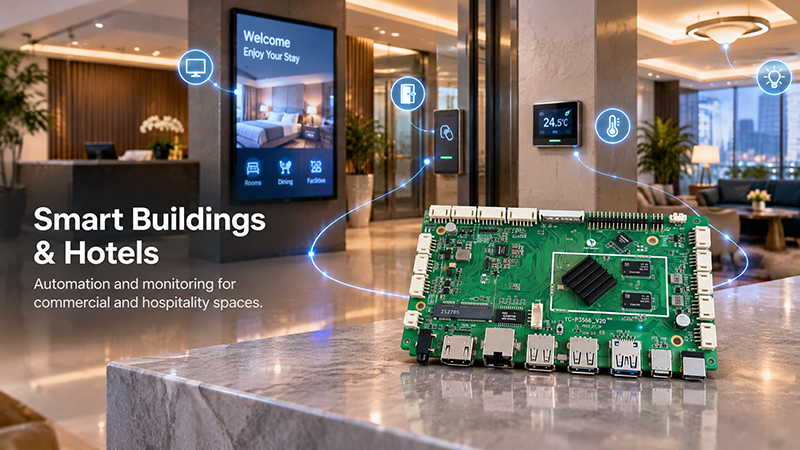
YC-P3566 rk3566 motherboard Smart Buildings Hotels
8. Portworld RK3568 and RK3588 Motherboard Solutions
Selecting the right processor is only one step in developing a dependable multi-screen embedded product. The motherboard must also meet requirements for display interfaces, power management, memory bandwidth, connectors, and software support.
Portworld offers Rockchip-based motherboards and embedded computing solutions for industrial and commercial applications.
RK3568-Based Motherboard Solutions
For projects with standard embedded computing and display requirements, Portworld offers RK3568-based motherboard solutions, including the YC-P6801 and YC-P6802.
These platforms may suit industrial terminals, smart devices, and embedded display applications.
Depending on the chosen configuration, project development may include:
- Display and touchscreen integration
- Ethernet and network connectivity
- RS485 and RS232 communication
- GPIO and peripheral expansion
- Android and Linux customization
- PCB and PCBA customization
For multi-screen products, verify the number of supported displays and available connectors for the specific motherboard revision.
Portworld RK3588 Core Board
For demanding display applications, Portworld offers the RK3588 Core Board, powered by the full Rockchip RK3588 processor.
Key specifications include:
4 × Cortex-A76 cores running at up to 2.3GHz + 4 × Cortex-A55 cores running at up to 1.8GHz
- Mali-G610 MP4 GPU
- Integrated NPU delivering up to 6 TOPS
- 8K video decoding and encoding with supported configurations
- HDMI 2.1, eDP, DP, and MIPI display interfaces
- 400-pin board-to-board connector
- PCIe, SATA, and USB expansion options
- Dual Gigabit Ethernet
- Support for Android, Ubuntu, and Debian
The RK3588 Core Board is designed for embedded products requiring higher computing performance, advanced multimedia capabilities, and adaptable display integration.
Paired with a suitably designed carrier board, it can power customized multi-screen systems for commercial displays, industrial terminals, smart kiosks, and AI-enabled visual applications.
Portworld also provides hardware customization, PCB/PCBA development, operating-system adaptation, SDK documentation, and OEM/ODM services.
Always validate the final display configuration against the core board pinout, carrier-board routing, display-controller allocation, and software support.