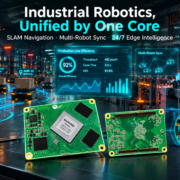
Core Board and Carrier Board: How They Work Together
A core board and a carrier board collaborate to create a comprehensive embedded computing platform. The core board supplies the essential processing resources, while the carrier board facilitates connections to displays, sensors, network interfaces, storage, and various peripherals. Grasping the interaction between these two components enables developers to select the appropriate hardware architecture for industrial equipment, AI devices, smart terminals, and other embedded applications.
What Is a Core Board?
A core board is a compact computing module that consolidates the fundamental components necessary for operating an embedded system. Depending on the specific platform, it generally comprises a processor or SoC, RAM, onboard storage, power management elements, and high-density connectors.
The core board is responsible for executing primary computing tasks, which include running the operating system, processing applications, rendering graphics, and performing AI inference when supported by the processor.
For instance, Portworld’s YC-Core3588 utilizes the Rockchip RK3588 octa-core processor, which integrates four Cortex-A76 cores and four Cortex-A55 cores along with an integrated NPU capable of achieving up to 6 TOPS. This configuration supports high-performance multimedia processing, including 8K video capabilities, making it ideal for demanding applications such as AI vision systems, robotics, and advanced smart terminals.
Due to the core board’s integration of essential computing components into a compact module, developers can leverage the same computing platform across various products without the need to redesign the processor section for each project.
What is a Carrier Board?
A carrier board serves as the primary interface board that accommodates the core board and links it to the overall system. It supplies the necessary physical connectors, power input and conversion circuits, peripheral interfaces, and additional supporting components essential for the intended application.
A carrier board may offer interfaces such as Ethernet, USB, HDMI, MIPI display or camera connections, serial communication, storage expansion, and industrial I/O. The specific interfaces are determined by the processor module, connector pinout, and the design of the carrier board.
For instance, an industrial AI device could utilize a carrier board to connect a core board to multiple cameras, an Ethernet network, an industrial display, and external control devices. The carrier board effectively translates the signals from the core board into a functional hardware platform for the final product.
This illustrates that the design of a carrier board involves more than merely adding connectors. Engineers must also take into account power delivery, signal integrity, thermal management, electromagnetic compatibility, mechanical dimensions, and interface compatibility.

RK3588 Drone Application Scene
How Do a Core Board and Carrier Board Work Together?
The two boards work as a coordinated system. The core board performs the computing, and the carrier board supplies the connections that allow the computing module to communicate with the outside world.
In a standard embedded product, the procedure consists of several stages:
- 1. Power delivery: The carrier board obtains power from an external source and supplies the necessary power rails to the core board and its associated peripherals.
- 2. Signal connection: High-density connectors transmit supported signals between the two boards, encompassing display, storage, networking, and communication interfaces.
- 3. System startup: The core board initiates its supported operating system and configures the hardware interfaces in accordance with the board configuration and software drivers.
- 4. Application execution: The processor executes the application, processes sensor data, renders graphics, or conducts AI inference.
- 5. External interaction: The carrier board links the system to displays, cameras, industrial machinery, and other devices.
- The primary requirement is compatibility. The core board and carrier board must be electrically and mechanically compatible, and the software must accommodate the interfaces utilized by the final system.
Why Opt for a Distinct Core Board and Carrier Board?
In numerous embedded products, the separation of the computing module from the interface board can simplify development and enhance hardware reusability.
Consider a manufacturer creating three distinct products: an AI inspection terminal, a smart display, and an industrial vision controller. While all three may demand similar processing capabilities, their external connections may vary significantly.
Rather than designing three entirely separate motherboards, the manufacturer could utilize a single core board and create a unique carrier board for each product. The AI inspection terminal might emphasize camera and industrial I/O connections, whereas the smart display could concentrate on display outputs, touch interfaces, and network connectivity.
This modular design presents several benefits:
- Accelerated development: Leveraging a validated computing module can minimize redundant processor-level design efforts.
- Adaptable interfaces: Carrier boards can be customized to accommodate various peripherals and application needs.
- Simplified product scaling: A unified computing platform can facilitate support for multiple device models.
- Streamlined maintenance: Certain hardware modifications can be executed on the carrier board without necessitating a complete redesign of the computing module.
- Enhanced customization: Manufacturers can modify the external hardware configuration to suit specific enclosure dimensions, connectors, and installation criteria.
- Nonetheless, modularity does not inherently ensure reduced costs or simplified development. Aspects such as connector design, board dimensions, thermal efficiency, and software compatibility require thorough validation.
Real-World Example: The YC-Core3588 Platform
YC-Core3588 — RK3588 High-Performance Core Board
The YC-Core3588 serves as a robust computing platform for applications requiring superior CPU performance, edge AI acceleration, and sophisticated video processing.
Equipped with the RK3588 processor, an integrated NPU, and a 400-pin high-density board-to-board connection design, this module enables developers to create tailored embedded platforms specific to their applications.
In the context of an AI inspection system, a bespoke carrier board could link the YC-Core3588 to compatible cameras, Ethernet networking, display interfaces, and other essential peripherals. The core board would manage image processing and AI tasks, while the carrier board would ensure the necessary electrical and physical connections.
For projects involving digital signage or multi-display setups, an alternative carrier board could focus on the display interfaces and peripheral connections essential for the installation. The actual combinations of displays will depend on the supported interface configuration, board routing, and software capabilities.
Portworld offers core board and motherboard solutions tailored for embedded computing initiatives, with customization options that may encompass carrier board design, interface integration, operating system adaptation, and OEM/ODM development. The ultimate design should align with the intended application and validated hardware specifications.
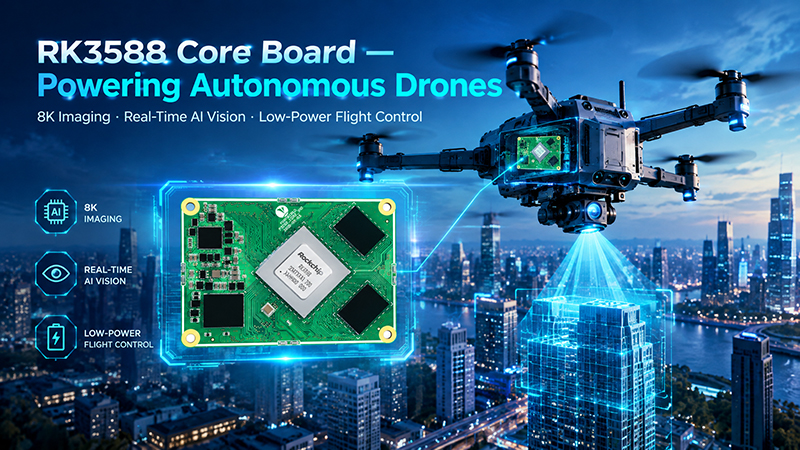
RK3588 Core Board- Drone Application Scene
What Factors Should You Take into Account When Designing a Carrier Board?
Selecting a robust core board is merely one aspect of the engineering process. The carrier board must be tailored to meet the specific requirements of the product.
Initially, outline the interfaces. Enumerate the necessary displays, cameras, Ethernet ports, USB devices, serial interfaces, storage, and GPIO connections. Ensure that the core board provides the signals required for each interface.
Subsequently, design the power architecture. Assess the power needs of the core board and its connected peripherals, taking into account peak loads and startup currents. If the device is intended for use in an industrial setting, factor in input-voltage variations, electrical protection, and power sequencing.
Thermal management is also crucial. High-performance processors can produce considerable heat during prolonged workloads. The enclosure, heat sink, airflow, and physical layout of both boards should be analyzed collectively.
Lastly, confirm the software stack. Support for Linux or Android does not automatically ensure that every peripheral will function correctly. It may be necessary to address drivers, device-tree configurations, firmware, bootloader settings, and application-level integration.
Core Board vs. Carrier Board: Which One Requires Customization?
The determination hinges on which aspect of the product necessitates alteration.
If the processor, memory setup, and computing capabilities align with the project specifications, a tailored carrier board might suffice. This option enables the developer to modify connectors,power inputs, I/O, and mechanical design to suit the application.
Conversely, if the project demands a different processor, a revised memory configuration, specialized onboard components, or a fundamentally altered computing architecture, it may be necessary to change the core board itself.
For projects with stringent size, performance, or budget constraints, both boards may need synchronized optimization. Early collaboration between hardware and software teams is essential to prevent interface conflicts and avoid unnecessary redesigns.
A core board and a carrier board fulfill distinct yet complementary roles. The core board delivers the primary computing capabilities, whereas the carrier board links these capabilities to the product’s displays, sensors, networks, and external devices.
For developers engaged in creating AI devices, industrial controllers, smart displays, or robotics platforms, grasping this distinction simplifies the process of selecting an appropriate hardware architecture and planning for customization from the outset.
Utilizing modular core board platforms like Portworld’s YC-Core3588, developers can create application-specific embedded systems while concentrating the design of the carrier board on the integration requirements and interfaces of the final product.