How Industrial Touch Screen Monitors Improve Water Pumping Station Control
Pumping stations constitute a fundamental component of municipal water distribution, wastewater management, irrigation infrastructure, and industrial water recirculation systems. Station operators are required to continuously monitor pump operational status, pipeline pressure measurements, water level indicators, volumetric flow rates, and electrical system parameters while maintaining responsiveness to fluctuating operational requirements. As pumping infrastructure undergoes increasing automation, industrial touchscreen monitors deliver an efficient solution for displaying equipment metrics and facilitating interaction with automated control systems.
Distinct from conventional office monitors, industrial touchscreen displays are engineered for incorporation into equipment enclosures, control panels, and industrial human-machine interface (HMI) platforms. When integrated with programmable logic controllers (PLCs), supervisory control and data acquisition (SCADA) systems, or industrial control units, these monitors enable operators to access system data and implement authorized operational commands via an intuitive graphical interface.
Streamlining Pumping Station Operational Monitoring
A typical pumping station comprises multiple pump units, valve assemblies, pressure measurement sensors, level detection transmitters, flow measurement instruments, and motor safeguard mechanisms. Without an integrated monitoring interface, operators may be compelled to examine individual instruments separately or depend upon remote monitoring capabilities to assess the station’s operational status.
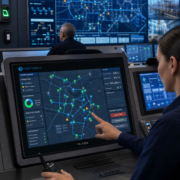
An industrial touchscreen HMI consolidates these information sources into a unified display interface. An operational control dashboard can present pump activation status, motor speed frequency, inlet and outlet pressure readings, reservoir or tank level measurements, flow rate data, system alerts, and operational configurations. Operators can rapidly determine active equipment status, identify which pump requires maintenance intervention, and verify whether system performance remains within established operational parameters.
The display itself does not automatically collect or analyze this information. Data acquisition and control are managed by the connected PLC, controller, sensors, and supervisory software. The touchscreen serves as the visual interface enabling operators to interact with the system.
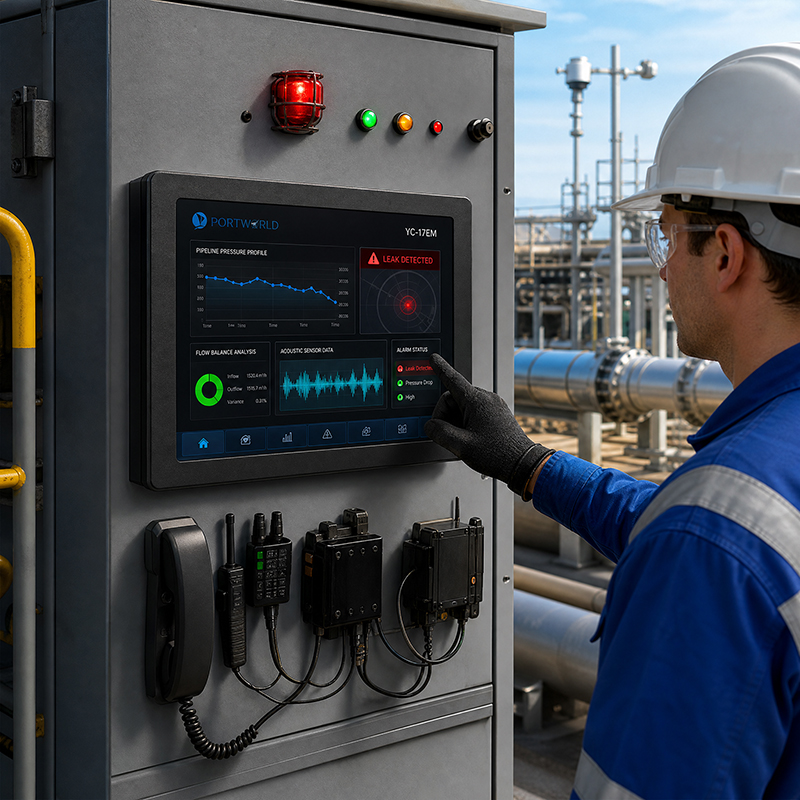
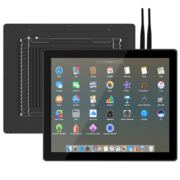
industrial touch screen
Enhancing Faster and More Accurate Control
Water demand and pipeline conditions fluctuate throughout the day. A pumping station may be required to alternate between pumps, modify motor speed, open or close valves, or adapt to changes in reservoir levels.
When paired with an appropriate control system, an industrial touch screen monitor enables authorized operators to choose operating modes, modify approved setpoints, acknowledge alarms, and transmit control commands. Distinct graphical depictions of pump groups, pipelines, and valve positions can substantially decrease the time needed to comprehend the system.
For instance, a station equipped with variable-frequency drives may present motor speed, current, and pressure feedback on a unified HMI. Operators can observe the system and modify authorized settings via the interface, while the PLC or drive controller implements the control logic and maintains configured limits.
Safety remains paramount. Essential functions must incorporate suitable authorization protocols, interlocks, alarm management, and fail-safe control logic. A touchscreen must not be regarded as a substitute for independent equipment protection or emergency shutdown systems.
Facilitating Distant Surveillance and Automated Pump Station Operations
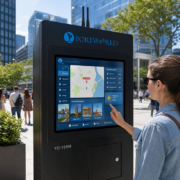
Contemporary water distribution systems frequently integrate local pumping facilities with a centralized command center. An industrial touchscreen display functions as the on-site operator workstation, while the associated control infrastructure transmits information to enterprise management software.
Based on the particular system design, the integrated controller may transmit data via industrial Ethernet, Modbus, or comparable communication standards. Personnel at the location can observe real-time operational metrics and troubleshoot apparatus malfunctions, whereas qualified off-site technicians supervise facility efficiency through the SCADA application.
This configuration can enhance cooperation between on-site and centralized management functions. Nevertheless, distant surveillance relies upon network connectivity, supervisory software capabilities, information security protocols, and the setup specifications of integrated apparatus. A touchscreen interface independently does not facilitate distant connectivity or SCADA capabilities.
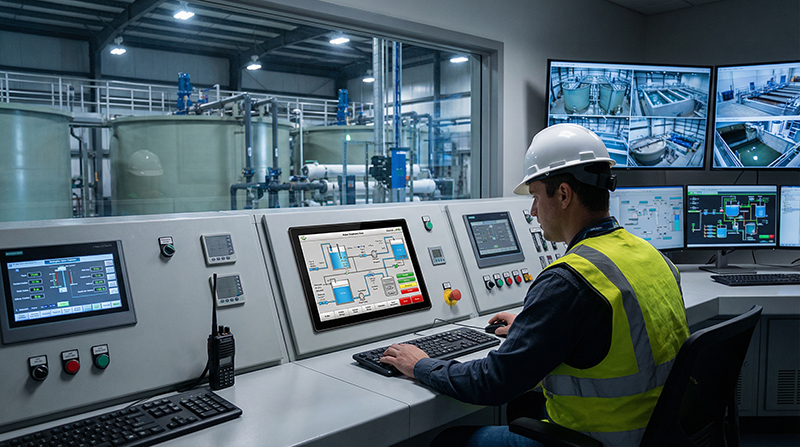
industrial touch screen monitor
Why Industrial Hardware Matters in Pumping Stations
Pumping stations frequently operate within environments characterized by electrical interference, temperature variations, airborne particulates, moisture exposure, and prolonged equipment utilization. Consequently, the display system and its associated hardware components must be specifically engineered to accommodate these operational conditions.
Display luminosity represents a critical factor when personnel work within illuminated control facilities or in proximity to natural light sources. Touch sensitivity and screen dimensions significantly affect the operator’s capacity to interpret system diagrams and manage operational controls effectively. Physical mounting specifications and protective enclosure construction determine the compatibility of the monitor with existing cabinet infrastructure or operator workstations.
For applications requiring extended operational periods, heat dissipation capabilities and material selection become essential considerations. Depending on the specific environment, procurement decisions must account for maximum operating temperature ranges, resistance to mechanical vibration, protective ratings for the front panel against environmental intrusion, and electromagnetic interference mitigation. These specifications should be systematically validated against manufacturer documentation and certified test results rather than inferred from the designation “industrial.”
Interface options represent an additional factor requiring evaluation. HDMI and USB connections may prove suitable for an independent monitor integrated with an industrial computing unit, whereas a comprehensive HMI panel PC system may necessitate Ethernet connectivity, serial communication protocols, or supplementary interfaces for data exchange with control systems and auxiliary equipment. The appropriate selection depends on whether the application requires a display component exclusively or a unified computing and display platform.
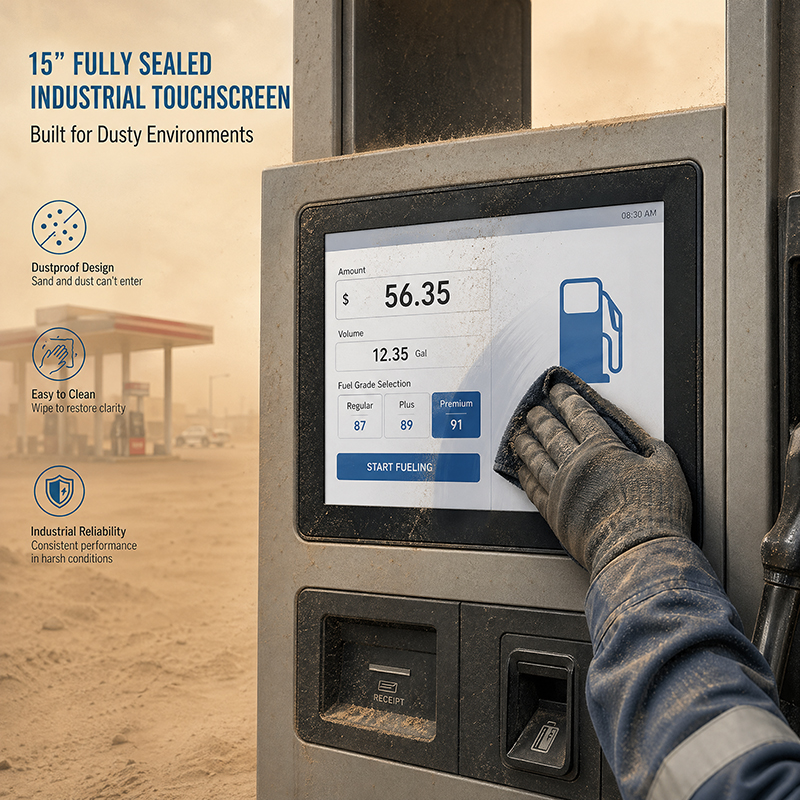
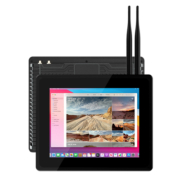
Embedded Touch Screen Panel23
Choosing a Touchscreen Solution for Water Pumping Applications
The right industrial touchscreen solution depends on the size of the pumping station, the control system, the installation environment, and the level of integration required.
A small booster station may only need a compact local interface for viewing pressure, pump status, and alarms. A larger municipal or industrial pumping facility may require a bigger display for multi-pump diagrams, trend charts, alarm lists, and maintenance information. Where a touchscreen runs the HMI application directly, an integrated panel PC may be more suitable than a standalone monitor connected to a separate computer.
Portworld provides industrial touch displays, embedded touch panel PCs, industrial mini PCs, and embedded motherboard solutions for equipment manufacturers and system integrators. Its industrial display portfolio includes models such as the YC-15EBT, YC-185EBT, and YC-215EBT, while its embedded panel PC options include the YC-104EM, YC-17EM, and YC-215EM. These product families can be evaluated for industrial monitoring and control projects according to the required screen size, mounting arrangement, computing capability, and interface configuration.
From Local Visualization to Better Operational Management
Industrial touch screen monitors help make pumping station information easier to understand and control. By presenting equipment status, sensor readings, alarms, and operating commands through a centralized interface, they support faster decision-making and more convenient interaction with automated pumping systems.
Their value depends on integration with reliable sensors, controllers, control software, and communication infrastructure. When the hardware is selected for the actual environment and the HMI is designed around operators’ needs, an industrial touchscreen becomes an important part of a practical, maintainable water pumping station control system.