Industrial Touch Screen Monitors for Oil and Gas: Key Selection Factors
The petroleum and gas sector depends upon sophisticated industrial monitoring and control systems to oversee drilling operations, refinery facilities, pipeline infrastructure, gas processing plants, and offshore installations. Personnel require dependable access to operational data, equipment conditions, alert notifications, and diagnostic information, frequently in settings where temperature variations, mechanical vibration, particulate matter, moisture exposure, and electromagnetic interference present challenges to electronic device performance.
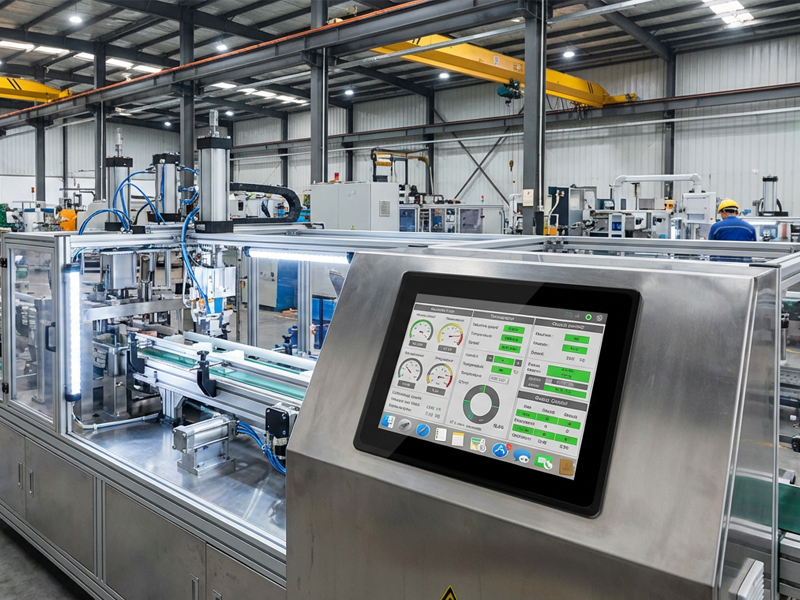
Industrial touch screen monitors serve as the visual interface facilitating human-machine interaction (HMI), permitting operators to observe operational metrics and engage with integrated control mechanisms. Nevertheless, procuring an appropriate industrial touchscreen involves considerations extending beyond display dimensions or pixel density. Environmental durability, compliance with hazardous-area standards, system interface compatibility, and sustained product accessibility constitute critical evaluation factors.
For manufacturing enterprises and systems integration firms, partnering with an industrial touchscreen monitor provider offering hardware modification capabilities facilitates the creation of customized display solutions designed for particular petroleum and gas sector applications.
Environmental Resistance and Operating Temperature
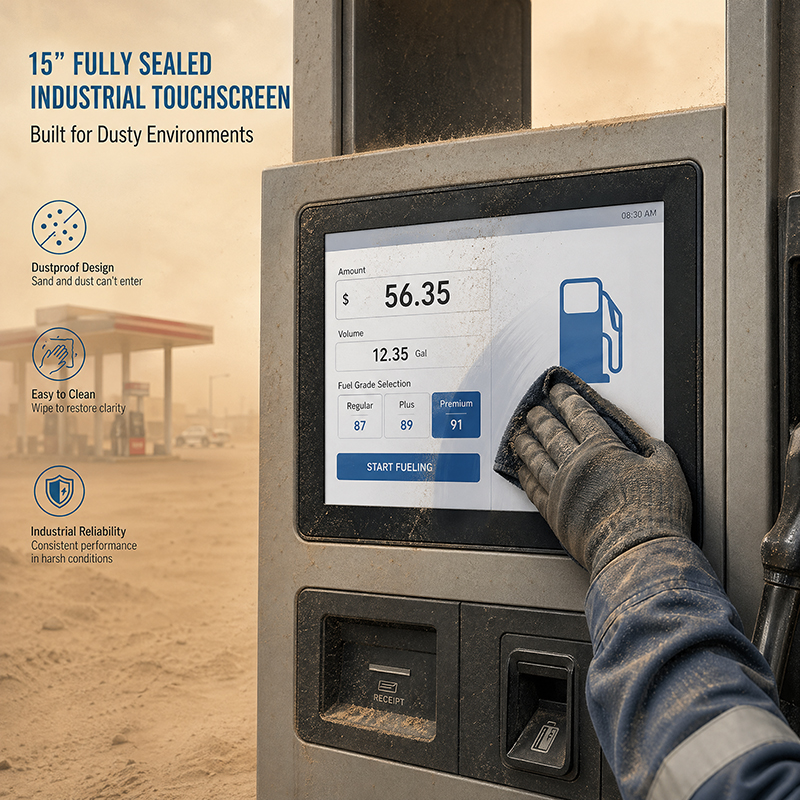
Oil and gas facilities subject electronic equipment to diverse operational environments. Outdoor pipeline systems may encounter direct solar exposure and significant temperature variations, whereas refinery control rooms and equipment enclosures necessitate specialized thermal and mechanical configurations.
When procuring an industrial touch screen monitor, stakeholders must assess the documented operating temperature range, vibration resilience, moisture tolerance, and housing protection specifications. Metallic enclosures can enhance structural durability and thermal management; however, the overall system design must still satisfy the particular application’s environmental demands.

Industrial Panel PCs
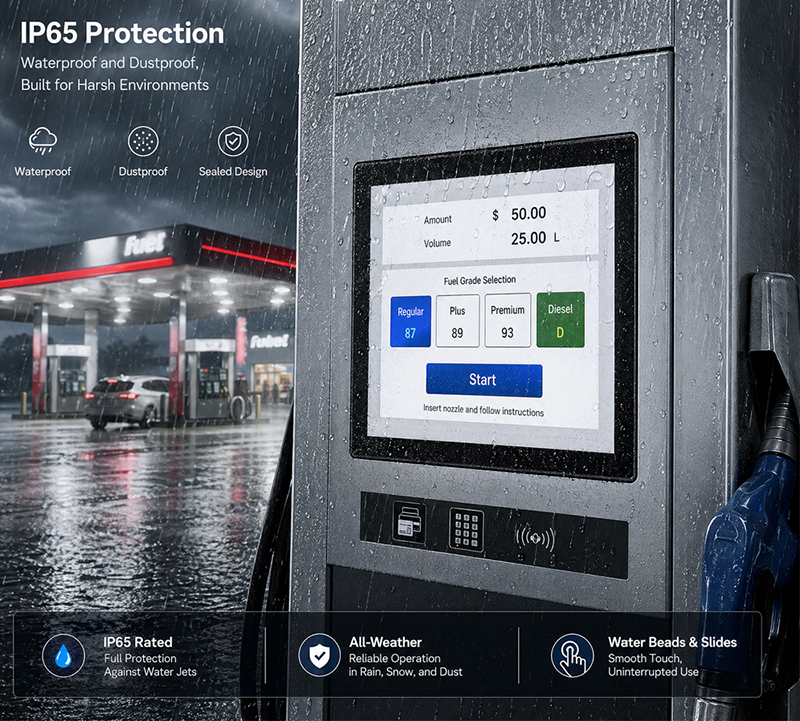
Ingress protection represents a critical factor in this evaluation. An IP65-rated front panel, for instance, is engineered to withstand dust penetration and pressurized water spray under defined testing parameters. This designation does not inherently guarantee complete waterproofing or suitability for all outdoor deployments. Purchasers should verify which components receive protection and obtain pertinent certification documentation.
Display visibility constitutes an additional consideration. High-luminance panels, suitable glare-reduction technologies, and optimal viewing angle specifications enhance visibility in high-illumination settings. The appropriate display specifications should be established based on the deployment environment and operator needs.
Hazardous-Area Certification and Electrical Safety
One of the most important considerations in oil and gas applications is whether equipment will be installed in a potentially explosive atmosphere.
Facilities handling flammable gases or vapors may have hazardous areas classified under applicable regulations and standards. Equipment installed in these locations may require ATEX, IECEx, or other applicable approvals, depending on the project and jurisdiction.
A standard industrial touchscreen monitor should not be assumed suitable for hazardous-area installation simply because it has a rugged metal enclosure or industrial-grade components. Buyers must verify that the complete device and installation arrangement meet the required hazardous-area classification.
In some applications, the touchscreen is installed in a safe control room while field sensors and other equipment operate in hazardous areas. This can simplify equipment selection, but the final system design must still comply with applicable electrical safety requirements.
For projects involving hazardous locations, certification requirements should be confirmed before selecting a product or requesting customization. General OEM/ODM capability does not itself establish explosion-protection compliance.
Embedded Touch Screen Panel23
Touch Technology, Display Readability, and Interface Compatibility
Operators may utilize touchscreen interfaces to examine process diagrams, respond to alarms, evaluate equipment condition, and retrieve maintenance documentation. The touch technology must be compatible with the operational environment and anticipated user interaction patterns.
Projected capacitive (PCAP) touch technology enables responsive multi-touch functionality and is extensively employed in contemporary HMI systems. Resistive touch may prove appropriate for applications with distinct input specifications. Actual performance is contingent upon variables including glove compatibility, moisture exposure, cover glass composition, and controller settings; therefore, evaluation under realistic operating scenarios is strongly advised.
Display dimensions should correspond to the sophistication of the HMI application. Smaller displays may be appropriate for localized equipment control panels, whereas larger screens offer expanded capacity for pipeline schematics, trend visualization, alarm notifications, and comprehensive process monitoring.
Connectivity represents an equally critical consideration. Contingent upon the system design, an industrial touchscreen may necessitate HDMI, DisplayPort, USB, Ethernet, VGA, or serial communication ports. A standalone monitor typically depends on an external computing device to execute the HMI software, whereas an integrated industrial panel PC incorporates the display with processing capabilities.
Procurement personnel should confirm all connectivity specifications and software prerequisites. For instance, Modbus protocol communication may be administered by an attached PLC or industrial computing system rather than directly by the display device. Proper grounding practices, cable management, electromagnetic shielding, and compatibility assessment in proximity to motors and variable-frequency drives are similarly essential.
Portworld Industrial Touchscreen Products for Oil and Gas Applications
Portworld manufactures industrial touch displays, embedded touch panel personal computers, industrial compact computers, and embedded motherboard solutions designed for equipment manufacturers and system integrators. These product categories are suitable for evaluation in local human-machine interface stations, pipeline surveillance systems, equipment control enclosures, and additional industrial monitoring applications, contingent upon the specific requirements of each individual project.
Applicable product selections include:
YC-15EBT — 15-inch industrial touch monitor: An embedded touchscreen display featuring HDMI, VGA, USB touch interface, and various mounting configurations. This option is appropriate for industrial operator control interfaces and equipment panels that utilize an external computing system.
YC-185EBT — 18.5-inch embedded touch monitor: An expanded display alternative for human-machine interface applications requiring additional screen real estate for system schematics, operational status indicators, and surveillance data.
YC-104EM — 10.4-inch embedded touch panel PC: A solution for space-constrained industrial environments requiring an integrated display and processing capability. Specific configurations should be verified according to project specifications.
Embedded Touch Screen Panel
YC-17EM — 17-inch industrial embedded panel PC: A touchscreen processing platform suitable for evaluation in equipment operation and on-site monitoring applications.
YC-215EM — 21.5-inch industrial embedded panel PC: An expanded integrated touchscreen computing platform designed for applications demanding increased display dimensions and integrated computational resources.
Portworld provides a selection of industrial mini personal computers, namely the YC-I720, YC-T620, and YC-T621, designed for applications requiring a discrete computing unit paired with an industrial display. For applications demanding greater flexibility, Portworld offers embedded motherboard and system-on-module solutions, including the YC-P3566, YC-P3576, YC-P6802, and YC-Core3588, which can be incorporated into purpose-built equipment.
The appropriate selection is determined by multiple factors encompassing display specifications, computational demands, connectivity requirements, software environment, electrical supply specifications, and environmental deployment conditions. Prior to finalizing any purchase order, customers should consult with Portworld to confirm detailed technical specifications and configuration availability.
Important: These product categories represent standard industrial computing hardware solutions. Compliance with hazardous-area installation requirements cannot be presumed. Should an application necessitate ATEX, IECEx, or comparable regulatory certification, customers must confirm that the selected model and its specific configuration possess the requisite certifications prior to implementation.
Portworld OEM/ODM Hardware Customization Services
Commercial industrial monitors frequently fail to satisfy the specific mechanical and electrical specifications required by oil and gas equipment. Portworld delivers comprehensive OEM/ODM services designed to assist customers in developing bespoke touchscreen hardware, embedded systems, and industrial terminals.
Display and mechanical customization encompasses screen-size configuration, housing specifications, mounting frameworks, enclosure architecture, and connector positioning, contingent upon engineering feasibility. These alternatives enable equipment manufacturers to seamlessly incorporate the touchscreen into control cabinets, operator consoles, and purpose-built industrial enclosures.
Industrial Embedded Touch Monitor
PCB and PCBA development facilitates initiatives requiring a specialized controller board, customized interface architecture, or proprietary embedded hardware solutions. Portworld additionally provides embedded motherboard and system-on-module engineering to enable customers to construct sophisticated industrial devices utilizing appropriate computing infrastructures.
Interface and connectivity configuration can be assessed in accordance with the customer’s operational specifications. Based on the chosen platform, the undertaking may encompass display interfaces, USB, Ethernet, serial communications, or supplementary hardware components. The engineering department must validate which interfaces and communication protocols are compatible with the proposed design.
Operating system and software support encompasses Android, Linux, Ubuntu, Debian, or Windows customization where compatible with the hardware infrastructure. Supplementary offerings may encompass BSP and SDK support, firmware customization, and application deployment to enhance interoperability with the customer’s HMI software and operational equipment.