How Does an ESP32 Control Panel Communicate with a Smart Home Network?
The proliferation of Internet of Things technology has facilitated the emergence of increasingly interconnected and sophisticated smart home systems. A contemporary ESP32 smart control panel functions as a centralized touchscreen interface, enabling users to regulate lighting, HVAC systems, window coverings, sensors, security apparatus, and other networked devices.
To facilitate communication within a smart home network, an ESP32 control panel employs both wireless and wired communication technologies, including WiFi, Bluetooth, MQTT, Ethernet, and RS485 protocols, thereby establishing seamless interaction between the user interface and connected smart devices.
The Function of ESP32 Control Panels in Smart Home Networks
An ESP32 control panel serves as an intermediary between end users and smart devices.
The fundamental communication architecture is structured as follows:
User Touch Input
↓
ESP32 Control Panel
↓
Smart Home Network / Gateway
↓
Connected Devices
Upon user interaction with a touchscreen icon, the ESP32 processes the corresponding command and transmits instructions to the designated device via the appropriate communication protocol.
1. Communication Through WiFi
WiFi represents one of the most prevalent communication methods employed by ESP32 intelligent control panels.
The ESP32 establishes a connection to the residential network via a WiFi router and facilitates communication with smart devices or cloud-based platforms.
Example:
ESP32 Panel → WiFi Router → Smart Home Server → Smart Devices
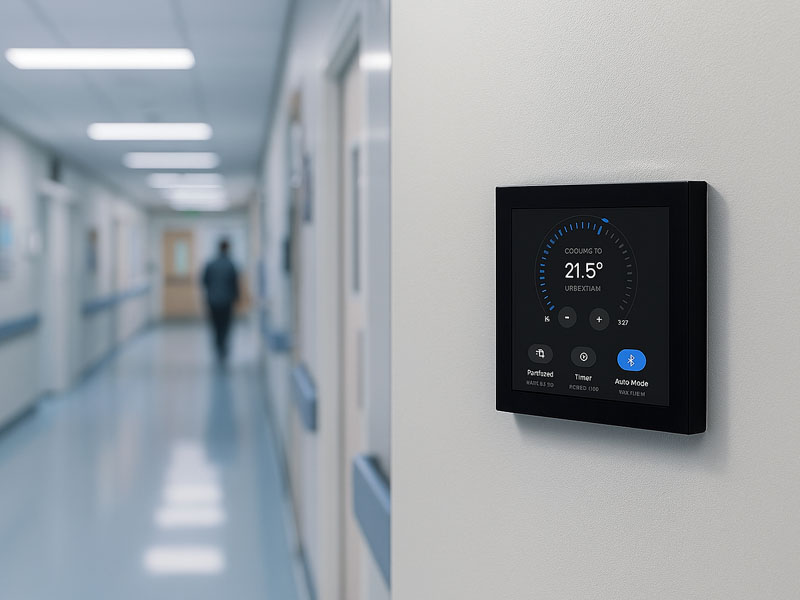
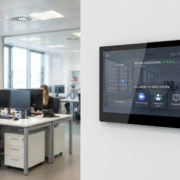
YC-SM10P
10.1 inch Smart Home Control Panel
WiFi facilitates the following capabilities:
- Remote device control
- Cloud connectivity
- Mobile app integration
- Smart home platform connection
Common use cases:
- Smart lighting control
- HVAC monitoring
- Energy management
- IoT device control
2. MQTT Communication for IoT Networks
Numerous ESP32 intelligent control panels utilize MQTT, a streamlined IoT communication protocol.
MQTT implements a publish/subscribe communication architecture.
The framework is structured as follows:
ESP32 Panel → MQTT Broker → Smart Devices
For instance:
A user activates the “Turn on bedroom light” command.
The ESP32 transmits the following publication:
Topic:
home/bedroom/light/control
Message:
ON
The MQTT broker forwards the message to the lighting controller.
After the light turns on, the device sends feedback:
home/bedroom/light/status
ON
The ESP32 panel receives the status update and refreshes the touchscreen display.
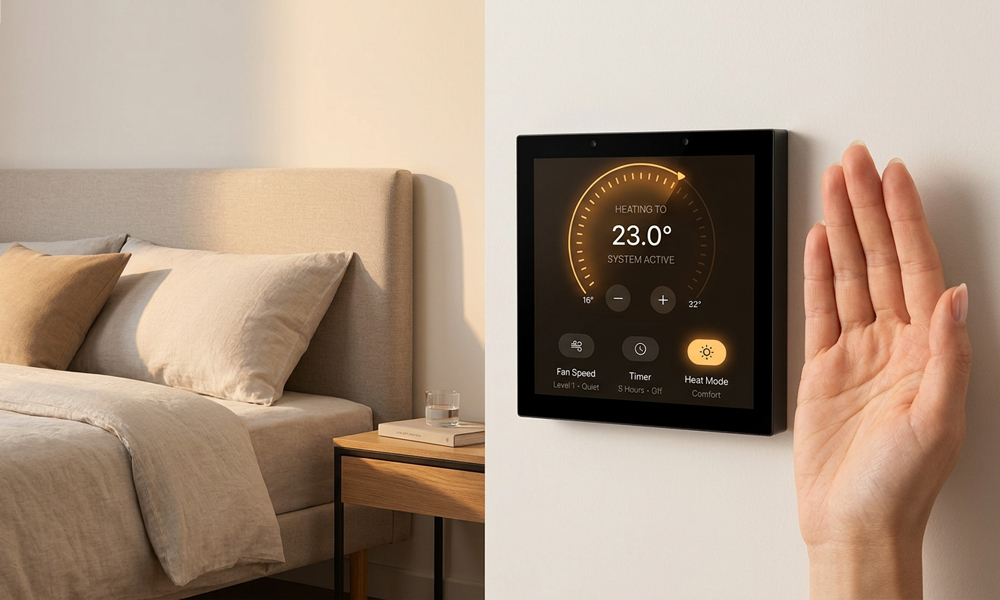
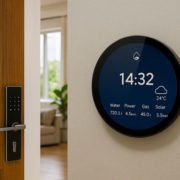
smart home control panel
3. Bluetooth and BLE Device Communication
ESP32 microcontrollers feature integrated Bluetooth capabilities, positioning them as ideal solutions for establishing short-range wireless connections with intelligent devices.
Bluetooth connectivity extends to:
- Intelligent sensors
- Electronic door locking systems
- Portable electronic devices
- Connected device accessories
Key benefits of BLE technology encompass:
- Minimized energy requirements
- Expedited device pairing procedures
- Dependable communication over limited distances
As an illustration, an ESP32 control interface can aggregate temperature readings from BLE-enabled sensors and present the collected data through its integrated touchscreen display.
4. Integration via Smart Home Gateway Systems
Within contemporary smart home infrastructures, the ESP32 control interface typically communicates through a central gateway rather than managing direct connections to individual devices.
Illustrative framework:
ESP32 Panel
↓ WiFi/MQTT
Smart Home Gateway
↓ Zigbee / Matter / Bluetooth
Smart Devices
The gateway orchestrates support for multiple communication standards, encompassing:
- Zigbee protocol
- Matter standard
- Thread protocol
- Bluetooth technology
- Z-Wave protocol
This architectural approach enables the ESP32 control interface to manage an expanded array of devices manufactured by various organizations.
5. RS485 Communication for Building Automation
Certain ESP32 smart control panels incorporate RS485 communication capabilities to facilitate wired automation systems.
RS485 finds widespread application in:
- HVAC systems
- Sensors
- Industrial controllers
- Building automation equipment
Illustrative example:
- ESP32 Control Panel
- ↓ RS485 Modbus
- HVAC Controller
Operators possess the capability to modify:
- Temperature
- Fan speed
- Operating modes
directly through the touchscreen interface.
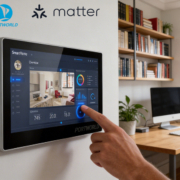
smart home control panel7
6. Ethernet Communication
In commercial smart home and building applications, Ethernet delivers dependable network communication.
Numerous ESP32-based control panels facilitate Ethernet connectivity via expansion modules or built-in interfaces.
Key benefits:
- Stable connection reliability
- Minimal latency
- Optimal for professional deployments
Typical use cases:
- Intelligent hotel systems
- Office automation solutions
- Building management platforms
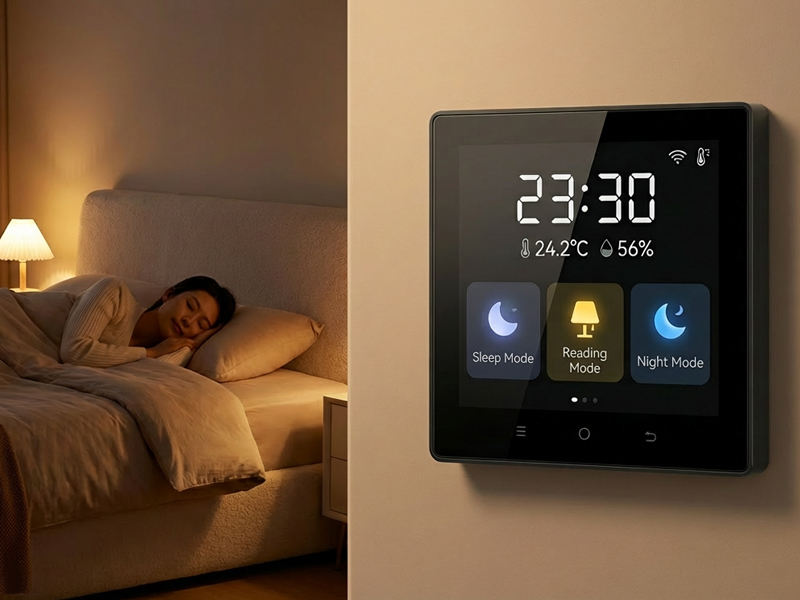
ESP32 Control Panel Communication Example
Consider a sophisticated smart bedroom automation system:
Step 1: User Interaction
The user selects:
“Night Mode”
on the ESP32 touchscreen interface.
Step 2: ESP32 Processes the Command
The microcontroller initiates the designated automation sequence.
Step 3: Commands Are Sent
Via MQTT/WiFi connectivity:
- Lighting fixtures deactivate
- Window coverings lower
- Temperature control system modulates
Step 4: Device Feedback Returns
- Sensory equipment transmits:
- Ambient temperature readings
- Illumination status information
- Window covering position data
Step 5: Display Updates
The ESP32 control panel refreshes to reflect the present environmental conditions.
Portworld YC-SM43P ESP32 Smart Control Panel
The Portworld YC-SM43P represents an ESP32-S3-based intelligent touch panel engineered for Internet of Things and automation applications.
It provides support for:
- ESP32-S3 dual-core processor
- WiFi connectivity
- Bluetooth 5.0
- Ethernet
- RS485 communication
- LVGL graphical interface
Utilizing these communication capabilities, the YC-SM43P can be incorporated into:
- Smart home systems
- Hotel room automation
- Industrial IoT solutions
- Building control platforms
Why Implement ESP32 Control Panels in Smart Home Networks?
Comprehensive Connectivity Options
The ESP32 platform accommodates multiple communication methodologies:
- WiFi
- Bluetooth
- MQTT
- RS485
- Ethernet
this facilitates seamless integration with diverse smart home architectures.
Minimal Power Requirements
In comparison to conventional embedded computing systems, the ESP32 delivers energy-efficient functionality for Internet of Things applications.
Simplified Customization Capabilities
Developers possess the ability to modify:
- Touchscreen interface
- Firmware
- Communication protocols
- Automation functions
- Economical Solution Implementation
ESP32-based solutions demonstrate suitability for expansive smart home and IoT deployment initiatives.
An ESP32 control panel facilitates communication with a smart home network through the integration of touchscreen functionality and various IoT communication protocols, including WiFi, MQTT, Bluetooth, Ethernet, and RS485.
This device operates as a smart home controller, an IoT terminal, or a gateway-connected interface, enabling users to govern multiple connected devices from a single centralized touchscreen platform.
Utilizing solutions such as the Portworld YC-SM43P ESP32-S3 smart touch panel, developers and system integrators are able to develop tailored smart home, hotel, and building automation systems with adaptable communication infrastructure.