Shelf-Edge Digital Displays: Features and Retail Applications
In the retail sector, the shelf edge serves as more than just a location for price displays. It represents one of the final opportunities for retailers to engage with consumers prior to their purchasing decisions. While traditional paper labels convey vital information, they lack the adaptability needed for promoting new products, emphasizing special offers, or modifying messages throughout the day.
Digital displays at the shelf edge open up fresh avenues for in-store communication by delivering digital content directly to the product. Retailers can utilize these displays to showcase discounts, outline product advantages, support seasonal promotions, and facilitate easier access to specific product information. Depending on the technology employed, the content can vary from basic pricing details to vibrant images, animations, and videos.
Nonetheless, not all digital shelf solutions fulfill the same role. Electronic shelf labels, narrow LCD shelf screens, and larger digital signage displays each have distinct power requirements, content capabilities, and installation prerequisites. Recognizing these distinctions is crucial for selecting an appropriate solution.
Shelf-edge digital displays refer to electronic screens that are positioned along the front edge of retail shelves or adjacent to products. These displays serve as a replacement or enhancement for traditional printed shelf labels and promotional cards, utilizing digitally managed content.
This term encompasses various technologies. Some displays are primarily intended to convey product names, prices, and essential details, while others utilize full-color LCD screens to showcase promotional graphics, animated content, and product information over an extended section of shelving.
Retailers may implement small electronic labels throughout a supermarket to ensure that product pricing remains current, while also installing color LCD displays in specific sections such as beverages, cosmetics, or consumer electronics to draw attention to particular products.
The primary distinction between these displays lies in their intended function. A pricing-focused label emphasizes low power consumption and precise information, whereas a promotional display focuses on visual appeal and adaptable content.
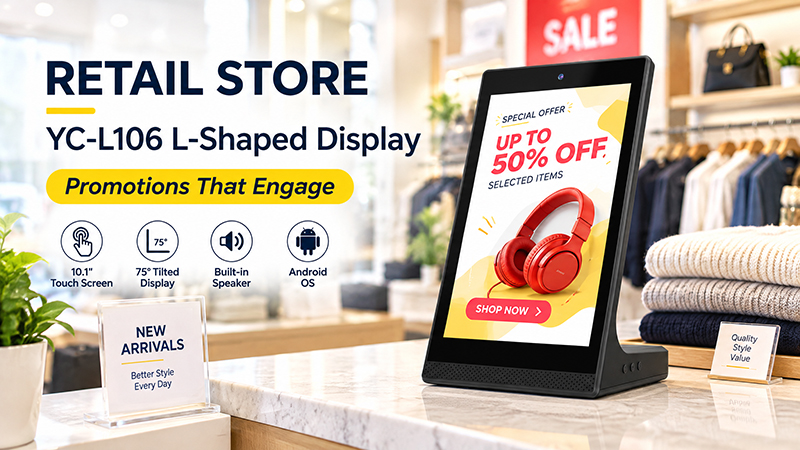
YC-L106 Retail Store Banner
Key Features of Shelf-Edge Digital Displays
1. Dynamic Content and Promotional Messaging
A significant advantage of digital shelf displays is their capacity to update content without the need for new printed materials.
Retailers have the opportunity to showcase new arrivals, seasonal items, limited-time promotions, bundled offers, or brand initiatives. For instance, a supermarket may advertise holiday-themed products during a seasonal promotion, while a cosmetics retailer might highlight a new product line or a special deal on select items.
Full-color LCD displays can accommodate product images, animated graphics, and videos, depending on their specifications. In contrast, electronic paper displays are typically more suitable for static pricing and product details, although the color and graphic capabilities can differ by model.
This adaptability enables retailers to align content with their sales objectives. The most successful implementations utilize succinct messages and clear visuals instead of attempting to convey excessive information in a confined space.
2. Remote Content Management
For retailers managing numerous shelves or multiple locations, the task of manually updating each display can become quite challenging.
A suitable content management system (CMS) enables authorized personnel to disseminate promotional materials, schedule campaigns, and oversee connected displays from a distance. A centralized system can also assist in ensuring consistent branding across various locations.
Prior to selecting a display, retailers should verify the methods of content upload, the ability to schedule updates, and the compatibility with network connections and software platforms.
The capability for remote management relies on the entire system, not solely on the display itself. The integration of hardware, software, network infrastructure, and any connections to retail systems must function cohesively.
3. Clear Product and Price Information
Shelf-edge displays should present information in a manner that is easily readable from the typical distance at which shoppers stand from a product.
Factors such as text size, contrast, brightness, screen resolution, and viewing angle all influence readability. While a narrow display may suffice for showing a price and a brief promotional message, it may lack the necessary space for comprehensive product descriptions.
Retailers should also take into account the ambient lighting conditions. A screen placed under bright retail lighting may require different brightness levels and anti-glare features compared to one situated in a darker specialty store.
For pricing applications, the information shown on the shelf must align with the retailer’s official pricing database and checkout system. If prices are managed electronically, the update process should be thoroughly tested to minimize discrepancies.
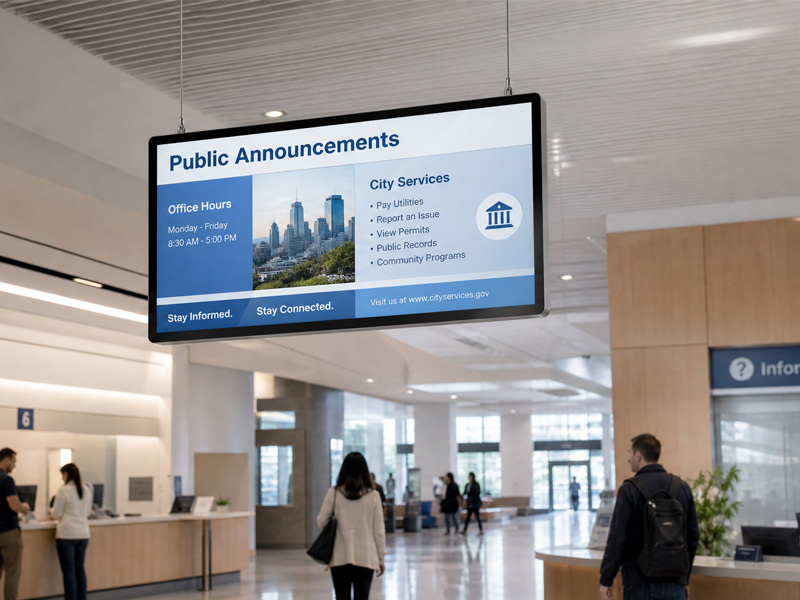
Stretch Bar Monitor
4. Streamlined Design and Versatile Installation
Shelf-edge displays must seamlessly integrate with retail fixtures without hindering product visibility, shelf accessibility, or customer movement.
Slim LCD screens can be mounted along a shelf rail, while compact electronic labels may be affixed to specific product locations. The suitable mounting technique is contingent upon the shelf dimensions, display type, cable management, and the retailer’s existing fixtures.
For extended display strips, retailers should evaluate whether a single screen can adequately cover the necessary shelf area or if multiple displays need to be installed and synchronized.
An effectively designed installation should also enable staff to restock products, clean the shelves, and replace hardware without causing unnecessary interruptions.
5. Connectivity and System Integration
Connectivity plays a crucial role in how displays receive content and their ability to interface with other retail systems.
Depending on the product, shelf-edge displays may accommodate wireless networking, Ethernet, or various other interfaces. Battery-operated electronic shelf labels generally utilize low-power wireless communication, whereas active LCD displays typically necessitate a more robust power and data setup.
Integration may encompass a CMS, product information management system, pricing database, or point-of-sale platform. However, merely having a network connection does not ensure compatibility with these systems.
Retailers should clarify which information needs synchronization, identify the source of authoritative data, and establish how updates are validated. For initiatives involving dynamic pricing, a dependable connection between the display management platform and the retailer’s pricing workflow is especially critical.
6. Power Consumption and Operating Requirements
Power requirements represent a significant distinction between electronic shelf labels and active digital shelf displays.
Electronic paper labels utilize minimal power during standard operation, as their images can remain visible without the need for continuous display refreshing. Many of these labels operate on batteries and utilize wireless communication.
In contrast, LCD shelf displays typically necessitate a constant power source while in use. Depending on their design, this may require a DC power supply, a dedicated power connection, or a compatible Power over Ethernet (PoE) configuration.
Retailers should assess overall power consumption, cable management, installation expenses, heat dissipation, and the anticipated operating schedule. PoE should only be considered when both the display and the power-sourcing equipment adhere to compatible standards and possess adequate power budgets.
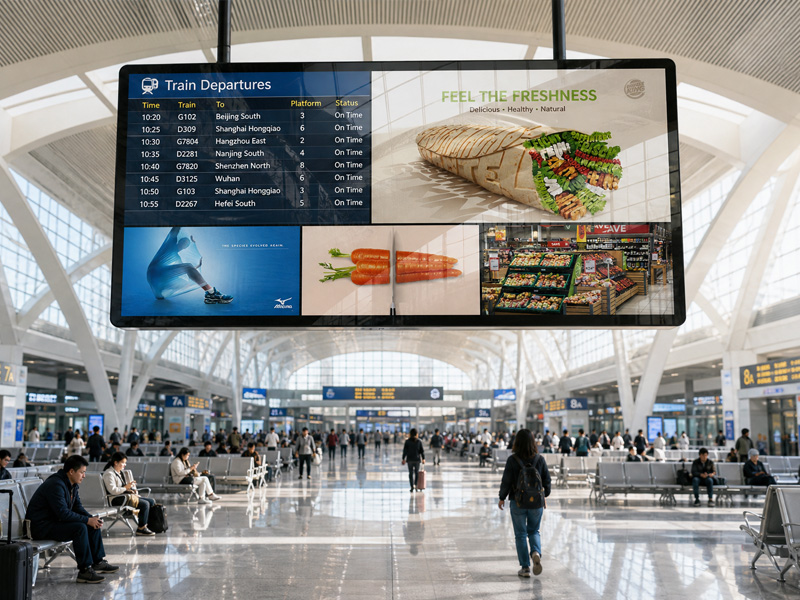
Advertising Digital Signage
Electronic Shelf Labels vs. LCD Shelf-Edge Displays
Although the two technologies can be used together, they address different retail requirements.
| Feature | Electronic Shelf Labels (ESL) | LCD Shelf-Edge Displays |
|---|---|---|
| Primary purpose | Pricing and product information | Promotions and visual communication |
| Display technology | Commonly e-paper; other technologies are available | Typically active LCD |
| Content | Prices, product details, simple graphics | Full-color images, animation, video, and text |
| Power | Often battery-powered | Usually requires a continuous power source |
| Updates | Typically wireless through a label management system | Through compatible network and content management software |
| Typical installation | Individual product or shelf positions | Along a shelf section or promotional area |
| Best suited for | Frequent price updates across many products | Product highlights, brand campaigns, and high-impact promotions |
The appropriate choice is contingent upon the business objective. If a retailer primarily needs to modify prices for thousands of products, an ESL system might be the more suitable initial option. Conversely, if the aim is to draw attention to specific products through color and motion, LCD shelf-edge displays could provide enhanced flexibility.
Some retailers opt to integrate both technologies, utilizing electronic labels for standard pricing and digital screens for promotional sections. This strategy can effectively balance operational efficiency with more impactful in-store marketing.
Retail Applications of Shelf-Edge Digital Displays
Supermarkets and Grocery Stores
Grocery retailers oversee extensive product assortments, frequent promotions, and seasonal campaigns. Digital shelf displays can effectively showcase special offers, new products, fresh-food promotions, and pertinent product information.
Electronic shelf labels can facilitate digital price management across a vast array of items, while LCD displays can be strategically placed in high-visibility locations such as beverage aisles, confectionery sections, or promotional endcaps.
For fresh food items, pricing and promotional messages may vary based on the retailer’s operational policies. Any automated updates should be linked to verified pricing data and thoroughly tested prior to implementation.
Electronics and Consumer Technology Retail
Electronics retailers frequently need to convey product specifications, compatibility, key advantages, and distinctions among similar models.
Shelf-edge LCD screens are capable of showcasing product images, feature highlights, and brief demonstrations without necessitating a large display at each product location. This is particularly advantageous when shoppers are comparing multiple devices side by side.
In instances where more comprehensive information is required, a retailer may integrate shelf-edge content with QR codes or a larger interactive display. The display itself should concentrate on the most pertinent purchasing information.
Cosmetics and Personal Care
Retailers in the cosmetics and personal care sector place significant emphasis on product presentation, brand identity, and promotional initiatives.
Digital shelf displays can effectively showcase new product lines, ingredients, product benefits, seasonal collections, or special promotions. Full-color content also aids retailers in maintaining a cohesive visual style across selected shelves.
Given that shelf space is often at a premium, slim display formats and thoughtfully designed mounting hardware are particularly crucial. The screen should enhance the product presentation rather than create a cluttered appearance on the shelf.
Selecting the Appropriate Shelf-Edge Display for Your Retail Space
The process of choosing a display begins with identifying the specific issue it is intended to address. A retailer prioritizing price accuracy will have distinct needs compared to one that seeks to enhance product visibility through digital marketing initiatives.
Initially, ascertain the type of content to be displayed. Simple price tags and brief product descriptions may be suitable for electronic labels, whereas dynamic promotions or product videos necessitate a display that can accommodate such formats.
Subsequently, measure the shelf space that is available. Document the usable length, height, viewing distance, mounting depth, and the pathways available for power and data cables. These dimensions will assist in determining whether individual displays, narrow LCD screens, or extended shelf strips are appropriate.
Next, assess the readability of the display. Evaluate the resolution, brightness, contrast, viewing angle, and glare under the actual lighting conditions of the store. For narrow screens, it is advisable to test the content layout at the designated viewing distance instead of relying solely on the specifications provided in product documentation.
Software compatibility must be examined prior to finalizing the hardware. Verify whether the display is compatible with the chosen Content Management System (CMS) and whether any connections to product, inventory, or pricing data necessitate further development.
Lastly, take into account the overall cost of implementation. The budget should encompass the expenses related to the displays, mounting hardware, power infrastructure, software licensing, integration, installation, maintenance, and future replacements. In the case of extensive rollouts, it is often prudent to pilot a representative section of the shelf before proceeding with a comprehensive store installation.
Stretch Bar Monitor
The Necessity of Custom Shelf-Edge Digital Display Solutions
While standard retail displays can serve numerous projects effectively, they may not fulfill every specific requirement regarding shelf length, enclosure design, operating system, interfaces, or software integration.
Custom hardware becomes increasingly important when a retailer requires a unique screen format, a slim enclosure to accommodate an existing fixture, a specific embedded motherboard, or a preconfigured operating environment tailored for its retail application.
Portworld offers digital signage hardware along with OEM/ODM customization services tailored for business projects. Depending on the specific project needs, their services may encompass display configuration, embedded motherboard selection, adaptation of Android or Linux software, interface customization, application preinstallation, branding, and packaging.
For shelf-edge applications, it is essential to assess the actual design in relation to the installation space, power arrangement, content type, and retail software requirements. A standard digital signage display is not inherently suitable for a shelf rail; factors such as dimensions, mounting, thermal performance, cabling, and continuous operation must be thoroughly evaluated.
Retailers intending to implement a customized deployment should clearly outline the mechanical design, software responsibilities, interface requirements, content management strategies, and maintenance expectations prior to commencing mass production.