RK3566 vs. RK3568 Core Boards: How to Choose for Your Project
Selecting the right processor is a key step in developing an embedded system. The Rockchip RK3566 and RK3568 are quad-core ARM Cortex-A55 platforms built for applications including smart devices, industrial terminals, digital signage, and IoT systems.
At first glance, the processors appear similar. Both include a Mali-G52 GPU, an integrated NPU, 4K video decoding, and support for Android and Linux-based operating systems. However, they differ in CPU frequency, display capabilities, and peripheral connectivity.
Which processor should you choose for your next project? The decision depends less on the processor’s name and more on your system requirements.
1. Understanding the RK3566 and RK3568
The RK3566 targets cost-effective embedded applications that need dependable computing and multimedia performance. Common uses include smart home devices, tablets, compact IoT gateways, and commercial display terminals.
The RK3568 offers a wider selection of connectivity and expansion options. With CPU speeds of up to 2.0 GHz, support for multiple displays, and additional high-speed interfaces, it is better suited to industrial systems and applications with more demanding hardware needs.
Both platforms feature four ARM Cortex-A55 CPU cores and a GPU from the Mali-G52 family. They also include a 1 TOPS-class NPU for supported AI inference workloads.
2. RK3566 vs. RK3568: Key Specifications
The following table summarizes the main differences between the two SoCs.
| Specification | RK3566 | RK3568 |
|---|---|---|
| CPU | Quad-core Cortex-A55 | Quad-core Cortex-A55 |
| CPU Frequency | Up to 1.8GHz | Up to 2.0GHz |
| GPU | Mali-G52 2EE | Mali-G52 2EE |
| NPU | Up to 1 TOPS | Up to 1 TOPS |
| Video Decoding | Up to 4K@60fps | Up to 4K@60fps |
| Video Encoding | Up to 1080p@60fps | Up to 1080p@60fps |
| Display | Single display engine | Multi-display support |
| Memory | DDR3/DDR4/LPDDR4/LPDDR4X options | DDR3/DDR4/LPDDR4/LPDDR4X options, including ECC support |
| Connectivity | USB 3.0, PCIe 2.1, SATA, Gigabit Ethernet | More extensive USB, PCIe, SATA and Ethernet options |
| Operating Systems | Android, Linux | Android, Linux |
Note: These are SoC-level capabilities. Actual performance, interface availability, memory capacity, and display combinations depend on the selected core board, package, pin multiplexing, and carrier-board design. Check the specific module datasheet before finalizing your hardware.
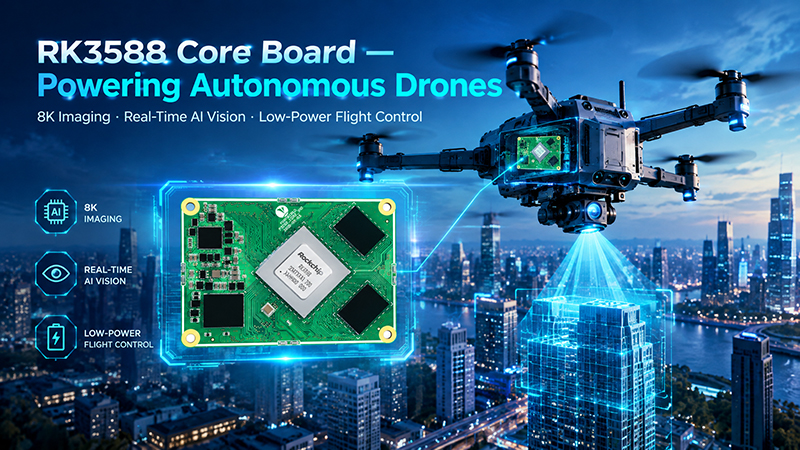
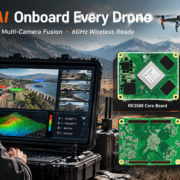
RK3588 Core Board- Drone Application Scene
3. CPU and AI Performance: What Difference Does It Make?
Both processors feature a quad-core Cortex-A55 architecture, making them suitable for embedded operating systems and routine application workloads.
The RK3568 reaches CPU frequencies of up to 2.0GHz, while the RK3566 supports up to 1.8GHz. This higher ceiling can provide more processing capacity for multitasking, system services, and applications with heavier CPU requirements.
However, the frequency gap does not guarantee that every RK3568 project will run substantially faster. Real-world performance also depends on software optimization, memory configuration, cooling, and the demands of the application.
For AI tasks, both platforms include an NPU rated at up to 1 TOPS. With compatible models, runtime software, and sufficient hardware resources, they can handle selected lightweight inference tasks, including basic image classification and object detection.
Developers planning more demanding AI workloads should consider a higher-performance platform with greater NPU computing capacity.
4. Display and Multimedia: When Should You Choose the RK3568?
Display requirements are a key factor in distinguishing between these two platforms.
The RK3566 supports HDMI 2.0, eDP, MIPI-DSI, LVDS, and RGB display interfaces. It is well suited to products with a primary screen, such as smart home control panels, tablets, and compact information terminals.
The RK3568 supports multiple displays, making it a better choice for applications that require several independent display outputs or more complex display configurations.
Typical applications include:
- Industrial HMI systems
- Multi-screen commercial terminals
- Digital signage controllers
- Smart meeting room systems
- Industrial monitoring equipment
Both processors support 4K video decoding, so resolution alone should not determine your choice. Instead, consider the number of screens, available output interfaces, display combinations, and graphics performance requirements.
5. Connectivity and Expansion: A Key Difference
For embedded projects, connectivity can matter more than peak CPU performance.
The RK3566 offers a practical range of interfaces for compact devices, including USB, PCIe, SATA, Gigabit Ethernet, UART, SPI, and I2C. It is well suited to systems with relatively straightforward peripheral requirements.
Depending on the chip configuration and board design, the RK3568 supports a broader set of high-speed expansion options, including additional PCIe, USB, SATA, and Ethernet capabilities.
This makes it a strong candidate for applications that connect multiple external devices, storage systems, network interfaces, or industrial peripherals.
For instance, an industrial gateway may require several Ethernet connections, serial communication, and extra storage. A commercial display controller may need multiple peripheral interfaces and more complex display outputs.
In such applications, the RK3568 provides greater design flexibility.
However, not every interface supported by the SoC is necessarily available on a core board. Before choosing a module, developers should review the board pinout, connector layout, and carrier-board routing.
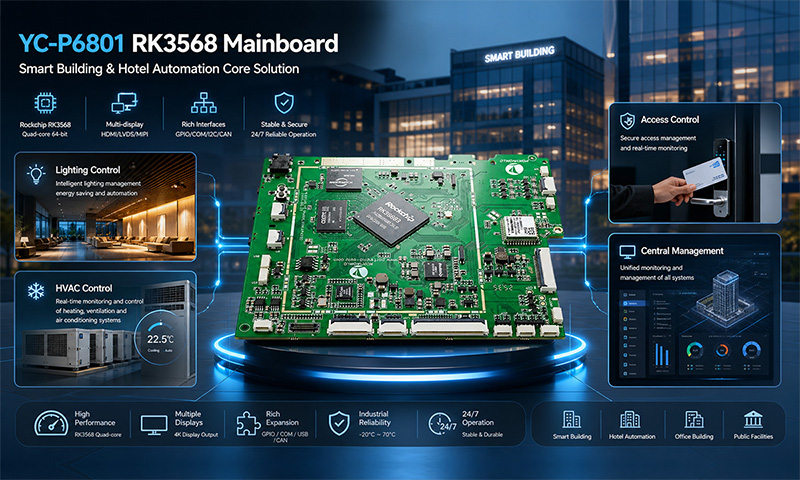
YC-P6802 RK3568 Mainboard
6. Which Core Board Is Best for Different Applications?
The right processor depends on the workload and the product’s hardware needs.
RK3566: An Affordable Choice for Embedded Applications
The RK3566 is a practical choice for projects that require reliable multimedia processing, touchscreen support, and standard connectivity without extensive expansion.
Common applications include:
- Smart home control panels
- Smart home gateways
- Digital signage players
- Tablets and interactive terminals
- Smart retail devices
- Compact IoT controllers
For instance, a smart home control panel with a single touchscreen, Wi-Fi, Ethernet, and RS485 communication can often meet its requirements with an RK3566-based core board.
RK3568: A Stronger Fit for Industrial and Multi-Interface Applications
The RK3568 is better suited to projects that need additional connectivity, support for multiple displays, or greater processing capacity.
Common applications include:
- Industrial panel PCs and HMIs
- Industrial IoT gateways
- Multi-screen commercial displays
- Network-connected control terminals
- Equipment monitoring systems
- Embedded systems requiring additional storage and peripheral support
For an industrial gateway requiring multiple network connections, serial interfaces, and storage expansion, an RK3568-based platform may offer a more suitable hardware foundation.
7. What Should You Evaluate Before Choosing a Core Board?
Choosing a processor is only the initial step. The core board determines how readily the processor can be integrated into your product.
Before deciding, assess the following factors:
Memory and storage: Ensure the board offers enough RAM and eMMC capacity to meet your operating system, application, and data storage needs.
Interface availability: Check how many USB, Ethernet, PCIe, SATA, UART, RS485, I2C, and SPI interfaces the module exposes, and confirm that their types meet your requirements.
Display compatibility: Verify which display interfaces are supported, along with resolution, touch-controller compatibility, and the number of screens supported.
Operating system and BSP: Make sure the board includes the required Android or Linux version, SDK, drivers, and development documentation.
Power and thermal design: Assess the power input, heat dissipation, operating temperature range, and enclosure conditions, particularly for industrial applications.
Long-term supply and customization: For commercial products, review component availability, production consistency, customization possibilities, and technical support.
These considerations can affect project development more significantly than the processor specifications alone.
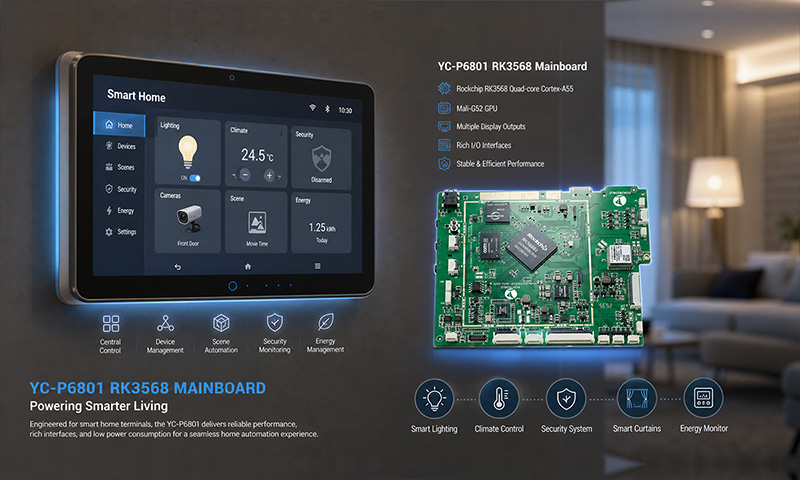
YC-P6802 RK3568 Mainboard
Portworld RK3566 and RK3568 Core Board Solutions
Portworld supplies Rockchip-based core boards and customized embedded hardware for smart devices, industrial systems, and commercial applications.
For RK3566-based projects, the YC-P3566 core board provides a compact computing platform with a quad-core Cortex-A55 processor, Mali-G52 GPU, and configurable memory options. It can be integrated into smart control panels, IoT terminals, and commercial embedded devices.
For RK3568 applications, the YC-P6802 core board features an RK3568 processor, an integrated NPU, and dual Gigabit Ethernet. It is well suited to industrial gateways, network-connected terminals, and embedded control systems requiring expanded connectivity.
Portworld also provides OEM/ODM services, including:
- Core board and carrier board customization
- PCB and PCBA design
- RAM and storage configuration
- Interface and connector customization
- Android and Linux system customization
- SDK, BSP, and development documentation
- Prototype development and mass production
From hardware design through system integration, Portworld helps customers create embedded computing platforms tailored to their application requirements.
RK3566 and RK3568 are both capable embedded processors, but they serve different design priorities.
RK3566 is a practical choice for cost-conscious products with standard display and connectivity requirements. RK3568 is more suitable for projects that need additional interfaces, multi-display support, and greater system expansion flexibility.
Before choosing a core board, evaluate the complete hardware configuration, software support, peripheral requirements, and long-term production needs. A well-matched embedded platform can reduce development complexity and provide a more reliable foundation for your final product.