Rockchip Core Boards for Embedded Linux Development
Embedded Linux is widely deployed in industrial automation, smart devices, robotics, commercial displays, and edge computing systems. For developers creating these products, selecting the right hardware platform is just the first step. Project success also depends on CPU performance, memory configuration, peripheral interfaces, Linux BSP availability, driver support, and long-term hardware supply.
Rockchip-based Core Boards offer a compelling platform for embedded Linux development. Featuring ARM-based computing architectures, multimedia acceleration, peripheral expansion, and support for Linux operating systems, they can power a broad range of embedded products.
Of the available platforms, the RK3576 and RK3588 stand out for projects that require greater computing capacity than entry-level embedded processors can provide.
This guide outlines the key factors to consider when choosing a Rockchip Core Board for embedded Linux development and explains how Portworld’s RK3576 SoM and RK3588 Core Board can address different development needs.
1. Why Choose a Rockchip Core Board for Embedded Linux?
A Core Board, often referred to as a System on Module (SoM), combines essential computing components in a compact module. These components typically include a processor, memory, power management circuitry, and selected onboard storage.
The module connects to a carrier board, which provides application-specific interfaces such as Ethernet, USB, display connectors, serial ports, and power input.
This modular design offers several benefits.
Faster Hardware Development
Building a complete embedded motherboard from the ground up demands substantial engineering effort, including processor placement and routing, memory design, power management, PCB development, and signal integrity testing.
A Core Board provides a proven computing foundation. Developers can concentrate on the carrier board and application-specific hardware instead of redesigning the entire processor subsystem.
Flexible Interface Expansion
Embedded Linux applications vary in the hardware interfaces they require.
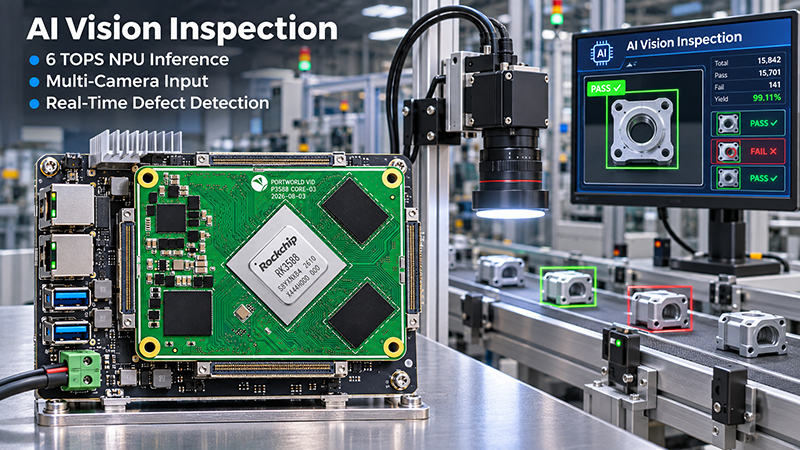
YC-Core3588 AI visual inspection
For example:
- Industrial gateways may require Ethernet, RS485, CAN, and USB.
- Smart displays may need HDMI, MIPI-DSI, and touch interfaces.
- Robotics systems may use camera inputs, USB, PCIe, and GPIO.
- Edge AI devices may need high-speed storage and connections for multiple cameras.
- A modular Core Board enables developers to build a carrier board around the interfaces their product requires.
Scalable Product Development
A common hardware platform can support multiple product configurations.
Manufacturers may develop a standard carrier board for one application and create additional carrier board versions for different interfaces, connectors, or installation environments.
This approach can reduce repeated hardware development work and simplify product customization.
2. What Defines a Strong Embedded Linux Development Platform?
Choosing a Rockchip Core Board requires more than comparing processor specifications. Developers should assess the entire hardware and software ecosystem.
CPU Architecture and Performance
The CPU determines how effectively a system manages operating system tasks, application logic, communications, and multitasking.
Typical workloads for embedded Linux products include:
- Running Linux services and background processes
- Running Qt or other graphical applications
- Managing network communications
- Processing sensor data
- Controlling external hardware
- Running local multimedia applications
More demanding applications may benefit from a processor featuring a big.LITTLE architecture, which can provide additional computing capacity.
Memory and Storage
Memory capacity directly influences how many applications can run simultaneously and how complex they can be.
A lightweight Linux gateway may work with relatively little memory, whereas an industrial HMI running a graphical interface, browser, database, and communication services may need more.
Storage is also an important consideration. eMMC is commonly used for embedded operating systems and application files, while PCIe-connected storage can suit projects that require greater capacity or performance.
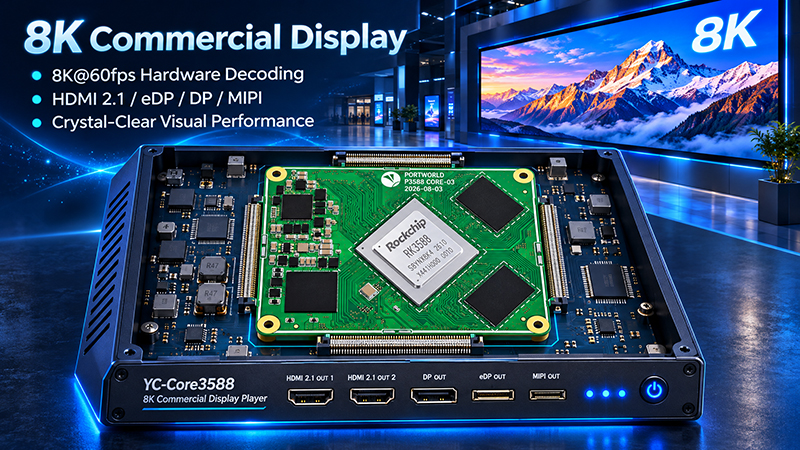
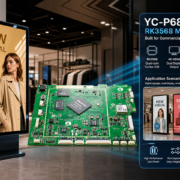
YC-Core3588 core board 8K
Peripheral Connectivity
Embedded Linux products often rely on several external devices.
Key interfaces may include:
- Gigabit Ethernet
- USB 2.0 and USB 3.0
- PCIe
- MIPI-CSI for camera connections
- MIPI-DSI, HDMI, and eDP for displays
- UART, SPI, and I2C
- GPIO and CAN
A key point is that interface support at the SoC level does not mean every interface is exposed on a specific Core Board. Developers should verify the module pinout and carrier board design.
Linux BSP and Driver Support
Hardware specifications alone do not determine how efficiently development can proceed.
The Linux Board Support Package (BSP) is critical, as it supplies the software components required to operate the hardware.
A typical embedded Linux development environment includes:
- A bootloader, commonly U-Boot
- The Linux kernel
- Device Tree configuration
- Hardware drivers
- A root filesystem
- Buildroot or Debian-based system integration
- Firmware and peripheral configuration tools
Before choosing a board, developers should verify the availability of kernel versions, drivers, and software packages for the exact hardware revision.
3. RK3576 vs. RK3588: Which Core Board Is Better for Linux Development?
RK3576 and RK3588 are two capable Rockchip platforms for embedded Linux projects, but they target different levels of system complexity.
| Specification | RK3576 | RK3588 |
|---|---|---|
| CPU | 4× Cortex-A72 + 4× Cortex-A53 | 4× Cortex-A76 + 4× Cortex-A55 |
| CPU architecture | 64-bit ARM | 64-bit ARM |
| GPU | Mali-G52 MC3 | Mali-G610 MP4 |
| NPU | Up to 6 TOPS INT8* | Up to 6 TOPS INT8 |
| Memory support | LPDDR4/4X/5 | LPDDR4/4X/5 |
| Video processing | Up to 4K120 decoding under supported formats | Up to 8K60 decoding under supported formats |
| Display | Multiple display outputs | Advanced multi-display architecture |
| High-speed expansion | PCIe 2.1 and shared interfaces | PCIe 3.0 and PCIe 2.0 |
| Typical positioning | Mid-to-high-performance embedded computing | High-performance embedded computing |
RK3576’s advertised 6 TOPS is achieved under supported sparse-computing conditions. Actual inference performance varies according to the model, precision, sparsity, runtime, and software optimization.
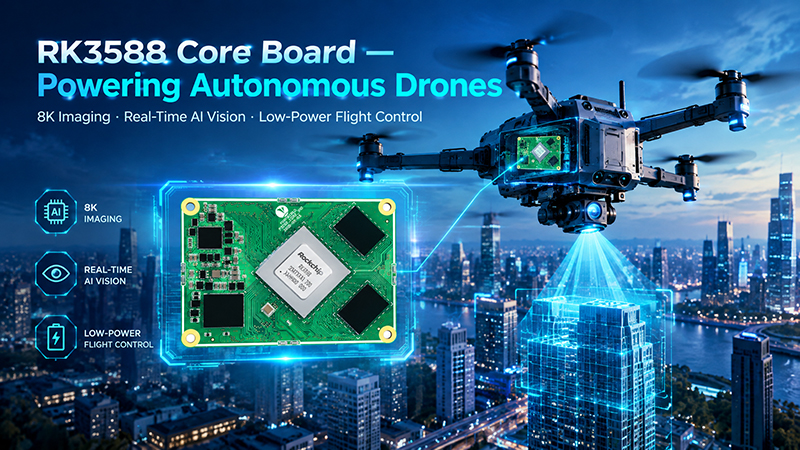
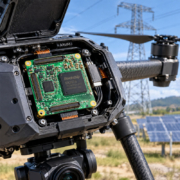
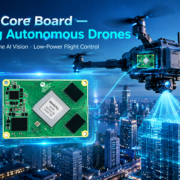
RK3588 Core Board- Drone Application Scene
RK3576: A Well-Balanced Platform for Embedded Linux Products
The RK3576 combines four Cortex-A72 cores with four Cortex-A53 cores, delivering application performance alongside efficient processing.
Its integrated Mali-G52 MC3 GPU handles common graphics workloads, and its NPU accelerates compatible edge AI applications.
Linux developers may find the RK3576 suitable for:
- Industrial HMI systems
- Smart building gateways
- Embedded touchscreen terminals
- Commercial display controllers
- Robotics control computers
- Edge AI devices with moderate computing requirements
Portworld’s RK3576 SoM features a compact 38 × 38 mm design, 4GB of LPDDR4 memory, and a 240-pin board-to-board connector.
Developers can use the module to create customized carrier boards and expose the interfaces their applications require.
- RK3588: Greater Performance for Complex Embedded Linux Systems
- The RK3588 is built for demanding embedded computing applications.
It brings together four Cortex-A76 performance cores, four Cortex-A55 efficiency cores, a Mali-G610 MP4 GPU, and an NPU delivering up to 6 TOPS of INT8 performance.
Key advantages include:
- Higher CPU performance
- More capable graphics processing
- Advanced multimedia features
- Support for multiple high-resolution displays
- PCIe 3.0 expansion
- Broad camera and peripheral connectivity
Typical applications include:
- AI robotics and humanoid robots
- Industrial machine vision
- Multi-camera processing systems
- High-performance digital signage
- Smart transportation terminals
- Advanced edge computing systems
Portworld’s RK3588 Core Board integrates the complete RK3588 processor and features a 400-pin board-to-board connector. When paired with a compatible carrier board, it supports numerous expansion options, including PCIe, SATA, USB, Ethernet, and display interfaces.
For developers creating complex embedded Linux products, the RK3588 provides additional capacity for expanding applications.
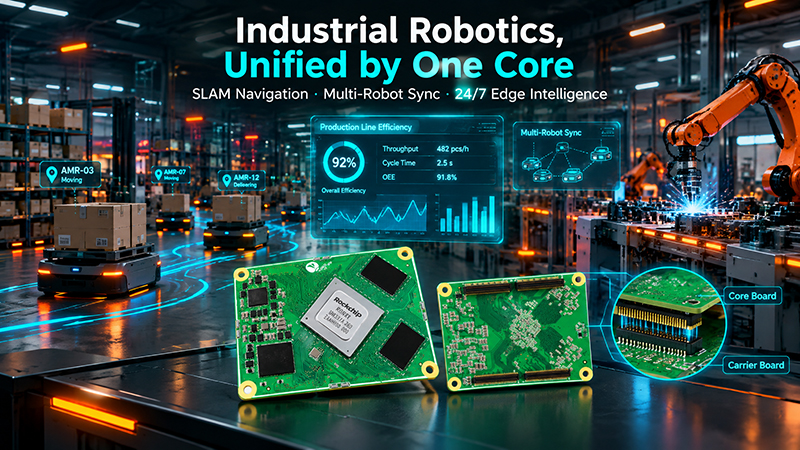
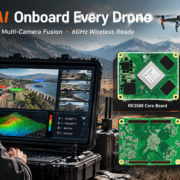
RK3588 Robot Application Scene 2
4. Embedded Linux Software Options for Rockchip Core Boards
Rockchip platforms support a range of Linux distributions and development environments. The right option depends on the product’s software needs, maintenance plan, and available BSP.
Ubuntu
Ubuntu suits development environments and embedded applications that benefit from a broad software ecosystem.
Common use cases include:
- Robotics development
- Edge computing
- Computer vision applications
- Developer tools and middleware
- Network services
Before choosing a release, developers should confirm that the selected board’s BSP supports it.
Debian
Debian is often chosen for embedded products that need a stable Linux environment.
It can be used for:
- Industrial control applications
- Embedded gateways
- Commercial terminals
- Network-connected devices
- Custom application services
Debian’s package management system can make software installation and system maintenance easier.
Buildroot
Buildroot is a practical option for developers creating a tailored Linux system with a carefully selected set of components.
Its advantages include:
- A smaller root filesystem
- Fewer unnecessary packages
- Integration of custom kernels and applications
- Reproducible build configurations
- Greater control over the software image
Buildroot is especially well suited to embedded products with fixed functionality and limited system resources.
Mainline Linux vs. Vendor BSP
A key decision in Rockchip Linux development is whether to use a vendor BSP or mainline Linux.
Vendor BSP
A vendor BSP generally includes board-specific drivers, firmware, patches, and hardware support for a particular product.
It may be the more practical starting point for projects that depend on hardware features such as:
- Hardware video acceleration
- Camera ISP functionality
- Display controllers
- NPU acceleration
- Specialized peripheral drivers
- Mainline Linux
Mainline Linux provides a more standardized environment for upstream kernel development.
It may appeal to products that prioritize upstream compatibility and long-term kernel maintainability.
However, hardware support differs depending on the SoC, kernel version, board, and peripheral. Some multimedia, GPU, camera, and NPU features may require additional vendor components or may not be supported in the same way as they are in the vendor BSP.
For commercial products, developers should assess the required hardware features before selecting a kernel path.
5. Typical Applications for Embedded Linux Development
Rockchip Core Boards can serve a broad range of embedded Linux products.
Industrial HMI and Control Terminals
Industrial HMI systems must run graphical applications while communicating with machinery, sensors, and industrial controllers.
A Rockchip Core Board can provide the computing platform for:
- Qt-based user interfaces
- Industrial monitoring dashboards
- Equipment status displays
- Serial communications
- Ethernet-connected control applications
RK3576 may meet the needs of many standard HMI products. RK3588 is worth considering for advanced graphics, multiple displays, or more demanding workloads.
Smart Building and IoT Gateways
Smart building gateways connect diverse devices and communication networks.
Linux-based gateway software can manage:
- Ethernet communications
- RS485 devices
- Modbus applications
- MQTT messaging
- Local data processing
- Remote device management
Actual protocol support depends on the chosen interface hardware and software integration.
Robotics and Autonomous Systems
Robotic systems may need camera input, sensor processing, network connectivity, and real-time coordination between applications.
The RK3576 can power embedded robot controllers and handle moderate edge-processing workloads.
With greater CPU and GPU capacity, the RK3588 is suited to advanced perception pipelines, multi-camera configurations, and sophisticated robot interfaces.
For precise, deterministic motor control, developers should use a dedicated MCU or real-time control subsystem instead of relying solely on a general-purpose Linux process.
AI Edge Computing
Both the RK3576 and RK3588 include NPUs that support compatible AI inference workloads.
Potential applications include:
- Object detection
- Image classification
- OCR
- Visual inspection
- Smart camera analytics
- Local recognition systems
Deploying models generally involves converting and optimizing them for the supported Rockchip inference runtime. Developers should validate framework compatibility, operator support, precision, and performance with the model they intend to use.
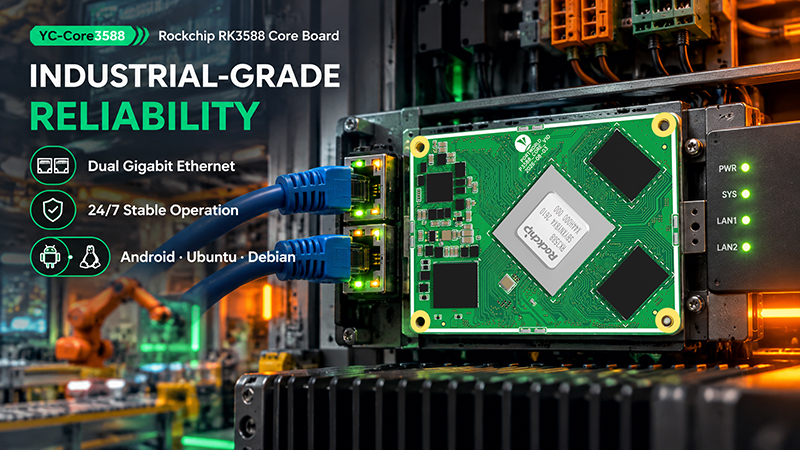
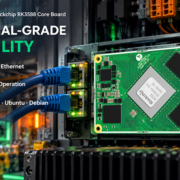
RK3588 core board
6. Common Challenges in Rockchip Embedded Linux Development
Even with an appropriate Core Board, embedded Linux projects can present a range of engineering challenges.
Device Tree Configuration
The Device Tree defines hardware components and how they connect to the processor.
Developers may need to configure:
- GPIO pin assignments
- UART and I2C devices
- SPI peripherals
- Ethernet PHYs
- Display interfaces
- Camera connections
- Power regulators
- PCIe devices
An incorrect Device Tree configuration may prevent peripherals from initializing properly.
Driver Integration
A product may require external touch controllers, Wi-Fi modules, sensors, cameras, or industrial communication devices.
Linux driver availability should be verified early in the development process.
Using a module with an existing driver can reduce engineering effort. Custom hardware may require additional driver development or adaptation.
Power and Thermal Design
Embedded products often run continuously within enclosed spaces.
Developers should assess:
Processor power consumption during sustained workloads
- Memory and storage temperatures
- Stability of the power input
- Heat dissipation
- Enclosure design
- Operating temperature requirements
A development board that performs well in a brief test may still require further thermal validation before commercial deployment.
Production Readiness
A successful prototype does not, by itself, ensure that a product will remain reliable in mass production.
Before production, manufacturers should verify:
- Hardware stability
- Boot reliability
- Peripheral compatibility
- Extended operation
- Thermal performance
- Software update procedures
- Manufacturing consistency
These measures are essential for industrial and commercial embedded products.
7. Portworld Rockchip Core Boards for Embedded Linux Development
For manufacturers seeking a customized embedded computing platform, Portworld offers Rockchip Core Board options and hardware development support.
Portworld RK3576 SoM
The RK3576 SoM is a compact computing module for developers seeking to integrate processing capabilities into a custom carrier board.
Key specifications:
- Rockchip RK3576 octa-core processor
- 4× Cortex-A72 cores running at up to 2.2GHz
- 4× Cortex-A53 cores running at up to 1.8GHz
- Mali-G52 MC3 GPU
- NPU delivering up to 6 TOPS INT8 under supported sparse-computing conditions
- 4GB of onboard LPDDR4 memory
- Module dimensions of 38 × 38 mm
240-pin board-to-board connector
Support for Linux, Ubuntu, and Android, depending on BSP availability
The module is suited to industrial HMI systems, embedded gateways, robotics, smart terminals, and edge AI applications.
Portworld RK3588 Core Board
For projects that demand greater computing performance, Portworld’s RK3588 Core Board offers a higher-performance embedded platform.
Key specifications:
- Rockchip RK3588 octa-core processor
- 4× Cortex-A76 cores running at up to 2.3GHz
- 4× Cortex-A55 cores running at up to 1.8GHz
- Mali-G610 MP4 GPU
- NPU delivering up to 6 TOPS INT8
8K video decoding, with 8K encoding supported in compatible configurations
400-pin board-to-board connector
Expansion options for PCIe, SATA, USB, and dual Gigabit Ethernet
HDMI 2.1, eDP, DP, and MIPI display options with compatible designs
Android, Ubuntu, and Debian software options, depending on BSP configuration
The board is suitable for robotics, industrial machine vision, high-performance edge computing, and multi-display embedded systems.
8. How Portworld Supports Embedded Linux Product Development
Choosing a Core Board is just one step in creating a commercial embedded Linux product.
Portworld offers hardware and software customization services that help manufacturers take a project from an initial concept to a production-ready embedded system.
Depending on project needs, support may include:
Hardware Development
- RK3576 and RK3588 platform selection
- Carrier board and PCB design
- RAM and storage configuration
- Integration of Ethernet, USB, UART, RS485, and GPIO
- Customization of display and camera interfaces
- Power supply and thermal design
Linux Software Integration
- Linux BSP adaptation
- Ubuntu and Debian customization
- Buildroot system configuration
- Device Tree and peripheral adaptation
- Driver integration
- Application pre-installation and auto-run configuration
OEM/ODM Manufacturing
- PCB and PCBA development
- Mechanical and enclosure customization
- Logo and packaging customization
- SDK and technical documentation
- Prototype development and support for mass production
This integrated approach helps bridge the gap between hardware selection, software adaptation, and commercial product development.
Rockchip Core Boards offer a versatile platform for embedded Linux development, bringing together ARM processing power, peripheral expansion, and multimedia features.
The RK3576 is a well-balanced choice for industrial HMIs, gateways, smart terminals, and moderate edge AI workloads. The RK3588 is better suited to demanding applications requiring advanced graphics, multiple cameras, complex processing, and high-performance edge computing.
Processor specifications, however, are only one factor in selecting a platform. Linux BSP maturity, kernel support, driver availability, carrier board design, and long-term hardware stability are equally significant.
For teams developing a new embedded Linux product, Portworld provides RK3576 SoM and RK3588 Core Board solutions, along with carrier board customization, Linux integration, and OEM/ODM engineering support.