How to Choose Between RK3566, RK3568, RK3576, and RK3588
Selecting the right processor is a critical decision when designing an embedded computing product. Whether you are developing an industrial HMI, smart home control panel, AIoT gateway, robotics controller, or commercial display, the processor influences system performance, power use, hardware cost, software compatibility, and future expansion.
Rockchip offers a range of ARM-based processors for embedded applications. Four models developers often evaluate are the RK3566, RK3568, RK3576, and RK3588.
These processors may appear similar at first because they belong to the same Rockchip family. In practice, however, they differ significantly in CPU architecture, NPU capabilities, multimedia processing, and expansion options.
The RK3566 and RK3568 are established choices for mainstream embedded products. The RK3576 delivers a substantial increase in CPU and AI capabilities, while the RK3588 is designed for more demanding computing, multimedia, and edge AI workloads.
Which processor is the right choice?
This guide compares the key specifications, outlines the practical differences, and offers recommendations to help you select the most suitable Rockchip platform for your embedded project.
1. RK3566 vs. RK3568 vs. RK3576 vs. RK3588: At a Glance
Before examining each processor, let’s look at their main hardware differences.
| Specification | RK3566 | RK3568 | RK3576 | RK3588 |
|---|---|---|---|---|
| CPU Architecture | 4× Cortex-A55 | 4× Cortex-A55 | 4× Cortex-A72 + 4× Cortex-A53 | 4× Cortex-A76 + 4× Cortex-A55 |
| CPU Frequency | Up to 1.8 GHz | Up to 2.0 GHz | Up to 2.2 GHz / 1.8 GHz | Up to 2.3 GHz / 1.8 GHz on Portworld board |
| GPU | Mali-G52 2EE | Mali-G52 | Mali-G52 MC3 | Mali-G610 MP4 |
| NPU | Up to 1 TOPS | Up to 1 TOPS | Up to 6 TOPS | Up to 6 TOPS |
| Video Decoding | Up to 4K | Up to 4K | Up to 4K@120fps for supported codecs | Up to 8K |
| Video Encoding | Up to 1080p60 | Up to 1080p60 | Up to 4K60 | Up to 8K@30fps under supported configurations |
| Display Capability | Single display engine | Multiple display configurations, depending on implementation | Multiple displays | Advanced multi-display support |
| Typical Positioning | Mainstream embedded computing | Industrial and connectivity-focused embedded computing | AIoT and edge AI | High-performance edge computing |
These specifications are drawn from Rockchip processor documentation and representative platform configurations. Actual clock speeds, memory support, display outputs, and peripheral interfaces vary according to chip revision, board design, and software configuration.
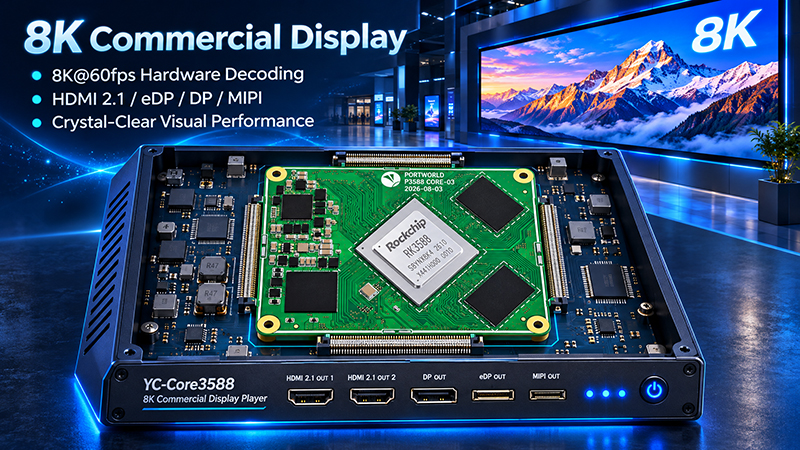
YC-Core3588 core board 8K
The platforms can be positioned as follows:
- RK3566 emphasizes practical performance for mainstream embedded applications.
- RK3568 builds on a similar CPU foundation while providing additional platform and expansion options.
- RK3576 features a significantly more powerful CPU architecture and integrated AI acceleration.
- RK3588 provides the greatest overall computing and multimedia capabilities of the four platforms.
- Nevertheless, the most powerful processor is not automatically the best choice for every project.
2. RK3566: A Practical Option for Cost-Sensitive Embedded Products
The RK3566 is a quad-core ARM Cortex-A55 processor built for embedded computing applications with relatively low power requirements.
It features an integrated Mali-G52 GPU and an NPU capable of up to 1 TOPS INT8 performance. These capabilities make it suitable for products requiring a responsive graphical interface, multimedia processing, and modest AI acceleration.
Key Characteristics
- Quad-core Cortex-A55 CPU operating at up to 1.8 GHz
- ARM Mali-G52 2EE GPU
- NPU performance of up to 1 TOPS INT8
- 4K video decoding for H.265, H.264, and VP9
- 1080p60 video encoding for H.264 and H.265
- Display connectivity options including HDMI 2.0, eDP, and MIPI-DSI
- Linux and Android software support, subject to BSP availability
- Where Is the RK3566 Best Suited?
The RK3566 is a practical choice for products that do not need advanced AI capabilities or extensive peripheral expansion.
Common applications include:
Smart Home Control Panels
A smart home control panel must present device status, accept touch input, communicate with connected devices, and operate a user interface. The RK3566 offers adequate computing resources for many control panels based on Android or Linux.
Commercial Advertising Applications
RK3566 supports content playback, network connectivity, and graphical interfaces for digital signage and information terminals.
Basic Industrial HMI
Equipment monitoring panels and machine interfaces typically need a stable operating system, touchscreen support, and communication with external controllers. RK3566 can satisfy the needs of many standard HMI projects.
Smart Appliances
Coffee machines, vending machines, and other intelligent appliances can rely on RK3566 for touchscreen interaction, application logic, and communication with peripherals.
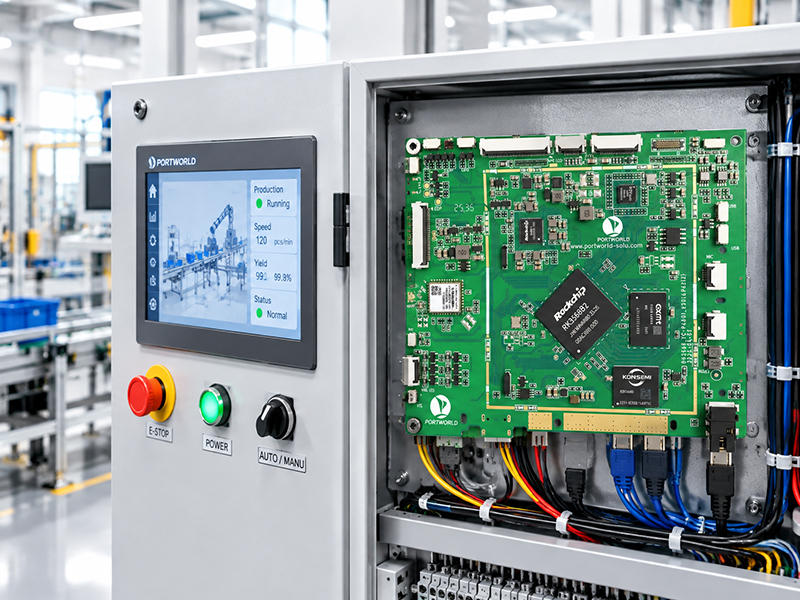
YC-P6602 RK3566 Motherboard
When Should You Choose RK3566?
Choose RK3566 when:
- Your application requires a moderate level of computing power.
- A standard touchscreen interface meets your needs.
- You need basic multimedia functionality.
- AI processing demands are limited.
- Hardware cost and power consumption are key considerations.
For straightforward embedded products, selecting a higher-end processor may raise hardware and thermal design costs without providing meaningful advantages.
3. RK3568: A Stronger Choice When Connectivity and Expansion Matter More
RK3568 shares the quad-core Cortex-A55 architecture and Mali-G52 GPU family with RK3566. Both platforms also deliver approximately 1 TOPS of NPU performance.
However, RK3568 provides a distinct connectivity and expansion profile, making it an appealing option for industrial and communication-intensive embedded systems.
Key Characteristics
- Quad-core Cortex-A55 CPU operating at up to 2.0 GHz
- ARM Mali-G52 GPU
- Up to 1 TOPS of NPU performance
- 4K video decoding
- Hardware video encoding
- PCIe expansion
- Gigabit Ethernet connectivity options
- USB, SATA, and industrial peripheral interfaces, depending on the implementation
- A key distinction is the availability of high-speed connectivity.
RK3568 supports PCIe 3.0 expansion and, in relevant configurations, offers a broader range of platform-level connectivity options than RK3566. This can benefit projects that need additional storage, network interfaces, or external hardware modules.
Typical RK3568 Applications
Industrial IoT Gateways
Industrial gateways commonly connect multiple devices, gather data, and relay it to higher-level management systems. The RK3568 provides a computing and connectivity platform for these functions.
Industrial Control Terminals
Projects that require multiple communication interfaces, external storage, and tailored peripheral connections can benefit from the RK3568’s expansion capabilities.
Networked Embedded Devices
Applications that need Ethernet connectivity, external modules, or additional storage can take advantage of the platform’s hardware flexibility.
Smart Equipment Controllers
The RK3568 can support control interfaces, on-device applications, and communication with external equipment.
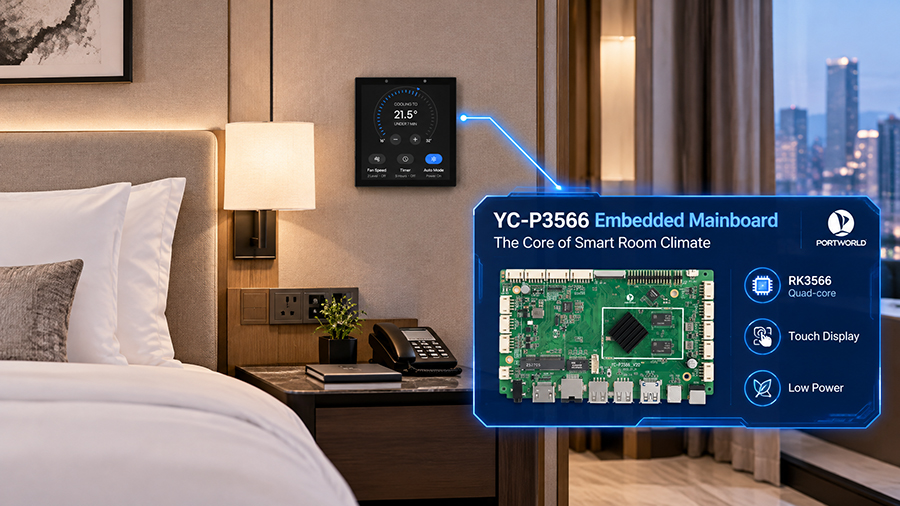
YC-P3566-smart home control panel
RK3566 vs. RK3568: What Are the Key Differences?
Both processors feature four Cortex-A55 CPU cores and provide comparable NPU and GPU capabilities.
The choice should therefore depend less on CPU performance and more on the overall hardware design.
| Selection Factor | RK3566 | RK3568 |
|---|---|---|
| CPU | Quad-core Cortex-A55 | Quad-core Cortex-A55 |
| NPU | Up to 1 TOPS | Up to 1 TOPS |
| Computing requirements | Mainstream | Mainstream |
| Expansion requirements | More limited in typical configurations | More flexible high-speed expansion |
| Application focus | Smart panels, media players, basic HMI | Gateways, industrial controllers, communication-intensive devices |
If your project mainly needs a touchscreen, basic networking, and standard peripheral connections, RK3566 may be sufficient.
If the design requires more expansion options, additional storage connectivity, or a more complex industrial hardware architecture, RK3568 deserves consideration.
The actual advantages depend on the selected board. Developers should verify which interfaces are exposed rather than assuming that every SoC-level feature is available on a finished product.
4. RK3576: A Significant Advance in AIoT and Edge AI
The RK3576 introduces a substantial architectural shift compared with the RK3566 and RK3568.
Rather than relying on four Cortex-A55 cores, the RK3576 features an octa-core design comprising:
- 4× Cortex-A72 performance cores running at up to 2.2 GHz
- 4× Cortex-A53 efficiency cores running at up to 1.8 GHz
- The chip also includes a Mali-G52 MC3 GPU and an NPU delivering up to 6 TOPS in INT8 performance.
This combination makes the RK3576 well suited to demanding embedded applications that bring together computing, graphics, multimedia, and on-device AI inference.
Key Characteristics
- Octa-core 64-bit CPU
- 4× Cortex-A72 + 4× Cortex-A53
- Mali-G52 MC3 GPU
- NPU performance of up to 6 TOPS
- Support for INT4, INT8, INT16, FP16, BF16, and TF32 precision formats
- 4K video decoding at up to 120 fps for supported codecs
- 4K60 H.264/H.265 video encoding
- 16 MP ISP with HDR and 3DNR
- Multiple display output options
Linux, Ubuntu, and Android support, depending on the BSP
Why Is RK3576 Relevant to Embedded Developers?
Local AI Inference
Equipped with a 6 TOPS NPU, RK3576 can execute supported AI models locally. Potential applications include object detection, image recognition, and intelligent device interaction.
Real-world performance varies according to model architecture, quantization, memory bandwidth, software runtime, and NPU optimization.
Robotics and Intelligent Devices
Robots commonly need to process sensor data, communicate with peripheral controllers, and manage user interactions at the same time.
RK3576 combines a more capable CPU architecture with integrated AI acceleration to support these workloads.
Machine Vision
Its 16MP ISP and multiple camera interfaces make RK3576 a suitable option for camera-based embedded systems, depending on the camera connections available on the chosen board and its software support.
Smart Commercial Displays
RK3576 can power advanced display applications involving high-resolution video processing, graphical interfaces, and AI-enabled features.
When Should You Choose RK3576?
RK3576 is worth considering when:
- RK3566 or RK3568 cannot provide enough CPU performance.
- The project requires local AI inference.
- Camera processing is an important part of the application.
- You need more advanced multimedia capabilities.
- You want to balance computing performance and system integration requirements.
For many new AIoT products, RK3576 can provide a practical middle ground between mainstream embedded processors and high-performance platforms.
5. RK3588: Designed for High-Performance Edge AI and Complex Embedded Systems
RK3588 is the most powerful processor in this comparison.
It integrates four Cortex-A76 performance cores and four Cortex-A55 efficiency cores, alongside a Mali-G610 MP4 GPU and an onboard NPU delivering up to 6 TOPS.
Compared with RK3576, RK3588 features a more powerful CPU architecture and GPU, as well as enhanced high-speed expansion and multimedia capabilities.
Key Characteristics
- 4× Cortex-A76 CPU cores, running at up to 2.3 GHz on Portworld’s RK3588 Core Board
- 4× Cortex-A55 CPU cores, running at up to 1.8 GHz
- ARM Mali-G610 MP4 GPU
- NPU performance of up to 6 TOPS
- 8K video decoding
- Video encoding up to 8K@30fps with supported configurations
- HDMI 2.1, eDP, DP, and MIPI display interfaces
- PCIe and SATA expansion options
- USB 3.0 and USB 2.0
- Dual Gigabit Ethernet MAC
What Sets the RK3588 Apart?
1. Higher CPU Performance
The Cortex-A76 performance cores offer a more capable computing foundation than the Cortex-A72 cores in the RK3576.
This advantage benefits applications that require intensive processing, run multiple software services, or feature demanding user interfaces.
2. More Powerful GPU
The Mali-G610 MP4 GPU handles advanced graphics and multimedia workloads, making the RK3588 well suited to high-resolution displays, sophisticated UI rendering, and graphics-intensive applications.
3. Integrated AI Acceleration
The RK3588 features an NPU rated at up to 6 TOPS. While this headline figure is similar to the RK3576’s, TOPS alone does not determine AI performance.
Real-world inference also depends on model compatibility, memory access, runtime optimization, and the quality of the overall software stack.
4. Advanced Multimedia
With support for 8K video processing and multiple display interfaces, the RK3588 is a strong option for commercial display systems, industrial visualization, and multimedia terminals.
5. High-Speed Hardware Expansion
PCIe, SATA, USB, and Ethernet support provide greater flexibility for complex embedded hardware designs.
- Typical Applications for RK3588
- Edge AI computing terminals
- Humanoid and service robots
- Industrial machine vision systems
- Autonomous mobile robots
- Smart transportation solutions
- High-resolution digital signage
- Industrial computers with multiple displays
- Advanced AI-powered HMI systems
- When Should You Choose RK3588?
Choose RK3588 for applications that require powerful CPU performance, advanced graphics, 8K multimedia, extensive high-speed expansion, or a combination of these capabilities.
It is especially well suited to products in which computing performance is central to the product’s value, rather than merely serving a supporting role.
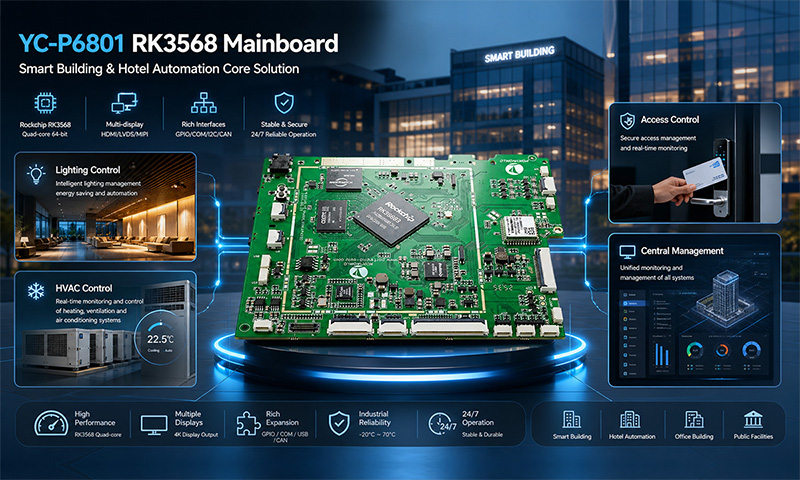
YC-P6802 RK3568 Mainboard
6. RK3576 vs. RK3588: Which AI Processor Should You Choose?
A frequently asked question is whether the RK3576 can serve as a replacement for the RK3588 in an embedded AI project.
Both processors deliver up to 6 TOPS of NPU performance, but they are not equivalent platforms.
| Comparison | RK3576 | RK3588 |
|---|---|---|
| CPU | 4× A72 + 4× A53 | 4× A76 + 4× A55 |
| GPU | Mali-G52 MC3 | Mali-G610 MP4 |
| NPU | Up to 6 TOPS | Up to 6 TOPS |
| Video | Up to 4K@120fps decoding | Up to 8K decoding |
| Camera | 16MP ISP | Advanced image processing capabilities |
| Expansion | PCIe 2.1 and other high-speed interfaces | PCIe 3.0 and additional expansion capabilities |
| Typical Positioning | AIoT and embedded edge AI | High-performance edge AI and multimedia |
The primary difference lies in the overall computing architecture.
RK3576 is well suited to applications that need AI acceleration but do not demand top-tier CPU or GPU performance.
RK3588 is a better choice when AI inference must be paired with intensive graphics, several video streams, complex software, or high-speed peripheral expansion.
For example:
- A smart appliance performing basic object recognition may be a good fit for RK3576.
- An industrial machine-vision system handling multiple camera streams and sophisticated image processing may benefit from RK3588.
- A compact AIoT terminal can use RK3576 to balance computing capability with system requirements.
- A robotics platform with demanding perception and visualization workloads may need RK3588.
- The final choice should be guided by testing with the actual workload, rather than by NPU TOPS alone.
7. Which Rockchip Processor Is Best for Different Applications?
The following table provides a practical starting point for selecting a processor.
| Application | Recommended Platform | Why |
|---|---|---|
| Smart home control panels | RK3566 / RK3568 | Sufficient computing resources for touchscreen control |
| Basic digital signage | RK3566 / RK3568 | Suitable for standard multimedia and display applications |
| Industrial HMI | RK3566 / RK3568 / RK3576 | Depends on interface, graphics, and processing requirements |
| Industrial IoT gateway | RK3568 / RK3576 | More flexible connectivity and computing options |
| Smart appliances | RK3566 / RK3568 / RK3576 | Depends on application complexity |
| AI-enabled terminals | RK3576 / RK3588 | Integrated 6 TOPS NPU |
| Machine vision | RK3576 / RK3588 | Camera processing and AI acceleration |
| Service robots | RK3576 / RK3588 | CPU, NPU, and peripheral integration |
| Humanoid robots | RK3588 | Higher overall computing and graphics capability |
| Multi-screen commercial displays | RK3576 / RK3588 | Advanced multimedia and display support |
| High-performance edge AI | RK3588 | Strong CPU, GPU, NPU, and expansion capabilities |
The processor alone does not define a finished product’s capabilities. Display interfaces, camera connectivity, memory, storage, cooling, power supply, and software support must also be taken into account.
8. Portworld Embedded Board Solutions: From RK3566 to RK3588
Choosing a processor is only the initial step in developing an embedded product. Developers must also select an appropriate motherboard or System on Module, carrier board, operating system, and peripheral configuration.
Portworld offers Rockchip-based motherboard solutions and embedded hardware customization services to meet a range of project requirements.
RK3566 and RK3568 Motherboard Solutions
For mainstream embedded products, Portworld offers motherboard options based on the RK3566 and RK3568.
These platforms can support:
- Smart home control panels
- Industrial touchscreen terminals
- Digital signage players
- Smart appliances
- Embedded IoT devices
They are well suited to projects requiring practical computing performance, display integration, and hardware configurations tailored to specific applications.
Portworld RK3576 SoM
The Portworld RK3576 SoM is built for embedded AI and intelligent device development.
Rockchip RK3576 octa-core processor
4× Cortex-A72 cores running at up to 2.2 GHz + 4× Cortex-A53 cores running at up to 1.8 GHz
- Mali-G52 MC3 GPU
- NPU delivering up to 6 TOPS
- 4GB onboard LPDDR4
- Compact 38 × 38 mm form factor
- 240-pin board-to-board connector
- Supports Linux, Ubuntu, and Android, depending on the BSP
This module offers developers a compact hardware platform for creating AIoT terminals, robotic systems, industrial HMIs, and machine vision products.
Portworld also provides customization and system integration services, supporting projects from prototype development through mass production.
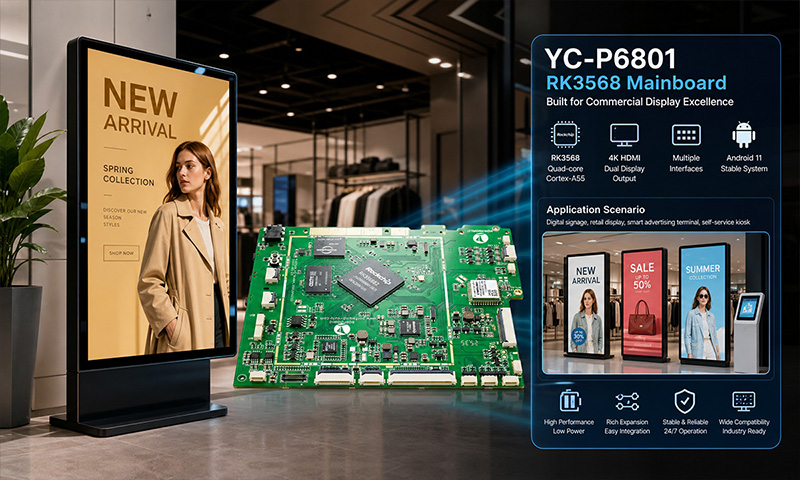
YC-P6802 RK3568 Mainboard
Portworld RK3588 Core Board
For projects that demand greater computing and multimedia performance, Portworld offers the RK3588 Core Board.
Rockchip RK3588 octa-core processor
- 4× Cortex-A76 cores running at up to 2.3 GHz + 4× Cortex-A55 cores running at up to 1.8 GHz
- Mali-G610 MP4 GPU
- NPU performance of up to 6 TOPS
- 8K video decoding and encoding
- 400-pin, high-density board-to-board connector
- HDMI 2.1, eDP, DP, and MIPI display interfaces
- PCIe, SATA, and USB expansion options
- Dual Gigabit Ethernet
- Supports Android, Ubuntu, and Debian
The high-density connector enables flexible integration between the core board and a customized carrier board.
This architecture suits embedded developers who need to connect multiple interfaces, displays, cameras, storage devices, and external peripherals.
Hardware and Software Customization
In addition to supplying embedded boards, Portworld supports multiple stages of product development, including:
- PCB and PCBA design
- SoM and carrier board integration
- Hardware interface customization
- Android and Linux system adaptation
- Display and touchscreen integration
- Peripheral and communication protocol integration
- SDK and technical documentation
- OEM/ODM development
- Prototype testing and mass production support
This enables customers to choose an appropriate Rockchip platform and build hardware tailored to their products’ specific requirements.
9. Five Questions to Ask Before Choosing a Rockchip Processor
Before making your final processor selection, evaluate the following factors.
1. What level of CPU performance does your application need?
RK3566 or RK3568 may be suitable for a basic touchscreen interface. Applications that run multiple services, perform complex processing, or support advanced robotics may require the RK3576 or RK3588.
2. Does the project need to perform AI processing locally?
If AI inference is unnecessary, the RK3566 or RK3568 may meet your requirements.
For applications requiring local AI acceleration, the RK3576 and RK3588 provide integrated 6 TOPS NPUs.
3. How many displays and cameras will the system use?
Confirm the required display resolution, screen count, camera sensors, and interface types. Ensure that the SoC’s theoretical capabilities align with the actual board design.
4. Which peripheral interfaces are required?
Identify all necessary connections, such as Ethernet, USB, PCIe, SATA, UART, RS485, CAN, I2C, and SPI.
Then confirm that the selected motherboard or carrier board exposes those interfaces.
5. What are the production requirements over the product’s lifetime?
Account for hardware availability, memory configuration, operating system maintenance, thermal design, customization, and manufacturing support.
For a commercial product, these considerations can significantly affect total development costs and the product lifecycle.
Select the Processor That Best Fits Your Product
No single Rockchip processor is ideal for every embedded application.
RK3566 is a practical choice for cost-conscious smart terminals and basic HMI products. Consider RK3568 when connectivity and expansion capabilities are higher priorities. RK3576 delivers a significant boost in CPU and AI performance for modern AIoT applications. For demanding edge AI, robotics, advanced multimedia, and complex embedded computing, RK3588 is the more powerful option.
To make the right choice, assess the entire system, including processing needs, interfaces, display capabilities, software compatibility, thermal design, and production plans.