What Hardware Is Required for a Custom Smart Home Control Panel?
As intelligent residential systems become increasingly interconnected, homeowners, system integrators, and smart home manufacturers are seeking control panels capable of managing illumination, window coverings, climate control, security infrastructure, and additional networked devices via a unified interface. Nevertheless, creating a proprietary smart home control panel extends beyond merely selecting a touchscreen and deploying control software. The hardware infrastructure must accommodate the requisite user interface specifications, data transmission protocols, deployment conditions, and sustained operational demands.
For enterprises designing proprietary smart home control panels, identifying critical hardware elements during the preliminary design phase can facilitate cost reduction, streamline system integration procedures, and facilitate scalable manufacturing processes.
1. Embedded Processor: The Cornerstone of the Control Panel
The processor represents a fundamental component within a custom smart home control panel. It governs the responsiveness of the user interface, the quantity of concurrent applications, and the compatible operating systems and software platforms the device can execute.
For Android-powered smart home panels, processors from the Rockchip series present a viable alternative. Specifically, Portworld’s YC-SM41P incorporates a PX30 quad-core Cortex-A35 processor according to its technical specifications, whereas the YC-P5 and YC-SM55P utilize the RK3566 architecture. The YC-1011 is equipped with an RK3568 processor.
These platforms address distinct operational demands. A minimalist control panel featuring essential illumination and thermal management interfaces may not necessitate the computational resources required by an expansive interactive display executing numerous concurrent applications, presenting comprehensive system analytics, or facilitating sophisticated automation protocols.
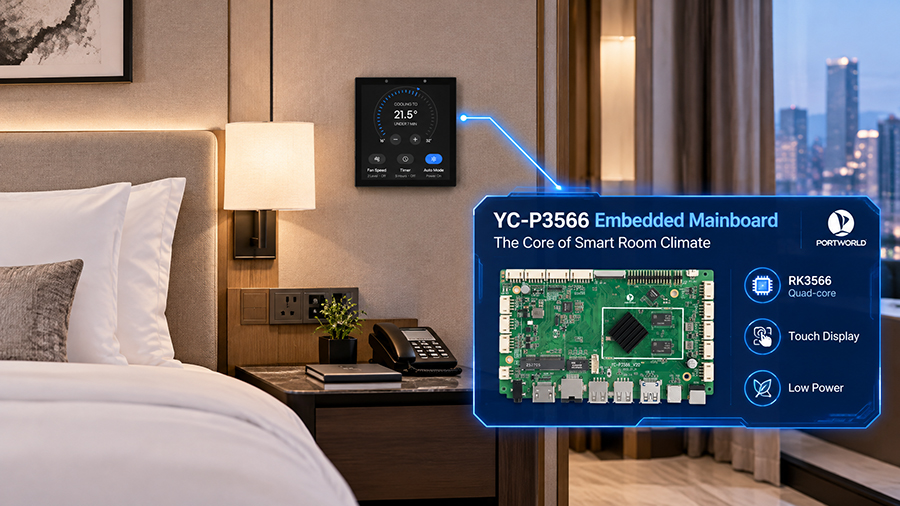
YC-P3566-smart home control panel
When evaluating processor options, development teams should assess:
- Processor performance metrics and visual rendering capabilities
- Operational compatibility with Android or Linux environments
- Compatibility with the designated display communication protocol
- Connectivity infrastructure for networking and peripheral devices
- Accessibility of development kits, board support packages, and sustained technical support
For less demanding embedded user interfaces, an ESP32-S3-based solution may prove appropriate. Portworld’s YC-SM43P leverages ESP32-S3 technology and facilitates LVGL-based graphical interface development, positioning it as a viable option for streamlined human-machine interfaces and Internet of Things management systems.
Optimal platform selection hinges upon application complexity requirements rather than processor specifications alone.
2. Touchscreen Display: Dimensions, Visual Clarity, and Interaction Quality
The touchscreen serves as the fundamental interface through which users engage with the smart home system. Its dimensions, visual clarity, luminosity, tactile responsiveness, and structural configuration substantially influence operational effectiveness.
Compact 4-inch interfaces prove advantageous for wall-integrated room management solutions where spatial constraints exist. Expanded 8-inch, 10-inch, and 11.6-inch interfaces deliver enhanced space for architectural layouts, equipment monitoring panels, environmental regulation options, and unified control frameworks.
As an illustration, Portworld’s YC-SM41P incorporates a 4-inch capacitive touchscreen featuring 480 × 480 pixel density, whereas the YC-SM10P delivers a 10-inch interface with 1280 × 800 pixel density and 500-nit light output according to its technical specifications.
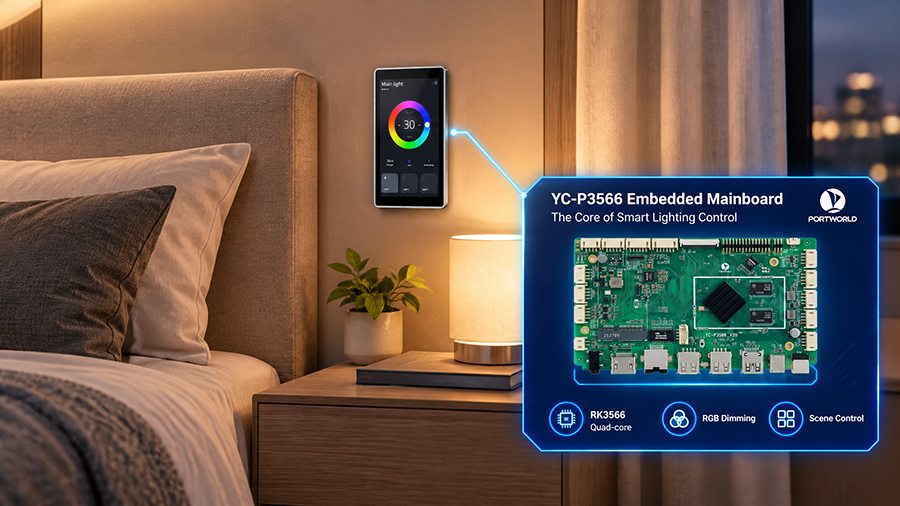
YC-P3566-smart home control panel
When selecting a display, developers must carefully consider multiple critical factors:
Screen dimensions and pixel density: Assess the volume of information requiring simultaneous presentation and the typical distance from which users will interact with the interface.
Touchscreen interface technology: Capacitive touchscreen technology delivers efficient responsiveness for contemporary smart home control systems. Multi-touch functionality may prove advantageous for implementing interactive gestures including swiping and zooming operations.
Display luminosity and angular visibility: These specifications must align with the anticipated ambient lighting environment and the intended installation orientation.
Structural and physical considerations: The display unit, front bezel, protective enclosure, and installation hardware must be compatible with the designated wall-mounted housing and operational setting.
An optimized control panel design necessitates equilibrating display dimensions, aesthetic appeal, operational efficiency, and installation constraints rather than defaulting to the largest available display option.
3. RAM and Storage: Supporting Applications and System Updates
Memory and storage capacity directly impact application performance, the range of available software functionalities, and the system’s capacity to integrate forthcoming updates.
A control panel equipped with a straightforward embedded interface typically requires different memory specifications compared to an Android-based panel executing a proprietary application, external smart home integration software, and multiple concurrent background processes.
As an illustration, Portworld’s YC-P5 features 2GB RAM and 32GB storage capacity, whereas the YC-SM55P is specified with 2GB RAM and 16GB storage capacity.
When determining memory and storage configurations, developers must evaluate the operating system requirements, application footprint, graphical asset resources, on-device data retention needs, and anticipated future software enhancements. Storage allocation should additionally encompass system upgrade packages and any configuration information retained locally on the device.
Making an informed configuration decision during the initial planning phase can minimize unnecessary expenditures on hardware infrastructure while preserving adequate resources throughout the product’s intended operational lifespan.
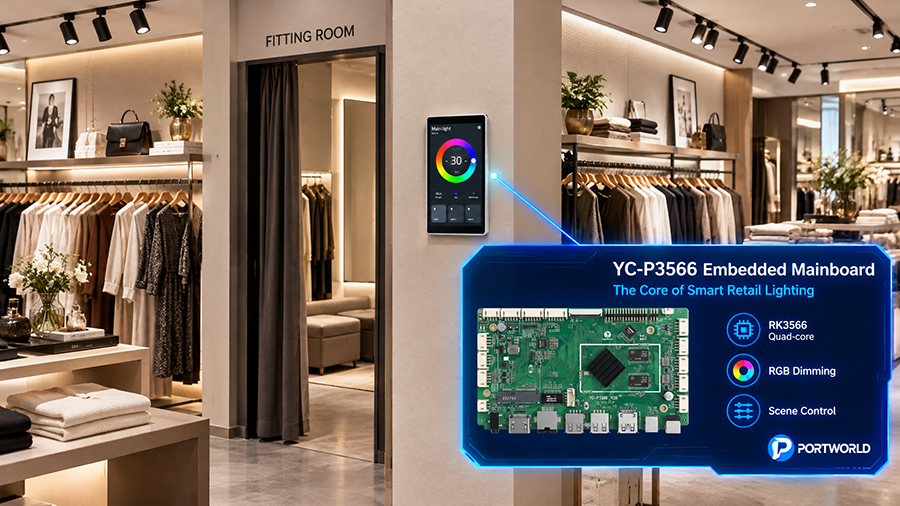
YC-P3566 Smart Mainboard
4. Connectivity and Communication Interfaces
A smart home control panel must establish dependable communication with the devices and automation systems under its management. The necessary interfaces are determined by the intended market segment, the existing building infrastructure, and the protocols employed by the customer’s smart home solution.
Wi-Fi and Ethernet facilitate network connectivity for applications, local system communication, and supported remote-control capabilities. Bluetooth enables compatibility with wireless devices and supports commissioning procedures.
For specialized installations, supplementary interfaces may be required.
- RJ45 Ethernet: Delivers a wired network connection and can facilitate Power over Ethernet functionality when the hardware and network infrastructure are appropriately configured.
- RS485: Facilitates the integration of compatible controllers and industrial or building automation equipment.
- KNX: Mandated when the panel requires integration with a KNX-based building automation system, utilizing the appropriate hardware interface and software configuration.
- Zigbee: May be facilitated through an appropriate radio module or gateway, contingent upon the product architecture.
- USB, UART, or alternative interfaces: Can enable debugging, peripheral device connections, and product-specific integration as circumstances necessitate.
Portworld’s YC-SM41P delivers RJ45 Ethernet and RS485 connectivity, whereas the YC-SM41P-KNX is engineered specifically for KNX-based smart building automation and facilitates Zigbee gateway integration capabilities.
A critical design factor is that a communication interface alone does not ensure protocol compatibility. The hardware, firmware, protocol stack, and target automation system must function cohesively.
5. Power Supply: DC Input or Power over Ethernet
Power architecture influences installation complexity, system reliability, and the total deployment cost of a smart home control panel.
A standard DC input may be suitable when an appropriate power supply already exists behind the wall or within the installation enclosure. Power over Ethernet (PoE) can streamline installation by transmitting both power and network data through a single Ethernet cable, provided the panel and network infrastructure support compatible PoE specifications.
As an illustration, Portworld’s YC-SM41P accommodates 48V PoE, and the YC-P5 accommodates PoE in addition to a DC 12V input according to its technical specifications.
Prior to selecting a power solution, developers should evaluate:
- The panel’s peak power consumption
- Supported input voltage range and PoE standard
- Network switch or injector compatibility
- Cable length and environmental installation conditions
- Power demands of supplementary peripherals
The power infrastructure should be established early in the design phase because it influences PCB design, enclosure specifications, thermal management strategy, installation components, and system certification obligations.
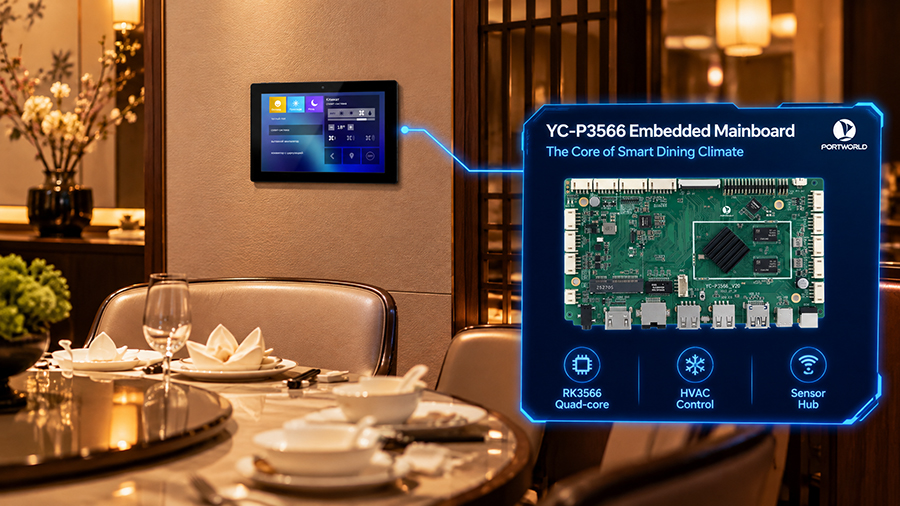
YC-P3566 Smart Mainboard
6. PCB and PCBA: Consolidating Hardware Elements
A custom smart home control panel requires an integrated printed circuit board (PCB) and a fully assembled circuit board assembly (PCBA) that consolidate the processor, display, memory, power management circuitry, and communication interfaces into a unified system.
Two primary development methodologies are available.
The first methodology involves leveraging an existing embedded platform or motherboard. This strategy can minimize hardware development duration and enable the engineering team to concentrate on user interface design, enclosure development, and overall system integration.
The second methodology entails designing a specialized PCBA. This approach may prove beneficial when the product demands a particular combination of interfaces, a distinctive form factor, supplementary sensors, customized power management circuitry, or a cost-optimized design intended for high-volume manufacturing.
For OEM/ODM initiatives, hardware customization encompasses processor selection, memory configuration, interface modifications, and incorporation of supplementary components including microphones, speakers, cameras, or environmental monitoring sensors.
The selection between an existing platform and a custom PCBA should be determined by the project’s technical specifications, anticipated production volume, allocated development budget, and long-term maintenance strategy.
7. Sensors and Additional Hardware
While not all smart home control panels require integrated sensors, supplementary components can enhance operational capabilities and facilitate more intelligent, context-sensitive automation.
Environmental monitoring can be achieved through temperature and humidity sensors, which deliver readings suitable for compatible applications. Light-sensitive detectors enable applications to adjust their behavior based on surrounding illumination levels. Audio input and output devices may prove beneficial for voice-activated control, system alerts, or two-way communication features. Video capture devices may be essential for particular applications involving remote visual communication or surveillance purposes.
The incorporation of these elements necessitates careful consideration of multiple factors, including energy efficiency, optimal sensor positioning, sound quality characteristics, structural apertures, data protection concerns, and system-level software compatibility.
As an illustration, Portworld’s YC-SM41P-KNX model accommodates optional temperature and humidity measurement capabilities, whereas the YC-SM43P provides configurable sensor options designed for distributed computing and human-machine interface implementations.
Optimal system design does not necessarily correlate with the greatest quantity of hardware components. Rather, it represents the thoughtful selection of only those elements that fulfill the requirements of the target application while maintaining simplicity and avoiding superfluous additions.
8. Enclosure, Mounting Structure, and Thermal Design
The enclosure represents a critical component of the hardware infrastructure, particularly for wall-mounted applications that must integrate seamlessly with a building’s existing electrical systems.
The housing must accommodate the touchscreen display, printed circuit board assembly, connectors, mounting framework, and any supplementary components. The material selection, dimensional specifications, surface treatment, and color scheme collectively determine the final product’s aesthetic and functional characteristics.
Various geographic markets adhere to different wall box standards; consequently, developers must validate mounting specifications prior to completing the mechanical design phase. Retrofit applications may require the panel to conform to pre-existing wall box dimensions, whereas new construction projects typically permit greater flexibility in installation configuration.
Thermal management holds equivalent significance. The central processor, display unit, and power distribution circuitry all generate substantial heat, necessitating that the enclosure provide adequate thermal dissipation under anticipated operational conditions.
For extensive commercial deployments, mechanical uniformity, assembly productivity, maintenance accessibility, and the supply chain for replacement components warrant careful consideration.
9. How to Choose the Right Hardware Configuration
The required hardware depends on what the control panel is expected to do. A basic room controller, a KNX wall panel, and a centralized smart building terminal can have very different requirements.
The following table provides a starting point for hardware planning.
| Application | Hardware priorities |
|---|---|
| Basic room control | Compact touchscreen, suitable embedded processor, Wi-Fi or Ethernet, required device interfaces |
| Android smart home panel | Embedded application processor, sufficient RAM and storage, capacitive touchscreen, network connectivity |
| KNX smart building control | Compatible processor, KNX interface, suitable software stack, required network and power interfaces |
| Lightweight IoT/HMI panel | Microcontroller platform such as ESP32-S3, touchscreen, supported UI framework, required communication interfaces |
| Centralized building control | Larger display, stronger processing platform where needed, Ethernet, expanded interface options, appropriate thermal design |
These represent planning guidelines rather than rigid universal specifications. The ultimate configuration must be verified against the application software, communication protocols, installation conditions, and anticipated operational duration.
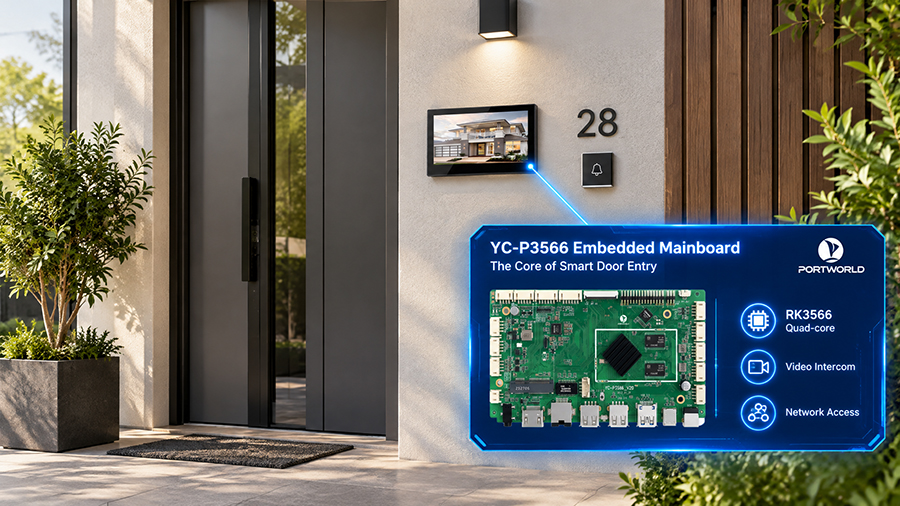
YC-P3566 smart home control panel
10. The Significance of OEM/ODM Customization
For smart home manufacturers and system integrators, hardware selection constitutes merely one component of product development. The control panel must also integrate with the customer’s automation ecosystem, software platform, installation protocols, and brand identity requirements.
An OEM/ODM partner can facilitate coordination of hardware selection, PCBA development, operating system customization, BSP and SDK support, interface integration, enclosure design, UI customization, and production readiness.
Portworld delivers smart touch control panels across multiple dimensions and embedded hardware architectures, encompassing Android- and Linux-based systems as well as ESP32-S3 solutions for resource-efficient HMI implementations. Its customization capabilities encompass hardware, software, aesthetics, brand identity, and packaging tailored to specific project specifications.
Leveraging an established panel platform can facilitate accelerated development cycles when its hardware specifications already satisfy application requirements. A purpose-built motherboard or PCBA may prove more advantageous when the project demands specialized connectivity, alternative mechanical design, or a distinct component arrangement.
For production initiatives, it is equally critical to assess technical support capabilities, prototype validation procedures, manufacturing uniformity, component sourcing reliability, and the vendor’s capacity to provide sustained product maintenance.
A bespoke intelligent home automation interface panel ordinarily necessitates a central processing unit, display screen with touch functionality, memory and data storage capacity, connectivity modules, an appropriate electrical power system, circuit board assembly, and a custom-engineered housing structure. Contingent upon the intended use case, the system may additionally require KNX or Zigbee protocol compatibility, RS485 serial communication, environmental monitoring sensors, acoustic components, or other specialized technological elements.
The fundamental principle involves treating these components as constituents of an integrated solution rather than as independent technical parameters. By establishing the intended operational context, computing framework, data transmission standards, deployment specifications, and manufacturing objectives in advance, engineers can develop a control panel that demonstrates operational effectiveness, economic viability, and appropriateness for extended operational periods.