Matter vs. Wi-Fi: What Smart Home Developers Need to Know
For years, Wi-Fi has played a central role in smart home technology. Smart cameras, lighting controllers, thermostats, smart plugs, and touchscreen control panels rely on Wi-Fi to connect to home networks and communicate with other devices.
As smart home ecosystems develop, however, Matter is becoming an increasingly important consideration for product manufacturers and developers.
This has prompted a common question: Is Matter replacing Wi-Fi, or do smart home devices require both technologies?
Matter and Wi-Fi serve distinct functions. Wi-Fi provides wireless network connectivity, while Matter specifies how compatible smart home devices communicate and interact. Matter can operate over Wi-Fi, Ethernet, and Thread.
For smart home developers, understanding this distinction is essential when choosing processors, wireless modules, operating systems, and communication architectures.
1. How Do Matter and Wi-Fi Differ?
The key difference lies in where each technology fits within the communication architecture.
What Is Wi-Fi?
Wi-Fi is a wireless networking technology that enables electronic devices to join a local area network (LAN) and exchange data.
In smart home systems, Wi-Fi is often used to connect devices such as:
- Smart lighting controllers
- Security cameras
- Smart plugs
- Thermostats
- Home appliances
- Touchscreen control panels
Wi-Fi provides network access, allowing devices to communicate with local servers, mobile apps, cloud platforms, and other equipment on the network.
However, Wi-Fi by itself does not establish a universal language for smart home applications.
For instance, two Wi-Fi-enabled smart lights made by different companies may use entirely different APIs, data formats, and mobile apps.
Although they use the same networking technology, they may not be directly compatible.
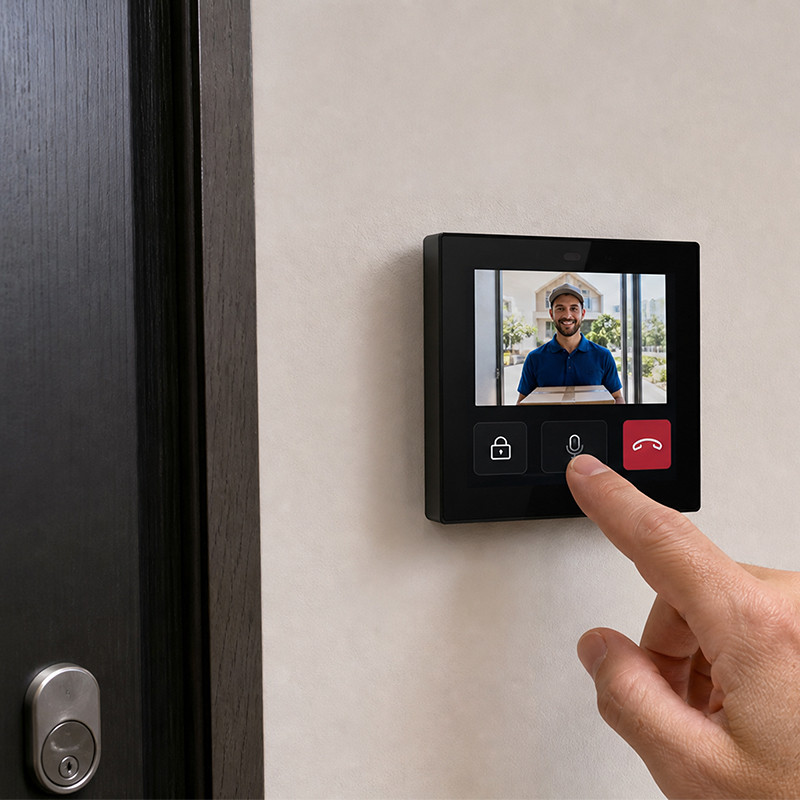
YC-SM43P ESP32 4″ Smart Touch Panel
What Is Matter?
Matter is an IP-based application-layer standard for smart homes, developed by the Connectivity Standards Alliance (CSA).
It is designed to improve interoperability among smart home devices made by different manufacturers.
Matter specifies standardized device types, data models, commands, and communication behavior. As a result, compatible devices can work with supported smart home platforms without each manufacturer needing to build a separate proprietary integration.
Matter supports three primary network transports:
- Wi-Fi
- Ethernet
- Thread
Bluetooth Low Energy (BLE) is commonly used during commissioning. It allows a compatible controller to provision a device before the device joins its operational network.
For example, a Matter-compatible smart switch may connect over Wi-Fi and use standardized commands to communicate with a compatible Matter controller.
The key point is that Matter does not replace Wi-Fi. Instead, it adds a standardized communication layer over supported network technologies.
2. Matter vs. Wi-Fi: Key Differences
Although these technologies work together, their functions are different.
| Comparison | Matter | Wi-Fi |
|---|---|---|
| Technology type | Smart home application-layer standard | Wireless networking technology |
| Main purpose | Standardized device communication | Network connectivity and data transmission |
| IP-based | Yes | Provides IP network connectivity |
| Frequency | Depends on underlying network | Commonly 2.4 GHz and 5 GHz; Wi-Fi 6E/7 also support 6 GHz |
| Device interoperability | Standardized for compatible Matter devices | Does not guarantee application compatibility |
| Power consumption | Depends on transport and implementation | Generally higher than low-power Thread for battery-operated devices |
| Network infrastructure | Requires a compatible IP network and Matter controller | Requires a compatible access point or wireless router |
| Typical applications | Smart home device interoperability and automation | Cameras, displays, appliances, panels, and network connectivity |
These technologies should not be considered direct substitutes for one another.
A Wi-Fi device can operate without Matter through a proprietary application or cloud platform. A Matter-over-Wi-Fi device uses Wi-Fi for network connectivity and Matter for standardized smart home communication.
3. How Does Matter over Wi-Fi Work?
Matter over Wi-Fi combines a home’s existing Wi-Fi infrastructure with Matter’s standardized application-layer communication.
A typical system consists of four components:
Matter-compatible device: A smart switch, lighting controller, thermostat, or another product equipped with Matter software.
- Wi-Fi access point: Connects the device to the local IP network.
- Matter controller: Manages compatible devices and automation functions.
- Smart home application: Provides the interface for setup, monitoring, and control.
- The communication process generally follows these steps:
- The user begins commissioning through a compatible smart home application.
- The device receives the necessary Wi-Fi network credentials.
- The device joins the local network and establishes IP connectivity.
- The Matter controller discovers the device and creates a secure operational session.
- The controller sends standardized commands and receives status information from the device.
BLE is commonly used to support initial commissioning, but routine Matter operation uses the chosen IP transport.
For Wi-Fi devices, operational discovery commonly relies on DNS-SD and mDNS. Developers therefore need to account for local network discovery, multicast behavior, IPv6 connectivity, and router configuration.
These considerations are particularly important in commercial environments and installations with multiple access points, where network segmentation or multicast filtering can disrupt device discovery.
YC-SM43P ESP32 4″ Smart Touch Panel
4. Matter over Wi-Fi vs. Matter over Thread
Matter supports both Wi-Fi and Thread, but they are designed for different device requirements.
Wi-Fi is generally better suited to devices that need higher data throughput or already have a reliable power source.
Thread is designed for low-power mesh networking, making it attractive for battery-operated sensors, door locks, and other small smart home devices.
| Comparison | Matter over Wi-Fi | Matter over Thread |
|---|---|---|
| Network technology | Wi-Fi | Thread |
| Frequency | Commonly 2.4 GHz or 5 GHz, depending on Wi-Fi support | 2.4 GHz |
| Network architecture | Infrastructure-based wireless LAN | Low-power IPv6 mesh |
| Data throughput | Higher | Lower |
| Power consumption | Generally higher | Designed for low-power operation |
| Battery-powered devices | Possible, but implementation-dependent | Particularly suitable |
| Network infrastructure | Wi-Fi router or access point | Thread network and Border Router |
| Typical applications | Smart displays, appliances, powered controllers | Sensors, locks, switches, and other low-power devices |
When Should Developers Choose Matter over Wi-Fi?
Matter over Wi-Fi is a practical choice for:
- Smart home control panels
- Smart displays
- Connected appliances
- Lighting controllers with a continuous power supply
- Devices that transmit larger volumes of data
- Products that already contain Wi-Fi hardware
For example, a wall-mounted smart home control panel with a touchscreen and continuous power can use Wi-Fi to communicate with a Matter ecosystem.
When Should Developers Choose Matter over Thread?
Matter over Thread is especially well suited to:
- Door and window sensors
- Motion detectors
- Temperature and humidity sensors
- Battery-powered smart locks
- Low-power wireless switches
Thread enables compatible devices to join a mesh network without requiring every device to maintain a conventional Wi-Fi connection.
A Thread Border Router links the Thread network to the broader IP network, enabling Matter controllers and other IP-connected devices to communicate with Thread-based products.
For many smart home projects, combining Matter over Wi-Fi and Matter over Thread provides a practical architecture instead of selecting only one.
5. Does Matter Require Wi-Fi?
No. Matter does not require all devices to connect through Wi-Fi.
Matter supports Wi-Fi, Ethernet, and Thread as network transport options.
For example:
- A smart display may connect via Wi-Fi.
- A permanently installed, industrial-style control panel may use Ethernet.
- A battery-powered door sensor may use Thread.
All three can work within a Matter ecosystem if their hardware, firmware, and software support the standard.
This flexibility benefits manufacturers creating different types of smart home products.
For instance, a touchscreen panel may communicate with the central automation system over Ethernet or Wi-Fi, while wireless sensors use Thread and other devices use Wi-Fi.
The Matter controller coordinates supported devices across the network.
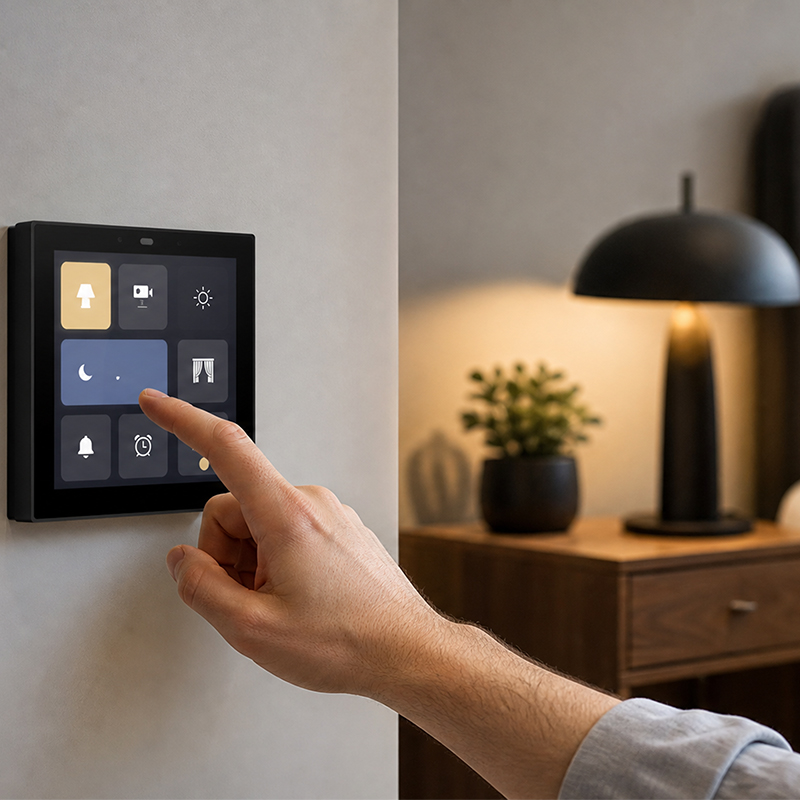
YC-SM43P ESP32 4″ Smart Touch Panel
6. Power Consumption and Hardware Selection
Power consumption is a key consideration when choosing a wireless technology.
Wi-Fi typically uses more power than low-power mesh technologies such as Thread. However, actual consumption depends considerably on the chipset, connection status, traffic volume, and firmware implementation.
For devices connected to mains power, Wi-Fi is often a practical option because it supports continuous network connectivity.
For battery-powered devices, developers should consider sleep modes, connection intervals, wake-up time, and the volume of data transmitted.
Consider the following examples:
A wall-mounted panel generally has a continuous power supply. Wi-Fi or Ethernet can provide dependable connectivity for its interface, automation platform, and network services.
Battery-powered motion sensor
A motion sensor may need to operate for months or years without a battery replacement. Matter over Thread may be a more suitable architecture, as Thread is designed for low-power devices.
Smart lighting controller
A powered lighting controller can use Matter over Wi-Fi or Matter over Thread, depending on the product architecture and network requirements.
Hardware selection should therefore be based on the device’s actual function, rather than the assumption that one communication technology is always superior.
7. Security and Device Interoperability
Security is a key concern for smart home manufacturers.
Wi-Fi networks generally rely on WPA2 or WPA3 to protect access. However, network encryption alone does not ensure secure communication between smart home products at the application level.
Matter provides additional security features, including device authentication, certificate-based operational credentials, and encrypted communication among authorized devices.
Matter also supports multi-admin functionality, which enables compatible devices to be shared across multiple supported smart home ecosystems.
Developers should therefore:
- Implement secure device commissioning.
- Protect device credentials and operational certificates.
- Adopt suitable firmware update mechanisms.
- Verify device behavior using supported Matter controllers.
- Test local network discovery and communication.
- Confirm interoperability across the intended ecosystem.
Network infrastructure is another important factor. Because Matter depends on IPv6, developers should ensure that IPv6 is available and correctly configured on the local network.
A Wi-Fi connection that provides internet access does not, by itself, guarantee that all Matter discovery and communication requirements are met.
8. What Hardware Do Developers Need for Matter over Wi-Fi?
Building a Matter-compatible product involves more than integrating a Wi-Fi module.
The hardware platform needs adequate processing capability, memory, wireless connectivity, and software support.
Key hardware considerations typically include:
Processor performance
Matter handles protocol operations, encryption, networking, and device application logic. Choose a processor with enough capacity to support the product’s intended functions.
Memory resources
Allow for the Matter stack, application firmware, network buffers, security credentials, and other software components.
Wireless connectivity
The hardware must support the required Wi-Fi bands and network configuration. BLE may also be necessary for the chosen commissioning process.
Operating system and software framework
The development platform must support an appropriate Matter SDK, network stack, security implementation, and application integration.
Certification and testing
Product manufacturers should plan for Matter compliance testing and any applicable certification requirements. A functional prototype is not automatically a Matter-certified product.
Can the ESP32-S3 Be Used for Matter over Wi-Fi?
Yes. With an appropriate software implementation, the Wi-Fi-enabled ESP32-S3 can be used to develop Matter-over-Wi-Fi devices.
Espressif offers the ESP-Matter development framework for supported ESP32 platforms, including the ESP32-S3.
In embedded smart home products, the platform may be suitable for devices such as connected switches, control interfaces, and other supported Matter device types.
However, it is important to distinguish hardware connectivity from a complete Matter implementation.
An ESP32-S3 board with Wi-Fi does not automatically function as a Matter device. It also needs the appropriate Matter stack, device data model, commissioning process, security configuration, and application firmware.
The ESP32-S3 has no built-in IEEE 802.15.4 radio, so it cannot provide Matter over Thread on its own. Additional hardware and a suitable system architecture are required.
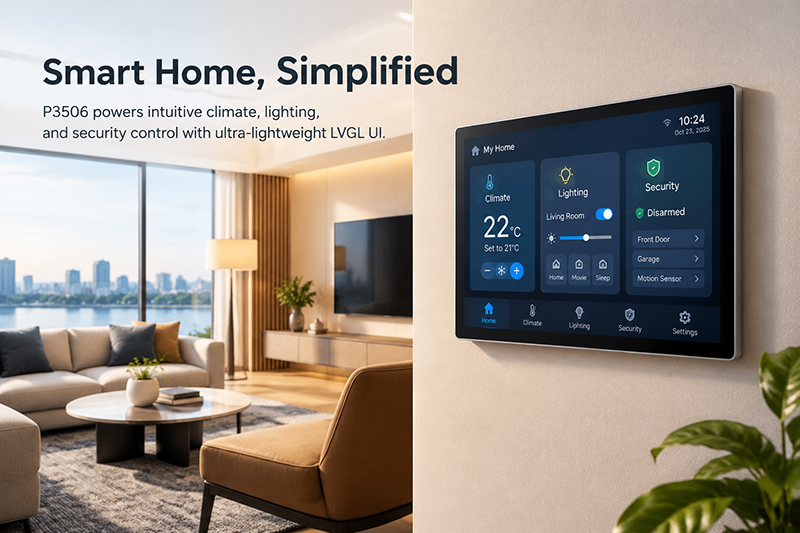
P3506 Smart Home Scenario
Portworld Smart Home Control Panels for Wi-Fi and Matter Integration
For smart home manufacturers, selecting a communication protocol is only one element of product development.
A control panel also needs an appropriate touchscreen, processor, memory, communication interfaces, and software environment.
Portworld develops smart home control panels based on ARM and ESP32 platforms to address a range of embedded interface and automation integration requirements.
YC-SM43P: ESP32-S3 Smart Home Control Panel
The YC-SM43P is a 4-inch smart home control panel powered by the ESP32-S3 platform.
Key specifications include:
- ESP32-S3 dual-core processor, with speeds up to 240 MHz
- 4-inch capacitive touchscreen
- 480 × 480 display resolution
- 8MB PSRAM and 16MB Flash
- LVGL graphical interface
- Wi-Fi and Bluetooth connectivity
- Ethernet and PoE options
- RS485 interface
For developers creating compact smart home interfaces, the YC-SM43P offers a customizable embedded hardware platform.
Customized firmware and software can enable communication with external automation controllers. Depending on project requirements, developers can implement MQTT, Modbus, or other communication functions.
Matter-over-Wi-Fi development is another potential application for a suitable ESP32-S3-based implementation. The required Matter firmware, device role, commissioning process, and certification work must, however, be developed and validated separately.