Indoor vs. Outdoor Digital Signage Displays: Which Do You Need?
Digital signage has emerged as an effective tool for organizations seeking to engage customers, market merchandise, and present data instantaneously. Spanning retail establishments, food service venues, external promotional screens, and information access points, commercial display systems operate across diverse settings.
Nevertheless, not all digital signage systems are appropriate for every application context. A display installed within an interior shopping environment operates under substantially different specifications than an exterior promotional display subjected to intense solar radiation, precipitation, and fluctuating atmospheric conditions.
Recognizing the distinctions between interior and exterior digital signage systems enables organizations to select appropriate equipment, minimize expenditures, and implement a framework aligned with their specific objectives.
What Distinguishes Interior from Exterior Digital Signage Systems?
The fundamental distinction between interior and exterior digital signage pertains to the operational setting. Interior displays are typically engineered for relatively stable environmental parameters, whereas exterior displays must sustain legibility and consistent functionality amid more rigorous atmospheric circumstances.
Interior digital signage finds widespread application in commercial retail locations, food establishments, corporate facilities, hospitality venues, medical institutions, and conference spaces. Representative implementations encompass promotional messaging, electronic menu systems, space reservation platforms, guest communication resources, merchandise information repositories, and self-service information stations.
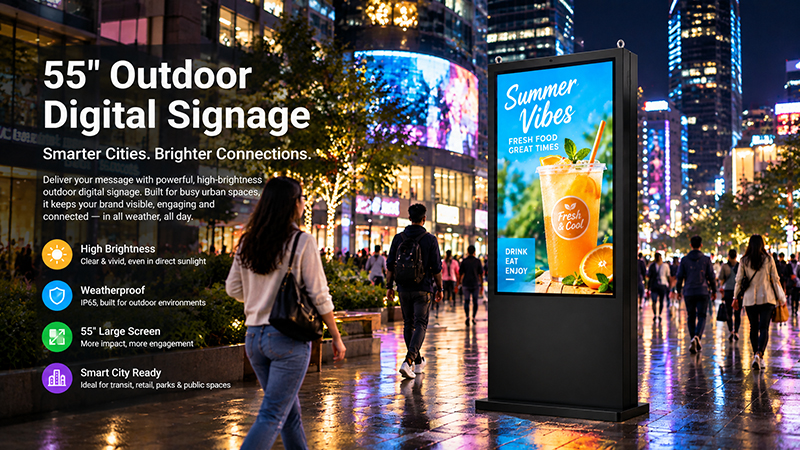
Outdoor digital signage is engineered for deployment in environments such as building entrances, storefronts, shopping districts, transit hubs, and outdoor advertising infrastructure. Contingent upon the specific installation requirements, such systems may necessitate elevated brightness levels, weatherproof housing, thermal regulation mechanisms, and reinforced safeguards against mechanical impact.The appropriate selection is determined not merely by whether a display is positioned within or outside a structure, but rather by the actual ambient lighting conditions, climatic exposure, duration of operation, and specific user requirements.
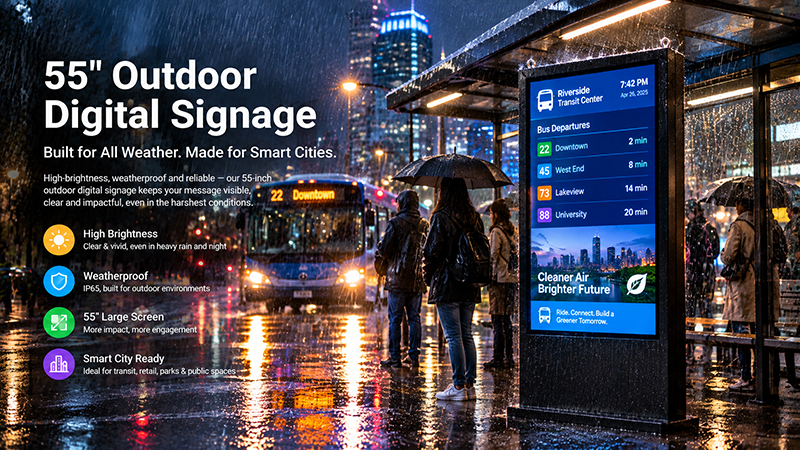
55 inch outdoor digital signage display
Indoor Digital Signage Displays: Engineered for Commercial Applications
Indoor digital signage is typically chosen for use cases in which viewers access information from moderate distances and where environmental circumstances remain relatively stable.
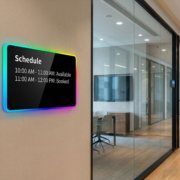
Within retail settings, commercial displays can communicate product offers, corporate messaging, and promotional campaigns aligned with seasonal periods. Food service establishments utilize digital menu systems to modify offerings and pricing structures, whereas hospitality venues and corporate offices employ digital displays for guest information, administrative communications, and conference room scheduling.
For implementations requiring interactive capabilities, touchscreen-enabled digital signage delivers expanded functionality. End users can examine detailed product specifications, make menu selections, locate facilities, or engage with service platforms directly through the display interface.
Portworld delivers indoor digital display solutions tailored for commercial installations, encompassing Android-based touchscreen systems, conference room display panels, and Power over Ethernet-compatible touch interfaces. Contingent upon the particular model selected, these solutions facilitate capabilities including intelligent automation, space reservation management, promotional content delivery, and dynamic information platforms.
For instance, Portworld’s YC-SM10P represents a 10-inch Android intelligent control interface utilizing the RK3566 processor, featuring a 1280 × 800 resolution display, 500-nit luminosity, 10-point capacitive touch functionality, and Power over Ethernet capability. This device is suitable for evaluation in compatible intelligent residential, commercial, and conference room management applications. The ultimate appropriateness for a specific signage implementation is contingent upon the requisite software specifications and deployment configuration.
Interior display systems typically do not necessitate equivalent environmental protection standards as completely unshielded exterior installations. However, prospective purchasers must nonetheless evaluate luminosity output, display resolution quality, viewing angle performance, operational duration specifications, communication interfaces, and installation hardware alternatives.
55 inch outdoor digital signage display
Exterior Digital Signage Displays: Optical Performance and Environmental Resilience
External advertising applications present operational difficulties that are comparatively infrequent in interior settings. Unobstructed solar radiation can render conventional display technology challenging to perceive, whereas precipitation, particulate matter, thermal variation, and thermal accumulation may compromise equipment performance and longevity.
Consequently, exterior digital signage must be selected in accordance with the particular environmental conditions of the installation location.
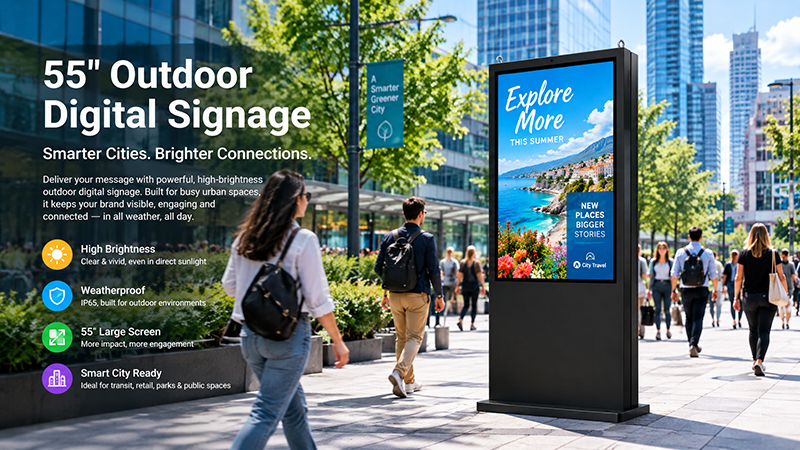
Luminosity constitutes a paramount selection criterion. Interior commercial display systems frequently function within the approximate spectrum of 300–700 nits, contingent upon environmental light conditions and intended purpose. Exterior displays subjected to intense solar exposure may necessitate 1,500–2,500 nits or greater output. Installations positioned in direct sunlight may demand substantially elevated luminosity specifications, determined by visibility requirements and display technological specifications.
The figures presented serve as general selection guidelines rather than absolute requirements. Purchasers should verify the specified brightness rating of their chosen model and evaluate the extent of direct sunlight exposure to the display surface.
Weather resistance represents an equally critical consideration. Outdoor display systems must incorporate an enclosure featuring an appropriate IP rating corresponding to the anticipated environmental conditions involving dust and moisture. The necessary protection classification is contingent upon whether the display is positioned beneath a protective structure, subjected to partial exposure, or situated in an entirely unprotected environment.
Thermal regulation is also significant. High-brightness display systems can dissipate substantial heat, particularly when housed in sealed enclosures and exposed to direct solar radiation. Both the display unit and its enclosure must accommodate the anticipated operating temperature parameters and incorporate adequate heat dissipation mechanisms.
Additional considerations may encompass anti-reflective coating technology, impact-resistant protection, stable mounting systems, sealed cable connections, and provisions for routine servicing.
Portworld supplies digital signage and display solutions tailored for commercial applications, encompassing high-brightness outdoor display configurations. For projects involving outdoor promotional display screens, clients must authenticate the accessible brightness specifications, IP classification, operating temperature parameters, enclosure construction, and supplementary environmental requirements for the particular product configuration prior to purchase.
Indoor vs. Outdoor Digital Signage: A Practical Comparison
| Selection Factor | Indoor Digital Signage | Outdoor Digital Signage |
|---|---|---|
| Typical applications | Retail promotions, menus, offices, meeting rooms, kiosks | Outdoor advertising, storefronts, public information |
| Brightness | Often around 300–700 nits, depending on lighting | Often 1,500–2,500 nits or higher for bright outdoor conditions |
| Weather protection | Usually designed for protected environments | Requires protection appropriate to rain, dust, and exposure |
| Temperature management | Based on indoor operating conditions | Must account for outdoor temperature and heat buildup |
| Touch interaction | Common in interactive panels and kiosks | Possible when the touch system is designed for the environment |
| Installation | Wall-mounted, countertop, or indoor freestanding | Outdoor wall-mounted, freestanding, kiosk, or advertising structures |
| Main selection priorities | Image quality, touch functionality, software, connectivity | Brightness, environmental protection, thermal design, installation |
A display characterized as possessing “high brightness” does not inherently qualify for outdoor deployment. Similarly, a screen positioned within a storefront window may encounter severe solar radiation and elevated temperatures despite being situated indoors. These semi-outdoor installations necessitate thorough evaluation of both optical performance and thermal management considerations.
Which Digital Signage Display Is Appropriate for Your Application?
The optimal selection becomes evident when the deployment setting and operational purpose are evaluated concurrently.
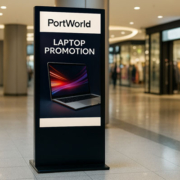
For interior retail marketing, an indoor commercial display can present promotional materials without the supplementary protective housing mandated by fully outdoor systems. Should customers require the ability to review product information or engage with displayed content, a touch-enabled display would prove more suitable.
For dining establishments and hospitality sectors, Android-powered displays can facilitate digital menu systems, marketing materials, and supplementary functions when appropriate software solutions are accessible. Conference spaces and corporate offices may derive considerable benefit from internet-enabled display panels supporting room reservation systems, calendar scheduling, and informational content.
For exterior advertising applications, the assessment should commence with solar intensity and atmospheric conditions. A display installed beneath a sheltered entryway may impose distinct specifications compared to one affixed to an unprotected building exterior. Procurement professionals should establish requirements regarding luminosity, ingress protection classification, temperature operating range, structural support systems, and service accessibility prior to product selection.
For initiatives that integrate promotional content with interactive capabilities, the display infrastructure may require specialized hardware components, a designated operating system, or connectivity with third-party platforms. Establishing these specifications at the outset mitigates potential compatibility challenges during system implementation.
Why Opt for a Specialized Digital Signage Solution?
Conventional digital signage displays can address numerous standard requirements; however, certain commercial undertakings demand more tailored specifications.
A retail equipment manufacturer may require a specific display dimension, interactive touch capabilities, and Android-based software. A conference-room service provider may necessitate Power over Ethernet connectivity and integration with room-reservation systems. An outdoor promotional campaign may demand a high-luminosity display panel, a purpose-built protective housing, and climate-resistant features appropriate to its deployment environment.
Portworld delivers digital display and embedded computing solutions, offering OEM and ODM capabilities for specialized commercial applications.
Based on the chosen technology platform and specific project parameters, Portworld’s offerings may encompass:
- Display customization: Screen size, display specifications, and touch configuration according to project needs.
- Embedded hardware customization: Selection or customization of motherboard and computing configurations for the intended application.
- Operating system and software support: Android or Linux system adaptation and support for application integration, subject to platform compatibility.
- Connectivity and interface integration: Configuration of supported network connections and hardware interfaces.
- Mechanical design and branding: Customized enclosure, product appearance, logo, and packaging options.
- OEM/ODM production support: Product development and manufacturing support for commercial display projects.
For outdoor products, the required brightness, enclosure protection, thermal design, and operating temperature range must be confirmed for the selected configuration. For indoor products, screen resolution, touch performance, software compatibility, and mounting requirements may be more important.
By aligning the hardware and software with the actual use case, businesses can develop a display solution that fits their commercial requirements rather than paying for specifications they do not need.
55 inch digital sigange display
Portworld Digital Signage Solutions for Diverse Operational Environments
Portworld facilitates commercial display initiatives encompassing indoor advertising, interactive touch-enabled applications, conference room systems, and bespoke digital signage implementations.
Regarding indoor deployments, the company’s product range encompasses Android-based touchscreen panels and commercial display systems that may be tailored for advertising purposes, informational content delivery, intelligent control mechanisms, and compatible interactive functionalities.
Concerning outdoor advertising initiatives, Portworld is equipped to address high-luminosity display specifications and application-specific configurations. Prospective clients should furnish details regarding the proposed installation site, solar radiation intensity, desired display dimensions, environmental protection measures, operational parameters, and anticipated order volume to facilitate comprehensive specification assessment.
Whether your organization requires an indoor interactive kiosk, a commercial promotional display, or a specialized outdoor signage solution, Portworld collaborates with your organization to address pertinent hardware considerations, system architecture, and original equipment manufacturer or original design manufacturer requirements.