How Do You Connect RS485 to an ESP32 Control Panel?
As industrial automation and smart control systems continue to advance, device communication has emerged as a fundamental component of embedded system architecture.
Numerous industrial devices, sensors, meters, and controllers continue to utilize RS485 communication due to its extended transmission range, robust noise immunity, and dependable functionality in demanding operational conditions.
For contemporary ESP32-based control panels, incorporating RS485 functionality offers an effective solution for interfacing with industrial equipment, sensors, and automation infrastructure.
Therefore, what methods exist for connecting RS485 to an ESP32 control panel, and what are the essential design factors to consider?
Understanding RS485 Communication
RS485 represents a prevalent industrial communication protocol engineered for dependable data transmission across extended distances.
In contrast to conventional UART communication, RS485 employs differential signaling methodology, which delivers superior protection from electrical interference.
Primary benefits encompass:
- Extended communication range
- Multi-device communication capability
- Robust interference rejection
- Reliable performance in industrial settings
Common RS485 implementation areas include:
- Industrial sensing devices
- Intelligent metering systems
- HVAC management controllers
- Programmable logic controller systems
- Building management automation
- Power consumption tracking systems
The Rationale for Integrating RS485 into an ESP32 Control Panel
The ESP32 microcontroller is extensively utilized in intelligent control panel applications due to its comprehensive capabilities:
- Wireless network connectivity
- Bluetooth-enabled communication
- Robust computational processing power
- Adaptable digital input/output connections
Nevertheless, numerous industrial apparatus lack native Wi-Fi or Bluetooth communication protocols.
Through the incorporation of RS485 technology, an ESP32 control panel gains the capacity to interface with established industrial infrastructure.
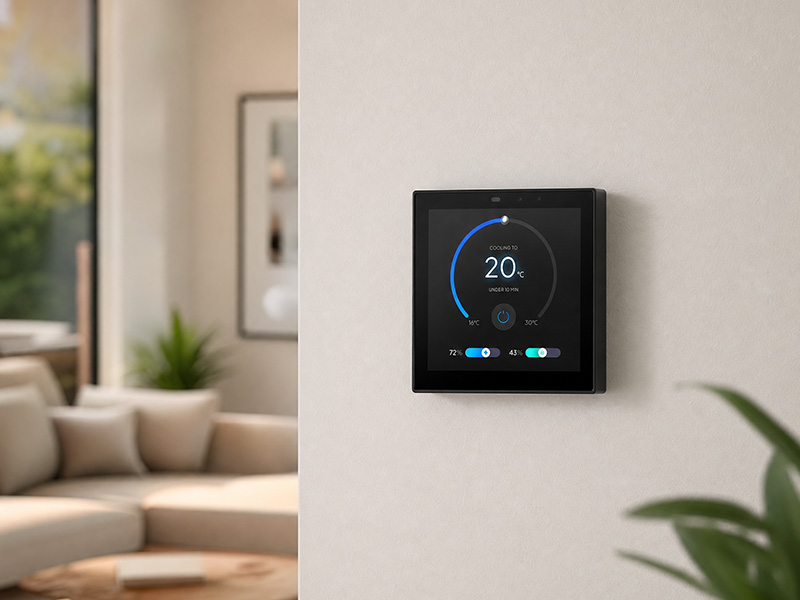
smart home control panel
A representative system configuration:
Industrial Devices / Sensors
↓
RS485 Communication Bus
↓
RS485 Transceiver Module
↓
ESP32 Control Panel
↓
Touchscreen Display / Cloud-Based Platform
This integration facilitates the supervision and regulation of industrial apparatus via an advanced user interface.
Hardware Components Required
Establishing a connection between RS485 and an ESP32 control panel necessitates the acquisition of multiple hardware components.
1. ESP32 Control Board
The ESP32 functions as the primary control unit.
Preferred options include:
- ESP32
- ESP32-S3
- ESP32-based HMI boards
The ESP32-S3 proves particularly advantageous for control panel applications due to its support for:
- Touchscreen display capabilities
- LVGL graphical interface functionality
- Multiple communication protocol interfaces
2. RS485 Transceiver Module
Since the ESP32 lacks an integrated RS485 interface, an external transceiver module becomes essential.
Prevalent RS485 transceiver integrated circuits include:
- MAX485
- SP3485
- SN65HVD series
The transceiver performs the following conversion:
- ESP32 UART signals
- into
- RS485 differential signals
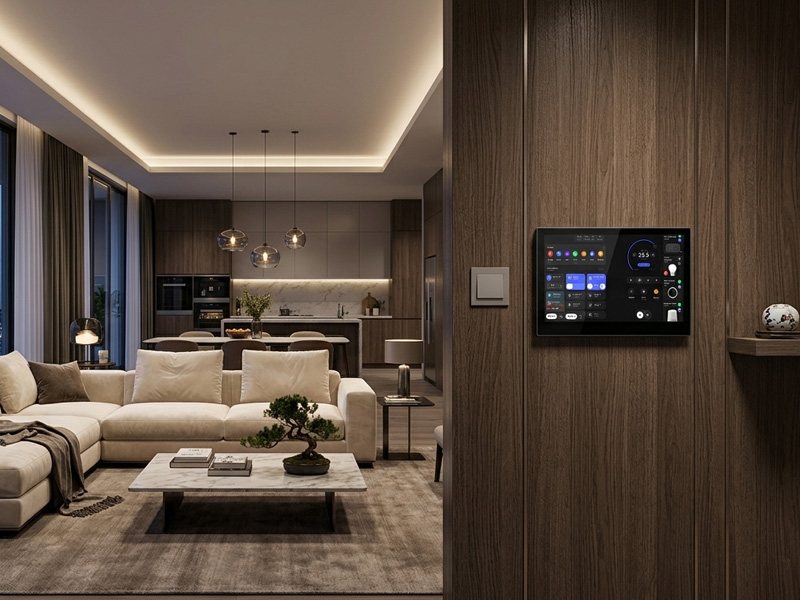
smart home control panel-1
3. Power Supply and Protection Circuit
Industrial settings demand consistent power delivery and comprehensive protection mechanisms.
A robust RS485 implementation may incorporate:
- Voltage regulation components
- Surge protection mechanisms
- Electrostatic discharge (ESD) protection
- Isolation circuit configurations
These elements substantially enhance system dependability within industrial operational contexts.
Establishing RS485 Communication with ESP32: A Systematic Approach
Step 1: Establish ESP32 UART Interface Connection
The ESP32 facilitates communication with the RS485 module via its UART interface.
Standard connection configuration:
| ESP32 | RS485 Module |
|---|---|
| TX | DI |
| RX | RO |
| GPIO Control | RE/DE |
| 3.3V/5V | VCC |
| GND | GND |
The TX/RX pins handle data transmission, while the RE/DE pin controls communication direction.
Step 2: Manage RS485 Communication Directionality
RS485 employs half-duplex communication, wherein devices utilize a shared communication line.
The ESP32 must alternate between:
- Transmission mode
- Reception mode
The RE/DE control pin governs the operational state:
Transmission:
ESP32 → RS485 Bus
Reception:
RS485 Bus → ESP32
The firmware manages this transition automatically.
Step 3: Establish Communication Protocol Configuration
Following hardware integration, the ESP32 firmware must specify communication parameters.
Standard parameters encompass:
- Baud rate
- Data bits
- Stop bits
- Parity settings
Predominant industrial devices operate at:
- 9600 bps
- 19200 bps
- 115200 bps
Step 4: Deploy Industrial Communication Protocols
- RS485 constitutes solely the physical communication layer.
- Most devices necessitate a communication protocol.
The predominant protocol is:
Modbus RTU
Modbus RTU finds extensive application in:
- Industrial sensors
- Energy measurement devices
- HVAC systems
- Automation equipment
An ESP32 control panel may function as:
- Modbus master
- Data monitoring terminal
- Device controller
Illustrative example:
Temperature Sensor
↓ RS485 Modbus
ESP32 Panel
↓
Touchscreen Display
Operators can monitor and regulate equipment through direct interface interaction.
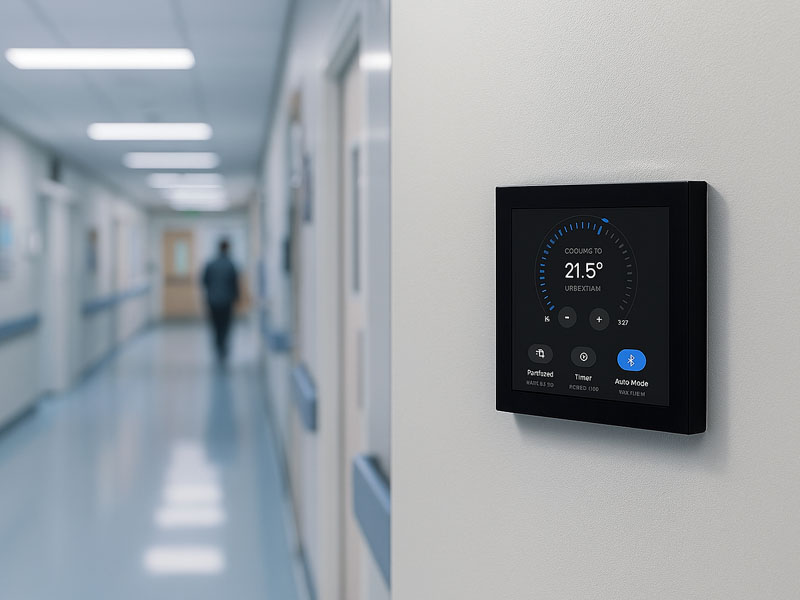
YC-SM10P
10.1 inch Smart Home Control Panel
Utilization of ESP32 and RS485 Control Panels in Industrial Automation
Applications:
- Machine surveillance and diagnostics
- Automated equipment operation
- Comprehensive factory monitoring interfaces
- Intelligent Building Infrastructure Systems
Applications:
- Heating, ventilation, and air conditioning regulation
- Automated illumination systems
- Power consumption analysis and tracking
- Energy Optimization and Management
Applications:
- Advanced metering infrastructure
- Photovoltaic system performance tracking
- Electrical distribution monitoring solutions
- Precision Agriculture Technologies
Applications:
- Greenhouse environmental oversight
- Automated watering system management
- Environmental parameter detection devices
- Residential Automation Solutions
Applications:
- Intelligent residential network hubs
- Residential infrastructure control systems
- Unified operational management platforms
The ESP32-S3 RS485 Intelligent Control Panel Architecture
Advanced implementations leverage ESP32-S3-based control panels that integrate the following components:
- Interactive touchscreen interface
- RS485 serial communication protocol
- Wireless network connectivity via Wi-Fi
- Bluetooth wireless technology
- Multiple sensor integration capabilities
This integration establishes a sophisticated Human-Machine Interface (HMI) solution that bridges conventional industrial equipment with contemporary Internet of Things (IoT) ecosystems.
Architectural Overview:
Industrial Equipment
↓
RS485 Communication Layer
↓
ESP32-S3 HMI Control Panel
↓
Cloud Infrastructure / Mobile Application Platform
Implementation capabilities include:
- Direct touchscreen-based equipment control
- Distributed system monitoring and oversight
- Instantaneous information presentation and analysis
- Automated decision-making and process optimization
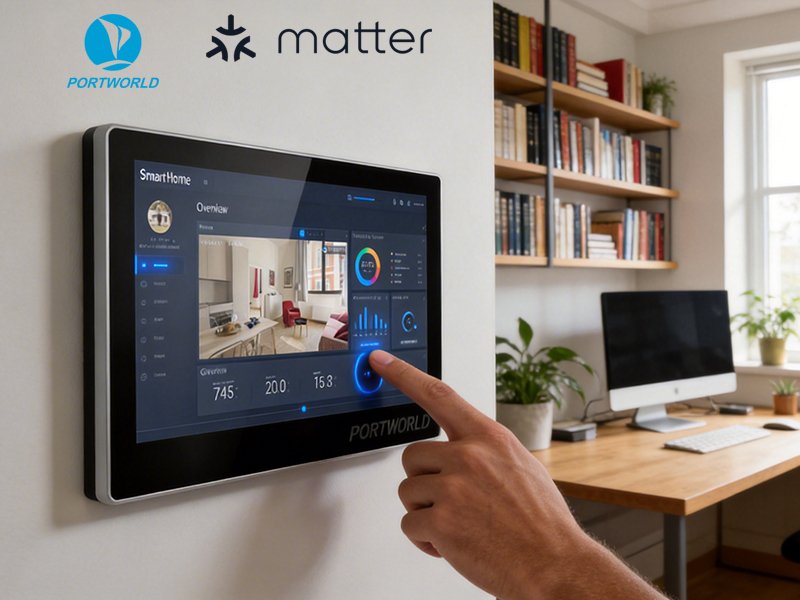
smart home control panel
Portworld ESP32 Control Panel Solutions
The development of an industrial-grade ESP32 control panel necessitates proficiency in hardware architecture, communication system integration, and software engineering.
Portworld delivers tailored ESP32 embedded solutions, encompassing:
- Hardware Customization
- ESP32 / ESP32-S3 control panels
- RS485 interface integration
- Touchscreen HMI design
- Custom PCB development
Software Development
- ESP-IDF firmware
- Modbus RTU integration
- LVGL UI development
- IoT connectivity
Product Services
- Prototype development
- Hardware optimization
- OEM/ODM manufacturing
From industrial HMI panels and intelligent building management systems to IoT gateways, Portworld assists clients in developing dependable embedded control solutions.
The integration of RS485 with an ESP32 control panel establishes a connection between contemporary IoT technology and conventional industrial equipment.
By leveraging ESP32’s wireless connectivity and graphical interface capabilities alongside RS485’s dependable industrial communication protocols, developers can construct more sophisticated and adaptable control systems.
For industrial automation, intelligent building infrastructure, energy management systems, and IoT applications, the ESP32 and RS485 combination presents an effective solution for contemporary embedded control platforms.