Can the Communication Interfaces of an ESP32 Control Panel Be Customized?
ESP32 control panels are extensively employed in smart home automation, industrial Internet of Things applications, building management systems, and intelligent equipment solutions. Nevertheless, not all projects employ identical communication protocols. A smart home controller may necessitate Wi-Fi and Bluetooth connectivity, whereas an industrial control panel may demand RS485, Modbus RTU, or Ethernet protocols to interface with pre-existing infrastructure.
This presents a critical consideration for product developers and system integrators: Can the communication interfaces of an ESP32 control panel be tailored to satisfy particular project specifications?
The response is affirmative. Through appropriate hardware architecture, firmware implementation, and interface configuration, an ESP32-based control panel can be customized to accommodate diverse communication frameworks. The fundamental principle is to identify the necessary interfaces during the initial development phase, rather than addressing connectivity requirements as a secondary concern.
Why Do ESP32 Control Panels Require Tailored Communication Interfaces?
While standard development boards serve effectively for prototyping purposes, production-grade applications typically demand more specialized functionality. A wall-mounted intelligent home control panel, for instance, may require simultaneous communication with wireless peripherals and integration with hardwired building management systems. An industrial-grade touchscreen interface controller might necessitate sensor data acquisition via RS485 protocol alongside host system communication through Ethernet connectivity.
Deploying a standard board without addressing these particular needs frequently results in supplementary adapters, intricate wiring configurations, expanded housing requirements, and superfluous integration efforts.
Customizing communication interfaces enables developers to strategically combine appropriate wired and wireless connectivity solutions. This approach additionally facilitates optimization of circuit board design, connector positioning, energy efficiency, installation procedures, and total manufacturing expenses.
For original equipment manufacturer and original design manufacturer initiatives, interface customization proves exceptionally advantageous because the identical ESP32 foundation can be modified to accommodate diverse clientele, equipment categories, and operational contexts.
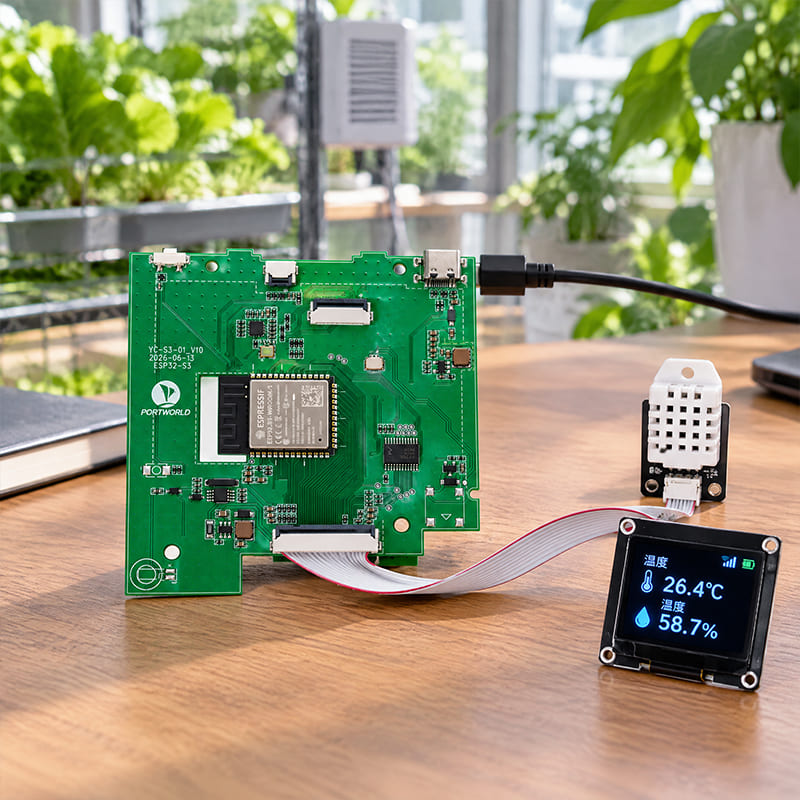
ESP32-S3 Motherboard
Which Communication Interfaces Can Be Customized on an ESP32 Control Panel?
The specific options available depend on the particular ESP32 chip variant, board configuration, accessible GPIO pins, and supporting external components. The following represent typical interfaces.
Wi-Fi and Bluetooth
Wi-Fi serves as a standard solution for smart home integration, application-to-device communication, cloud platform connectivity, and remote device administration. Bluetooth and Bluetooth Low Energy (BLE) facilitate device connection, remote setup, and interaction with compatible devices.
These wireless communication methods prove advantageous for residential smart devices, environmental controllers, and space-constrained IoT applications. Development teams can modify the software implementation to accommodate necessary network parameters and functional requirements.
Ethernet and PoE
Certain control panels necessitate hardwired network communication for deployment convenience or compatibility with established network infrastructure. Ethernet represents a dependable communication solution for enterprise-grade control systems, networked interfaces, and facility management platforms.
Power over Ethernet (PoE) can streamline deployment by transmitting both data connectivity and electrical power via a unified Ethernet connection. Nevertheless, PoE implementation demands appropriate power management and connection hardware; this capability cannot be achieved through ESP32 software configuration alone.
RS485 and Modbus RTU
RS485 represents a widely adopted standard for industrial equipment, HVAC controllers, energy meters, and building automation systems. It facilitates differential serial communication and is frequently deployed in environments where devices are dispersed throughout extensive installations.
When a control panel requires communication with compatible equipment utilizing Modbus RTU, developers can deploy the protocol within firmware and incorporate an appropriate RS485 transceiver into the hardware architecture.
This integration proves particularly advantageous when a touchscreen panel must present data originating from sensors, meters, controllers, or other Modbus-compatible devices.
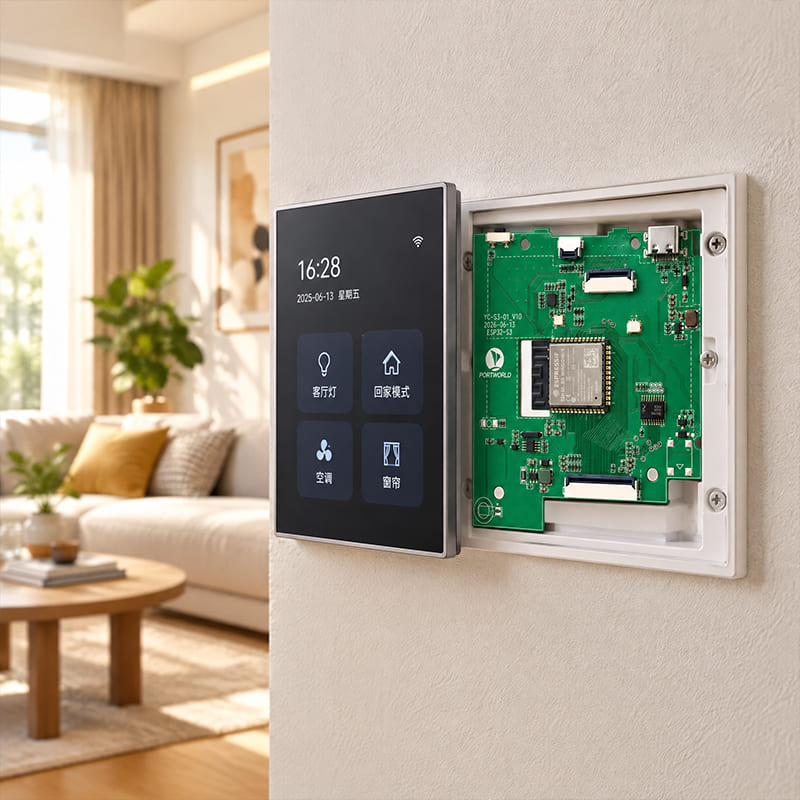
ESP32-S3 Motherboard
UART and RS232
UART is extensively utilized for communication between embedded devices and external modules. Contingent upon system specifications, it can facilitate debugging, configuration, or communication with a host controller.
RS232 is employed by certain legacy devices and specialized equipment. Given that UART logic-level signals and RS232 electrical signals differ substantially, an appropriate level-conversion circuit is necessary when interfacing an ESP32 with an RS232 interface.
I²C, SPI, and GPIO
Not all interfaces are designed for network-based communication. I²C and SPI are frequently employed to interface with touch controllers, sensors, display modules, and auxiliary integrated circuits. GPIO pins facilitate digital input reception, status signal transmission, button inputs, and connections to external control mechanisms.
Through the incorporation of appropriate supplementary circuitry, a control panel may integrate relay outputs or other domain-specific input/output capabilities. The ultimate system configuration must consider pin capacity, voltage specifications, electrical isolation requirements where applicable, and the specifications of interfaced devices.
CAN communication may also be feasible on select ESP32 variants when equipped with the requisite controller and external transceiver module. Developers must confirm the specific microcontroller capabilities and electrical specifications prior to incorporating CAN functionality into their design.
How Does Hardware Customization Influence Communication Interface Performance?
Communication interface customization extends beyond the installation of a connector on a printed circuit board. The electrical architecture must align with the communication protocol standard and the characteristics of the connected equipment.
For instance, implementing RS485 typically necessitates an appropriate transceiver module, correct signal path configuration, and evaluation of bus termination methodology and protective measures. Industrial applications may additionally demand galvanic isolation or supplementary surge protection mechanisms, contingent upon the specific operational context.
Likewise, Wi-Fi connectivity may necessitate network configuration and reconnection procedures, whereas Ethernet-based products may require IP configuration and application-level communication. The touchscreen interface must additionally display the collected data in a comprehensible manner and furnish appropriate controls aligned with the intended application.
For ESP32-S3 projects utilizing LVGL, developers are capable of constructing a graphical user interface incorporating status indicators, device controls, sensor readings, and configuration screens. These capabilities can be integrated with communication protocols to ensure the display accurately reflects the operational state of connected devices.
The ESP32-S3 demonstrates suitability for numerous embedded control and human-machine interface applications; however, it does not serve as a comprehensive substitute for all industrial controllers. Interface selection and computational requirements warrant evaluation against the specific project demands.
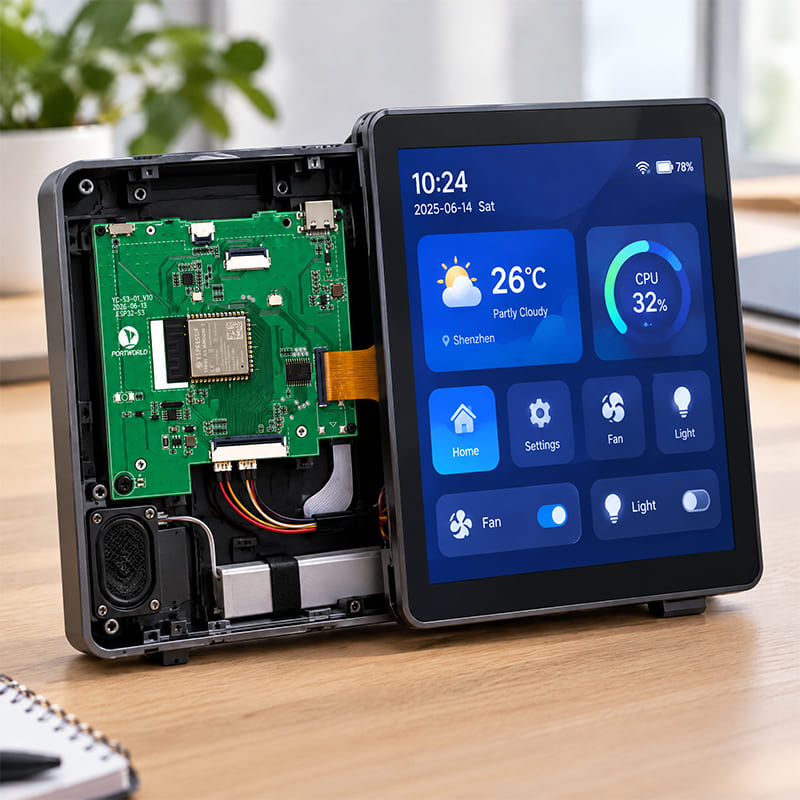
ESP32-S3 Motherboard
Selecting the Appropriate Interface Configuration for Your Application
The optimal configuration is determined by the installation location of the control panel and the devices with which it must establish communication.
A residential automation control panel may incorporate Wi-Fi, Bluetooth, touchscreen functionality, and optional Ethernet connectivity. A facility management panel may emphasize RS485 and Modbus RTU protocols for interfacing with climate control systems, measurement instruments, and compatible control devices. An industrial Internet of Things panel may demand hardwired Ethernet, serial interfaces, galvanically isolated inputs and outputs, and specialized connectors to integrate with existing infrastructure.
Prior to commencing development, product development teams should address the following considerations:
- Which devices, sensors, or control systems will the panel interface with?
- Which communication standards are supported by these devices?
- Is wired, wireless, or hybrid connectivity necessary?
- Does the product require Power over Ethernet, relay switching, isolated interfaces, or proprietary connectors?
- Which display, touch input, and auxiliary components utilize the ESP32’s processing capacity?
- Are there environmental, electrical safety, or regulatory certification requirements?
Portworld ESP32-S3 Control Panel Customization
For projects requiring capabilities beyond those offered by standard development boards, Portworld delivers specialized embedded hardware and software customization services for control panels and Internet of Things devices.
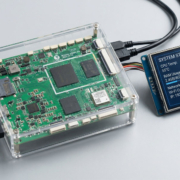
The Portworld ESP32-YCS3 platform leverages the ESP32-S3 dual-core processor architecture and incorporates 8MB PSRAM, 16MB Flash memory, Ethernet connectivity, RS485 communication, GPIO expansion capabilities, and PoE expansion support. Its compact 79 × 77 mm footprint renders it appropriate for embedded control applications where spatial constraints are a critical consideration.
The platform facilitates LVGL-based graphical user interfaces and serves as a foundation for developing customized touchscreen solutions. Project development may encompass interface selection, PCB and connector design, firmware integration, communication protocol implementation, and user interface customization, contingent upon specific requirements.
For OEM and ODM partners, the objective is to align hardware and software specifications with the intended application rather than conforming the product to a predetermined reference design. Project requirements must be evaluated in relation to the selected board, resource availability, electrical limitations, and applicable certification standards prior to finalizing specifications.
Whether the application involves a smart home wall controller, a building automation interface, or an industrial Internet of Things device, a customized ESP32 control panel can facilitate system integration and enable the development of an application-optimized product.