Digital Signage for Train Station Announcements
Railway stations process substantial passenger volumes on a daily basis, rendering expeditious and dependable information dissemination critically important. Conventional announcement mechanisms, including static display boards and manual notification procedures, frequently prove inadequate in delivering timely updates, particularly during service disruptions, critical incidents, or timetable modifications.
A digital signage infrastructure for railway station communications represents a sophisticated and operationally efficient approach by facilitating instantaneous passenger information delivery, streamlining passenger navigation, and augmenting the comprehensive travel experience.
Why Railway Stations Require Digital Signage Solutions
Contemporary transportation facilities necessitate dependable communication frameworks capable of furnishing passengers with transparent and instantaneous notifications.
Digital signage installations enable railway stations to communicate:
- Departure and arrival schedules
- Platform designations and assignments
- Operational service notifications
- Critical safety and emergency communications
- Directional and navigational assistance
- Promotional and commercial messaging
Through unified administrative oversight, station personnel can modify content across numerous displays throughout the facility utilizing a consolidated management interface.
Principal Applications of Digital Signage Systems in Railway Stations
1. Real-Time Train Information Display
The primary function of station digital signage systems is the presentation of precise and current travel information.
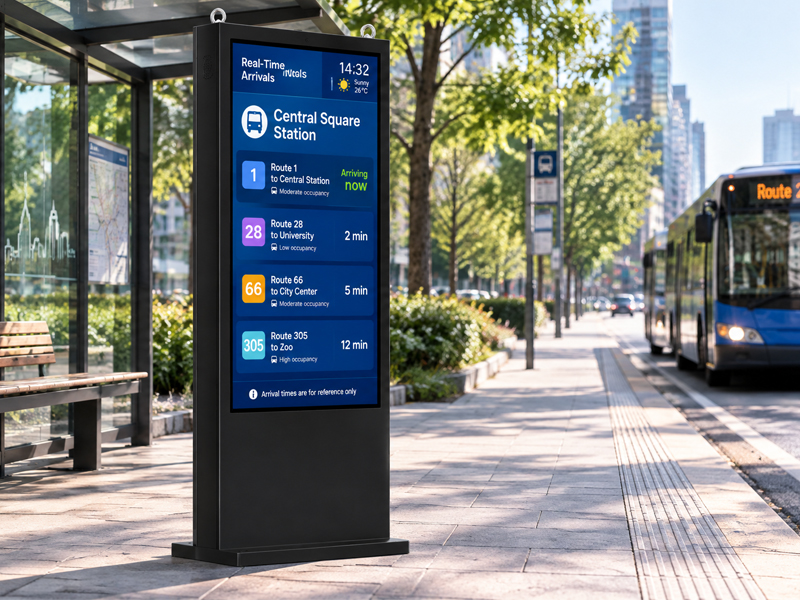
digital Signage display
Displays are capable of presenting:
- Scheduled arrival and departure times
- Designated platform numbers
- Current train operational status
- Delay notifications and advisories
- Route information and connections
Passengers are able to obtain critical updates promptly without relying on conventional verbal announcements.
2. Platform Navigation and Wayfinding Guidance
Large-scale railway stations present navigational challenges, particularly for first-time visitors.
Interactive digital signage systems can deliver:
- Directional guidance to specific platforms
- Comprehensive station layout maps
- Exit location information
- Transfer connection guidance
- Facility and amenity locations
Touchscreen information kiosks enable passengers to query routes and identify their intended destinations.
3. Emergency Notification Systems
Digital signage infrastructure serves as a dependable communication mechanism during unforeseen circumstances.
Key applications encompass:
- Emergency procedural instructions
- Service disruption notifications
- Safety alerts and warnings
- Evacuation procedures and guidance
Immediate information dissemination enhances passenger safety outcomes and strengthens operational performance metrics.
4. Advertising and Commercial Information
Train stations experience substantial passenger volumes, positioning them as premium advertising venues.
Digital signage systems can present:
- Corporate brand messaging
- Retail and promotional offers
- Information regarding local enterprises
- Announcements serving the public interest
Operators possess the capability to administer advertising content from remote locations, tailoring delivery according to geographic location and temporal scheduling.
Features of Train Station Digital Signage Displays
Enhanced Brightness for Public Environments
Transportation display systems typically necessitate superior optical clarity.
Critical specifications include:
- High-luminance display panels
- Expansive viewing angle capabilities
- Optional anti-reflective glass surfaces
For exterior platforms and access points, displays may necessitate:
- Brightness levels ranging from 1000–3000 nits
- Screens engineered for sunlight readability
- Continuous 24/7 Operational Reliability
Train stations maintain round-the-clock operations, demanding robust and dependable equipment.
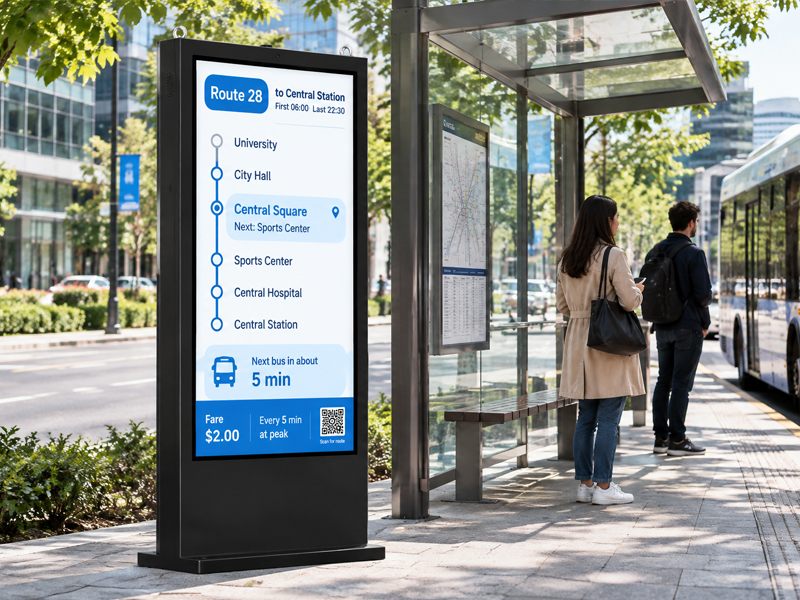
digital Signage display
Professional transportation display systems incorporate:
- Enterprise-grade component construction
- Optimized thermal management architecture
- Extended operational lifespan
- Uninterrupted operational support capabilities
Adaptable Network Connectivity Solutions
Train station display systems require dependable data transmission infrastructure.
Available connectivity mechanisms encompass:
- Ethernet connections
- Wireless networking protocols
- Fourth and fifth-generation cellular technology
Specialized industrial communication protocols:
- RS485 standard
- RS232 standard
- GPIO interfaces
These technologies facilitate seamless integration with transportation infrastructure management platforms.
Centralized Remote Content Administration
A unified content management system enables operators to oversee displays with operational efficiency.
Core operational capabilities include:
- Asynchronous content distribution and modification
- Temporal scheduling administration
- Real-time system performance monitoring
- Software version deployment and updates
- Coordinated management across multiple facility locations
Hardware Platforms for Train Station Digital Signage
Transportation applications necessitate robust and dependable embedded computing platforms.
Prevalent processors encompass:
- Rockchip RK3566
- RK3568
- RK3576
- RK3588
Facilitating:
- High-resolution video playback
- Multiple display outputs
- AI-based applications
- Industrial communication
- Operating System Options
Various transportation projects may necessitate distinct software environments.
Android
Applicable for:
- Interactive information kiosks
- Passenger service terminals
- Touchscreen applications
- Linux / Debian / Ubuntu
Applicable for:
- Custom transportation software
- Extended industrial deployment
Yocto Linux
Applicable for:
- Embedded transportation systems
- Customized platforms
- Secure applications

Advertising Digital Signage
Portworld Train Station Digital Signage Solutions
Portworld delivers tailored digital signage solutions engineered for transportation infrastructure and public information dissemination systems.
Core Capabilities:
- Enhanced brightness display configurations
- Android/Linux/Debian operating system compatibility
- RK3566/RK3568/RK3576/RK3588 processor architectures
- Ethernet/WiFi/4G network connectivity options
- Interactive touchscreen interface customization
- Environmental protection features for outdoor deployment
- Centralized remote content management system
- Proprietary motherboard engineering and development
Implementation Areas:
- Train station information display systems
- Platform-based announcement broadcasting screens
- Interactive passenger information kiosks
- Metropolitan transit information terminals
- Transportation navigation and guidance infrastructure
Original Equipment Manufacturer and Original Design Manufacturer Customization for Transportation Initiatives
Portworld delivers comprehensive customization capabilities tailored for railway and transportation applications:
Hardware Customization
- Display dimension alternatives
- Outdoor protective enclosure engineering
- High-luminosity panel incorporation
- Proprietary motherboard engineering
Software Customization
- Firmware engineering and development
- User interface personalization
- Transportation infrastructure system integration
- Distributed management software solutions
Manufacturing Support
- Prototype engineering and fabrication
- Large-scale production capabilities
- Regulatory compliance verification
- Completely Knocked Down and Semi-Knocked Down assembly solutions
Digital signage for train station announcements provides a reliable way to deliver real-time passenger information, improve navigation, and enhance transportation efficiency.
By combining high-brightness displays, powerful embedded hardware, network connectivity, and centralized management, digital signage systems help create smarter and safer railway environments.