RK3568 vs. RK3576 for Embedded Linux Development
Selecting between RK3568 and RK3576 for an embedded Linux project depends on performance needs, software support, power limits, peripheral connectivity, and long-term product goals.
- RK3568 is a well-established option for industrial HMIs, IoT gateways, embedded control systems, and Linux-based terminals.
- RK3576 features a newer architecture, higher CPU performance, more capable AI acceleration, and greater scope for advanced embedded applications.
The newest processor is not necessarily the best choice. The ideal platform is the one that satisfies your application requirements while keeping development complexity, hardware costs, and production needs manageable.
If you are developing an embedded Linux product, here is a comparison of the two platforms.
1. Hardware Architecture Comparison
| Specification | RK3568 | RK3576 |
|---|---|---|
| CPU | 4× Cortex-A55 | 4× Cortex-A72 + 4× Cortex-A53 |
| CPU frequency | Up to 2.0GHz | Up to 2.2GHz |
| CPU architecture | Quad-core ARM Cortex-A55 | Octa-core heterogeneous CPU |
| GPU | Mali-G52 | Mali-G52 MC3 |
| NPU | Up to 1 TOPS | Up to 6 TOPS |
| Memory | LPDDR4/LPDDR4X, depending on design | LPDDR4/LPDDR4X, depending on design |
| Linux support | Linux distributions, depending on BSP | Linux distributions, depending on BSP |
| Typical applications | HMI, gateways, IoT, industrial control | Edge AI, advanced HMI, robotics, smart terminals |
RK3568 focuses on balanced embedded computing performance and widely used industrial applications. RK3576 brings a more powerful CPU configuration and significantly higher AI computing capability, making it more suitable for projects with heavier workloads.
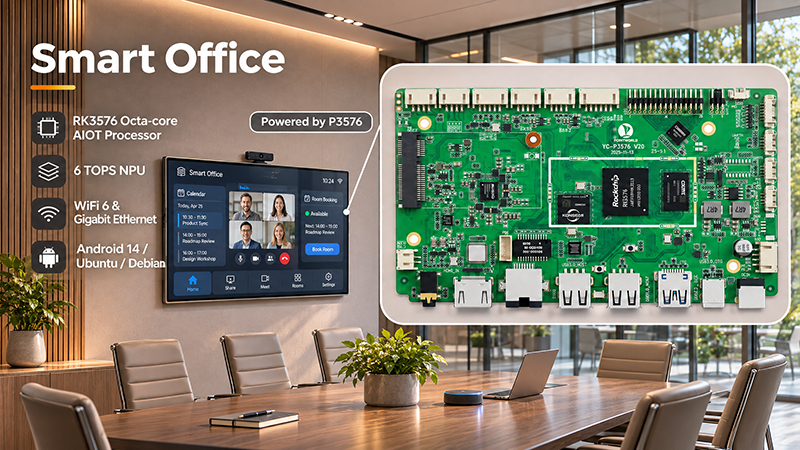
P3576 rk3576 motherboard Smart Office
2. CPU Performance: RK3568 vs. RK3576
RK3568 features four Cortex-A55 cores, making it well suited to a range of embedded Linux workloads, such as system services, lightweight graphical interfaces, communication protocols, and background control tasks.
RK3576 pairs four Cortex-A72 performance cores with four Cortex-A53 efficiency cores. This heterogeneous architecture supports more demanding computation, multitasking, and complex application workloads.
RK3568 is suitable for:
- Basic Linux applications
- Lightweight Qt or LVGL interfaces
- IoT gateways and protocol conversion
- Industrial monitoring and control
- Digital signage and embedded terminals
RK3576 is better suited to:
- Complex touchscreen interfaces
- Multiple concurrent Linux applications
- Computer vision preprocessing
- AI-enabled edge devices
- Robotics and intelligent terminals
For projects that require more intensive GUI rendering, data processing, or multiple application services, RK3576 offers greater performance headroom.
3. NPU and Edge AI Capabilities
One of the most significant differences between these two platforms is their AI processing capability.
RK3568 can support lightweight AI inference when the model, runtime, and software environment are appropriately optimized.
RK3576 provides a more capable NPU for AI applications such as object detection, image classification, and intelligent monitoring. However, actual inference performance depends on model architecture, precision, memory bandwidth, software framework, and NPU runtime optimization.
For a Linux project that may introduce AI functions later, RK3576 offers more flexibility for future upgrades.
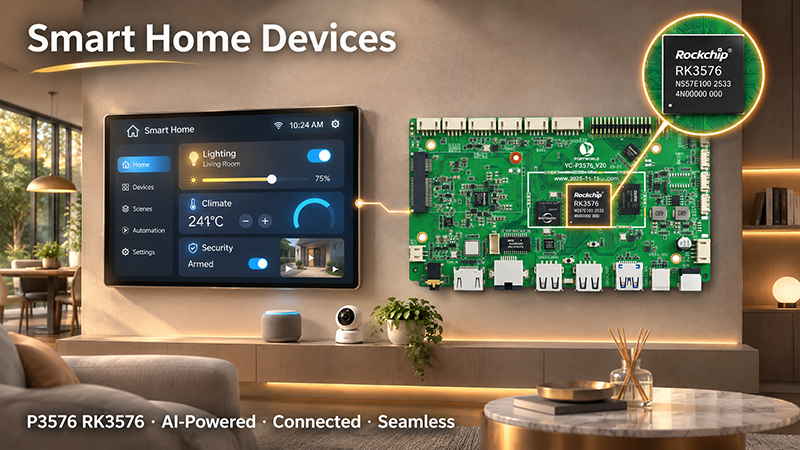
P3576 rk3576 motherboard Smart Home Devices
4. Embedded Linux Development Experience
Both platforms support embedded Linux development. However, the development experience depends largely on the BSP, kernel version, drivers, SDK, and hardware implementation.
RK3568 is commonly used in embedded Linux projects involving:
- Ubuntu and Debian systems
- Buildroot-based embedded systems
- Qt-based industrial interfaces
- LVGL applications
- USB, UART, SPI, I2C, and GPIO
- RS485 and industrial communications
- Ethernet and Wi-Fi connectivity
For projects with relatively stable hardware requirements, the RK3568 offers a practical foundation for product development.
RK3576 Linux Development
The RK3576 supports more demanding embedded computing applications, including:
- Linux-based multitasking systems
- Complex GUI applications
- Edge AI software
- Advanced multimedia applications
- Robotics and intelligent terminals
- Embedded systems with multiple interfaces
When choosing this platform, developers should also assess BSP maturity, kernel support, peripheral drivers, NPU SDK compatibility, and the quality of available documentation.
A more powerful SoC does not necessarily make Linux development easier. Reliable SDKs and hardware support can be just as important.
5. Power Consumption and Thermal Design
Power consumption is an important factor, especially for embedded products that run continuously or are installed in compact enclosures.
RK3568 is often a practical option for applications with modest CPU or AI requirements. Its relatively low computing demands can make thermal management easier in fanless designs.
RK3576 offers greater computing capability, but its higher performance potential calls for careful evaluation of:
- CPU and NPU workloads
- Power consumption during sustained operation
- Heat dissipation and enclosure design
- Power supply capacity
- Operating temperature requirements
For fanless industrial devices, test power and thermal performance under the intended workload rather than relying solely on the processor specifications.
6. Which Platform Is Better for Different Applications?
Industrial HMI and Control Panels
RK3568 is suitable for standard interfaces, equipment monitoring, control dashboards, and communication with industrial devices.
AI Vision and Intelligent Monitoring
RK3576 is more suitable for applications requiring stronger CPU processing and NPU-based inference.
IoT Gateways
RK3568 works well for protocol conversion, device connectivity, data collection, and edge communication. RK3576 is preferable when more complex processing or AI functions are required.
Robotics and Intelligent Devices
RK3576 offers more computing headroom for intelligent interfaces, sensor processing, and edge AI integration.
7. RK3568 vs. RK3576: Which One Should You Choose?
Choose the RK3568 if your project prioritizes:
- Stable embedded Linux performance
- Standard industrial interfaces
- Basic touchscreen functionality
- IoT gateways and data acquisition
- Cost-conscious embedded products
- Mature, relatively lightweight software requirements
Choose the RK3576 if your project needs:
- Greater CPU performance
- More demanding Linux applications
- Edge AI inference
- Advanced multimedia capabilities
- Robotics or intelligent terminals
- Additional computing capacity for future development
For products with long lifecycles, also evaluate software maintenance, hardware availability, SDK support, and options for future hardware customization.
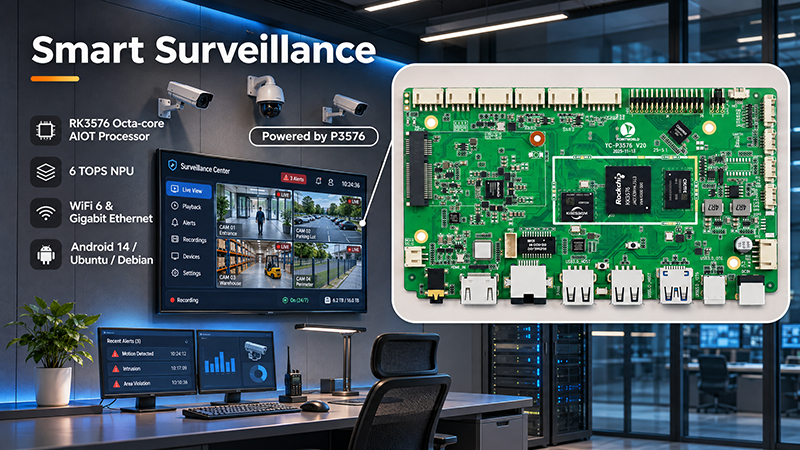
P3576 RK3576 Motherboard Smart Surveillance
8. Portworld Embedded Linux Hardware Solutions
Portworld provides Rockchip-based embedded motherboards and SoM solutions for industrial computing, smart terminals, HMI systems, IoT devices, and edge AI applications.
RK3568 Motherboard Solutions
Suitable for industrial HMI, IoT gateways, embedded Linux terminals, and communication-focused applications.
RK3576 Motherboard Solutions
Designed for more demanding computing, AI-enabled devices, smart terminals, and advanced embedded applications.
Portworld supports embedded hardware development with:
- Selection of Rockchip motherboards and systems-on-module (SoMs)
- Adaptation of Android, Ubuntu, Debian, or Buildroot, as appropriate for the hardware
- Custom PCB and PCBA design
- Integration of GPIO, UART, RS485, RS232, and other interfaces
- Display and touchscreen integration
- Hardware and software customization
- OEM/ODM development, prototyping, and production support
For projects that need to balance computing performance with hardware customization, choosing the right Rockchip platform from the outset can help minimize redesign risks and facilitate a smoother progression from prototype to mass production.
RK3568 and RK3576 are both capable embedded Linux platforms, designed to meet different performance needs.
RK3568 remains a practical choice for industrial control, IoT gateways, and standard embedded Linux products. RK3576 is better suited to projects that demand greater CPU performance, more sophisticated applications, and edge AI capabilities.
The right platform depends on your workload, interfaces, power budget, software requirements, and production plans—not merely on processor generation.