Raspberry Pi Alternatives with Better-Suited Industrial Interfaces
Raspberry Pi boards are widely used in embedded development thanks to their low cost, extensive software ecosystem, and straightforward prototyping. Yet as a project moves from the development bench into an industrial setting, the standard interfaces of a general-purpose SBC may no longer meet its needs.
Industrial applications often call for RS485, RS232, CAN, isolated I/O, dual Ethernet, PoE, broader power-input ranges, dependable display connections, and long-term hardware availability. Rather than building a Raspberry Pi-based system with several expansion boards and adapters, developers may find it more practical to select an embedded motherboard designed to support these requirements from the outset.
This article examines industrial-focused alternatives to Raspberry Pi and explains how to choose the right platform for your application.
1. Why Raspberry Pi May Not Be the Best Fit for Industrial Projects
Raspberry Pi is well suited to software development, proof-of-concept testing, education, and many commercial embedded projects. However, industrial applications may require interfaces that are not directly available on the standard board.
| Industrial Requirement | Why It Matters |
|---|---|
| RS232 / RS485 | Connect PLCs, meters, sensors, controllers and legacy devices |
| CAN / CAN FD | Communicate with vehicles, robotics, machinery and distributed controllers |
| DI / DO | Monitor switches, alarms, relays and control external equipment |
| Dual Ethernet | Separate device networks, management networks or industrial LANs |
| PoE | Simplify power and network installation |
| Wide-voltage DC input | Support industrial power sources and equipment cabinets |
| Isolation and protection | Improve electrical robustness in noisy environments |
| eMMC storage | More suitable storage options for embedded deployment |
| DIN-rail mounting | Easier installation in control cabinets |
| Extended temperature options | Better suited for demanding operating environments |
These interfaces are often essential for the final product, not optional extras. A board that requires several USB adapters, expansion HATs, external converters, and custom wiring can increase the system’s size, cost, and integration complexity.
The key consideration is not simply whether an SBC can support an interface. It is whether the interface is integrated into the hardware in a way that fits the actual application.
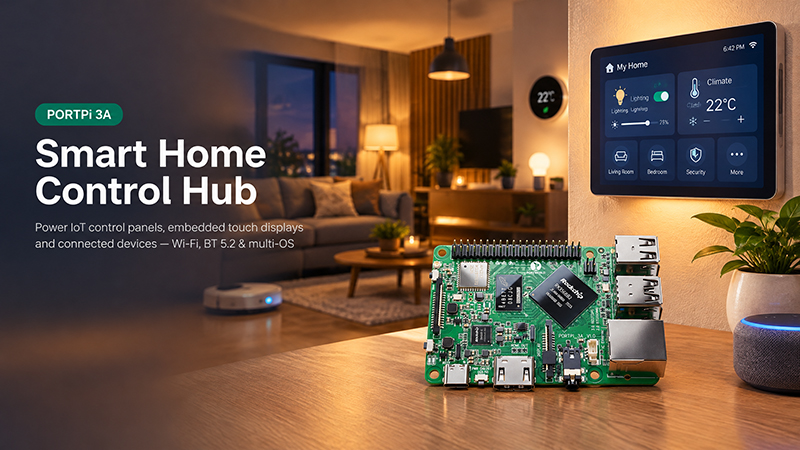
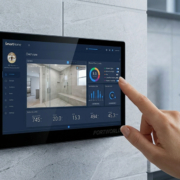
PortPi 3A smart home control hub
2. Which Industrial Interfaces Should You Consider in an Alternative?
RS232 and RS485
RS485 is widely used in industrial automation, building management, energy metering, HVAC systems, and sensor networks. RS232 remains common for equipment configuration, maintenance, and communication with legacy devices.
An industrial SBC with built-in serial ports can remove the need for USB-to-serial adapters while simplifying wiring and system integration.
When choosing a board, verify:
- The number of RS232 and RS485 ports
- Whether the ports provide electrical isolation
- The terminal-block or connector type
- Surge and ESD protection
- Hardware direction control for RS485
- Driver support in the Linux BSP
- CAN and CAN FD
CAN bus is widely used in robotics, automotive electronics, industrial machinery, motor controllers, and distributed control systems.
For projects that communicate with CAN-based devices, selecting a board with built-in CAN interfaces and a controller supported by Linux drivers can streamline development. Check CAN FD requirements separately, as not all CAN hardware supports CAN FD.
Digital Inputs and Outputs
- Industrial digital I/O enables embedded systems to communicate with external equipment.
- DI: Monitor switches, sensors, alarm signals, and equipment status.
- DO: Operate relays, indicator lights, and other external control circuits.
For industrial applications, verify the input voltage range, output current rating, electrical isolation, protective circuitry, and need for external drivers. GPIO pins alone are not suitable substitutes for industrial-voltage I/O.
Dual Ethernet and Networking
Two Ethernet ports can separate equipment and management networks, connect to different devices, or support particular network configurations.
Some industrial computers pair Gigabit Ethernet with a second Ethernet interface; others include PoE or additional networking capabilities.
Power and Mounting
Industrial applications often benefit from:
- 12V or 24V DC power input
- A wide input-voltage range
- Reverse-polarity and overvoltage protection
- A metal enclosure
- DIN-rail or wall-mounting options
- Fanless thermal design
When selecting a board for field deployment, these features can be as important as CPU performance.
3. Industrial Raspberry Pi-Based Computers
If your development team wants to preserve the Raspberry Pi software ecosystem, an industrial computer built around Raspberry Pi Compute Modules may be a compelling choice.
These systems pair Raspberry Pi computing hardware with a tailored carrier board, enclosure, and industrial connectivity.
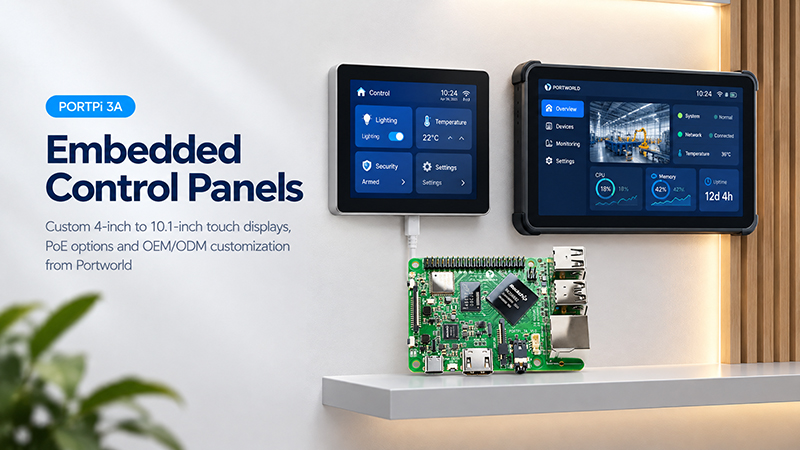
PortPi 3A single board computer
For instance, industrial computers based on Compute Modules may include:
- Multiple RS232/RS485 ports
- CAN interfaces
- Digital inputs and outputs
- Dual Ethernet
- Wide-range DC power input
- DIN-rail mounting
- RTC and watchdog functions
Some industrial CM5 systems provide several isolated serial ports, CAN, digital I/O, dual Ethernet, and support for a broad range of DC input voltages.
Advantages
- Maintain familiarity with the Raspberry Pi ecosystem
- Use existing Raspberry Pi software and development tools
- Add industrial connectivity without designing an entire board
- Minimize the need for external adapters
- Make enclosure and cabinet installation easier
- Limitations
These systems may be more expensive than standard Raspberry Pi boards because they include industrial-grade hardware, enclosures, protection circuits, and additional interfaces.
They may also remain dependent on Compute Module availability, configuration, and lifecycle planning. If your project calls for a specific combination of interfaces or extensive long-term customization, consider evaluating a Rockchip-based motherboard or a custom embedded platform.
4. Rockchip-Based SBCs and Embedded Motherboards
Rockchip-based embedded boards are another alternative for developers who need Linux computing, display interfaces, networking, and customized hardware integration.
Platforms such as RK3568 and RK3576 are used in industrial terminals, HMI systems, IoT gateways, commercial displays, and intelligent embedded devices.
RK3568: A Practical Platform for Industrial Linux
RK3568 is a quad-core Cortex-A55 processor suited to a wide range of embedded Linux applications, including:
- Industrial HMIs and touchscreen terminals
- IoT gateways and data acquisition
- Serial protocol conversion
- Equipment monitoring systems
- Smart building controllers
- Digital signage and embedded displays
For projects requiring Linux, Ethernet, USB, serial communication, display interfaces, and GPIO integration, an RK3568 motherboard can provide a practical foundation.
RK3576: Greater Computing Capacity for Advanced Applications
RK3576 combines four Cortex-A72 cores with four Cortex-A53 cores and, in supported configurations, an NPU rated at up to 6 TOPS.
It is better suited to projects that may need:
- More demanding Linux applications
- Advanced touchscreen interfaces
- AI-assisted monitoring
- Edge AI processing
- Robotics and smart terminals
- Multiple applications running concurrently
The industrial interfaces supported by an RK3568 or RK3576 board depend on its specific PCB design. Confirm the availability of RS232, RS485, CAN, DI/DO, Ethernet, PoE, and other interfaces against the motherboard’s specifications rather than assuming they are provided by the processor itself.
Industrial Rockchip-based systems are available with combinations of RS232, RS485, CAN, DI/DO, dual Ethernet, wide-voltage input, and mounting options.
5. PortPi 3A: A Customizable Embedded Linux Alternative
For developers seeking a customizable embedded Linux platform with production support, Portworld offers the PortPi 3A, built on the Rockchip RK3568 platform.
The PortPi 3A supports embedded Linux development across smart devices, industrial terminals, IoT systems, and commercial applications.
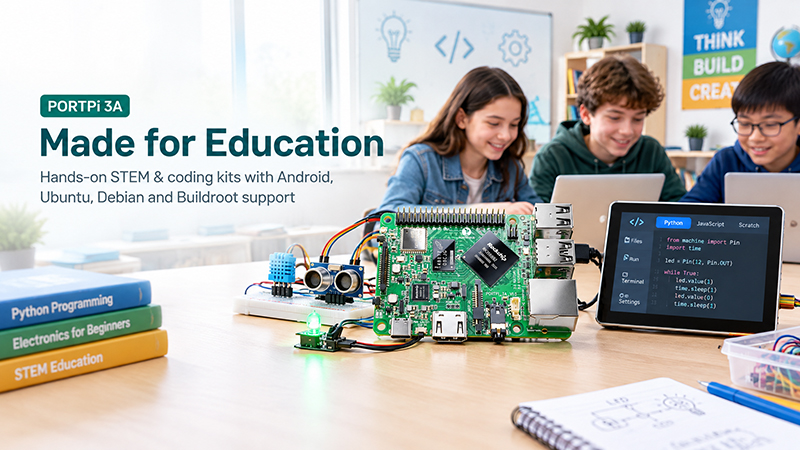
PortPi 3A
Single Board Computer
Why Consider the PortPi 3A?
- Powered by the Rockchip RK3568 platform
- Designed for embedded development with Linux
- Supports Android, Ubuntu, Debian, and Buildroot, depending on configuration
- Offers Ethernet, USB, HDMI, and wireless connectivity
- Provides flexible options for RAM, storage, and I/O customization
- Includes hardware and software customization support
- Backed by OEM/ODM development and production services
Beyond a standard development board configuration, Portworld can tailor hardware interfaces, memory and storage, software, and product integration to meet specific project requirements.
Customization for Industrial Applications
For applications that need greater industrial connectivity than a standard SBC offers, customization may include:
- RS232 and RS485 interfaces
- CAN interfaces, when supported by the design
- GPIO and application-specific I/O
- Ethernet configuration
- Power input and power-management design
- Display and touchscreen integration
- PCB layout and connector customization
- Operating system and driver adaptation
Not all PortPi 3A configurations include every interface. Confirm interface requirements during hardware selection or customization planning.
When a project needs a particular combination of serial ports, CAN, DI/DO, Ethernet, power protection, or mounting features, a customized motherboard may be a better fit than adding external expansion modules.
6. Raspberry Pi vs. Industrial Embedded Alternatives
| Feature | Standard Raspberry Pi | Industrial CM-Based Computer | Rockchip Embedded Motherboard |
|---|---|---|---|
| Development ecosystem | Raspberry Pi ecosystem | Raspberry Pi ecosystem | Rockchip Linux ecosystem |
| RS232/RS485 | Usually external expansion | Often integrated | Board-dependent / customizable |
| CAN | External expansion usually required | Available on selected models | Board-dependent / customizable |
| DI/DO | GPIO or expansion boards | Available on selected models | Board-dependent / customizable |
| Dual Ethernet | Model / expansion dependent | Available on selected models | Available on selected designs |
| PoE | Model / add-on dependent | Configuration dependent | Configuration dependent |
| Wide DC input | Typically external power solution | Available on selected models | Customizable by board |
| DIN-rail mounting | External enclosure required | Available on selected products | Customizable |
| Hardware customization | Limited | Moderate | Flexible |
| Best fit | Prototyping and general embedded development | Industrial deployment retaining Pi ecosystem | Customized embedded products and OEM/ODM |
The table represents typical platform characteristics, not guaranteed specifications for every board. Actual interface availability, isolation, power protection, operating temperature, and mounting options depend on the exact product configuration.
7. How to Choose the Right Alternative
Choose Standard Raspberry Pi
Best for software prototyping, education, lightweight embedded projects, and applications that do not require extensive industrial interfaces.
Choose an Industrial Pi-Based Computer
Best when retaining the Raspberry Pi ecosystem is important, but you need onboard serial communication, CAN, digital I/O, industrial power, or cabinet mounting.
Choose an RK3568 Embedded Platform
Best for industrial Linux terminals, IoT gateways, HMI systems, and embedded products with moderate computing requirements.
Choose an RK3576 Platform
Best for advanced HMI, AI-enabled devices, robotics, and embedded systems requiring more CPU and NPU performance.
Choose a Custom Motherboard
Best when your product requires a specific combination of industrial interfaces, power design, connectors, mechanical dimensions, and long-term production planning.
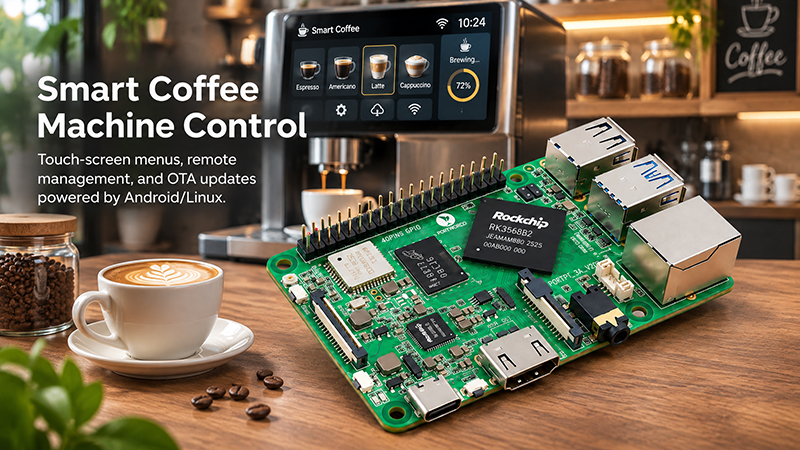
PortPi 3A – Smart Coffee Machine Control
8. From SBC Development to Industrial Product Design
A standard SBC is often a practical foundation for software development. However, when an application calls for multiple industrial interfaces, a customized power supply, a purpose-built enclosure, or a defined production lifecycle, hardware selection becomes a more significant engineering decision.
Rather than adding expansion modules to a standard SBC, developers can consider a platform with the required interfaces integrated directly into the motherboard.
Portworld offers embedded motherboard and SoM solutions based on Rockchip platforms, including RK3566, RK3568, RK3576, and RK3588. Its services also include hardware customization, PCB/PCBA development, operating system adaptation, and OEM/ODM support.
For industrial applications, the development process may include:
- 1. Interface requirements — Specify RS232, RS485, CAN, DI/DO, Ethernet, PoE, display, and other connections.
- 2. Platform selection — Select a processor and motherboard according to performance, power, software, and cost requirements.
- 3. Hardware customization — Tailor connectors, power design, PCB, I/O, and mechanical dimensions.
- 4. Linux integration — Adapt the operating system, drivers, communication protocols, and application software.
- 5. Prototype validation — Assess performance, connectivity, thermal behavior, and application stability.
- 6. Production preparation — Plan manufacturing, testing, configuration, and supply requirements.
This approach can help developers transition from a prototype based on a general-purpose SBC to a more integrated embedded product.