Matter, Zigbee, Thread, and Z-Wave: A Complete Comparison
Smart home automation involves more than smart devices and control apps. Every connected light, thermostat, door lock, motion sensor, and touchscreen panel relies on communication technology to exchange information.
Four technologies commonly used in smart home projects are Matter, Zigbee, Thread, and Z-Wave. Although they are often discussed as competing protocols, they do not all perform the same technical role.
Matter establishes a shared application-layer standard for device interoperability. Thread, Zigbee, and Z-Wave use distinct methods for wireless communication and networking. Understanding these differences is essential when designing a smart home system, choosing compatible devices, or developing a custom control panel.
This guide compares the four technologies and outlines how to select the right option for different smart home applications.
1. Understanding Four Smart Home Technologies
Before assessing their performance, it is helpful to understand the function of each technology.
Matter: A Shared Language for Smart Home Devices
Matter is an open connectivity standard for smart homes, developed by the Connectivity Standards Alliance (CSA). Its main objective is to enhance interoperability among devices made by different manufacturers and used within different smart home ecosystems.
Rather than requiring manufacturers to create separate integrations for each platform, Matter establishes a standardized method for compatible devices to communicate.
Matter uses IP-based networking technologies, including:
- Wi-Fi
- Ethernet
- Thread
Bluetooth Low Energy (BLE) is generally used to commission devices and complete initial setup, rather than for regular Matter communication.
For instance, a Matter-compatible lighting controller can connect with a compatible smart home platform through a standardized interface, reducing reliance on separate proprietary integrations.
Matter is especially relevant to manufacturers of smart switches, lighting products, thermostats, door locks, sensors, and smart home controllers.
Zigbee: A Mature, Low-Power Mesh Network
Zigbee is a wireless communication protocol developed for low-power Internet of Things (IoT) applications.
It is widely used in smart lights, motion and temperature sensors, wireless switches, and other home automation products.
Zigbee typically operates in the 2.4 GHz frequency band and uses IEEE 802.15.4 radio technology. Its mesh networking capability enables compatible, powered devices to relay messages among network nodes.
A typical Zigbee network has three device roles:
- Coordinator: Creates and manages the Zigbee network.
- Router: Forwards messages and expands network coverage.
- End Device: Communicates through its parent device and is often battery-powered.
Zigbee is well suited to projects that involve numerous low-power devices and benefit from a mature device ecosystem.
However, Zigbee devices do not communicate directly with Matter devices by default. Integration generally requires a compatible bridge or gateway.
YC-SM43P ESP32 4″ Smart Touch Panel
Thread: A Low-Power Mesh Network Based on IPv6
Thread is a low-power wireless mesh networking technology built on the IEEE 802.15.4 standard.
Unlike Zigbee, Thread relies on IPv6 networking. As a result, Thread devices can communicate within IP-based networks without needing a proprietary application-layer communication stack such as Zigbee’s.
Thread is intended for connected devices that require dependable communication while using little power.
Its key features include:
- IPv6-based communication
- Low-power wireless networking
- Mesh topology
- Self-healing network capabilities
- Support for battery-powered devices
- Integration with Matter
A Thread Border Router links a Thread network to other IP networks, including Wi-Fi and Ethernet.
Importantly, Thread does not define the smart home application language on its own. Matter can run over Thread and specify how compatible devices exchange commands and data.
Z-Wave: A Wireless Technology Designed for Home Automation
Z-Wave is a low-power wireless communication technology created specifically for smart homes and residential automation.
Unlike Zigbee and Thread, which typically rely on 2.4 GHz IEEE 802.15.4 radios, Z-Wave uses regional sub-GHz frequency bands.
This can make Z-Wave advantageous in settings where interference on the 2.4 GHz band is a concern.
Common Z-Wave applications include:
- Door locks
- Security sensors
- Smart switches
- Thermostats
- Lighting controllers
- Residential automation systems
Z-Wave also supports mesh networking, enabling compatible, powered devices to relay messages throughout the network.
When developing products for international markets, manufacturers must account for regional frequency requirements and Z-Wave’s dedicated controller architecture.
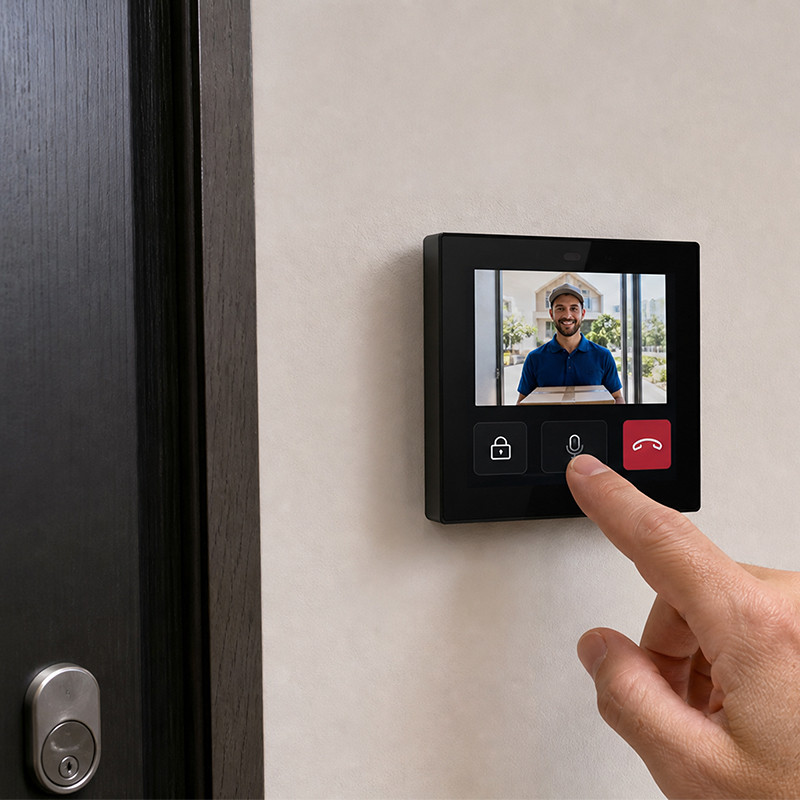
YC-SM43P ESP32 4″ Smart Touch Panel
2. Matter vs. Zigbee vs. Thread vs. Z-Wave: Key Differences
The following table provides a practical overview of the four technologies.
| Comparison | Matter | Zigbee | Thread | Z-Wave |
|---|---|---|---|---|
| Technology type | Application-layer standard | Wireless protocol stack | IP-based mesh networking | Wireless protocol stack |
| Frequency | Depends on transport | Commonly 2.4 GHz | 2.4 GHz | Regional sub-GHz |
| Network | IP over Wi-Fi, Ethernet or Thread | Mesh | IPv6 mesh | Mesh |
| Power consumption | Depends on transport and device | Low | Very low | Low |
| IP connectivity | Yes | Not natively | Yes | Not natively |
| Gateway requirement | Matter controller; Thread Border Router for Thread devices | Zigbee coordinator or gateway | Thread Border Router for external IP connectivity | Z-Wave controller or hub |
| Battery-powered devices | Supported, depending on device type | Supported | Particularly suitable | Supported |
| Device interoperability | Standardized Matter compatibility | Depends on Zigbee compatibility and profiles | Depends on application layer | Depends on Z-Wave certification and device support |
| Typical applications | Smart home devices across ecosystems | Lighting, switches, sensors | Sensors, locks, Matter devices | Security, locks, switches, sensors |
One important point: Matter does not have its own radio frequency. Its communication performance depends on whether a device uses Wi-Fi, Ethernet, or Thread.
Similarly, a Matter-over-Thread device has different networking characteristics from a Matter-over-Wi-Fi device.
3. Communication Architecture: How Does It Work?
Understanding network architecture is often more useful than comparing protocol names.
Matter: Standardized Communication Across IP Networks
Matter relies on IP networking so compatible smart home devices and controllers can communicate.
A typical setup includes:
- Matter-over-Wi-Fi devices connected to the home wireless network.
- Matter-over-Ethernet devices connected through a wired network.
- Matter-over-Thread devices communicating through a Thread mesh network.
- A Matter controller that manages compatible devices and automation functions.
This architecture enables different types of devices to operate within a shared smart home environment.
Matter also offers multi-admin functionality, allowing compatible devices to be shared across multiple smart home platforms.
Zigbee: Coordinator-Based Mesh Networking
Zigbee networks rely on a coordinator to create and manage the network.
Mains-powered devices, including smart plugs and lighting controllers, may serve as routers. Battery-powered sensors generally function as end devices to conserve energy.
In larger homes, adding appropriate Zigbee routers can extend coverage and improve communication reliability.
Network planning remains important. Performance can be influenced by coordinator placement, radio interference, device compatibility, and building materials.
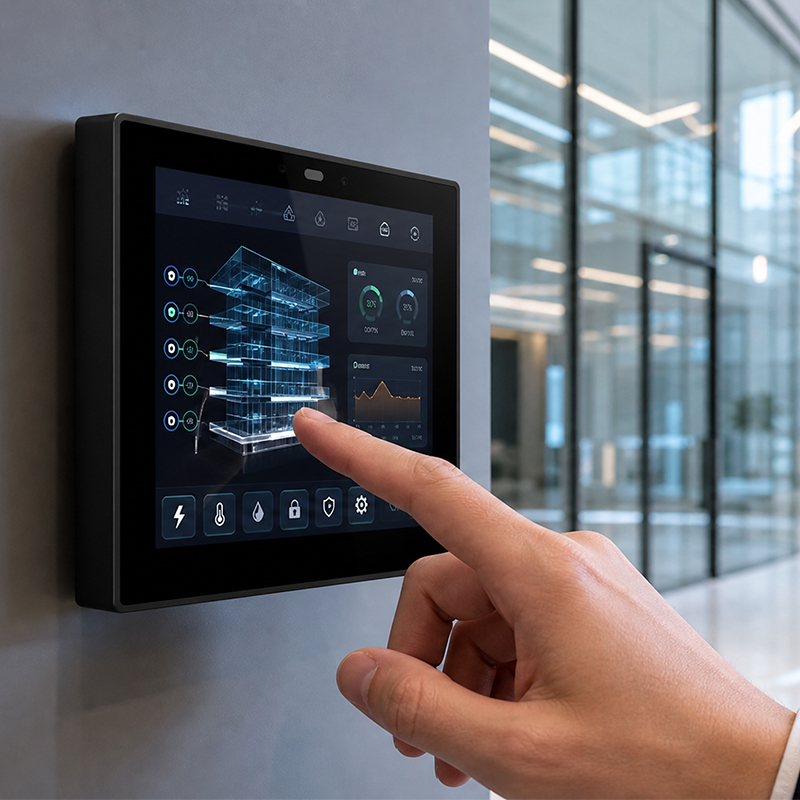
YC-SM43P ESP32 4″ Smart Touch Panel
Thread: Distributed IP-Based Mesh Networking
Thread uses a mesh architecture that allows compatible powered devices to act as routers.
A Border Router links the Thread network to the broader IP network.
Unlike a conventional Zigbee coordinator, a Thread Border Router does not have to translate every application message between separate networking protocols. Instead, it provides IP connectivity between networks.
This makes Thread especially well suited to Matter-based smart home systems.
Z-Wave: Dedicated Mesh Networking
A controller manages devices across a Z-Wave network.
Compatible, mains-powered devices can relay messages, extending coverage throughout a building.
Operating in sub-GHz frequency bands, Z-Wave avoids direct competition with many commonly used 2.4 GHz Wi-Fi devices.
Actual communication range, however, depends on the regional frequency, antenna design, installation environment, building materials, and network configuration.
4. Power Consumption: Which Protocol Is Better for Battery-Powered Devices?
Power consumption is an important factor when developing wireless sensors, smart locks, and other products designed to run for long periods without frequent battery changes.
Both Zigbee and Thread are designed for low-power IoT applications. Their sleep and communication mechanisms make them suitable for battery-powered sensors.
Z-Wave also supports low-power, battery-operated products, including security sensors and door locks.
Matter does not, by itself, determine a device’s power consumption. The underlying transport and the device’s implementation have a greater influence.
For example:
- Matter over Thread is suitable for low-power sensors and smart locks.
- Matter over Wi-Fi is better suited to devices with adequate power and existing Wi-Fi connectivity.
- Zigbee is a practical choice for battery-powered sensors in established Zigbee installations.
- Z-Wave is worth considering for battery-powered security and residential automation devices.
When developing a new smart home product, engineers should assess standby power, communication frequency, sleep modes, battery capacity, and firmware optimization instead of choosing a protocol based on its name alone.
5. Compatibility: Can These Four Technologies Work Together?
Integrating devices that rely on different communication technologies is one of the main challenges in smart home projects.
These four technologies are not inherently interchangeable.
Matter and Thread
Matter can operate directly over Thread, pairing a standardized application layer with a low-power IPv6 mesh network.
For instance, a Thread-based door sensor that supports Matter can communicate with a Matter controller over the Thread network.
Matter and Zigbee
Matter and Zigbee do not communicate directly.
However, a compatible Matter bridge can make supported Zigbee devices available within a Matter ecosystem.
This enables existing Zigbee lights, switches, and sensors to work as part of a wider smart home setup without requiring every device to be replaced.
Matter and Z-Wave
Compatible bridges can also connect Z-Wave devices to a Matter ecosystem.
The bridge translates supported device functions for use in the Matter environment.
This option is useful for projects with an established Z-Wave network that are seeking to add Matter compatibility.
Zigbee and Thread
Both technologies typically use IEEE 802.15.4 radios in the 2.4 GHz band, but they rely on different network protocols.
Using the same radio technology does not enable Zigbee and Thread devices to communicate directly.
A dedicated bridge or gateway is required to connect the two networks.
For system integrators, this distinction matters: radio compatibility does not guarantee protocol compatibility.
6. Typical Applications: Which Technology Should You Choose?
No single protocol is the best choice for every smart home application. The right option depends on the device type, power needs, existing infrastructure, and integration objectives.
Smart Lighting Systems
Smart lighting setups often contain numerous switches, bulbs, dimmers, and lighting controllers.
Zigbee is a well-established choice for extensive lighting networks. Matter offers a standardized method of integrating compatible lighting products with supported platforms.
For new, low-power lighting controls, Matter over Thread is also worth evaluating.
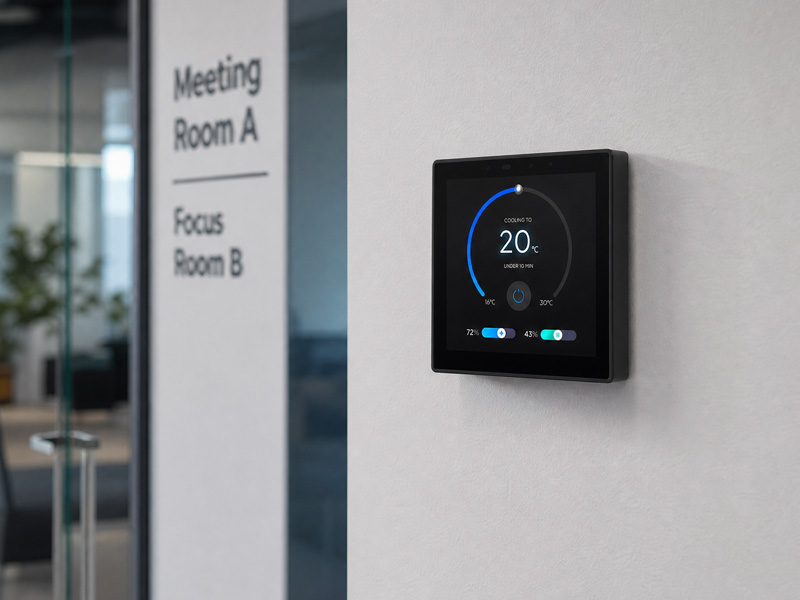
smart home control panel
Smart Sensors and Environmental Monitoring
Temperature and humidity sensors, motion detectors, and door sensors generally send relatively small amounts of data.
Low-power mesh networking suits these applications, particularly when long battery life is a priority.
Thread is especially appealing when a project also calls for IP-based integration through Matter.
Smart Door Locks and Security Systems
Door locks and security sensors depend on dependable connectivity and thoughtful power management.
Z-Wave has a well-established role in residential security. Zigbee and Matter over Thread also support relevant device categories.
The final choice should account for certification, security implementation, compatibility with local controllers, and product availability in the region.
Multi-Room Smart Home Control
Large smart homes may need multiple touchscreen panels, gateways, wireless sensors, lighting controllers, and HVAC systems.
A practical system design may include:
- A central automation controller to manage devices.
- Zigbee or Z-Wave gateways to support existing wireless devices.
- Thread Border Routers for Thread-enabled devices.
- Matter to standardize communication among supported IP-connected devices.
- Ethernet or Wi-Fi connectivity for touchscreen control panels.
This hybrid design enables different technologies to work together without requiring every device to use the same wireless network.
7. How Smart Home Control Panels Work with These Protocols
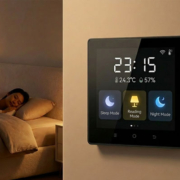
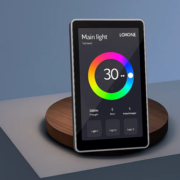
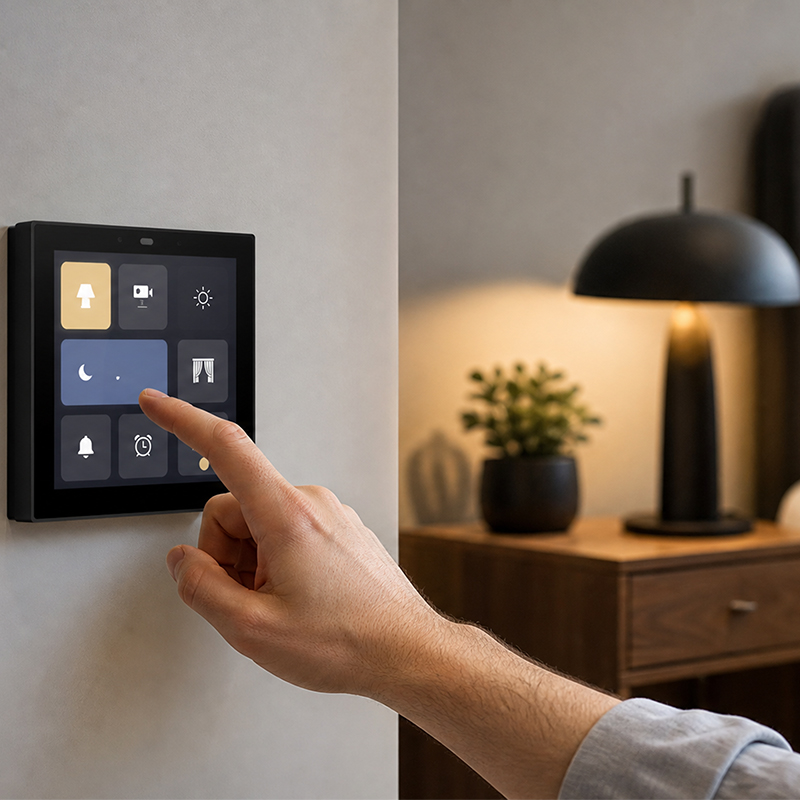
A smart home control panel serves as the user-facing interface for an automation system. It enables homeowners to monitor and manage lighting, curtains, air conditioning, security systems, and other connected devices.
However, a touchscreen panel does not inherently support Matter, Zigbee, Thread, or Z-Wave merely because it provides Wi-Fi, Ethernet, or RS485 connectivity.
Its protocol capabilities are determined by its processor, wireless radio, communication interfaces, firmware, operating system, and gateway architecture.
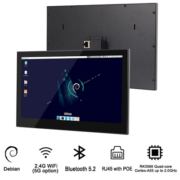
For example, Portworld provides various hardware platforms for smart home control applications.
YC-SM41P: ARM-Based Smart Home Control Panel
The YC-SM41P is built on an RK3566 platform and features a 4-inch touchscreen with a resolution of 480 × 480.
Depending on its configuration, it supports Android or Linux-based software development and offers interfaces such as Ethernet, PoE, and RS485.
It can function as a touchscreen interface for smart home automation systems, with custom software linking it to compatible controllers and gateways.
For Zigbee-based projects, an external Zigbee gateway or an appropriate integrated radio architecture is necessary, unless the selected hardware configuration explicitly includes Zigbee functionality.
YC-SM41P-KNX: Smart Home Panel with KNX Integration
The YC-SM41P-KNX is intended for smart home applications that integrate KNX with a Zigbee gateway.
Powered by the RK3566 platform, it features a touchscreen for controlling and monitoring connected building automation systems.
In projects that combine KNX, Zigbee, and IP-based automation, the system architecture should specify how the panel communicates with each gateway or controller.
The available KNX and Zigbee functions depend on the chosen hardware and software configuration.
YC-SM43P: ESP32-S3 Smart Home Control Panel
The YC-SM43P is a smart home control panel built on the ESP32-S3 platform, featuring a 4-inch, 480 × 480 touchscreen.
Its hardware platform includes:
- ESP32-S3 dual-core processor
- 8 MB PSRAM and 16 MB Flash
- LVGL graphical interface framework
- Wi-Fi and Bluetooth connectivity
- Ethernet and PoE options
- RS485 interface
The platform is suited to custom embedded control interfaces, sensor monitoring, and communication with external automation systems.
For instance, developers can add MQTT communication, Modbus integration, or customized Home Assistant connectivity through appropriate firmware and software development.
One important technical limitation is that the ESP32-S3 has no native IEEE 802.15.4 radio. Consequently, it cannot function as a standalone Zigbee or Thread device unless additional radio hardware and a suitable software architecture are provided.
For manufacturers creating smart home control panels, Portworld offers support with hardware customization, PCB and PCBA development, firmware adaptation, UI/UX design, and OEM/ODM production.
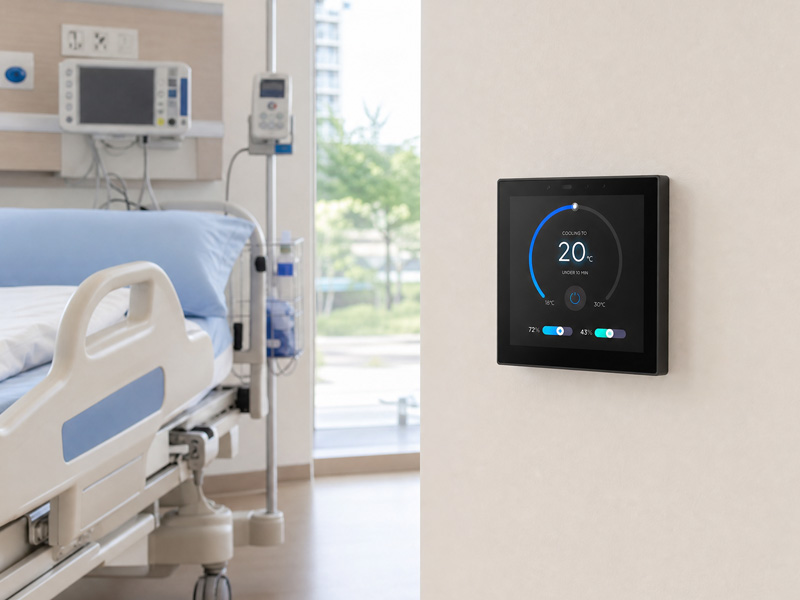
smart home control panel-1
8. How to Select the Right Protocol for Your Smart Home Project
When choosing a communication technology, take the following factors into account.
1. Identify device requirements
Establish whether the product is a sensor, lighting controller, smart lock, touchscreen panel, or central gateway. Each device type has distinct bandwidth and power needs.
2. Assess the existing ecosystem
If a project already includes numerous Zigbee or Z-Wave devices, replacing the entire network may be impractical. A compatible gateway or bridge can support a gradual transition.
3. Account for battery life
For battery-powered products, assess sleep modes, transmission frequency, and support for low-power networking. Thread and Zigbee are especially relevant options for these devices.
4. Plan for network coverage
Take into consideration the building’s size, wall materials, interference, device locations, and mesh-routing capabilities. Avoid relying solely on theoretical radio range.
5. Verify platform compatibility
Ensure the chosen devices work with the intended smart home controller and that their required functions are properly supported.
6. Allow for future customization
For manufacturers creating their own smart home products, protocol selection should also account for processor capabilities, wireless modules, software development tools, certification, and ongoing maintenance.
9. Can a Smart Home System Use Multiple Protocols?
Yes. Using several communication technologies is often a practical solution for larger smart home installations.
For example, a residential automation system might use:
- Matter over Thread for battery-powered sensors and smart locks.
- Zigbee for existing lights and wireless switches.
- Z-Wave for compatible security devices.
- Matter over Wi-Fi for selected powered appliances and controllers.
- Ethernet or PoE for fixed touchscreen panels.
A central automation platform can coordinate these devices using compatible integrations, gateways, and bridges.
The key is to design the communication architecture correctly. Each network requires compatible infrastructure or a controller, and the central system must be able to exchange commands and status information across the different networks.
For OEM manufacturers and system integrators, this approach offers opportunities to create customized control panels and gateways that unite different communication technologies under a single user interface.