
How to Design an RS232 to RS485 Level Converter Circuit for Industrial Embedded Systems
In contemporary industrial automation and embedded computing systems, RS232 and RS485 remain prevalent communication standards. Nevertheless, the majority of smart devices, industrial touch panels, and IoT gateways necessitate dependable long-distance and multi-node communication, thereby rendering RS232 to RS485 level conversion circuits indispensable.
This article elucidates the process of designing an RS232 to RS485 converter circuit and how this design is incorporated into Portworld embedded industrial control panels, smart HMI systems, and AIoT solutions.
1. The Significance of RS232 to RS485 Conversion in AIoT Systems
RS232 is commonly utilized in legacy systems, whereas RS485 is the standard for industrial networking.
Limitations of RS232:
- Point-to-point communication only
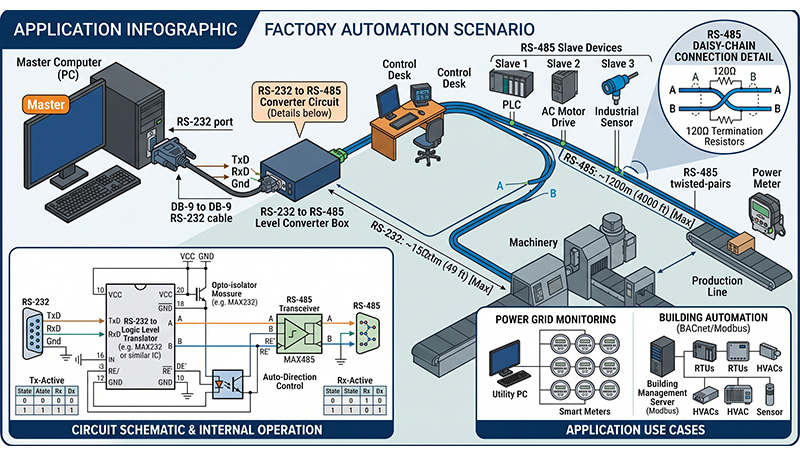
- Limited distance (~15 meters)
- Inadequate noise immunity
Advantages of RS485:
- Multi-device networking (supporting over 32 nodes)
- Extended distance capability up to 1200 meters
- Robust anti-interference through differential signaling
In practical industrial applications, RS232 devices continue to be in use, while RS485 is essential for system scalability.
This is why converter circuits are vital in:
- Smart factories
- Energy monitoring systems
- Building automation
- Embedded HMI control panels
industrial automation
2. Fundamental Structure of RS232 to RS485 Converter Circuit
A typical configuration consists of three main functional components:
(1) RS232 Level Conversion Stage
IC: MAX232
Transforms ± voltage RS232 signals into TTL logic (0–5V)
(2) Logic Interface Stage
UART TX/RX interface
Optional MCU control (Arduino / STM32 / RK platform GPIO)
(3) RS485 Differential Driver Stage
IC: MAX485 / SP3485
Converts TTL signals to differential A/B signals
3. Essential Circuit Design Block Diagram
RS232 Device → MAX232 → MCU/UART → MAX485 → RS485 Bus (A/B lines)
Additional necessary components:
120Ω termination resistor (to ensure stability over long distances)
Pull-up / pull-down resistors (for fail-safe biasing)
TVS diode (for ESD and surge protection)
Optional optocoupler isolation (for industrial-grade design)
4. Direction Control (Crucial for RS485 Design)
RS485 operates in half-duplex mode, necessitating direction switching:
DE (Driver Enable)
RE (Receiver Enable)
Typical control logic:
TX mode: DE = HIGH, RE = HIGH
RX mode: DE = LOW, RE = LOW
In sophisticated embedded systems, this is managed automatically through:
MCU GPIO control
Hardware auto-direction chips
5. Industrial Design Considerations
For effective industrial implementation, the circuit should incorporate:
Isolation Design
- Optical isolation or digital isolators
- Prevents damage from ground loops
Surge Protection
- TVS diodes for protection against lightning/ESD
- Particularly critical in factory settings
Stable PCB Layout
- Short routing for differential pairs (A/B)
- Separation of ground planes
Cable Requirements
- Twisted pair RS485 cables
- Shielded wiring for environments with EMI
6. How Portworld Integrates RS232 / RS485 in Embedded Systems
In contrast to standalone converter modules, contemporary industrial systems necessitate a cohesive communication architecture.
Portworld offers embedded hardware platforms that inherently support RS232/RS485 expansion, which includes:
Smart Control Panels (HMI Systems)
Portworld’s industrial touch panels are compatible with:
- RS232 for debugging legacy devices
- RS485 for building automation networks
- Modbus RTU integration
Example applications include:
- Smart home control panels
- Hotel room automation systems
- Centralized HVAC control
Industrial Embedded Motherboards
Portworld’s embedded platforms (RK3566 / RK3588 / Intel-based) are capable of:
- Directly interfacing with RS485 transceivers
- Operating Linux / Android control systems
- Facilitating edge AI and industrial communication
This capability negates the necessity for external converter boards in numerous designs.
AIoT Gateway & Edge Computing Devices
Portworld systems can function as:
- Bridges for RS232 legacy devices
- Collectors of RS485 industrial data
- Gateways for Modbus RTU to cloud data
With:
- MQTT integration
- Cloud connectivity
- Edge AI processing
7. Example Application: Smart Building + RS485 Network
A typical solution based on Portworld would involve:
RS232 legacy meter → MAX232 conversion
An RS485 bus connecting:
- Lighting systems
- HVAC controllers
- Security sensors
The Portworld HMI panel serves as:
- A central control user interface
- A data visualization terminal
- An IoT gateway to the cloud
8. Advanced Upgrade: From Converter to Full Embedded System
Rather than merely constructing a converter circuit, modern designs progress into:
RS232/RS485 + Embedded Linux/Android + AI Edge Computing System
This is where Portworld platforms excel:
- RK3588 AI computing capabilities
- Multi-interface industrial I/O
- Custom OEM/ODM hardware design
- BSP/SDK software support
Creating an RS232 to RS485 converter circuit transcends simple level shifting—it forms the bedrock of industrial communication systems.
Nevertheless, in contemporary AIoT applications, the prevailing trend is integration:
- Embedded control panels
- Industrial gateways
- Edge

