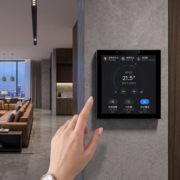
Design of wired whole-house smart lighting control system based on RS485 bus
As smart homes and building automation technologies advance, dependable lighting control has emerged as a fundamental necessity in residential, hotel, and commercial projects. Among various communication technologies, the RS485 bus-based wired whole-house smart lighting control system stands out as one of the most stable and commonly utilized solutions for professional installations.
In comparison to wireless systems, RS485 provides robust anti-interference capabilities, long-distance communication, and exceptional reliability—rendering it particularly suitable for structured smart lighting control in extensive environments.
What Is an RS485-Based Smart Lighting Control System?
An RS485-based smart lighting control system constitutes a wired communication network that links lighting controllers, switches, sensors, and central control panels via a shared bus line.
Rather than managing lights on an individual basis, all devices interact through a centralized protocol, facilitating:
- Group lighting control
- Scene-based automation
- Centralized scheduling
- Real-time status feedback
- Multi-zone lighting management
This architecture is extensively employed in professional smart building initiatives.
Why RS485 Is Used in Whole-House Lighting Control
RS485 is a robust industrial communication standard designed for long-distance and noise-resistant data transmission.
It is widely adopted in smart lighting systems because of its key advantages:
- Stable communication over long cable distances (up to 1200 meters)
- Strong resistance to electromagnetic interference
- Support for multi-device networking (multi-drop topology)
- Low cost and simple wiring structure
- High reliability in industrial and building environments
These features make RS485 particularly suitable for villas, hotels, and commercial buildings.
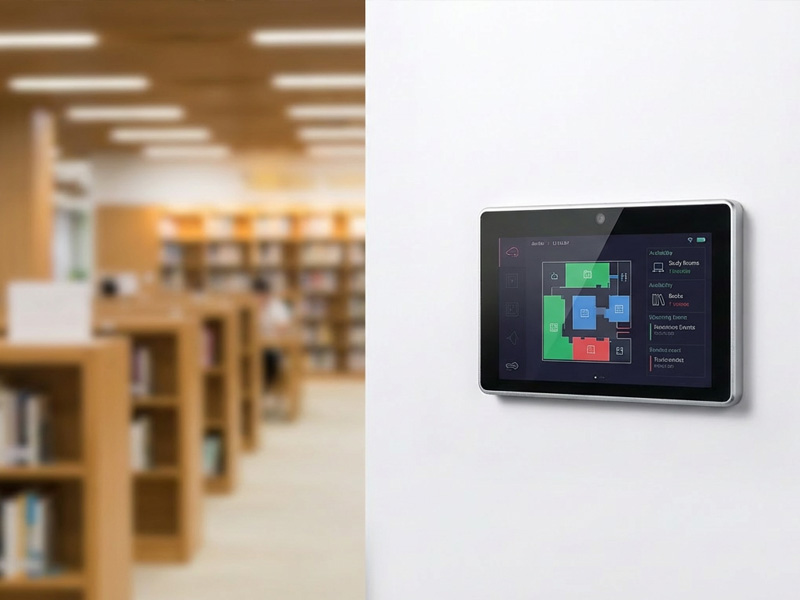
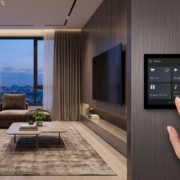
smart home control panel
System Architecture of RS485 Smart Lighting Control
A typical whole-house lighting control system based on RS485 includes several key components.
At the core is a central control panel or gateway, which sends commands to lighting controllers across the RS485 bus.
Connected devices include:
- Wall-mounted smart control panels
- Relay modules and dimming modules
- Lighting switches
- Motion and brightness sensors
- Power distribution units
The RS485 bus forms a daisy-chain network structure, ensuring stable and efficient communication across all devices.
Role of Smart Control Panels in RS485 Lighting Systems
Smart control panels act as the human-machine interface (HMI) of the lighting system.
They allow users to:
- Turn lights on/off by zone or room
- Adjust brightness levels
- Activate preset lighting scenes
- Schedule automatic lighting control
- Monitor system status in real time
Modern control panels often feature Android or Linux operating systems, enabling rich UI design and integration with other smart home systems.
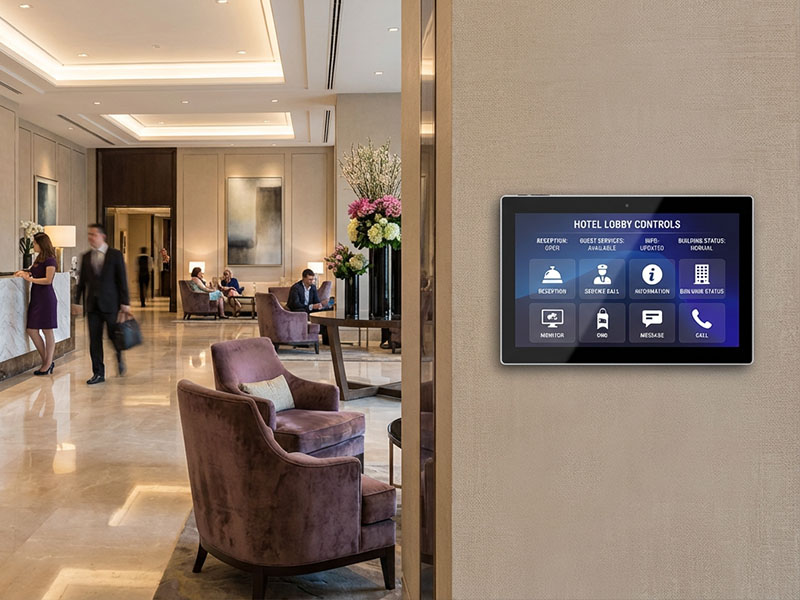
YC-SM10P
10.1 inch Smart Home Control Panel
Lighting Scene and Automation Design
One of the key advantages of RS485-based systems is advanced scene control.
Lighting scenes allow multiple lights to be controlled simultaneously based on predefined settings.
Common examples include:
- “Home Mode” for comfortable evening lighting
- “Away Mode” for energy saving
- “Meeting Mode” for office environments
- “Cinema Mode” for entertainment spaces
Automation can also be triggered by time schedules, sensors, or external events.
Integration with Smart Building Systems
RS485 lighting systems are often integrated into broader smart building platforms.
They can work alongside:
- HVAC control systems
- Curtain and shading automation
- Security and access control systems
- Energy management platforms
- IoT monitoring systems
This integration allows full building automation from a unified control interface.
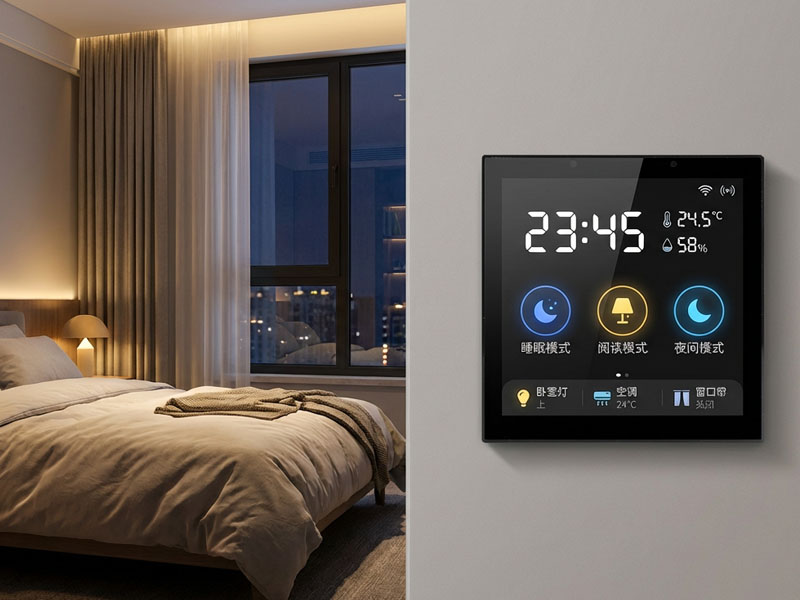
4″ KNX Smart Touch Control Panel
Advantages Over Wireless Lighting Systems
While wireless systems like Zigbee or WiFi are popular in consumer smart homes, RS485 offers superior performance in professional environments.
Key advantages include:
- Higher stability and lower failure rate
- No dependency on wireless signal strength
- Better scalability for large buildings
- Stronger resistance to interference
- Easier maintenance in structured wiring systems
For critical infrastructure, RS485 remains the preferred choice.
Hardware Requirements for RS485 Lighting Systems
A well-designed RS485 lighting system requires industrial-grade hardware, including:
- RS485-enabled smart control panels
- Relay and dimming control modules
- Stable power supply systems
- Shielded twisted-pair communication cables
- Embedded controllers with real-time processing capability
Smart control panels often support additional interfaces such as Ethernet, WiFi, or KNX for extended functionality.
Applications of RS485 Smart Lighting Control
RS485-based lighting systems are widely used in:
Luxury villas with multi-zone lighting control Smart hotels for centralized guest room lighting management Office buildings with scene-based lighting automation Commercial complexes requiring energy-efficient lighting Industrial facilities with structured lighting control systems
In each case, RS485 ensures stable and predictable system behavior.
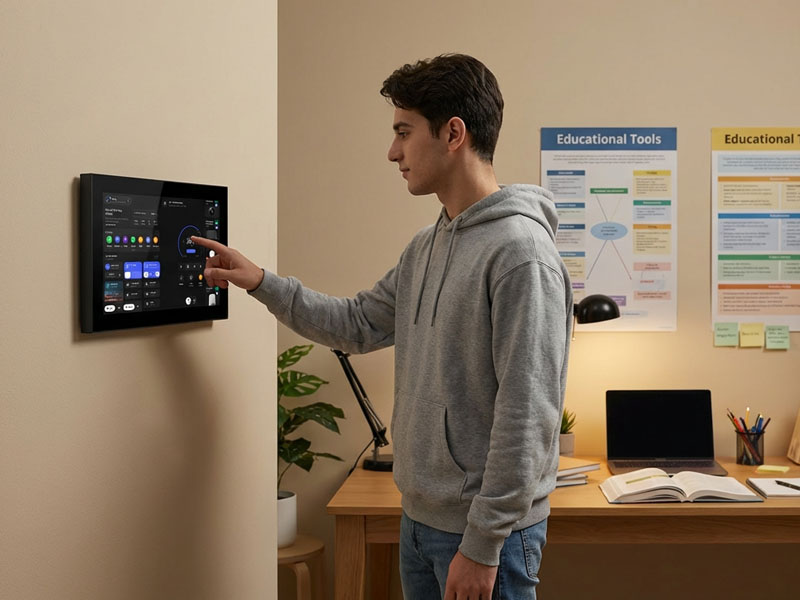
10 inch smart home control panel
Portworld RS485 Smart Lighting Control Solutions
In real-world deployments, manufacturers such as Portworld provide smart control panel solutions designed for RS485-based lighting automation systems.
These solutions typically include:
Android and Linux-based smart control panels with RS485 interface support Embedded wall-mounted designs for whole-house lighting control Integration with relay and dimming modules for lighting automation OEM/ODM customization for hardware, software, and UI design Compatibility with KNX, MQTT, and smart building systems
Portworld solutions are widely used in smart homes, hotels, and commercial automation projects.
OEM/ODM Customization for Lighting Control Projects
Every lighting automation project has unique requirements, especially in large-scale installations.
Portworld offers OEM/ODM services including:
Hardware customization such as panel size, interface configuration, and enclosure design Software customization for lighting control UI and automation logic Protocol integration including RS485, KNX, and IoT communication Branding and system-level customization for commercial deployment
This ensures that each system can be tailored to specific architectural and engineering requirements.