How Does an Industrial Touchscreen Monitor Factory Ensure Product Quality?
Industrial touchscreen monitors are extensively utilized in factory automation, machine control systems, self-service kiosks, industrial inspection systems, and comparable applications demanding dependable human-machine communication. In contrast to standard consumer displays, industrial monitors frequently must accommodate extended operational periods, continuous touch interactions, and challenging environmental conditions.
For manufacturers and system integrators, selecting an appropriate production facility requires consideration beyond display specifications and acquisition costs. Product excellence is determined by component sourcing, mechanical architecture, production methodologies, comprehensive testing protocols, and the manufacturer’s capacity to ensure uniformity throughout successive production runs.
Component Sourcing and Mechanical Architecture
Quality assurance commences prior to the manufacturing phase. The LCD display panel, touch-sensing technology, processing circuitry, connection interfaces, electrical supply systems, and protective housing collectively determine the finished product’s operational capabilities and long-term dependability.
A proficient industrial touchscreen monitor manufacturing facility procures components aligned with the specific application’s operational demands. For instance, equipment deployed in high-illumination factory settings may necessitate enhanced brightness capabilities, whereas a monitor incorporated into machinery enclosures may require specialized mounting configurations, port arrangements, or protective housing specifications.
Mechanical architecture similarly influences heat dissipation efficiency, power supply stability, and structural resilience. These considerations warrant thorough examination during the design phase rather than deferral to post-production quality verification.
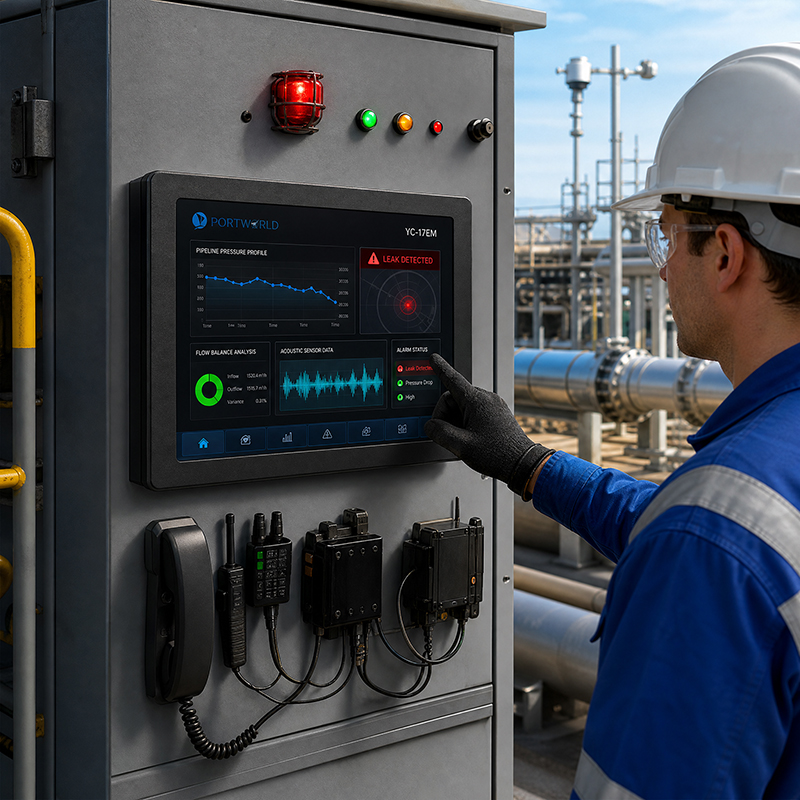
industrial touch screen
Assembly Control and Functional Testing
Industrial touchscreen monitors require numerous assembly operations, encompassing display incorporation, touch panel attachment, control circuit board configuration, connector integration, housing assembly, and system calibration. Deficient assembly practices may result in complications including inconsistent touch responsiveness, compromised connector integrity, visual imperfections, and structural misalignment.
A dependable manufacturing facility implements quality assurance checkpoints at strategic intervals throughout the production workflow. Display assessment procedures can validate visual output, luminosity levels, and surface irregularities in accordance with predetermined quality standards. Touch functionality assessment evaluates response precision and uniform performance across the entire interactive display region. Power and communication testing confirms appropriate voltage supply, data transmission reliability, and operational compatibility with the designated end-use system.
Supplementary evaluations should be determined based on the product’s technical requirements. Contingent upon the intended use case, these may encompass prolonged performance evaluation, thermal stress assessment, mechanical shock resistance testing, or radiofrequency interference compliance verification.
Environmental Protection and Reliability Validation
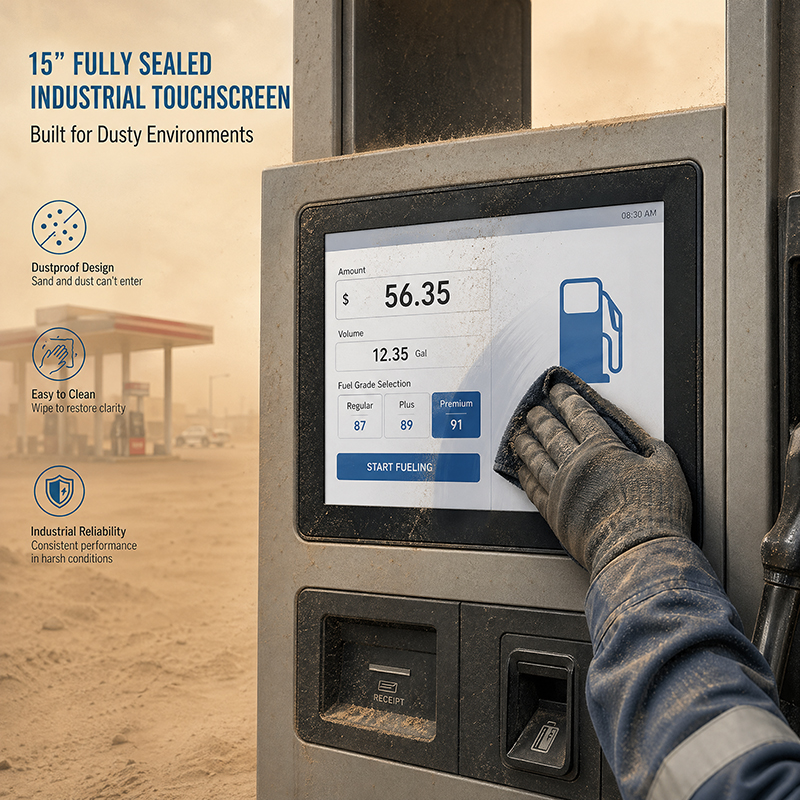
Industrial monitors frequently function in challenging environments characterized by dust, moisture, elevated temperatures, or mechanical vibration. Consequently, manufacturers are obligated to assess enclosure construction, protective sealing mechanisms, thermal regulation systems, and the appropriateness of selected components relative to anticipated operational conditions.
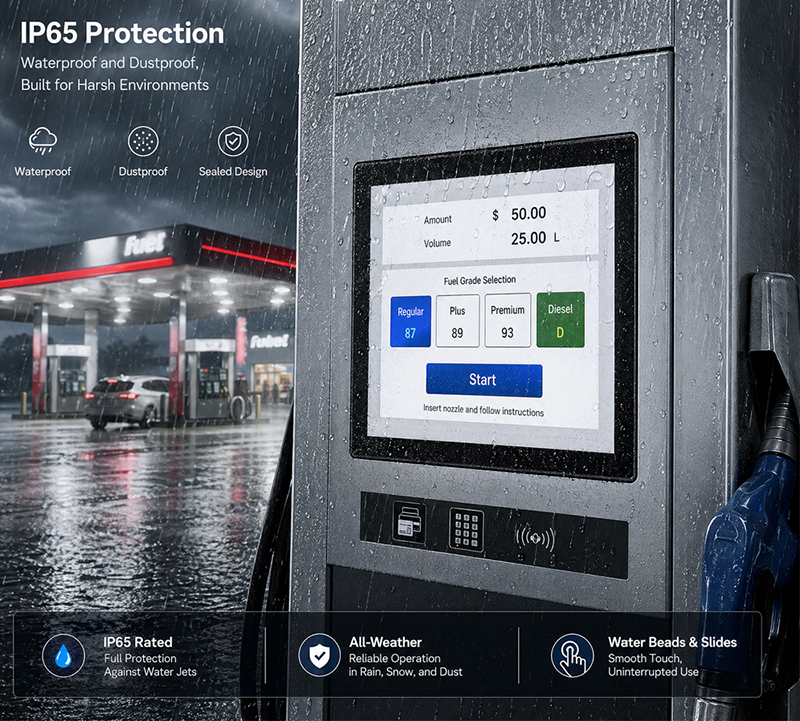
Consider a scenario in which a project mandates IP65 protection certification on the front panel; in such cases, both the design methodology and assembly procedures must be engineered to satisfy this particular specification, and rigorous testing protocols must substantiate the stated protection classification. Although a metal enclosure or fanless configuration may present operational benefits, neither approach independently ensures adequate environmental safeguarding or sustained dependability.
For original equipment manufacturer initiatives, clients should establish the permissible temperature operating range, preferred installation techniques, anticipated operational intensity, and necessary environmental validation procedures prior to authorizing production-scale implementation.

Industrial Panel PCs
Portworld’s Contribution to Industrial Touchscreen Initiatives
Portworld functions as a comprehensive provider of touchscreen and embedded hardware solutions, specializing in industrial touch display systems, embedded touch panel computing devices, digital display signage, and purpose-built electronic hardware assemblies. The organization’s comprehensive product range accommodates diverse project requirements, spanning from independent industrial display units to sophisticated integrated solutions that merge touchscreen technology with embedded computational capabilities.
Industrial touchscreen monitors: Portworld provides embedded monitor solutions including the YC-15EBT, YC-185EBT, and YC-215EBT models, which accommodate various display dimensions suitable for industrial equipment and embedded display requirements. The YC-104EM, YC-17EM, and YC-215EM product series offer supplementary alternatives for applications demanding embedded touchscreen technology or an integrated industrial panel PC. Detailed specifications and configuration options should be verified for each individual model.
Industrial panel PCs and embedded tablets: When projects necessitate both display and computational capabilities, Portworld delivers solutions such as the YC-15EM industrial panel PC, YC-215EM industrial embedded PC, and YC-102EB embedded PoE Android tablet. Based on the chosen configuration, these offerings can facilitate industrial HMI, machine operation, equipment monitoring, and comparable interactive functionalities.
Industrial mini PCs and IoT boxes: Certain applications require the touchscreen to interface with an independent computing platform. Portworld’s industrial computing ecosystem encompasses the YC-I720, YC-T620, YC-T621, and YC-T720U. These systems merit consideration for industrial control, edge computing, and equipment integration applications, contingent upon the requisite processor, operating system, and interface specifications.
Embedded motherboards and system-on-modules: Portworld, alongside its PortPi product line, supplies embedded computing components, encompassing the YC-P3566, YC-P3576, YC-P6802, and YC-Core3588 platforms. These offerings prove valuable when an equipment manufacturer seeks to engineer a proprietary touchscreen terminal, industrial controller, or comprehensive embedded system rather than procure a standalone monitor.
Embedded Touch Screen Panel
What OEM and ODM Services Are Offered by Portworld?
Product quality is significantly determined by the extent to which a manufacturing facility customizes its design and production methodologies to align with customer specifications. Portworld delivers comprehensive OEM/ODM services to organizations requiring bespoke touchscreen solutions or specialized embedded hardware systems.
Display and mechanical customization: Modify screen dimensions, housing configuration, attachment methodology, substrate composition, and visual design to accommodate the operational setting and apparatus specifications.
Hardware development: Facilitate PCB and PCBA architecture, embedded system board creation, part procurement, connection setup, and component amalgamation.
Operating system and software support: Deliver customization services for Android, Linux, Ubuntu, Debian, and Windows platforms, supplemented by BSP, SDK, firmware, and application deployment assistance as required for the designated operating environment.
Interface and connectivity customization: Establish communication protocols and connection standards in accordance with project specifications, with technical feasibility validated through comprehensive engineering assessment.
Branding and product configuration: Facilitate customization including trademark application, product designation, packaging design, and pre-loaded application installation for OEM initiatives.
Prototype verification and mass production: Facilitate the complete manufacturing lifecycle encompassing specification validation, prototype assessment, limited-quantity manufacturing, and large-scale production.
CKD/SKD solutions: Deliver complete-knock-down or semi-knock-down production frameworks for undertakings necessitating component-level or partial assembly coupled with regional customization.
These services enable customers to align the display technology, embedded hardware, operating system, and mechanical design through collaboration with a single engineering and manufacturing partner. The precise scope is contingent upon the product specifications, project requirements, and the mutually established development strategy.
Embedded Touch Screen Panel23
How Buyers Can Verify Factory Quality
When assessing an industrial touchscreen monitor manufacturing facility, buyers should request substantive documentation beyond general quality assurance statements. Obtain the detailed product specifications, approved prototypes, inspection methodologies, pertinent test documentation, and relevant certification records. Furthermore, it is advisable to examine the factory’s procedures for managing component replacements, manufacturing modifications, defective product handling, and subsequent orders.
For bespoke projects, prototype validation holds particular significance. Prior to initiating full-scale production, both parties must validate display functionality, tactile responsiveness, mechanical tolerances, interface integration, operational parameters, and requisite environmental safeguards. The manufacturing facility should subsequently employ the validated specifications as the reference standard for production execution and quality verification.