How Can a Digital Signage Display Factory Support Custom Hardware and Software Integration?
Digital signage technology has advanced considerably beyond conventional advertising displays. Contemporary commercial display systems are now frequently integrated with content management platforms, enterprise software, Internet of Things devices, sensors, and industrial automation systems. Consequently, numerous initiatives necessitate purpose-built hardware and software solutions rather than standard displays with predetermined specifications.
For organizations manufacturing proprietary digital signage solutions, partnering with a digital signage display manufacturer possessing comprehensive hardware and software development expertise can streamline the entire undertaking. From selecting the central processing unit and engineering the circuit board to tailoring the operating system and incorporating external applications, a proficient manufacturing collaborator can facilitate the conversion of particular project specifications into a fully functional, market-ready product.
Portworld delivers digital signage hardware, embedded computing solutions, and OEM/ODM customization offerings for commercial and industrial sectors, assisting clients throughout the product development lifecycle to manufacturing completion.
1. Specialized Hardware Engineering for Diverse Digital Signage Applications
Hardware integration constitutes the fundamental framework of a customized digital signage infrastructure. Display dimensions, computational capacity, output connections, telecommunications capabilities, supplementary equipment, and mounting techniques all significantly impact the ultimate product architecture.
A conventional content player may suffice for elementary advertising materials; however, interactive information stations, industrial display terminals, and networked facility management systems frequently demand supplementary elements or specialized circuit board configurations.
Portworld facilitates digital signage initiatives with varying display dimensions, touch-sensitive screen options, specialized microprocessors, data transmission protocols, and housing configurations. Based on specific use cases, clients may choose hardware architectures utilizing Rockchip microprocessors including RK3566, RK3568, RK3576, and RK3588.
Custom hardware development encompasses PCB and PCBA design, motherboard customization, touchscreen integration, and the incorporation of peripherals including cameras, speakers, NFC/RFID readers, and external sensors. Communication interfaces such as USB, Ethernet, UART, RS232, RS485, and GPIO can be assessed based on the selected platform.
This adaptability enables organizations to create products tailored to their specific applications rather than modifying their operational processes to accommodate the constraints of commercially available displays.
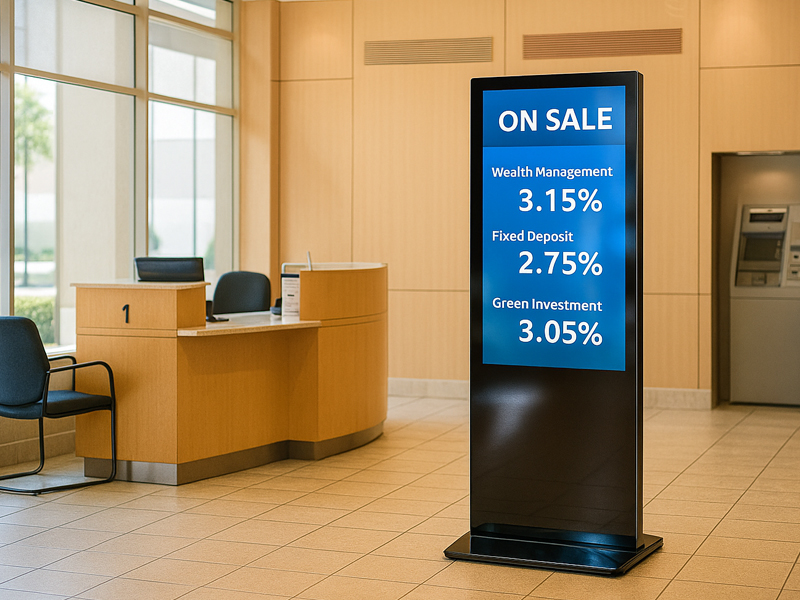
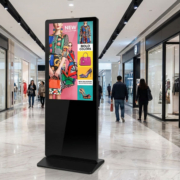
Floor Standing Digital Signage
2. Software Integration Beyond Basic Content Playback
Digital signage displays require software that bridges the hardware with the intended business application. Depending on the project scope, this may encompass an operating system, a content playback application, a remote device management agent, and communication services for external systems.
A digital signage manufacturer possessing embedded software capabilities can facilitate the configuration of these components for optimal integration.
Portworld facilitates Android and Linux-based customization, offering alternatives such as Debian or other embedded Linux distributions where compatible with the selected hardware platform. Software development and integration may encompass firmware customization, branded launchers, automatic application startup, driver integration, application deployment, and third-party CMS integration.
For instance, an organization may require a display to activate automatically, establish connection to its designated content server, download scheduled media, and resume playback without requiring manual intervention. A customized software image can be engineered to support this operational workflow, minimizing extraneous system functions and streamlining operation.
For projects demanding a more restricted embedded environment, developers may also assess Buildroot or Yocto Linux, contingent upon processor compatibility, available drivers, and project specifications.
3. Integration of Hardware and Software Components in Practical Implementations
The advantages of integrated development become increasingly apparent when digital signage systems are deployed across diverse commercial and industrial settings.
Retail Environments and Commercial Shopping Facilities
Retailers deploy digital signage systems for marketing initiatives, product details, interactive product catalogs, and consumer interaction. Certain implementations require touch-enabled displays, whereas others incorporate imaging technology, near-field communication readers, optical scanning devices, or motion detection sensors.
As an illustration, an interactive product showcase may require customer interaction detection, retrieval of product specifications from a central database, and delivery of customized information via a touch-enabled display interface.
Portworld offers customization of display equipment, accessory interfaces, Android/Linux operating systems, and content management system connectivity based on project requirements. Retail organizations may additionally request personalized screen dimensions, custom user interface designs, protective housing configurations, and system setups suitable for multi-location retail operations.

Digital Signage Display
Airports, Train Stations, and Public Transportation Information Systems
Airports, railway facilities, underground transit systems, and coach terminals depend on digital display technology to communicate timetables, transit routes, operational updates, and navigation assistance.
These installations may require network connectivity via Ethernet or wireless protocols, autonomous initialization, centralized system oversight, and connection with passenger communication infrastructure. Installations in outdoor or partially exposed conditions may additionally demand enhanced display luminosity, suitable protective housing, and climate performance verification.
A tailored digital signage implementation can integrate appropriate display technology with applications that obtain information from the client’s communication infrastructure and renders it according to specified formatting requirements.
Portworld delivers commercial-grade display solutions and equipment customization for transportation infrastructure initiatives, with specific configurations established according to the deployment context and infrastructure integration specifications.
Medical institutions and healthcare delivery systems utilize digital signage technology for managing patient queues, directing patients through facilities, displaying appointment schedules, and facilitating internal organizational communication. Interactive display terminals may additionally offer self-service capabilities or establish connections with hospital management information systems.
These implementations may necessitate touchscreen interfaces, audio output systems, imaging devices, connectivity infrastructure, and purpose-built software aligned with specific operational workflows. The compatibility between hardware components and software applications must be evaluated comprehensively, particularly when the display system interfaces with established hospital infrastructure.
Portworld provides support for bespoke touchscreen terminal solutions and integrated display systems featuring application-specific user interfaces and customized software implementations. For installations handling confidential patient information, security protocols, encrypted data transmission, and information protection standards should be established and verified as integral components of the comprehensive system architecture.
Intelligent Building Infrastructure and Conference Space Control Systems
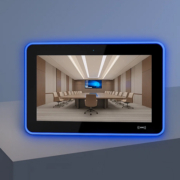
Within corporate offices, hospitality establishments, and commercial properties, digital signage functions as a conference room scheduling panel, guest information interface, occupancy status indicator, or facility management control system.
These systems may require data synchronization with calendar management platforms, security systems, or automated building control infrastructure. Depending on implementation specifications, data exchange may utilize Ethernet connectivity, wireless networking, RS485 serial communication, Modbus protocols, MQTT messaging, BACnet standards, or additional supported communication methods.
Portworld delivers customization of integrated display hardware and software to accommodate these integration specifications. Organizations can define display dimensions, installation configurations, interactive touch capabilities, communication interfaces, and customized visual designs to align with their facility management systems.
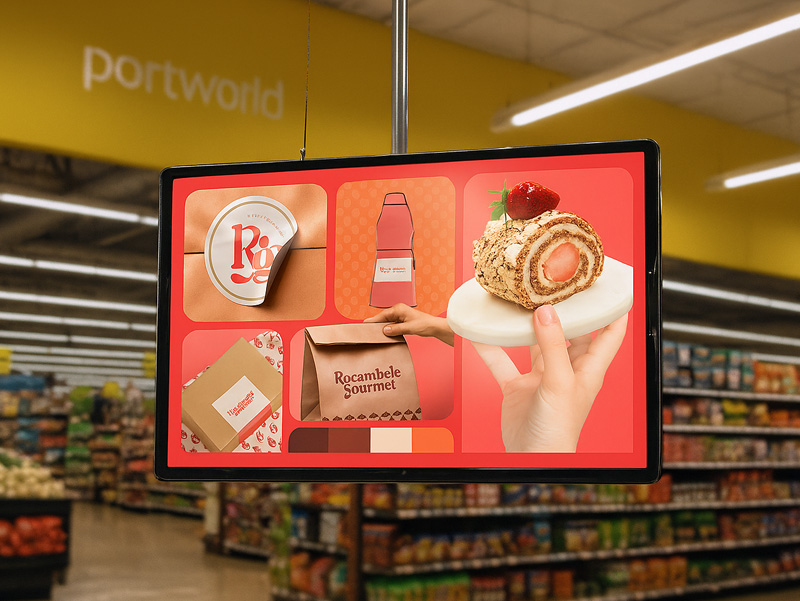
ultra thin hanging advertising screen
Factories and Warehouses
Industrial facilities employ digital displays to communicate production advancement, inventory levels, equipment specifications, logistics information, and operational directives.
Distinct from conventional advertising displays, these systems frequently require integration with industrial controllers, sensors, gateways, or manufacturing software platforms. Consequently, interfaces including RS232, RS485, UART, and GPIO represent critical considerations when evaluating hardware platform selection.
Portworld’s embedded motherboard and digital signage solutions offer configurable options for industrial information displays and connected terminals. Depending on specific application requirements, the software may integrate local display capabilities with data sourced from external systems via supported communication interfaces.
Processor selection, operating system choice, enclosure design, and connectivity specifications should be determined based on performance demands and environmental conditions relevant to the installation.
4. Integration of Motherboards, Operating Systems, and Peripheral Devices
A primary challenge in custom digital signage implementation involves verifying that all hardware components function appropriately with the designated software.
A touchscreen controller, for instance, may necessitate a compatible driver. A camera may depend on supported interfaces and multimedia libraries. An industrial peripheral may require particular serial communication configuration parameters. The operating system must additionally support the selected processor, graphics output capabilities, audio functionality, network connectivity, and storage solutions.
Consequently, hardware and software integration should commence during the design phase rather than following finalization of the display hardware.
Portworld facilitates embedded hardware development and software customization utilizing platforms such as RK3566, RK3568, RK3576, and RK3588. The optimal platform selection depends on the application’s computational requirements, video resolution specifications, graphics capabilities, available interfaces, and software ecosystem compatibility.
For projects requiring a customized motherboard, engineering teams have the opportunity to collectively assess processor specifications, memory capacity, storage solutions, connector types, power supply requirements, and peripheral needs. This comprehensive evaluation approach can effectively minimize compatibility challenges and establish a more robust and maintainable hardware infrastructure for subsequent production phases.
Nevertheless, critical functionalities including hardware-based video decoding, GPU acceleration capabilities, secure boot functionality, and extended software support timelines must be thoroughly validated for both the selected motherboard and the corresponding software environment.
5. Customization for Branding, Device Management, and Deployment
For distributors, system integrators, and brand proprietors, product customization frequently encompasses considerations beyond technical performance. The display interface may require a branded initialization screen, a proprietary user interface, a distinctive physical housing, or a tailored methodology for application installation and system updates.
A digital signage display manufacturing facility can orchestrate these specifications across hardware engineering, embedded software development, and production processes.
Portworld’s OEM/ODM service offerings can encompass:
Hardware customization: PCB/PCBA engineering, motherboard selection or modification, display integration, and accessory interfaces.
Operating system customization: Android/Linux configuration management, firmware modifications, automated application initialization, and compatible driver deployment.
UI and branding: Proprietary application launchers, branded initialization screens, corporate identifiers, and housing design specifications.
System integration: Content management system connectivity, third-party software integration, and supported IoT or industrial communication protocols.
Manufacturing support: Prototype fabrication, quality assurance validation, specialized packaging solutions, and production execution for approved specifications.
For extensive deployments, remote administration capabilities and software distribution mechanisms should be incorporated into the planning phase. A well-architected system may facilitate remote system diagnostics, application distribution, configuration administration, and system restoration protocols, contingent upon the selected management infrastructure and deployment methodology.
6. Why Select a Digital Signage Manufacturer Featuring Consolidated Research, Development, and Production Capabilities?
When hardware design, embedded software development, and manufacturing operations are distributed among multiple independent suppliers, integration challenges frequently result in extended development cycles and complex diagnostic procedures. A manufacturing facility with consolidated research and development capabilities can coordinate these functions with greater efficiency and conduct comprehensive system evaluation prior to initiating mass production.
Portworld integrates digital signage manufacturing with specialized embedded hardware and software customization services to facilitate commercial and industrial OEM/ODM initiatives. Drawing upon more than 18 years of OEM/ODM expertise, the organization collaborates with clients in the development of advertising display players, interactive touchscreen systems, embedded processing boards, and purpose-built digital signage solutions.
The development methodology typically commences with the specification of the intended application, display technical parameters, computational processor specifications, connectivity interfaces, operating system selection, and software feature requirements. Following the determination of the hardware and software framework, the comprehensive solution undergoes development and rigorous testing before transitioning to production phase.
This methodology proves especially advantageous for clients requiring a product customized to their proprietary brand identity, software infrastructure, or sector-specific requirements rather than acquiring a standard display unit with restricted customization capabilities.
A digital signage display manufacturing facility can facilitate custom hardware and software integration through the combination of embedded hardware development, operating system customization, peripheral integration, application development, and manufacturing support.
For retail, transportation, healthcare, smart buildings, and industrial environments, this comprehensive integration strategy enables organizations to engineer displays that seamlessly interface with their existing infrastructure and fulfill their distinct operational requirements.
Utilizing digital signage hardware, embedded motherboard solutions, and OEM/ODM services, Portworld assists clients in transitioning from initial project specifications to fully customized display solutions. Whether the objective involves creating an interactive advertising platform, establishing a connected information kiosk, or deploying an industrial display system, the appropriate integration of hardware and software components is fundamental to achieving a dependable, scalable implementation.