Digital Signage Display Hardware with RS232 CMS Control
In the realm of commercial AV (Audio-Visual) systems, contemporary digital signage displays significantly depend on cloud-based Content Management Systems (CMS) through Wi-Fi or Ethernet to deliver video loops and image carousels. Nevertheless, network-based control presents a notable limitation: it solely governs the software layer. It is incapable of powering a monitor on or off, switching physical video inputs, or diagnosing hardware issues if the operating system becomes unresponsive.
For environments where mission-critical operations are essential—such as airport terminals, hospital directories, command centers, and corporate lobbies—enterprise networks necessitate a more resilient solution. This is where the integration of industrial digital signage display hardware with RS232 CMS control becomes vital.
What is RS232 Control in Digital Signage?
RS232 (Recommended Standard 232) is a traditional, highly secure, point-to-point serial communication protocol. While consumer televisions depend entirely on infrared (IR) remotes or standard HDMI-CEC, commercial-grade digital signage displays are equipped with dedicated RS232 serial ports (typically via a DB9 connector or a 3.5mm mini-jack).
When combined with a commercial CMS media player or a centralized control processor (such as Crestron, Extron, or an industrial PC), RS232 enables the transmission of strings of hex or ASCII commands directly to the display’s internal microcontrollers.

Digital Signage display
The Necessity of RS232 Hardware in Enterprise CMS Deployments
1. Hardware-Level Power Management (True Automation)
Network-based CMS software can place an Android or Windows media player into a “sleep” mode; however, it frequently leaves the LCD backlight panel powered, resulting in a blank or glowing black screen. By utilizing RS232 commands, the central CMS controller can issue a direct POWER OFF or POWER ON command to the display panel’s hardware. This significantly lowers energy expenses during non-operational hours, mitigates screen burn-in, and prolongs the backlight’s lifespan beyond 50,000 hours.
2. High-Reliability Failover and Auto-Switching
In the event that an outdoor kiosk or lobby display loses its internet connection, conventional network software control fails. RS232, being a hardwired serial connection that operates independently of the local area network (LAN), remains fully functional. Should the primary CMS media player fail, a central controller can utilize RS232 to promptly switch the display hardware’s input source from HDMI 1 to a backup local media player on HDMI 2 or a USB loop.
3. Remote Hardware Diagnostics and Telemetry
In contrast to basic monitors that solely receive data, RS232 facilitates bi-directional communication. A sophisticated CMS controller can query the digital signage hardware in real-time to retrieve essential operational telemetry, which includes:
Internal panel temperature sensors (vital for outdoor or recessed wall installations).
Active video sync detection (verifying that a signal is indeed being displayed).
Backlight fault or power supply error codes.
| Environment | Deployment Style | Core RS232 Benefit |
| Command Centers & Corporate Lobbies | Multi-screen Video Walls / Large Panels | Synchronized one-touch power toggling for dozens of screens simultaneously without network lag or IR remote interference. |
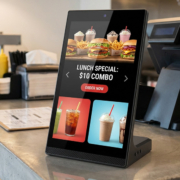
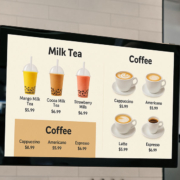
| Quick Service Restaurants (QSR) | Digital Menu Boards | Automatic morning wake-up and evening shutdown synchronized precisely with local store operating hours. |
| Transportation Hubs (Airports/Subways) | Flight and Train Timetables | Immediate hardware input switching to emergency broadcast channels if the network CMS platform fails. |
| Smart Buildings & Lifts | Wall-Mounted Signage | Direct integration with central building automation hardware (BMS) via serial-to-IP gateways. |
Selecting the Appropriate Hardware Architecture
When implementing commercial-grade displays, the significance of hardware engineering cannot be overstated. Enterprise project managers frequently turn to specialized OEM/ODM manufacturers such as Portworld (Sunworld Technology Limited), which boasts nearly twenty years of expertise in developing embedded systems and digital signage solutions.
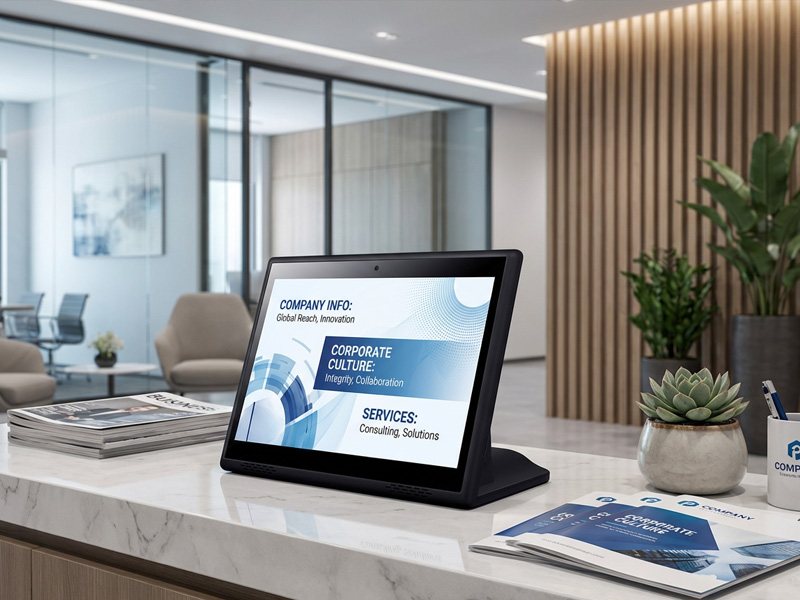
L-Shape Feedback Android Tablet
When acquiring hardware with RS232 functionality, it is essential to consider the following two primary hardware design approaches:
A. The “All-In-One” Smart Display
Displays such as Portworld’s YC-55MT Series Metal Case Wall-Mount Displays amalgamate the computing hardware and commercial panel into a singular unit. These devices incorporate robust industrial processors (like the Rockchip RK3566 or RK3588 operating on Android/Linux) along with a comprehensive I/O array. For installations that necessitate hardwired control, it is advisable to specify a customized mainboard that includes a dedicated serial interface in addition to standard RJ45 and USB ports, thereby enabling the operation of local CMS applications while ensuring external hardware control over the device.
B. Ultra-Wide Stretched & Bar Monitors
In confined areas such as supermarket shelf edges, elevator headers, or transit corridors, specialized Stretched Bar Monitors are extensively utilized. Premium bar displays are equipped with multi-port interface panels that offer dedicated serial control lines alongside their native 1920*290 ultra-wide resolution configurations, facilitating the seamless integration of unique architectural designs into standard facility automation networks.

Wall-Mounted Digital Signage
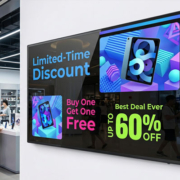
As digital signage displays scale across smart cities, retail storefronts, and corporate campuses, relying entirely on wireless networks for total device management introduces operational risks.
By anchoring your hardware architecture with RS232 serial control, you decouple software-level content management from physical hardware reliability. The result is a highly secure, automated, and truly resilient commercial signage network built for continuous 24/7 operation.