RK3506 vs. RK3566: Performance and Power Consumption
Selecting the right processor is a key part of embedded product development. Greater computing performance can also mean higher memory requirements, more sophisticated hardware, and increased power consumption. Conversely, a low-power platform may lack the resources needed for applications involving advanced graphics, multimedia, or AI processing.
The Rockchip RK3506 and RK3566 are embedded processors built to serve different levels of application complexity.
The RK3506 is suited to lightweight embedded control, industrial communications, HMI, and smart devices. The RK3566 offers a more powerful computing platform, featuring a 64-bit quad-core CPU, GPU acceleration, an integrated NPU, and advanced multimedia capabilities.
Which processor is the better fit? Let’s compare their architectures, performance, power consumption, and practical applications.
1. RK3506 vs. RK3566: Core Specifications
The primary distinction between these processors lies in their computing architecture.
The RK3506 features three ARM Cortex-A7 CPU cores and is designed for embedded control and peripheral connectivity. By contrast, the RK3566 has four 64-bit Cortex-A55 cores, along with a Mali-G52 GPU and a 1 TOPS NPU.
| Specification | RK3506 | RK3566 |
|---|---|---|
| CPU architecture | Triple-core Cortex-A7 | Quad-core Cortex-A55 |
| CPU instruction set | 32-bit ARM | 64-bit ARM |
| CPU performance class | Lightweight embedded computing | More capable application processing |
| GPU | No dedicated 3D GPU; 2D graphics engine | Mali-G52 2EE |
| NPU | No integrated NPU | Up to 1 TOPS INT8 |
| Memory | DDR2/DDR3/DDR3L, depending on variant | LPDDR4/LPDDR4X and other supported types |
| Video decoding | Limited; not designed for 4K multimedia | Up to 4K60 H.264/H.265/VP9 |
| Video encoding | Not a primary multimedia platform | Up to 1080p60 H.264/H.265 |
| Display | MIPI DSI, RGB and MCU-oriented display interfaces, depending on variant | HDMI 2.0, eDP, MIPI DSI, LVDS, RGB and EBC |
| Connectivity | USB 2.0 OTG, UART, SPI, I2C, CAN, RMII | USB 3.0, USB 2.0, PCIe 2.1, SATA 3.0, Gigabit Ethernet |
| Typical applications | HMI, PLC, IP phones, voice devices | Smart terminals, industrial HMI, multimedia and edge AI |
Specifications vary according to the precise chip variant and board design. The RK3506 family offers different memory and peripheral configurations.
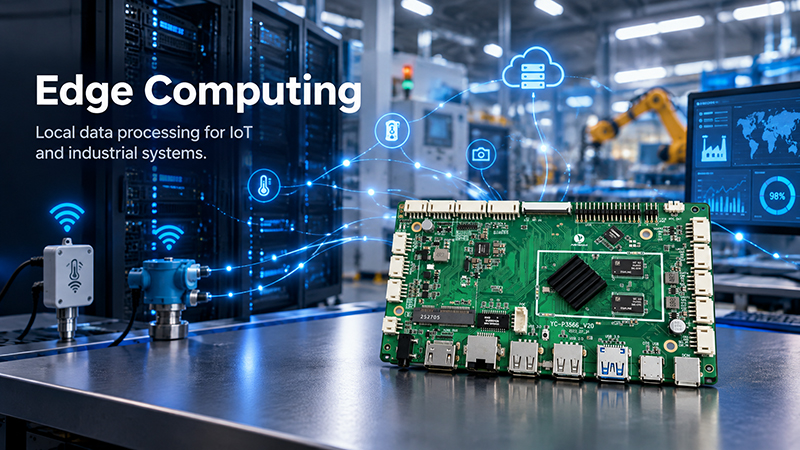
YC-P3566 RK3566 Motherboard Edge Computing
2. CPU Performance: Cortex-A7 vs. Cortex-A55
CPU architecture significantly affects application performance, operating-system compatibility, and multitasking capacity.
RK3506: Efficient Embedded Processing
The RK3506 features three Cortex-A7 CPU cores.
Cortex-A7 is a mature, 32-bit ARM architecture developed for energy-efficient embedded applications. It suits workloads that require modest computing resources.
Common uses include:
- Reading sensor data
- Controlling industrial equipment
- Processing communication protocols
- Managing simple graphical interfaces
- Handling basic device logic
- Running lightweight embedded Linux applications
For products focused primarily on data collection, peripheral control, and displaying basic operational information, the RK3506 provides a suitable hardware foundation.
Its architecture is especially well suited to devices such as PLC controllers, smart meters, IP phones, and industrial control panels.
RK3566: Greater Computing Capacity for Demanding Applications
The RK3566 is equipped with four 64-bit Cortex-A55 CPU cores.
In comparison with the Cortex-A7 architecture, Cortex-A55 features a newer instruction set, better processing efficiency, and enhanced performance for application-focused workloads.
As a result, the RK3566 is well suited to:
- Running Android or Linux applications
- Managing sophisticated graphical interfaces
- Handling multiple background services
- Processing network communications and managing data
- Running multimedia applications
- Supporting certain AI inference workloads
The RK3566 is a stronger option for embedded devices that require capabilities beyond basic control functions.
For instance, an industrial touchscreen terminal running a graphical operating system alongside communication services and a device-management application can generally take advantage of the RK3566’s greater computing capacity.
CPU comparison: The RK3506 is intended for lightweight embedded processing, whereas the RK3566 is better suited to application-intensive systems that need a 64-bit computing platform.
3. GPU and Graphics Performance
Graphics processing is another key area of difference.
RK3506: Basic 2D Graphics
The RK3506 features a 2D graphics engine, not a dedicated 3D GPU like the Mali-G52 found in the RK3566.
It is well suited to straightforward user interfaces, such as:
- Basic control menus
- Equipment status displays
- Simple icons and animations
- Industrial parameter interfaces
- Lightweight touchscreen applications
This level of capability may be sufficient for products that primarily present text, numerical values, buttons, and simple graphical elements.
However, the RK3506 is not an appropriate choice for applications requiring advanced 3D rendering or intensive GPU-accelerated graphics.
RK3566: Mali-G52 GPU
The RK3566 features an ARM Mali-G52 2EE GPU.
Depending on the software stack and driver support, it supports graphics technologies including OpenGL ES, Vulkan, and OpenCL.
This enables greater flexibility for:
- Modern touchscreen interfaces
- Animated user interfaces
- Interactive applications
- Multimedia displays
- GPU-accelerated graphics processing
For smart home control panels, digital signage, and industrial HMI products that require more sophisticated visual interfaces, the RK3566 provides a distinct advantage.
4. AI Processing: Do Either of These Processors Support Edge AI?
AI functionality is becoming increasingly important in embedded devices.
- However, the two platforms differ significantly in this area.
- RK3506: AI Processing via External Hardware or the Cloud
- The RK3506 does not feature a dedicated NPU.
It can perform basic logic operations, sensor processing, communications, and lightweight algorithmic tasks. More demanding AI workloads typically need to run on an external AI processor or a remote server.
This approach is suitable for products that do not require local neural-network inference.
For instance, a smart controller can gather sensor data and transmit it to a cloud platform for analysis.
RK3566: Integrated 1 TOPS NPU
The RK3566 features an integrated NPU delivering up to 1 TOPS of INT8 computing performance.
It can support selected AI inference workloads, such as:
- Image classification
- Object detection
- Basic visual recognition
- Intelligent camera applications
- Local AI-assisted monitoring
Using the NPU can reduce the need to send every inference task to a cloud server.
Actual performance varies according to model complexity, operator support, precision, available memory, and the RKNN software toolchain.
For products requiring local AI processing, the RK3566 is the more suitable choice.
5. RK3506 vs. RK3566: Power Consumption
Power consumption is a key factor when choosing an embedded processor.
A low-power platform can make thermal management simpler, reduce energy demands, and enable more compact product designs.
It is essential, however, to distinguish the processor’s power consumption from that of the complete board.
An embedded system’s actual power usage depends on:
- CPU workload and operating frequency
- Memory type and capacity
- Display size and brightness
- Network and wireless modules
- USB devices and connected peripherals
- Power-management circuit efficiency
- Cooling and operating conditions
RK3506: Built for Lightweight, Low-Power Applications
With its Cortex-A7 architecture and focus on lightweight embedded systems, the RK3506 is well suited to applications with relatively modest computing needs.
Potential benefits include:
- Lower processing requirements
- Less demanding thermal design for suitable workloads
- Support for compact embedded hardware
- Suitability for control devices that operate continuously
This makes the RK3506 an appealing option for industrial controllers, communication terminals, and basic HMI panels.
RK3566: Greater Performance with a Larger System Power Budget
The RK3566 offers additional processing resources, GPU acceleration, and an integrated NPU.
These features can raise power requirements when the system handles demanding workloads.
However, power consumption does not necessarily rise in direct proportion to the number of processor cores.
A more capable processor may finish certain tasks sooner, enabling the system to return to a lower-power state more quickly. Actual results depend on workload scheduling, frequency scaling, power management, and board design.
The RK3566 is therefore a suitable choice when its added computing capabilities warrant the associated system power and thermal requirements.
Power Consumption Comparison
| Factor | RK3506 | RK3566 |
|---|---|---|
| Computing architecture | Lightweight Cortex-A7 | Cortex-A55 application processor |
| Typical workload | Basic control and communication | Application processing, graphics and multimedia |
| GPU power requirements | No dedicated 3D GPU | Mali-G52 GPU |
| AI acceleration | No integrated NPU | Integrated 1 TOPS NPU |
| Thermal design | Generally simpler for lightweight workloads | Requires evaluation under heavier workloads |
| Best power strategy | Minimize unnecessary computing resources | Balance performance with workload and power management |
Important: There is no single universal wattage figure that accurately represents every RK3506 or RK3566 board. For an accurate comparison, test both complete hardware platforms under the same operating conditions, including idle, normal operation, and peak workload.
6. Operating System and Software Compatibility
Software compatibility is an important factor when comparing the two processors.
RK3506: Lightweight Embedded Linux
The RK3506 is designed primarily for lightweight embedded applications.
Its software environment is well suited to projects requiring:
- Embedded Linux
- Device control applications
- Industrial communications
- Simple user interfaces
- Peripheral management
- Real-time interaction with external equipment
The specific operating system, kernel, drivers, and development tools available depend on the chip variant and the board vendor’s BSP.
As the RK3506 uses a 32-bit Cortex-A7 architecture, developers should also verify that their application dependencies and software libraries support 32-bit ARM environments.
RK3566: Android and Linux Applications
The RK3566 offers a versatile software environment designed for application-focused development.
Depending on the board and BSP, supported options may include:
- Android
- Ubuntu
- Debian
- Buildroot
- Other customized Linux distributions
With its 64-bit CPU architecture and GPU, the RK3566 can handle more advanced applications, such as graphical user interfaces, multimedia systems, and embedded application platforms.
Manufacturers developing commercial devices should assess operating-system support, driver availability, SDK documentation, and the long-term maintenance of the BSP before choosing the processor.
7. Which Applications Are Best Suited to RK3506 and RK3566?
The right processor depends on the product’s practical requirements, not just the specifications listed on its data sheet.
Applications for RK3506
Industrial Control Panels
RK3506 offers adequate processing capability for equipment that displays basic operating information, accepts user input, and communicates with controllers.
PLC and Industrial Communication Devices
With interfaces such as UART, SPI, I2C, CAN, and RMII, RK3506 is well suited to industrial communication and control devices.
IP Phones and Voice Devices
Its audio interfaces and lightweight processing architecture make RK3506 a good fit for communication terminals and other voice-focused embedded devices.
Smart Appliances
RK3506 can manage sensors, buttons, status displays, and peripheral communications in the basic control systems used by smart appliances.
Robotic Vacuum Control Systems
RK3506 can handle low-level device management, sensor communication, and control tasks. More demanding functions—such as navigation, computer vision, or AI processing—may require a separate computing platform.
Applications for RK3566
Smart Home Control Panels
RK3566 supports sophisticated touchscreen interfaces, Android apps, network connectivity, and integration with smart home systems.
Industrial HMI Systems
For industrial terminals that need detailed graphics, multiple application services, and multimedia features, RK3566 offers enhanced flexibility.
Digital Signage and Smart Kiosks
With its GPU and video-decoding capabilities, RK3566 is well suited to commercial displays, interactive advertising players, and information terminals.
AI Edge Devices
Its integrated NPU supports selected on-device inference workloads, making RK3566 a practical option for smart cameras and basic AI-enabled devices.
Smart Retail Equipment
RK3566 can handle touchscreen interaction, network services, multimedia playback, and supported image-processing tasks in commercial equipment.
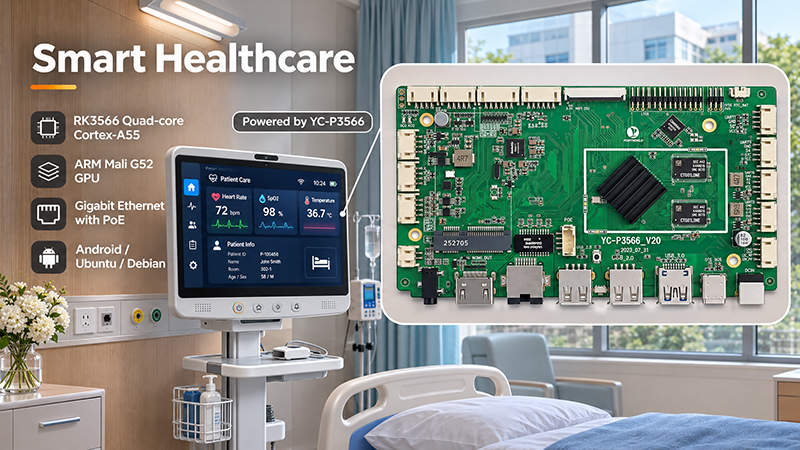
YC-P3566 rk3566 motherboard Smart Healthcare
8. How to Choose Between RK3506 and RK3566
Before selecting a processor, consider the following questions:
| our project requirement | Recommended platform |
|---|---|
| Basic industrial control | RK3506 |
| Simple HMI and parameter display | RK3506 |
| Lightweight embedded Linux | RK3506 |
| Industrial communication gateway | RK3506, depending on interface requirements |
| Android-based touchscreen interface | RK3566 |
| Advanced graphical user interface | RK3566 |
| 4K video decoding | RK3566 |
| Local AI inference | RK3566 |
| Smart signage and multimedia terminals | RK3566 |
| More demanding application processing | RK3566 |
A useful rule is:
Choose RK3506 when your product mainly handles control logic, peripheral communication, simple displays, and lightweight embedded software.
Choose RK3566 when your product needs a 64-bit operating environment, GPU acceleration, multimedia processing, or integrated AI inference.
There is little benefit in selecting a more powerful processor if the application does not need its capabilities. Similarly, choosing a lightweight processor for a demanding graphical or multimedia application may create performance limitations later.
9. Portworld Embedded Motherboard Solutions
Choosing the right SoC is just the first step in developing an embedded product. Manufacturers must also address PCB design, memory configuration, power management, peripheral connectivity, operating-system adaptation, and long-term production needs.
Portworld offers embedded motherboard solutions and hardware customization for industrial and commercial applications.
For projects using Rockchip platforms, Portworld supports hardware development, PCB and PCBA customization, software adaptation, and OEM/ODM integration.
Depending on the project, development may include:
- Processor and motherboard selection
- Custom PCB and PCBA design
- Display and touchscreen integration
- UART, RS485, RS232, CAN, and GPIO expansion
- Android and Linux system customization
- SDK and technical documentation
- Mechanical and interface customization
- Prototype testing and mass-production support
For applications requiring greater computing resources, Portworld also offers motherboard solutions based on the RK3566, including the YC-P3566 platform.
For example, the YC-P3566 uses the RK3566 processor and provides a hardware foundation for smart terminals, industrial HMI systems, and embedded Linux applications. Its configuration and available interfaces should be chosen to suit the project’s requirements.
For simpler, control-oriented devices, an RK3506-based design may be a better fit when its processing performance, memory configuration, and peripheral interfaces satisfy the application’s needs.