What Is a Core Board? Understanding Embedded System on Modules
As embedded devices grow more intelligent and connected, hardware developers must meet rising demands for computing power, compact form factors, and flexible system integration. Whether developing industrial control terminals, smart displays, robotics, or edge AI devices, selecting the right computing platform is a key part of product development.
One widely used solution in embedded hardware design is the Core Board, also known as a System on Module (SoM).
A core board combines essential computing components in a compact module. This enables developers to create application-specific products without designing the entire computing system from the ground up. The modular approach can streamline hardware development, lower engineering complexity, and speed up product deployment.
What is a core board, how does it operate, and what factors should guide your choice for a project?
1. What Is a Core Board?
A Core Board, or System on Module (SoM), is a compact computing module that brings the primary components of an embedded system together on a single PCB.
A typical core board contains:
- CPU: Executes operating system instructions and application tasks.
- GPU: Processes graphics and supports visual applications.
- NPU: Accelerates compatible artificial intelligence workloads.
- RAM: Supplies temporary memory for active applications.
- Storage: Holds the operating system, firmware, and application data.
- Power Management: Regulates power supplied to the processor and other components.
- Expansion Interfaces: Connect external hardware through a board-to-board connector or other interfaces.
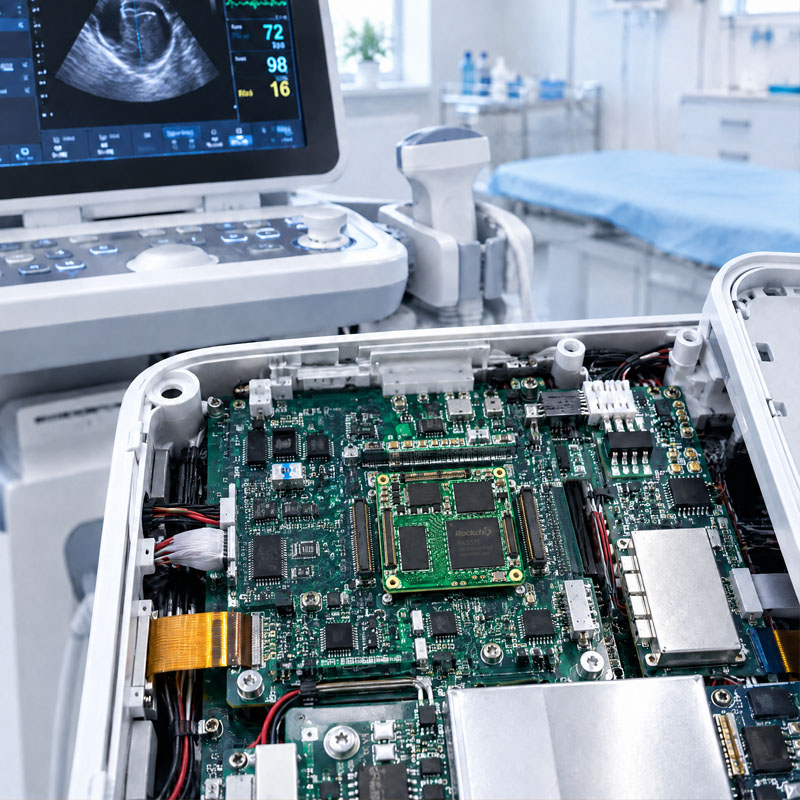
The core board is usually installed onto a separate carrier board, which provides application-specific connections such as displays, cameras, Ethernet, USB, audio, and industrial communication interfaces.
This modular architecture separates the main computing platform from the product-specific hardware design.
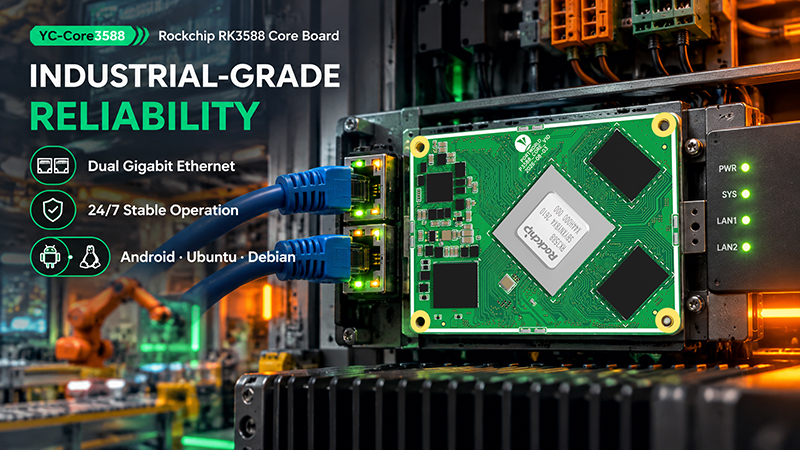
RK3588 core board
2. How Does a Core Board Work?
A core board typically works with a carrier board to form a complete embedded computing system.
The core board performs the primary computing tasks, such as running the operating system, processing data, managing applications, and executing AI inference when supported.
The carrier board connects the core board to the external components needed by the finished product.
For example, an industrial touchscreen terminal may include:
- A core board for system processing
- A carrier board for hardware integration
- An LCD and touchscreen for user interaction
- Ethernet or Wi-Fi for network communication
- RS485 or UART for connecting to industrial equipment
- USB and audio interfaces for external peripherals
This architecture allows developers to reuse the same computing module across multiple products by creating different carrier boards for specific applications.
It is especially useful for manufacturers producing several embedded devices with comparable computing needs but different physical interfaces.
3. Core Board vs. Development Board vs. Motherboard
Although these terms are sometimes used interchangeably, they refer to different hardware concepts.
| Hardware Type | Main Purpose | Typical Characteristics |
|---|---|---|
| Core Board (SoM) | Provides the main computing platform | Compact module designed for integration with a carrier board |
| Development Board | Supports hardware evaluation and software development | Usually includes accessible interfaces and debugging features |
| Motherboard | Integrates computing and peripheral circuits | Designed around the requirements of a specific system or product |
A development board is mainly used for testing processors, evaluating interfaces, and developing software.
A core board is designed to be integrated into a larger embedded product. It provides a reusable computing module while allowing manufacturers to customize the carrier board.
A motherboard generally integrates the processor, memory, power circuits, and external interfaces into one PCB. It may be designed for direct installation into a particular product.
For commercial embedded systems, a core board offers a practical balance between hardware flexibility and development efficiency.
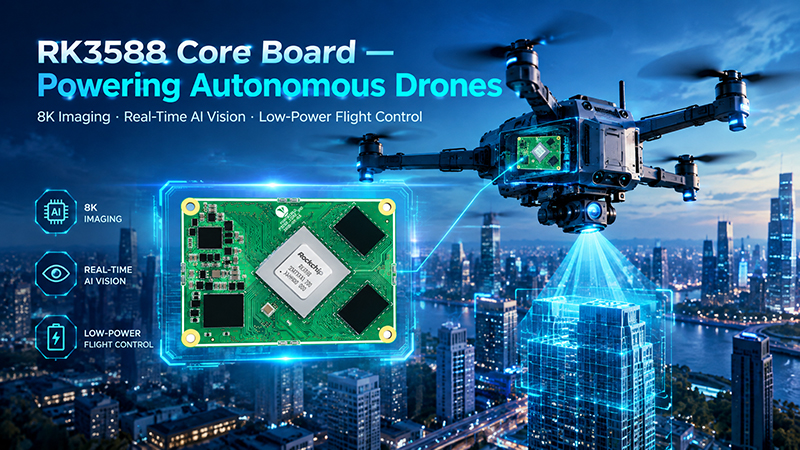
RK3588 Drone Application Scene 1
4. Why Use a Core Board in Embedded System Development?
Building a complete embedded computing platform calls for expertise in processor design, memory routing, power management, high-speed signal layout, and thermal management.
A core board can streamline several parts of this development process.
Faster Product Development
Developers can use an established computing module rather than designing processor and memory circuits from scratch. This enables engineering teams to concentrate on application-specific hardware and software.
Reduced Hardware Design Complexity
Processor and memory circuits typically involve intricate PCB layouts and careful signal-integrity management. A professionally designed core board offers a pre-integrated computing platform, limiting the high-speed circuit design needed on the carrier board.
Flexible Hardware Integration
Multiple carrier boards can be designed around the same core board to accommodate different display sizes, communication interfaces, and product configurations.
Easier Product Upgrades
A modular design can simplify assessment of a higher-performance computing platform as application needs evolve. However, compatibility must still be verified for connector pinouts, power requirements, software, and mechanical dimensions.
Better Production Planning
Core boards can support standardized hardware platforms across multiple product models, helping manufacturers simplify development, assembly, and maintenance.
5. What Factors Should You Consider When Selecting a Core Board?
Selecting a core board requires more than comparing processor specifications. Developers should assess the final product’s complete hardware and software requirements.
Processing Performance
Evaluate the CPU architecture and clock speed, as well as GPU performance and NPU capabilities. Industrial control systems and basic user interfaces may require different computing resources than robotics or real-time visual analysis.
AI Computing Capability
For products that perform AI inference locally, verify NPU performance, supported precision formats, software runtime, and model compatibility.
Memory and Storage
RAM and eMMC capacity influence operating system performance, application loading times, and data storage. Choose a configuration that addresses both present and anticipated needs.
Display and Multimedia Support
For touchscreen products, commercial displays, and camera-based systems, verify supported display interfaces, video decoding and encoding capabilities, camera connections, and graphics performance.
Expansion Interfaces
Ensure the core board and carrier board provide the interfaces your product requires, including USB, Ethernet, PCIe, SATA, MIPI, UART, RS485, I2C, and GPIO.
Operating System and Software Support
Check the availability of Android, Linux, Ubuntu, Debian, BSP packages, drivers, SDKs, and development documentation.
Power and Thermal Design
Evaluate input voltage, power consumption, cooling requirements, and the operating temperature range. The final product should be tested under its actual workload and installation conditions.
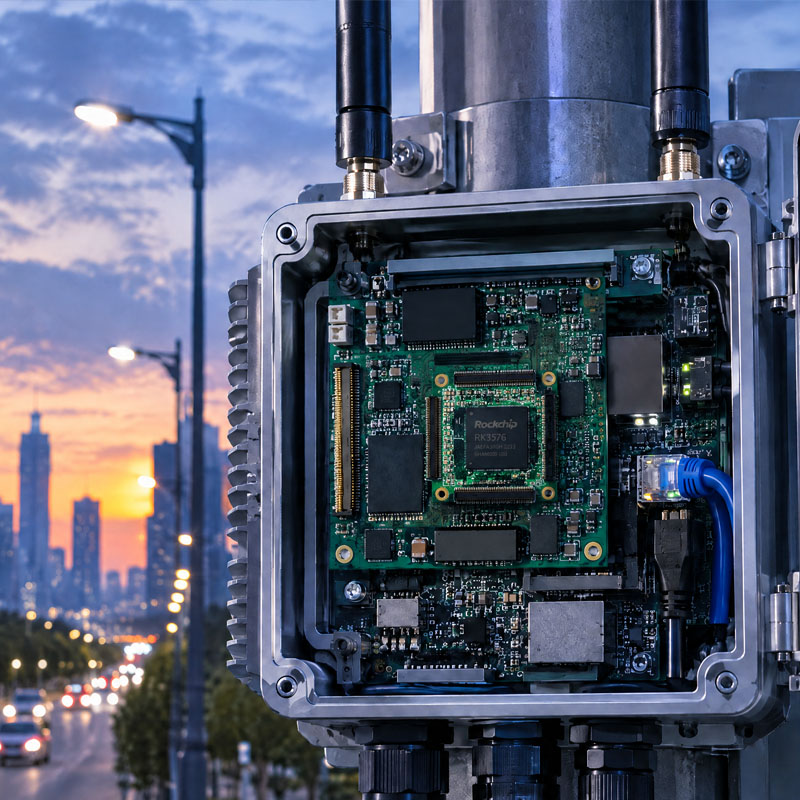
YC-Core3588 Core Board
6. Portworld Core Board Solutions: RK3576 and RK3588
Portworld supplies embedded computing modules for industrial equipment, smart terminals, robotics, and edge AI applications.
Its core board portfolio includes the RK3576 SoM and RK3588 Core Board, each offering distinct computing capabilities and integration options.
Portworld RK3576 SoM – Compact AI Computing Module
The Portworld RK3576 SoM is designed for embedded systems requiring a balance of processing power, AI acceleration, and compact hardware integration.
Based on the octa-core Rockchip RK3576 processor, this 38 × 38 mm module features four Cortex-A72 cores operating at up to 2.2GHz and four Cortex-A53 cores running at up to 1.8GHz.
Its integrated NPU provides up to 6 TOPS of AI computing performance, supporting selected edge inference applications when used with compatible models and software runtimes.
Key Features:
- Rockchip RK3576 64-bit octa-core processor
- 4 × Cortex-A72 cores running at up to 2.2GHz, plus 4 × Cortex-A53 cores running at up to 1.8GHz
- Integrated NPU delivering up to 6 TOPS of performance
- Mali-G52 MC3 GPU
- Compact 38 × 38 mm module
- Onboard 4GB LPDDR4 memory
- 240-pin board-to-board connector
- Supports video decoding up to 4K at 120fps with supported formats
- Integrated 16MP ISP
- RK806S-5 PMIC with 5V DC input
- Supports Linux, Ubuntu, and Android, depending on software configuration
- Hardware and software customization available
Typical Applications:
- Industrial HMI systems
- Edge AI gateways
- Smart cameras and visual analytics
- Robotics and intelligent equipment
- Smart commercial terminals
- Compact AI-enabled embedded devices
With its compact footprint, the RK3576 SoM is well suited to products with limited PCB space that require greater computing power and AI processing capabilities.
Portworld RK3588 Core Board – High-Performance Embedded Computing
For applications that demand enhanced CPU performance, advanced multimedia capabilities, and broad peripheral expansion, Portworld provides a Core Board based on the RK3588.
The board is powered by Rockchip’s octa-core RK3588 processor, featuring four Cortex-A76 cores clocked at up to 2.3 GHz and four Cortex-A55 cores running at up to 1.8 GHz.
An integrated NPU delivers up to 6 TOPS of AI computing power, supporting more demanding edge AI applications.
Key Features:
- Rockchip RK3588 octa-core processor
- 4 × Cortex-A76 cores up to 2.3 GHz + 4 × Cortex-A55 cores up to 1.8 GHz
- Integrated NPU delivering up to 6 TOPS of performance
- 8K video decoding and 8K@30fps encoding with supported configurations
- Multi-display output via HDMI 2.1, eDP, DP, and MIPI interfaces
- 400-pin high-density board-to-board connector (4 × 100-pin)
- PCIe 3.0/2.0, SATA 3.0, and USB 3.0/2.0 expansion options
- Dual Gigabit Ethernet
- Scalable LPDDR4/4X/5 memory and eMMC 5.1 storage configurations
- Support for Android, Ubuntu, and Debian
- Built for continuous operation in embedded systems
Typical Applications:
- High-performance edge AI systems
- Humanoid and service robots
- Industrial machine vision
- Multi-screen commercial displays
- Smart transportation systems
- Advanced industrial computing terminals
With its powerful CPU architecture and broad expansion options, the RK3588 Core Board is well suited to embedded systems with demanding processing and multimedia requirements.
YC-Core3588 Core Board
7. RK3576 SoM vs. RK3588 Core Board: Which One Should You Choose?
Both platforms support edge AI applications, multimedia processing, and embedded system development. However, they target different product requirements.
| Comparison | RK3576 SoM | RK3588 Core Board |
|---|---|---|
| CPU Architecture | 4 × A72 + 4 × A53 | 4 × A76 + 4 × A55 |
| Maximum CPU Frequency | Up to 2.2GHz | Up to 2.3GHz |
| AI Performance | Up to 6 TOPS | Up to 6 TOPS |
| GPU | Mali-G52 MC3 | Mali-G610 MP4 |
| Form Factor | 38 × 38 mm | 400-pin module design |
| Connector | 240-pin BTB | 400-pin BTB |
| Video Capability | Up to 4K@120fps decoding | Up to 8K decoding and 8K@30fps encoding |
| Typical Positioning | Compact AI embedded systems | High-performance embedded systems |
Choose the RK3576 SoM when compact size, balanced computing performance, and integrated AI acceleration are important.
Choose the RK3588 Core Board when your project requires stronger CPU and GPU performance, advanced video processing, multi-display capabilities, and extensive peripheral expansion.
The final selection should also consider memory configuration, software support, carrier-board design, power consumption, and thermal requirements.
8. Portworld OEM/ODM Services for Embedded Hardware Projects
Choosing the right core board is just one stage of developing an embedded product. Hardware integration, software adaptation, and production planning are also essential.
Portworld provides OEM/ODM development services for customers seeking tailored embedded computing solutions.
Available services include:
- Hardware Customization: Carrier board design, PCB/PCBA development, connector configuration, and peripheral integration.
- Memory and Storage Configuration: RAM and eMMC options customized to meet project requirements.
- Operating System Customization: Android and Linux adaptation, BSP integration, and driver development.
- Interface Integration: Connections for displays, cameras, Ethernet, USB, UART, RS485, and other peripherals.
- Software Development Support: SDKs, development documentation, and application integration.
- Production Support: Prototyping, testing, CKD/SKD, and mass production.
From initial hardware planning through prototype validation and high-volume production, Portworld helps businesses create embedded computing platforms tailored to their applications.