LCD vs. LED Digital Signage Displays: Understanding the Differences
Digital signage has emerged as a vital communication mechanism across retail establishments, shopping centers, dining facilities, hospitality venues, transportation terminals, and professional workplaces. Encompassing promotional multimedia, digital menu systems, informational broadcasts, and participatory experiences, commercial display systems enable organizations to convey their messages with enhanced dynamism and engagement.
When evaluating digital signage display options, decision-makers frequently assess LCD and LED display technologies. Both technologies maintain substantial presence in commercial display implementations; however, they demonstrate distinctions in panel architecture, visual output quality, deployment adaptability, and primary use cases.
Comprehending these distinctions enables organizations to identify a digital signage platform that aligns with their specific viewing conditions, display dimensions, content specifications, and financial parameters.
What Constitutes an LCD Digital Signage Display?
LCD denotes Liquid Crystal Display technology. An LCD panel employs liquid crystal substances to regulate the transmission of light through individual pixels. Given that liquid crystals lack inherent luminosity, the majority of professional-grade LCD displays incorporate backlighting mechanisms to generate perceptible imagery.
Contemporary professional LCD displays predominantly employ LED backlighting technology. Consequently, products marketed as LED-backlit LCD displays represent a prevalent category within the digital signage sector. In this application context, LED designates the illumination source rather than functioning as an autonomous, light-generating LED display system.
Liquid Crystal Display digital signage systems are extensively utilized for interior advertising applications, retail marketing initiatives, dining establishment menus, conference room communications, guest information systems, and interactive terminal solutions. These systems are capable of delivering intricate visual imagery, legible typography, and superior resolution content across multiple display dimensions.
For organizations requiring a standard commercial display solution for proximate or intermediate viewing distances, Liquid Crystal Display digital signage represents a pragmatic alternative. Interactive touch capabilities may be incorporated into appropriate Liquid Crystal Display monitors to facilitate applications including automated service stations, merchandise exploration, and facility reservation platforms.
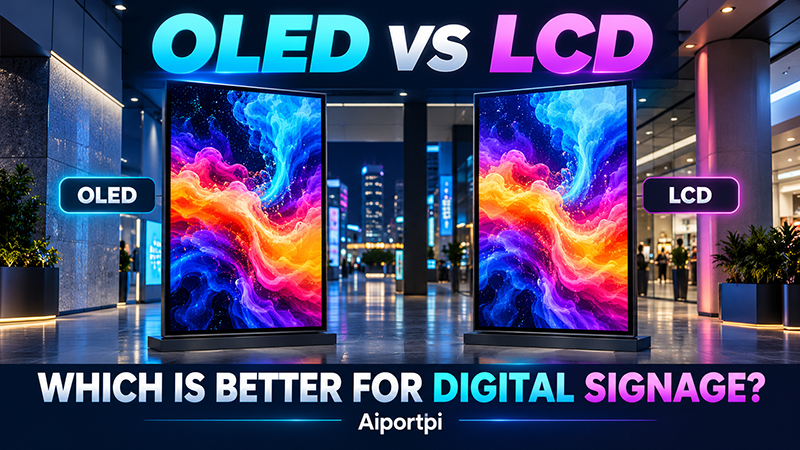
OLED LCD digital signage display
What Constitutes an LED Digital Signage Display?
Within the commercial signage sector, the designation LED display typically denotes a direct-view LED display system. Rather than depending upon an independent illumination source positioned behind a Liquid Crystal Display panel, this technology employs an arrangement of luminescent diodes to generate the visual content directly.
Direct-view LED display systems are frequently deployed for expansive promotional installations, architectural facade applications, performance spaces, athletic facilities, and comparable projects necessitating substantial audience viewing capacity. Their segmented construction facilitates the assembly of display surfaces in diverse configurations and proportional arrangements.
A critical technical parameter is pixel pitch, which quantifies the spacing between consecutive pixels. A reduced pixel pitch generally facilitates enhanced image clarity when observed from shorter distances, whereas an expanded pixel pitch may prove advantageous for displays intended for observation from extended distances.
Direct-view LED technology can also be designed for outdoor environments, with suitable brightness, enclosure protection, and thermal management. However, the actual performance and weather resistance depend on the specific product configuration.
LCD vs. LED Digital Signage: Key Differences
Although both technologies are used for digital advertising, they are suited to different installation requirements.
| Comparison | LCD Digital Signage | Direct-View LED Digital Signage |
|---|---|---|
| Display structure | Liquid crystal panel with a backlight | Array of LEDs that produces the image directly |
| Typical applications | Indoor advertising, menus, kiosks, meeting rooms | Large advertising screens, building facades, stadiums |
| Common screen formats | Standard commercial screen sizes | Modular configurations with flexible dimensions |
| Image characteristics | Detailed images and text at native resolution | Image detail depends significantly on pixel pitch |
| Viewing distance | Often suitable for close and medium-distance viewing | Depends on pixel pitch and screen configuration |
| Brightness | Varies by panel and product configuration | Can be designed for high-brightness applications |
| Touch interaction | Available on compatible touch-enabled models | Requires a suitable touch solution if interaction is needed |
| Installation | Often uses a complete display unit | Frequently uses multiple LED modules or cabinets |
| Maintenance | May involve replacing or servicing the display unit or its components | May involve servicing individual modules and related components |
| Cost considerations | Often practical for standard indoor display projects | Depends on pixel pitch, screen area, installation, and control system |
These are general distinctions rather than fixed rules. Product specifications, installation conditions, and the quality of the selected display can significantly affect performance.
Which Technology Is Better for Indoor Digital Signage?
For many indoor commercial applications, LCD digital signage offers a straightforward way to present advertising and information.
Retail stores can use LCD displays to show product promotions, brand videos, and seasonal campaigns. Restaurants can install digital menu boards to update prices and menu items without replacing printed materials. Hotels and office buildings can use LCD screens for visitor information, directories, and meeting-room schedules.
LCD displays are also useful when content contains small text, detailed graphics, or user-interface elements that need to remain clear at relatively close viewing distances. For applications that require direct user input, a compatible touchscreen LCD display can combine content presentation with interactive functionality.
When selecting an indoor LCD display, buyers should consider resolution, brightness, viewing angle, operating hours, connectivity, and installation method. For continuous commercial operation, it is important to verify that the selected model supports the intended duty cycle.
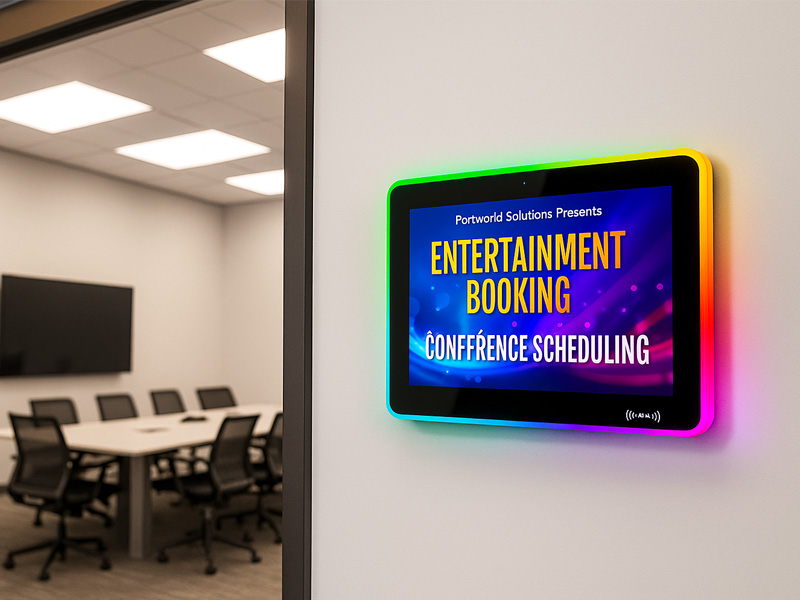
YC-LE156
15.6″ Meeting Room Display Panels
When Should You Opt for LED Digital Signage Solutions?
Direct-view LED displays merit serious consideration when your project demands an expansive visual presentation area, a non-standard display configuration, or exceptional visibility performance across diverse viewing angles.
Outdoor promotional campaigns, retail center exteriors, entertainment facilities, and athletic arenas frequently employ direct-view LED displays due to their modular architecture, which facilitates extensive installations. Pixel pitch must be determined based on anticipated viewing distance and the level of image clarity needed.
For outdoor implementations, luminosity represents merely one consideration among many. Decision-makers should thoroughly assess environmental protection measures, thermal operating parameters, electrical consumption, load-bearing infrastructure, service accessibility, and deployment expenditures.
Direct-view LED technology does not invariably represent the optimal solution for all outdoor applications. A self-contained outdoor LCD digital signage system may prove more suitable when your project necessitates a standard screen format, particular resolution specifications, or an all-in-one display housing. The appropriate selection should ultimately reflect the specific site conditions and intended project outcomes.
Selecting an Appropriate Digital Signage Display for Your Initiative
Prior to determining between LCD or direct-view LED technology, organizations must establish the intended application of the display.
Begin by assessing the viewing environment. Retail displays for indoor use, outdoor screens positioned in shaded areas, and advertising installations exposed to full environmental conditions each present distinct brightness and environmental specifications. Examine existing ambient lighting conditions and potential exposure to direct sunlight when evaluating product options.
Assess display dimensions and optimal viewing distance. LCD technology frequently proves appropriate for conventional display formats intended for observation at moderate distances. Direct-view LED accommodates substantially larger display configurations, with visual clarity determined by pixel pitch specifications and the distance from which viewers will observe the content.
Align the display technology with your content requirements. Detailed product information, compact text elements, menu systems, and interactive user interfaces may perform optimally on high-resolution LCD screens. Expansive promotional imagery and large-scale architectural advertising installations may be more effectively executed through modular direct-view LED systems.
Assess requirements for interactivity and technical integration. When end users require the capability to access information, make selections, or execute transactions, verify that the display incorporates necessary touch-enabled hardware and compatible software solutions. System connectivity and compatibility with content management platforms warrant careful consideration.
Determine comprehensive project expenditure. Equipment acquisition represents merely a single component of total project expenses. Installation procedures, structural support systems, electrical consumption, content administration, ongoing maintenance, and anticipated future upgrades must all be factored into the financial assessment.
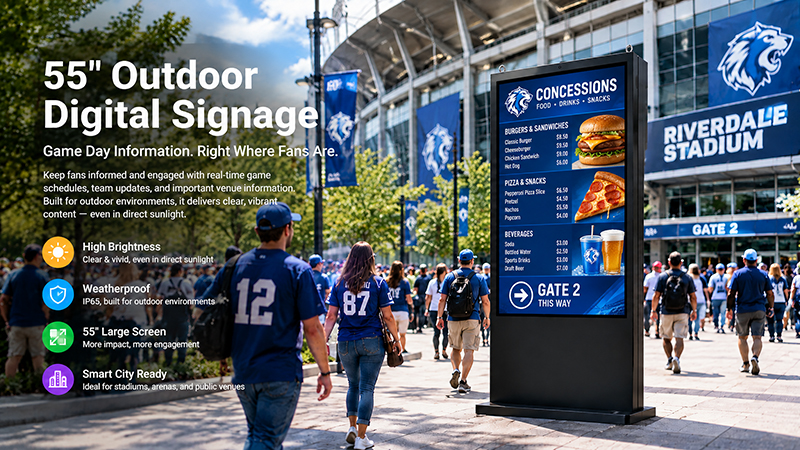
55 inch digital signage display
Tailored Digital Signage Solutions Provided by Portworld
Not all digital signage implementations can be effectively resolved through conventional, commercially available display systems. Organizations frequently require specialized screen proportions, luminosity specifications, interactive touch capabilities, integrated processing components, data transmission options, software platforms, or structural configurations.
Portworld delivers enterprise-grade digital display and integrated hardware solutions, offering original equipment manufacturer (OEM) and original design manufacturer (ODM) services for bespoke initiatives. Based on the chosen product architecture and specific project parameters, customization possibilities encompass display characteristics, touch-enabled interfaces, processing unit specifications, Android or Linux platform modifications, communication protocols, corporate identity elements, and structural housing design.
As an illustration, a consumer-facing retail environment may necessitate an Android-based interactive touchscreen display for dynamic product engagement, whereas a corporate conference space may require a networked display panel facilitating room reservation management. An external promotional campaign may demand an exceptionally bright display coupled with an enclosure engineered to withstand particular environmental circumstances.