Smart control panel PCBA board design and manufacturing services
In the smart home and building automation sector, the effectiveness and dependability of a control panel are significantly influenced by one essential element: the PCBA (Printed Circuit Board Assembly). Every seamless touchscreen interface and agile smart control system is supported by a meticulously designed PCB that incorporates processing, connectivity, power management, and communication protocols.
With the increasing demand for intelligent automation, the design and manufacturing services of smart control panel PCBAs have become integral to OEM and ODM supply chains, allowing companies to create tailored and scalable smart control solutions.
What Constitutes a Smart Control Panel PCBA?
A smart control panel PCBA serves as the fundamental electronic board within a smart touchscreen device. It consolidates all necessary hardware functions required for the system’s operation, which include:
- Main processor (SoC or MCU)
- Memory (RAM and storage)
- Power management modules
- Communication interfaces (WiFi, Bluetooth, Ethernet)
- Industrial protocols (RS485, CAN, KNX, etc.)
- Display and touch control circuits
- Peripheral interfaces (USB, GPIO, sensors)
In essence, the PCBA acts as the brain of the smart control panel, influencing its performance, stability, and scalability.
The Importance of PCBA Design for Smart Control Panels
In contrast to typical consumer electronics, smart control panels are engineered for continuous operation around the clock in residential, commercial, and industrial settings.
Consequently, PCBA design must emphasize:
- Long-term stabilit
- Low power consumption
- Heat management
- Signal integrity
- Multi-protocol compatibility
- EMI/EMC compliance
A meticulously designed PCBA guarantees that the control panel can effectively manage lighting, HVAC, security systems, and IoT devices without experiencing performance decline over time.
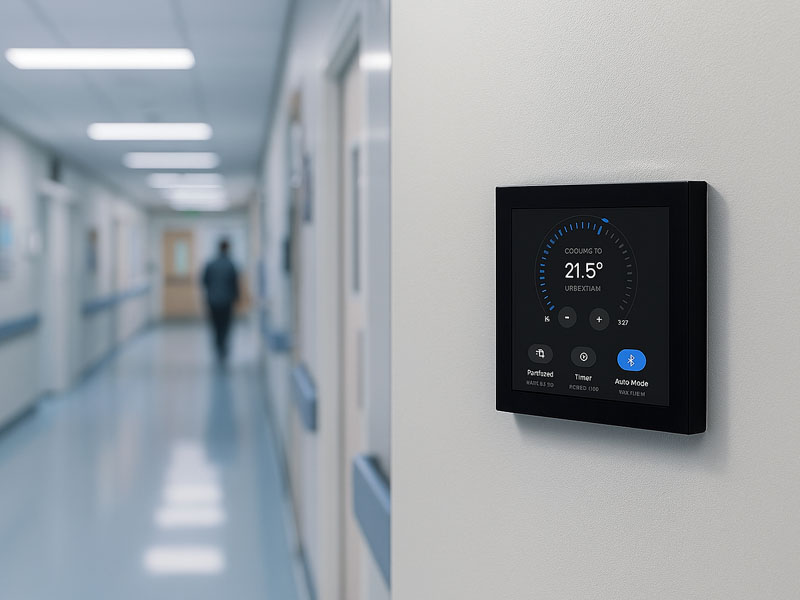
YC-SM10P
10.1 inch Smart Home Control Panel
Essential Phases of PCBA Design for Smart Panels
Creating a PCBA for a smart control panel encompasses multiple engineering phases.
The process generally initiates with system architecture design, during which engineers establish the processor platform, memory configuration, and communication requirements tailored to application specifications.
Following this is the schematic design phase, where all electronic components and circuits are meticulously outlined.
Subsequently, PCB layout design is conducted to ensure appropriate signal routing, power distribution, and thermal optimization.
Upon completion of the design, prototype manufacturing and testing are performed to confirm functionality prior to the commencement of mass production.
Ultimately, the design is transitioned to large-scale manufacturing, where the emphasis shifts to consistency and quality control.
Manufacturing Considerations for Smart Control Panel PCBA
In large-scale production, the manufacturing of PCBA must guarantee high reliability and uniformity across all units.
This necessitates accurate component placement, automated soldering techniques, and rigorous quality inspection protocols.
Manufacturers are also required to adhere to international certifications such as CE, FCC, and RoHS, particularly for the global smart home and building automation sectors.
Testing protocols generally encompass functional testing, power-on validation, communication assessments, and long-term aging evaluations to confirm durability.
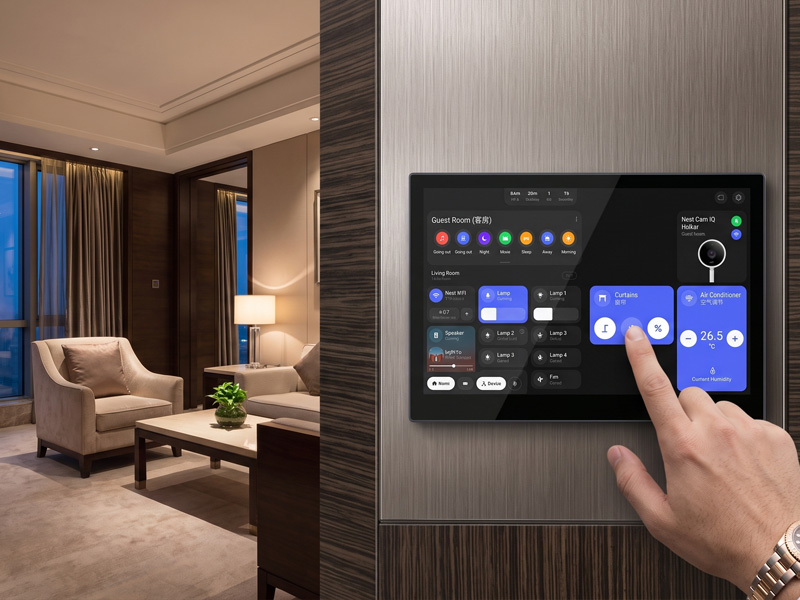
smart home control panel
Integration with Smart Control Panel Systems
A well-structured PCBA should facilitate seamless integration with smart control panel software and operating systems.
In contemporary designs, PCBA boards are typically constructed around platforms like Rockchip SoCs, which support Android or Linux systems.
This enables the control panel to operate sophisticated user interfaces while concurrently managing background automation processes.
The PCBA also interfaces with external systems via protocols such as:
- KNX for building automation
- RS485 for HVAC systems
- MQTT for IoT communication
- Ethernet and WiFi for cloud connectivity
This multi-protocol functionality is crucial for modern smart building ecosystems.
Manufacturing Considerations for Smart Control Panel PCBA
In the context of mass production, the manufacturing of PCBA must prioritize high reliability and uniformity across all units.
This necessitates accurate component placement, automated soldering techniques, and rigorous quality inspection protocols.
Manufacturers are also required to adhere to international certifications such as CE, FCC, and RoHS, particularly for the global smart home and building automation sectors.
Testing protocols generally encompass functional testing, power-on validation, communication assessments, and long-term aging evaluations to guarantee durability.
Integration with Smart Control Panel Systems
A well-engineered PCBA should facilitate seamless integration with smart control panel software and operating systems.
In contemporary designs, PCBA boards are typically constructed around platforms like Rockchip SoCs, which support Android or Linux operating systems.
This configuration enables the control panel to operate sophisticated user interfaces while concurrently managing background automation processes.
Additionally, the PCBA interfaces with external systems via protocols such as:
- KNX for building automation
- RS485 for HVAC systems
- MQTT for IoT communication
- Ethernet and WiFi for cloud connectivity
This multi-protocol functionality is crucial for the modern smart building ecosystem.
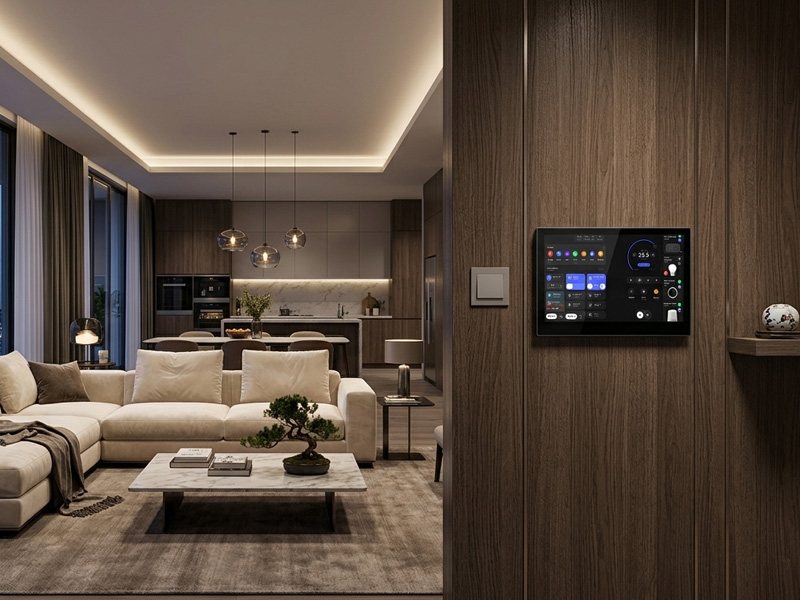
smart home control panel-1
Customization in PCBA Design (OEM/ODM Services)
A key element in the development of smart control panel PCBA is customization.
OEM and ODM services enable clients to create PCBA solutions that are specifically designed to meet unique project needs.
This encompasses hardware customization, including the selection of processors, configuration of interfaces, and design of power systems.
Additionally, it involves considerations for software compatibility, ensuring that the PCBA operates effectively with Android or Linux firmware.
Moreover, manufacturers can modify form factors to accommodate various panel sizes, such as 4-inch, 5-inch, 10-inch, or larger wall-mounted displays.
Applications of Smart Control Panel PCBA Boards
Smart control panel PCBA boards find applications in a diverse array of industries.
In smart homes, they facilitate wall-mounted control interfaces for lighting, HVAC, and security systems.
In hotels, they support automation of guest rooms and centralized service management.
In office buildings, they are utilized for scheduling meetings, controlling environmental conditions, and managing energy consumption.
In industrial settings, they assist in monitoring systems and controlling equipment interfaces.
In all these contexts, the PCBA guarantees stable performance and dependable communication between hardware and software systems.
Portworld Smart Control Panel PCBA Solutions
In practical applications, manufacturers like Portworld offer smart control panel PCBA design and manufacturing services specifically tailored for smart home and building automation systems.
Portworld’s engineering expertise generally includes:
Custom PCBA design utilizing Rockchip embedded platforms, support for Android and Linux operating systems, integration of KNX, RS485, and MQTT communication protocols, industrial-grade PCB manufacturing for enhanced long-term stability, and OEM/ODM services that encompass hardware, firmware, and system integration.
These solutions are extensively employed in smart apartments, hotels, commercial buildings, and IoT automation initiatives.