
RK3566 vs. RK3568: Which Embedded Mainboard Fits Your Project Requirements?
When evaluating an embedded mainboard for applications such as smart control panels, industrial human-machine interfaces, commercial displays, or Internet of Things devices, the selection process extends beyond processor considerations alone. Critical factors including connectivity infrastructure, display interface options, expansion capabilities, energy efficiency, software ecosystem compatibility, and anticipated long-term product lifecycle requirements collectively determine whether a given platform aligns with project specifications.
Rockchip’s RK3566 and RK3568 represent two processor options frequently assessed for embedded Linux and Android implementations. Both incorporate a quad-core Arm Cortex-A55 central processing unit and Mali-G52 graphics processing capabilities, with support for 4K-resolution video decoding functionality. Nevertheless, the interface specifications and corresponding mainboard architectures constructed around these processors demonstrate substantial differentiation.
For development teams prioritizing cost-effectiveness in embedded platform selection, the RK3566 may deliver the requisite functionality. Conversely, for applications demanding enhanced networking capabilities, multiple display support, or expanded hardware integration flexibility, the RK3568 warrants thorough evaluation.
Optimal platform selection hinges upon comprehensive system architecture assessment rather than isolated processor performance metrics.
RK3566 versus RK3568: Examining the Fundamental Distinctions
The RK3566 and RK3568 demonstrate considerable architectural similarities, rendering both processors appropriate for diverse embedded computing implementations. The significance of their distinctions becomes apparent when transitioning from elementary application processing to comprehensive system-level integration.
In accordance with Rockchip’s official technical documentation, both processors incorporate a quad-core Cortex-A55 central processing unit and Mali-G52 graphics architecture. Both processors likewise facilitate 4K video decoding capabilities, 1080p video encoding functionality, and an embedded neural processing unit with a performance rating of approximately 1 TOPS as specified in the manufacturer’s technical literature.
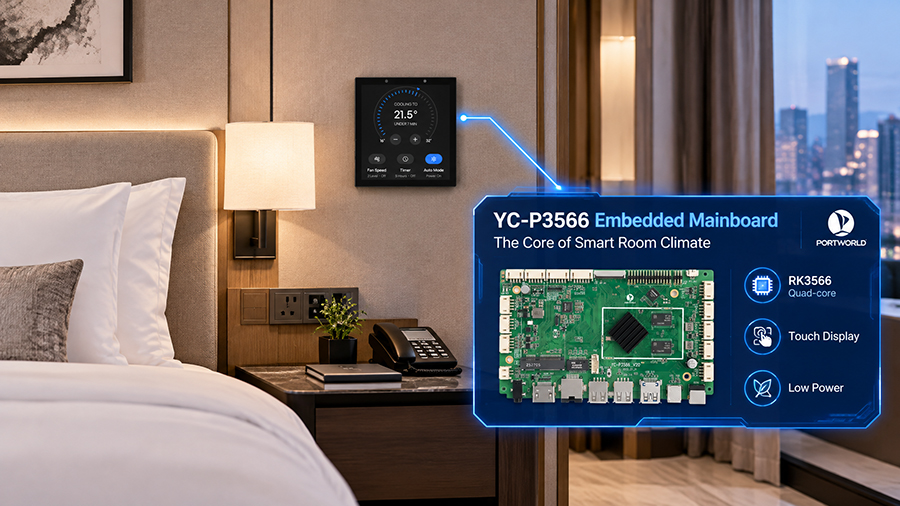
YC-P3566-smart home control panel
| Specification | RK3566 | RK3568 |
|---|---|---|
| CPU | Quad-core Cortex-A55, up to 1.8 GHz | Quad-core Cortex-A55, up to 2.0 GHz |
| GPU | Arm Mali-G52 | Arm Mali-G52 |
| AI acceleration | Integrated NPU; commonly specified at 1 TOPS | Integrated NPU; commonly specified at 1 TOPS |
| Video decoding | Up to 4K at 60 fps, depending on codec and configuration | Up to 4K at 60 fps, depending on codec and configuration |
| Video encoding | 1080p-class encoding | 1080p-class encoding |
| Display capabilities | Generally suited to single-display designs; implementation depends on the board | Supports multi-display configurations; implementation depends on the board |
| Connectivity and expansion | Suitable for mainstream embedded designs | Offers additional high-speed interface options at the SoC level |
| Typical positioning | Compact, cost-conscious embedded products | Connectivity-intensive and more expandable embedded systems |
Specifications derive from Rockchip’s official processor documentation. The actual performance capabilities, interface accessibility, memory capacity, and display compatibility are contingent upon the particular mainboard architecture and the underlying software framework.
The principal consideration is that the RK3568 does not represent a fundamentally distinct processor category. Its primary advantages typically manifest in elevated CPU operating frequencies and expanded system-level interface options, rather than substantial modifications to CPU design or graphics capabilities.
For numerous applications, the RK3566 delivers adequate computational resources. Investing in a more versatile platform becomes justified when the application can genuinely leverage those supplementary functionalities.
When Should RK3566 Be Selected?
The RK3566 constitutes a suitable selection for embedded systems requiring responsive graphical interfaces, dependable application execution, multimedia capabilities, and a space-efficient hardware footprint.
Consider an intelligent home management interface that regulates illumination, window coverings, climate control, and automated routines. Should the interface execute primarily a single-purpose application and interface with one display output, the RK3566 may furnish sufficient processing capacity without necessitating a more sophisticated system design.
This principle extends to numerous IoT communication hubs, data collection platforms, security verification systems, and compact embedded processing units. Such applications may require network connectivity, serial interfaces, tactile input mechanisms, and wireless communication capabilities, yet they do not inherently demand multiple high-definition visual outputs or comprehensive expansion connectivity options.
An RK3566 mainboard can prove advantageous when product dimensions, component expenses, and power consumption represent critical considerations. A reduced board footprint may facilitate enclosure design simplification and minimize the spatial requirements for deployment.
Portworld’s YC-P6602 RK3566 mainboard exemplifies this methodology. According to Portworld’s published comparison, the P6602 functions as a compact embedded platform designed for smart home nodes, sensor hubs, and automation devices. Its specified configuration incorporates a MIPI DSI display interface alongside embedded I/O capabilities including RS485, RS232, UART, and sensor-related interfaces.
For OEM manufacturers developing specialized control devices, such a platform can mitigate unnecessary hardware complexity. Rather than selecting the most feature-rich processor available, the project may commence with a board that satisfies its genuine display, connectivity, and software specifications.
When Should You Consider RK3568?
RK3568 emerges as a more compelling option when a product demands supplementary connectivity, multiple display outputs, or enhanced expansion capabilities.
Consider an industrial HMI requiring communication with a controller through one network interface while simultaneously connecting to an enterprise network via another. A commercial display system may necessitate a distinct display interface compared to a compact smart home panel. An industrial gateway may require expansion hardware for storage, communications, or supplementary peripherals.
At the SoC level, RK3568 supports dual-display configurations and additional high-speed interfaces, including PCIe 3.0 and multiple USB 3.0 connections. The actual interfaces available to an application depend on the selected package, PCB design, and mainboard implementation.
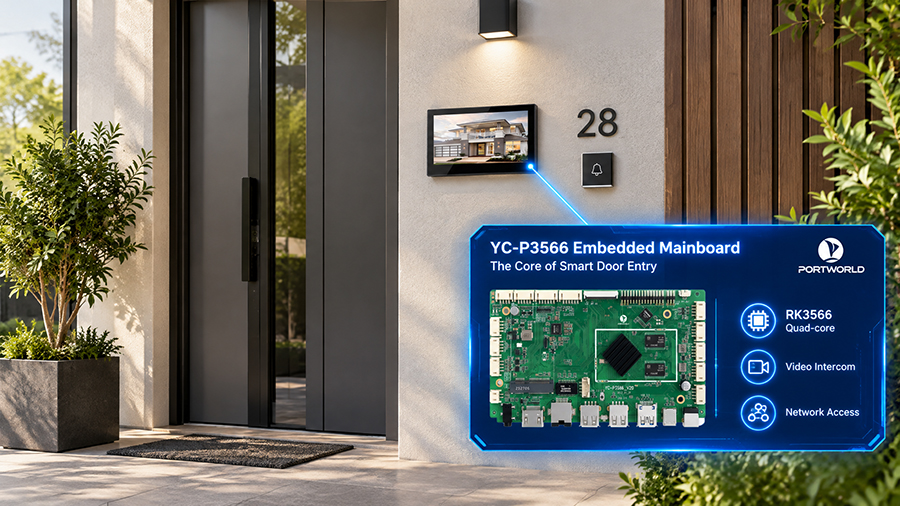
YC-P3566 Smart home control panel
The RK3568 merits consideration when a design requires capabilities beyond those of a fundamental embedded computing platform.
Portworld provides two RK3568-based implementations featuring distinct hardware specifications.
The YC-P6801 addresses applications requiring equilibrium between computational performance and physical board size. According to Portworld’s published specifications, this RK3568 platform incorporates a 100 Mbps Ethernet interface with PoE capability, supplemented by MIPI DSI and eDP display connectivity options.
The YC-P6802 serves applications demanding enhanced connectivity options. Its documented specifications feature dual Gigabit Ethernet ports with PoE support on a single port, alongside MIPI DSI and eDP display interfaces. These specifications warrant evaluation for expansive intelligent control panels, commercial display infrastructure, and embedded systems with elevated networking demands.
These instances demonstrate that processor designation comparison alone proves insufficient. Two circuit boards utilizing different processors—or even identical processors—may provide markedly different interface options and physical configurations.
Display Architecture Considerations: Single or Multiple Screens?
Display architecture represents one of the most significant factors to evaluate when deciding between the RK3566 and RK3568 processors.
For single-display applications, including wall-mounted smart home control panels or specialized industrial control systems, the RK3566 may prove adequate provided its display interface aligns with your selected screen. Display resolution, touch-controller compatibility, graphics rendering capabilities, and software support require thorough verification.
The RK3568 merits consideration when your project demands multiple display outputs or enhanced flexibility regarding display interface selection. A control system might require driving a primary touchscreen in conjunction with a secondary status display, or a commercial application might necessitate an interface combination unavailable on more compact boards.
Nevertheless, processor-level dual-display capability does not guarantee that every RK3568 mainboard implementation can simultaneously operate two screens. The board must provide the requisite interfaces, deliver adequate power and signal routing, and incorporate compatible drivers alongside appropriate software configuration.
Prior to board selection, verify the following:
- The quantity of displays requiring simultaneous operation.
- The resolution and refresh rate specifications for each display.
- Whether the display employs MIPI DSI, eDP, HDMI, LVDS, or an alternative interface standard.
- Whether touch input functionality is integrated and supported.
- Whether the operating system and graphics software stack support your intended configuration.
- For original equipment manufacturer projects, confirming these specifications before finalizing printed circuit board design and enclosure specifications can prevent costly redesign efforts.
- Connectivity and Expansion: Mainboard Requirements Assessment
- Connectivity frequently represents a more critical consideration than processing capacity alone.
A compact intelligent control interface may require only Ethernet, Wi-Fi, Bluetooth, and a serial connection. An industrial gateway system, however, typically demands multiple Ethernet ports, USB device support, storage capabilities, or supplementary communication protocols.
The RK3568’s extensive high-speed interface options deliver enhanced adaptability for such implementations. Nevertheless, the presence of any particular interface must be validated against the relevant board schematic and technical documentation.
For instance, a dual-Gigabit-Ethernet configuration proves advantageous when equipment must isolate distinct network segments or accommodate sophisticated network architectures. A single-Ethernet configuration may prove entirely sufficient for a specialized display control device.
Similarly, RS485, RS232, CAN, GPIO, and comparable industrial interfaces frequently prove indispensable for industrial system integration. Their availability should be assessed at the mainboard specification level, as processor-supported peripheral capabilities are not uniformly implemented across all boards.
Should the application require Modbus RTU, KNX, or comparable industrial or building automation standards, the physical interface represents merely the preliminary requirement. Firmware development, driver support, protocol stack implementation, and compatibility validation must receive equal consideration.
The optimal mainboard selection is one that accommodates the comprehensive communication framework while avoiding superfluous elements or unwarranted complexity.
Software Compatibility: Android, Linux, and Application Development
Both the RK3566 and RK3568 processors are suitable for embedded systems that operate on platforms such as Android and Linux, contingent upon the software support provided by the mainboard manufacturer and the specific configuration chosen. Portworld identifies Android, Ubuntu, Buildroot, and Debian as operating systems that are compatible with its YC-P6602, YC-P6801, and YC-P6802 product platforms.
In the context of an OEM project, the processor represents merely one component of comprehensive software planning. Purchasers must verify the accessibility of a board support package, kernel and driver support, SDK documentation, and the requisite tools for application development and maintenance.
Android proves advantageous for products requiring touchscreen-based applications, sophisticated graphical interfaces, or compatibility with an established Android software ecosystem. Linux-based systems offer benefits when products demand enhanced control over the embedded software architecture, background operations, or system parameters.
Transitioning between the RK3566 and RK3568 may necessitate software modifications. Despite similarities in application logic, variations in board-specific device trees, peripheral drivers, display settings, and foundational initialization procedures may be present.
Regarding sustained production operations, the reliability and ongoing support of the software package can be equally significant as the processor itself. Purchasers should investigate which operating system versions receive support, whether source-code customization is obtainable, and the procedures for software updates and resolution of identified defects.
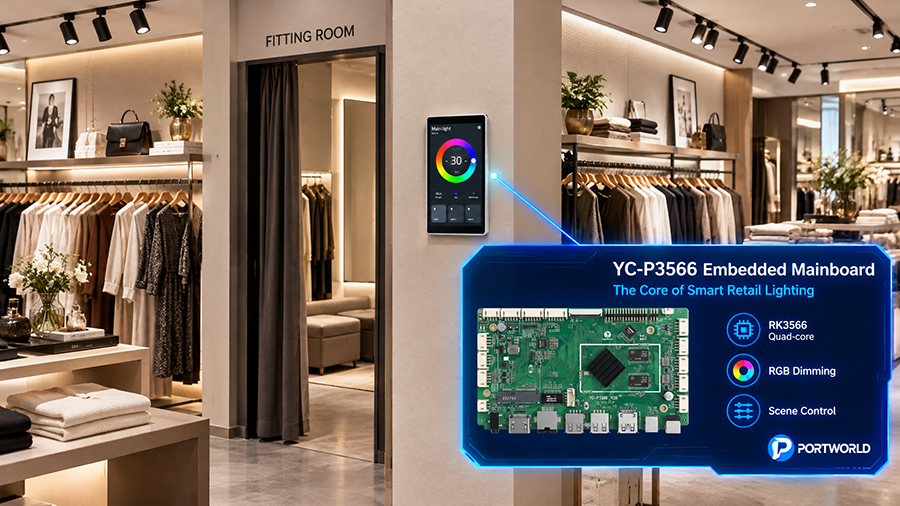
YC-P3566 Smart Mainboard
The decision between RK3566 and RK3568 must account for the device’s power consumption and thermal management requirements.
The RK3566 may prove adequate for applications featuring a single display, minimal peripheral components, and a focused functional purpose. A streamlined hardware architecture can diminish the total component count and facilitate compliance with power and physical enclosure specifications.
The RK3568 may deliver meaningful benefits when the application demands enhanced connectivity or scalability options. Nevertheless, actual power draw and thermal performance are contingent upon the complete system design, encompassing RAM, storage capacity, network connectivity, display requirements, peripheral utilization, and power management circuitry.
No absolute principle exists stating that all RK3566 implementations will necessarily consume less power than all RK3568 implementations. Evaluation should be conducted using the specific board configuration and operational workload intended for deployment.
Overall project expenditure extends considerably beyond the mainboard cost alone. Design engineering, software development, regulatory compliance, mechanical enclosure engineering, quality assurance, supply chain coordination, and ongoing product support all contribute substantially to the total cost of ownership for an embedded system.
A lower-priced board represents the optimal selection when it fulfills all critical functional requirements. A more feature-rich board may demonstrate superior economic value throughout the product’s operational lifetime by eliminating supplementary hardware, avoiding complex technical solutions, or preventing the necessity for subsequent system redesign.
Which Platform Fits Your Application?
The following examples provide a practical starting point for platform selection.
| Project type | Platform to evaluate first | Why |
|---|---|---|
| Single-screen smart home control panel | RK3566 | Often sufficient for dedicated touch interfaces |
| Compact sensor hub or embedded controller | RK3566 | Suitable when the required I/O fits the board |
| Mid-sized smart control panel | RK3566 or RK3568 | Depends on display interfaces, software, and connectivity |
| Industrial gateway with multiple network connections | RK3568 | Additional networking and expansion options may be useful |
| Commercial display requiring flexible display interfaces | RK3568 | Worth evaluating for multi-display and interface requirements |
| Industrial HMI with extensive peripherals | RK3568 | May provide more flexibility for system integration |
This table is a guide rather than a strict rule. The specific mainboard configuration matters: an RK3566 board with the required interfaces may be a better fit than an RK3568 board that lacks them.
How Portworld Supports Embedded Mainboard Projects
For embedded hardware manufacturers, selecting the right processor is only the first step. The chosen platform must also fit the enclosure, display, communication interfaces, operating system, application software, and production plan.
Portworld provides embedded mainboards and OEM/ODM services for smart control panels, IoT devices, industrial interfaces, and commercial display applications.
Its RK3566- and RK3568-based platforms provide different starting points for hardware integration. The YC-P6602 is a compact RK3566 option, while the YC-P6801 and YC-P6802 offer RK3568 configurations with different board dimensions, networking capabilities, and interface arrangements.
Depending on project requirements, development discussions can cover hardware configuration, PCBA customization, operating system adaptation, driver and application integration, enclosure design, and manufacturing preparation.
For companies developing a new product, starting with a suitable existing platform can help reduce duplicated engineering work. If the standard board does not expose the required interfaces or fit the mechanical design, a more customized hardware solution may need to be evaluated.

