How Does a Digital Signage Display Work?
Digital signage displays have emerged as a crucial communication tool for businesses, supplanting traditional posters and static signs with engaging digital content. These systems enable organizations, ranging from retail outlets and airports to hospitals and smart offices, to showcase videos, advertisements, announcements, and real-time information via connected commercial screens.
But what is the operational mechanism of a digital signage display? A comprehensive digital signage system integrates display hardware, media processing equipment, network connectivity, and content management software to efficiently deliver and control digital content.
The Fundamental Operating Principle of a Digital Signage Display
A digital signage system operates through three primary components:
1. Digital Signage Display Hardware
2. Media Player or Embedded Computing System
3. Content Management System (CMS)
The CMS transmits digital content to the media player, which processes the data and presents it on the screen. Through network communication, operators can remotely update and manage multiple displays.
The basic workflow is as follows:
Create Content → Upload to CMS → Send Through Network → Process by Media Player → Display on Screen

ultra thin hanging advertising screen
1. Digital Signage Display Hardware
The display is the visible component for users. Unlike consumer televisions, commercial digital signage displays are engineered for prolonged operation and professional settings.
Common types of displays include:
- Wall-mounted digital signage displays
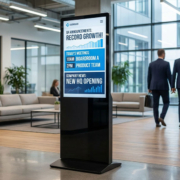
- Floor-standing kiosks
- Interactive touchscreen displays
- Stretched bar displays
- Outdoor high-brightness displays
- Double-sided hanging displays
Commercial displays typically offer:
- 24/7 operational capability
- Industrial-grade components
- High brightness panels
- Wide viewing angles
- Multiple installation options
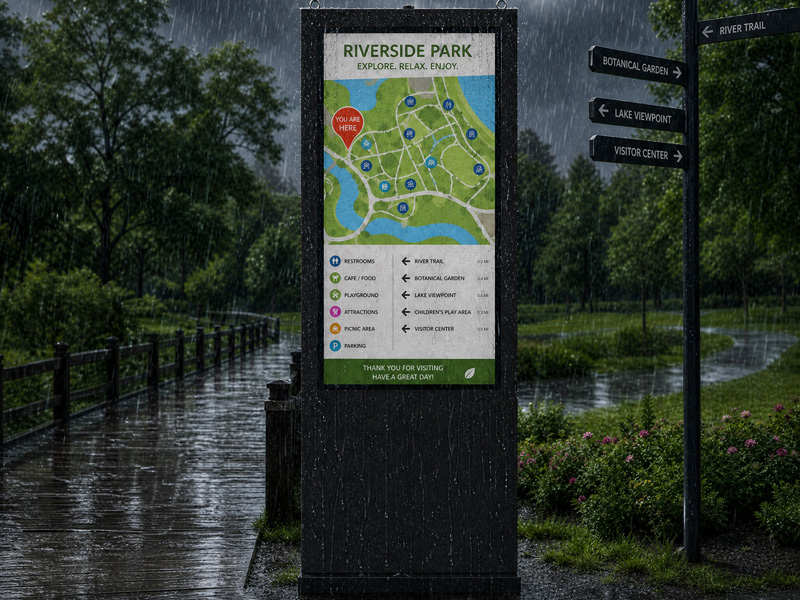
For instance, outdoor digital signage utilized at bus stops or tourist attractions may necessitate:
- 1500–3000 nits brightness
- IP65 waterproof protection
- IK10 anti-vandal glass
- Wide temperature operation
These specifications guarantee consistent visibility in sunlight and challenging environments.
Advertising Digital Signage
2. Media Player: The Core of Digital Signage
The media player plays a crucial role in receiving, processing, and displaying content.
In traditional setups, an external media player is typically connected via HDMI. In contrast, many contemporary digital signage displays feature an integrated computing system within the display itself.
Embedded digital signage systems frequently utilize processors such as:
- Rockchip RK3566
- RK3568
- RK3576
- RK3588
These platforms are capable of supporting:
- 4K video playback
- Various media formats
- Touch interaction
- AI applications
- Remote device management
The operating systems may consist of:
- Android
- Linux
- Debian
- Windows
The selection of an operating system is contingent upon the specific application requirements and software compatibility.
digital signage display
3. Content Management System (CMS)
The CMS empowers users to manage the content displayed on digital signage screens.
Rather than updating each display individually, operators can oversee hundreds or even thousands of devices from a single platform.
A CMS can offer:
- Remote content updates
- Scheduling for videos and images
- Playlist management
- Control across multiple locations
- Device monitoring
- Management of advertising campaigns
For instance, a retail brand with outlets in various cities can update promotional content across the nation from a centralized office.
How Content Is Delivered to Digital Signage Displays
Digital signage content can be transmitted using various methods:
Cloud-Based Management
The display interfaces with an online CMS platform via:
- Ethernet
- WiFi
- 4G/5G networks
Users have the capability to upload and schedule content remotely at any time.
Local Playback
For straightforward applications, content can be directly played using:
- USB drives
- SD cards
- Internal storage
This approach is frequently utilized for standalone advertising displays.

Digital Signage Display
Enterprise Network Deployment
Large organizations may link displays to internal networks to ensure secure content management.
Applications encompass:
- Airports
- Hospitals
- Banks
- Government buildings
How Content Is Delivered to Digital Signage Displays
Digital signage content can be transmitted using various methods:
Cloud-Based Management
The display interfaces with an online CMS platform via:
- Ethernet
- WiFi
- 4G/5G networks
This allows users to upload and schedule content remotely at any time.
Local Playback
For straightforward applications, content can be directly played using:
- USB drives
- SD cards
- Internal storage
This approach is typically employed for standalone advertising displays.
Enterprise Network Deployment
Large organizations may link displays to internal networks to ensure secure content management.
Applications include:
- Airports
- Hospitals
- Banks
- Government buildings

Advertising Digital Signage
Interactive Digital Signage: Beyond Mere Display
Contemporary digital signage systems are evolving to become interactive by incorporating touchscreens and intelligent modules.
Additional functionalities may encompass:
- Capacitive touchscreens
- Cameras
- NFC/RFID readers
- QR code scanning
- Sensors
- Voice interaction
These technologies facilitate applications such as:
- Self-service kiosks
- Visitor registration
- Smart wayfinding
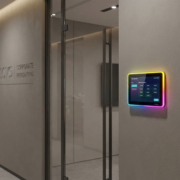
- Meeting room booking
- Access control systems
For instance, a touchscreen kiosk in a hospital can enable visitors to check their appointments, locate departments, and obtain navigation assistance.
How Digital Signage Operates Across Various Industries
Retail
Retail establishments utilize digital signage to showcase:
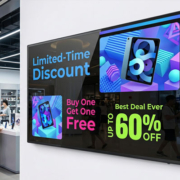
- Product promotions
- Advertising videos
- Price information
- Brand campaigns
Stretched bar displays are particularly favored for shelf-edge advertising due to their compatibility with narrow retail environments.
Transportation
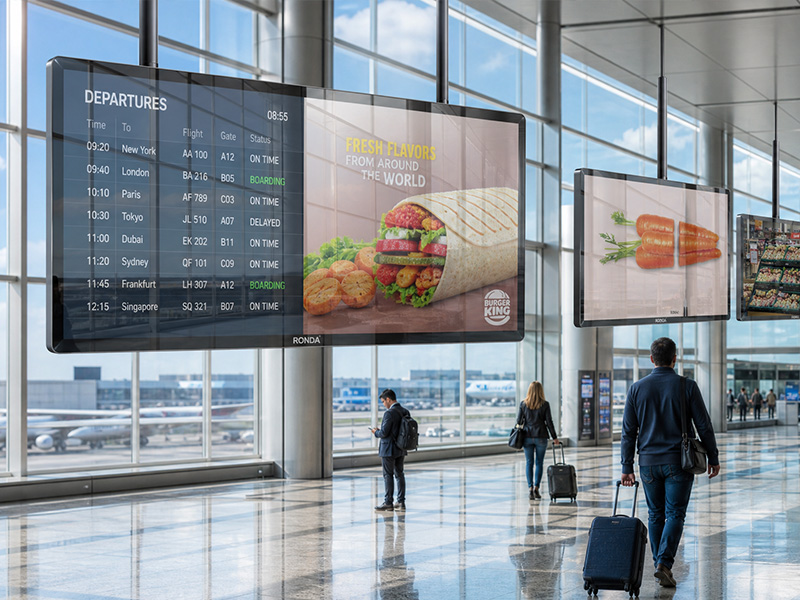
Airports, train stations, and bus stops employ digital signage for:
– Schedule information
– Navigation assistance
– Public announcements
– Advertising
Healthcare
Hospitals implement digital signage for:
- Patient queue management
- Departmental information
- Medical education content
- Smart Offices
Organizations utilize digital displays for:
- Meeting room scheduling
- Visitor management
- Internal communication
Portworld Digital Signage Solutions
Portworld offers tailored digital signage hardware solutions designed for commercial and industrial use on a global scale.
With capabilities in OEM/ODM, Portworld provides support for:
- Android/Linux digital signage displays
- Interactive touchscreen kiosks
- Outdoor advertising displays
- Stretched bar displays
- Meeting room panels
- Custom PCBA and embedded systems
- CMS and software integration
From the design of hardware and development of firmware to large-scale production, Portworld assists clients in creating personalized digital signage solutions across various industries.
A digital signage display operates by integrating display hardware, embedded computing, network connectivity, and content management software to facilitate dynamic digital communication.
Whether utilized for advertising, information dissemination, customer engagement, or smart building functionalities, digital signage offers businesses a versatile and effective means of communication.