
AI Edge Computing: The Hidden Infrastructure Behind the Future of Humanoid Robots
Humanoid robots are emerging as one of the most fascinating technologies in the realm of artificial intelligence. With developments in embodied AI, VLA (Vision-Language-Action) models, and world models, these robots are evolving from mere programmed movements to engaging intelligently with the real world.
However, creating a genuinely intelligent robot necessitates more than just a robust mechanical framework.
A humanoid robot must consistently gather information, comprehend its surroundings, process intricate data, and make real-time decisions. Behind every intelligent action lies a sophisticated computing system operating in the background.
This underscores the importance of AI edge computing as a vital infrastructure for the forthcoming generation of robotics.
From Robot Control to Robot Intelligence
Conventional industrial robots primarily adhere to pre-established instructions. While their movements are precise, their capacity to adapt to fluctuating environments is restricted.
Contemporary intelligent robots demand an entirely different methodology.
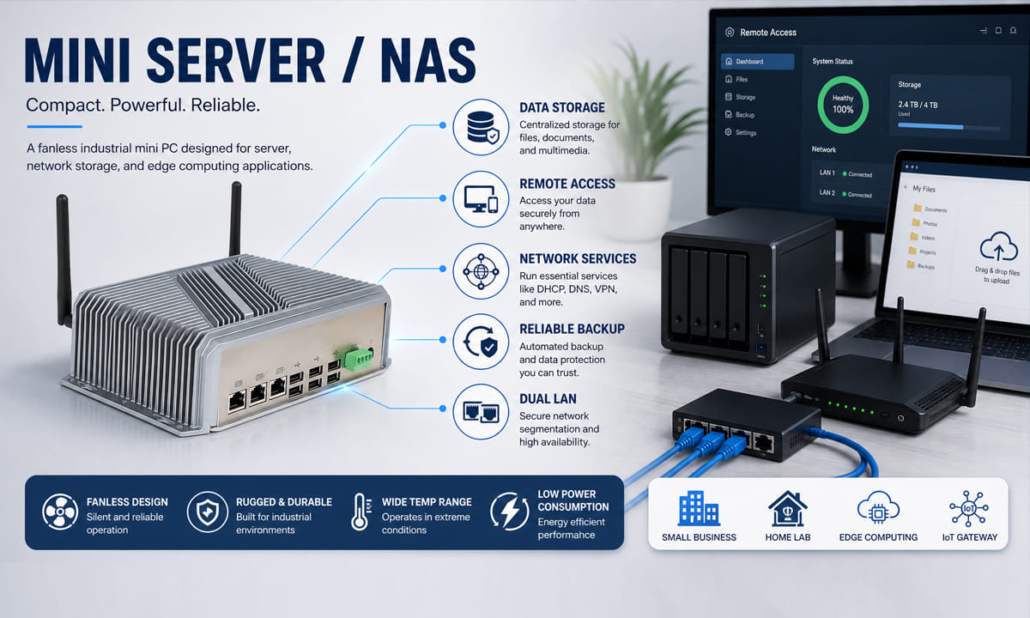
YC-T720U AI Edge Computing IoT Box
A humanoid robot should be capable of:
- Recognizing objects and environments
- Understanding human commands
- Predicting potential outcomes
- Dynamically adjusting movements
- Learning from past experiences
For instance, when a robot is given the command:
“Pick up the bottle and place it on the shelf.”
The robot must:
- Identify the bottle through visual perception.
- Comprehend the intention behind the task.
- Calculate the trajectory for movement.
- Control its motors and joints.
- Modify its actions based on real-time feedback.
All these operations necessitate swift and dependable computing capabilities.
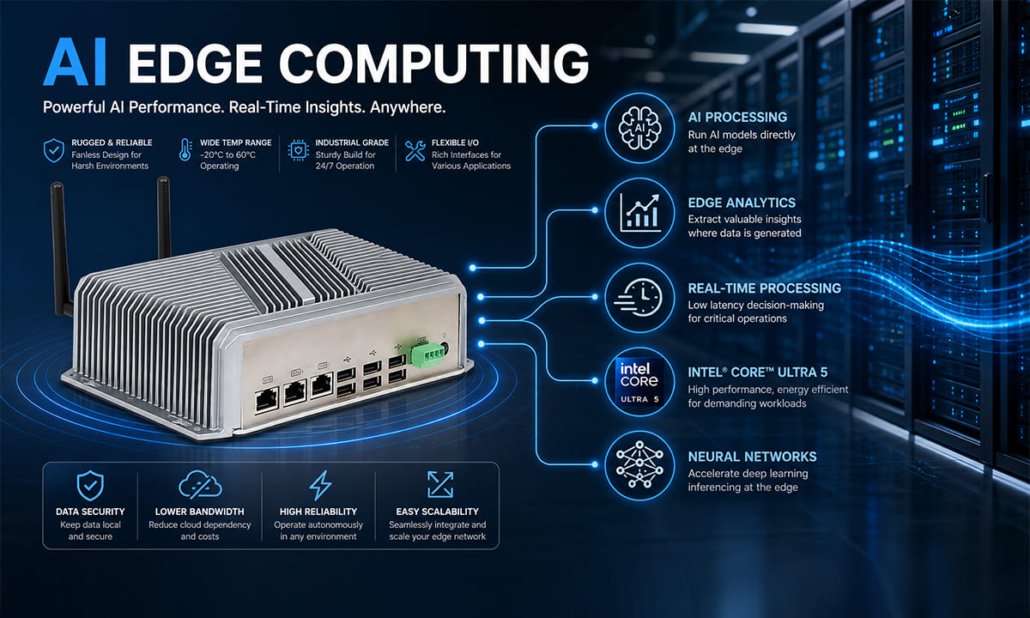
YC-T720U AI Edge Computing IoT Box
The Importance of Edge AI Computing in Robotics
Real-Time Processing with Minimal Latency
While cloud computing offers substantial processing capabilities, robots frequently function in settings that necessitate prompt reactions.
AI edge computing facilitates the processing of data in proximity to the robot, thereby minimizing communication lags and enhancing real-time efficiency.
This is particularly crucial for:
- Autonomous mobile robots
- Humanoid robots
- Industrial robotic arms
- Smart manufacturing systems
Managing Multimodal Robot Data
Contemporary robots depend on various data sources, such as:
- Cameras
- LiDAR sensors
- Microphones
- Force sensors
- Motion controllers
These instruments produce vast quantities of data every second.
AI edge computing platforms are capable of locally processing and analyzing this data, allowing robots to better comprehend their environment.
Facilitating AI Model Deployment at the Edge
As VLA models and AI algorithms advance, robots necessitate computing platforms that can execute AI inference directly on the device.
High-performance embedded platforms can accommodate:
- Computer vision applications
- Deep learning inference
- Object recognition
- Natural language interaction
- Motion planning
This capability enables robots to function more autonomously without complete dependence on cloud services.
The Connection Between Robot Data and Edge Computing
Data serves as the cornerstone of embodied intelligence.
In the training and deployment of robots, a comprehensive workflow typically encompasses:
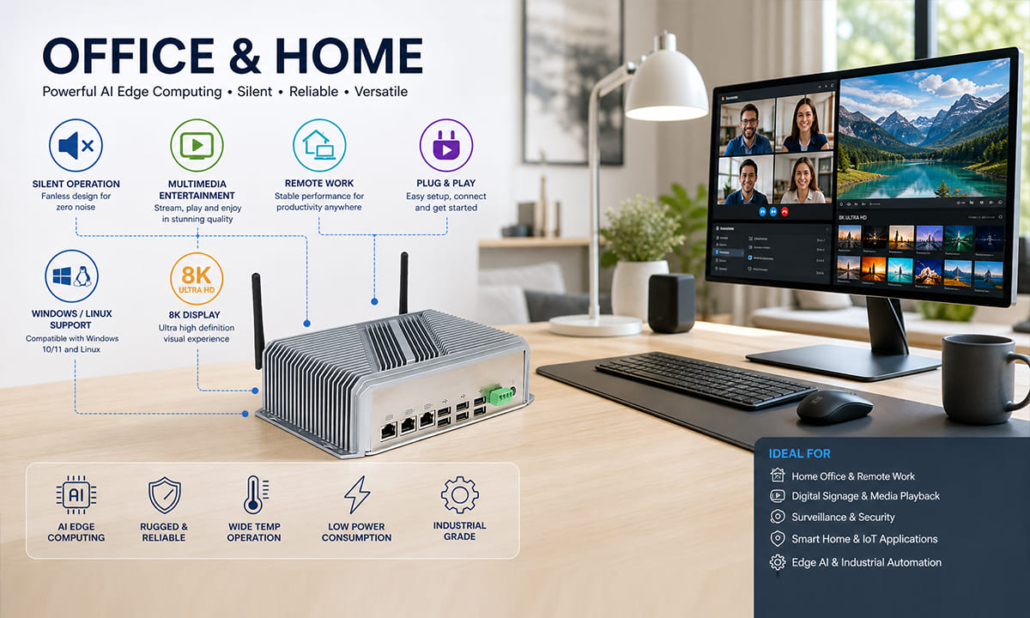
YC-T720U AI Edge Computing IoT Box
Data Collection → AI Model Training → Edge AI Deployment → Real-Time Robot Interaction
Data collection techniques such as:
- Ego first-person data
- UMI manipulation data
- Teleoperation data
offer valuable insights for AI models.
Post-training, edge computing hardware allows these models to operate effectively within real-world robotic systems.
Embedded Hardware: The Link Between AI and Robotics
In robotics applications, computing hardware must strike a balance between performance, power consumption, size, and reliability.
The forthcoming generation of robots will transcend mere machines executing pre-programmed tasks. They will evolve into intelligent systems endowed with perception, reasoning, and the ability to make autonomous decisions.
This transformation is driven by two critical components:
High-quality training data and robust edge AI computing.
As embodied AI progresses, AI edge computing will assume a more significant role in transitioning humanoid robots from research settings to practical applications in the real world.
The future of robotics encompasses not just the development of more intelligent machines — it also involves establishing the computational infrastructure that enables these machines to attain true intelligence.

