RK3576 Motherboard for Next-Generation Embedded Applications
As embedded products grow more intelligent and connected, hardware platforms must do more than run an operating system. Today’s devices increasingly need to handle AI workloads, control multiple peripherals, support high-resolution displays, and communicate reliably with industrial equipment.
The Rockchip RK3576 is built to meet these demands. With an octa-core CPU, integrated AI NPU, Mali-G52 GPU, and extensive connectivity options, it offers a flexible foundation for next-generation embedded systems.
For manufacturers creating industrial terminals, smart devices, robotics platforms, and edge AI products, an RK3576 motherboard can provide a practical balance of computing performance, power efficiency, and hardware integration.
1. What Makes the RK3576 Suitable for Embedded Applications?
The RK3576 is a 64-bit AIoT processor developed by Rockchip. Its architecture brings together high-performance and energy-efficient CPU cores, integrated graphics, and dedicated AI acceleration.
Its primary hardware capabilities include:
- CPU: Four Cortex-A72 cores running at up to 2.2GHz, paired with four Cortex-A53 cores running at up to 1.8GHz.
- GPU: ARM Mali-G52 MC3 for graphics processing and user-interface rendering.
- NPU: Up to 6 TOPS of INT8 AI computing performance with supported sparse-computing conditions.
- Memory support: LPDDR4, LPDDR4X, and LPDDR5, depending on the motherboard design.
- Display: HDMI, eDP, MIPI DSI, and DisplayPort-related interfaces.
- Connectivity: PCIe 2.1, SATA 3.0, USB 3.0, dual RGMII, CAN FD, UART, SPI, and I2C.
This combination makes the RK3576 well suited to embedded devices requiring both general-purpose computing and selected AI acceleration capabilities.
The NPU supports several precision formats, including INT4, INT8, INT16, FP16, BF16, and TF32. It can run AI inference workloads such as image recognition, object detection, and other edge-intelligence tasks, provided that models are converted and optimized for the available software runtime.
The advertised 6 TOPS figure assumes sparse-computing conditions. Actual inference performance varies according to model architecture, precision, software optimization, memory bandwidth, and workload.
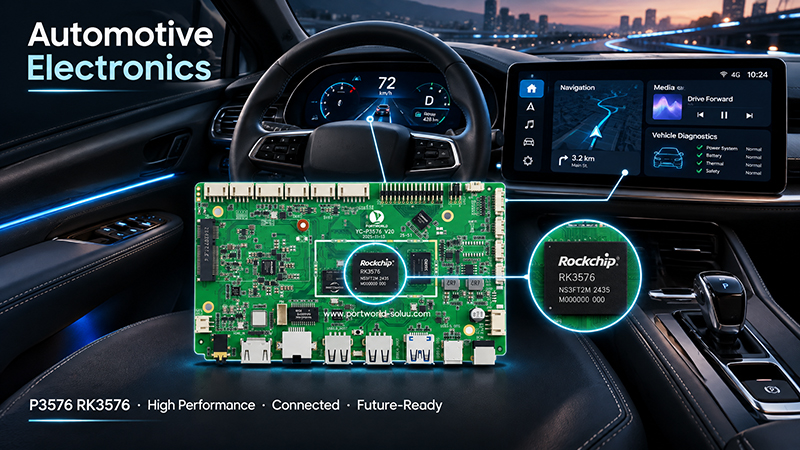
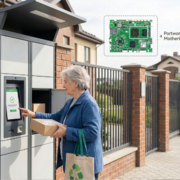
P3576 Automotive Electronics
2. Key Hardware Features of an RK3576 Motherboard
A processor alone does not determine whether a platform is appropriate for a commercial product. Motherboard design, memory configuration, power management, connectors, and peripheral interfaces are just as important.
Octa-Core Processing for Multitasking
With four Cortex-A72 cores and four Cortex-A53 cores, an RK3576 platform can support a range of workloads.
The high-performance cores can handle demanding application processing, while the efficiency cores can run background services and lighter system tasks.
This architecture suits embedded products that must run a graphical interface, communication services, device management software, and application logic at the same time.
Integrated NPU for Edge AI
The built-in NPU can reduce reliance on external AI accelerators for supported inference workloads.
Potential applications include:
- Object detection in smart cameras
- Visual inspection in industrial equipment
- People counting and image analysis
- Intelligent access control
- AI-assisted robot perception
- Local image classification
Before choosing the platform for a production project, developers should assess the supported RKNN toolchain, model conversion requirements, operator compatibility, and real-world inference benchmarks.
Rich Display and Multimedia Capabilities
Many embedded products need more than a standard display output. Industrial control terminals, smart retail systems, and interactive devices may require high-resolution screens or several display interfaces.
Depending on the supported configuration, the RK3576 platform accommodates display technologies such as HDMI 2.1, eDP, MIPI DSI, and DisplayPort. Its display architecture can drive multiple displays using different sources.
The platform also integrates a 16MP image signal processor (ISP) with HDR and 3D noise reduction. This makes it well suited to products that combine cameras, visual interfaces, and on-device image processing.
Industrial Connectivity and Peripheral Expansion
Connectivity is a key consideration in embedded hardware designed for industrial and commercial settings.
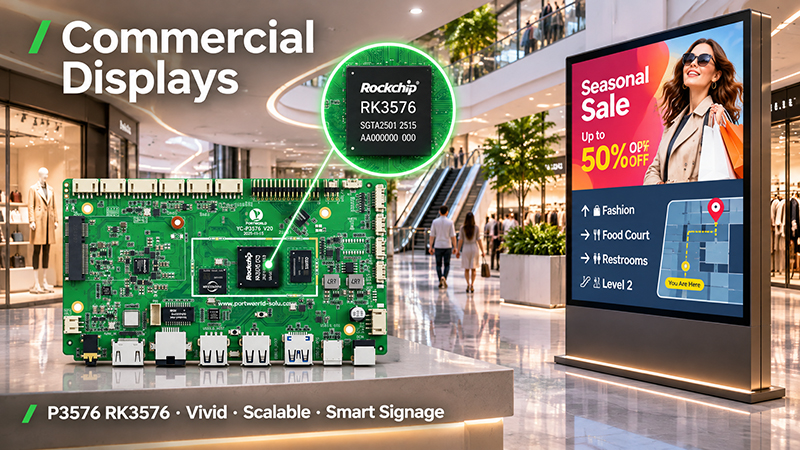
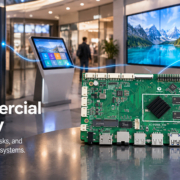
P3576 rk3576 motherboard Commercial Displays
At the SoC level, the RK3576 offers a broad selection of interfaces, including:
- PCIe 2.1 and SATA 3.0 combinations
- USB 3.0
- Dual RGMII Ethernet interfaces
- CAN FD
- UART, SPI, and I2C
- MIPI CSI-2 camera interfaces
- I2S, PCM, and other audio interfaces
These interfaces can connect sensors, cameras, storage devices, network equipment, and industrial controllers.
However, a finished motherboard may not expose every interface provided by the SoC. The connections available in a product depend on the PCB layout, pin multiplexing, connector design, carrier board, and software support.
3. Where Can RK3576 Motherboards Be Used?
The RK3576 combines CPU performance, AI acceleration, multimedia capabilities, and peripheral connectivity, making it well suited to a variety of embedded applications.
Industrial HMI and Control Terminals
Industrial HMI systems must display equipment status and process data while accepting commands from operators.
An RK3576 motherboard can serve as the computing platform for touchscreen control panels, machine interfaces, and industrial monitoring devices.
With appropriate display interfaces and peripheral integration, manufacturers can create customized HMI products for production lines, equipment monitoring, and automation systems.
AI Edge Devices and Machine Vision
Some edge devices must analyze image data locally rather than transmit every frame to a remote server.
Featuring an integrated NPU and a 16MP ISP, the RK3576 platform can support selected machine-vision and AI inference tasks.
Examples include:
- Product inspection systems
- Smart access control terminals
- AI-enabled cameras
- Retail analytics devices
- Visual monitoring equipment
For more demanding vision applications, developers should assess camera bandwidth, memory needs, thermal design, and model performance during prototyping.
Robotics and Autonomous Equipment
Robotic systems commonly integrate sensor communications, motion-control interfaces, visual perception, and application processing.
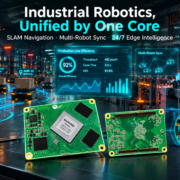
An RK3576 motherboard can provide an embedded computing platform for service and inspection robots, smart cleaning equipment, and other autonomous devices.
It can handle application logic, user interfaces, network communications, and supported AI inference tasks. However, real-time motor control and safety-critical operations may still need dedicated microcontrollers or external control systems.
Smart Retail and Commercial Displays
Smart retail devices increasingly bring together digital content, interactive screens, network connectivity, and local intelligence.
RK3576-based hardware can power interactive advertising players, smart kiosks, information terminals, and commercial display systems.
Its multimedia capabilities and display interfaces accommodate a range of screen configurations, while its processing resources support application software and device management.
Smart Gateways and Industrial IoT
Industrial IoT gateways must gather data from connected equipment, process it, and exchange information with cloud platforms or local servers.
Featuring interfaces such as Ethernet, CAN FD, UART, SPI, and I2C, an RK3576 motherboard can be configured for gateway applications that link a variety of devices and communication modules.
Support for specific protocols, including Modbus and other industrial communication standards, depends on the chosen transceivers, peripheral circuitry, and software implementation.
4. RK3576 SoM vs. RK3576 Custom Motherboard
When developing an embedded product, manufacturers typically choose between using a System on Module (SoM) with a carrier board and building a more integrated motherboard.
Either approach may be appropriate, depending on the project’s development requirements.
RK3576 SoM
A System on Module combines the primary computing components in a compact module. The product developer then creates a carrier board to connect the necessary peripherals and interfaces.
This option is suitable when:
- The product needs a compact computing module.
- The manufacturer aims to reduce the complexity of processor-level hardware design.
- Several products may use the same computing platform.
- The project requires flexibility to customize the carrier board.
A custom motherboard brings the processor, memory, power circuitry, connectors, and necessary peripheral interfaces together on a PCB tailored to a specific project.
This approach is useful when:
- The product has a defined mechanical design.
- The application requires particular connectors and interfaces.
- The manufacturer aims to eliminate unnecessary components.
- The project is advancing toward sustained production.
Developing a custom motherboard may involve substantial upfront engineering, including schematic design, PCB layout, signal-integrity analysis, thermal assessment, and hardware verification.
For some projects, beginning with a SoM and transitioning to a more integrated motherboard after validating functionality can be an effective development strategy.
5. Portworld RK3576 Hardware Solutions
Portworld offers RK3576-based hardware for embedded product development, including the RK3576 SoM and P3576 Smart Mainboard.
Designed to meet different integration needs, these products give developers a choice of hardware foundation for their projects.
Portworld RK3576 SoM
The Portworld RK3576 SoM is intended for embedded products that need a compact computing module and flexible integration with a carrier board.
Key specifications include:
Rockchip RK3576 octa-core processor
4 × Cortex-A72 cores running at up to 2.2GHz + 4 × Cortex-A53 cores running at up to 1.8GHz
Mali-G52 MC3 GPU
Integrated NPU delivering up to 6 TOPS of INT8 performance under supported sparse-computing conditions
- 4GB of onboard LPDDR4 memory
- 38 × 38mm module dimensions
- 240-pin board-to-board connector
- 16MP ISP with HDR and 3D noise reduction
- Linux, Ubuntu, and Android support, depending on BSP configuration
The module’s compact form factor enables developers to design custom carrier boards with the display, communication, storage, and peripheral interfaces their projects require.
For project-specific needs, Portworld can also provide software adaptation, hardware integration, and engineering customization.
Portworld P3576 Smart Mainboard
For projects seeking a more integrated board-level solution, Portworld also provides the P3576 Smart Mainboard.
Built on the RK3576 platform, the board brings together computing hardware, memory, storage, connectivity, and peripheral interfaces.
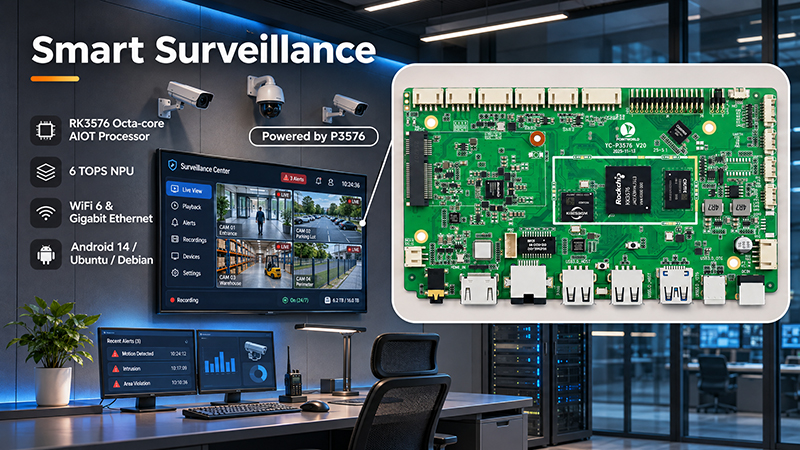
P3576 rk3576 motherboard Smart Surveillance
Its main specifications include:
- RK3576 octa-core processor
- 4GB LPDDR4 memory, with alternative configurations available to meet project requirements
- 32GB eMMC storage, with larger capacities available
- Integrated GPU and NPU
- Wi-Fi 6 connectivity
- Gigabit Ethernet
- MIPI DSI display interface
- I2C, UART, RS485, RS232, speaker, microphone, and other interfaces for project-specific needs
- Software options including Android 14, Ubuntu, Buildroot, and Debian
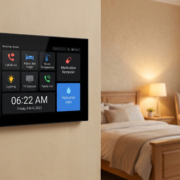
The P3576 Smart Mainboard may be suitable for smart home products, industrial HMI systems, commercial displays, industrial automation equipment, and other embedded applications.
Confirm the precise interface configuration and software support for the selected board revision and project requirements.
6. What to Consider Before Choosing an RK3576 Motherboard?
Selecting an RK3576 motherboard requires more than comparing processor specifications. The hardware should suit the product’s operating environment and manufacturing requirements.
1. Processing and AI requirements
Determine the application’s CPU, GPU, and NPU workloads. For AI inference, test the actual model on the intended software platform rather than relying solely on TOPS ratings.
2. Memory and storage
Estimate the memory needed for the operating system, application software, multimedia processing, and AI models. Assess storage capacity, read and write performance, and data-retention requirements as well.
3. Display and camera connections
Verify the required screen resolution, display interface, number of displays, camera sensors, and available bandwidth.
4. Industrial communication
Identify the necessary interfaces, including Ethernet, RS485, RS232, CAN FD, USB, UART, and GPIO. Confirm that the completed board exposes the required signals and has the appropriate transceivers.
5. Power and thermal design
Assess the power input, peak workload, operating temperature, enclosure, and cooling approach. Thermal testing is especially important for products designed for continuous operation.
6. Software and long-term support
Confirm the availability of the required Android or Linux BSP, device drivers, SDK, documentation, and update strategy. Software compatibility can significantly affect development time and product maintenance.
7. Customization and production planning
For commercial products, consider mechanical dimensions, connector placement, PCB design, certifications, component availability, and expected production volume early in the development process.
Build Your Next Embedded Product with Portworld
The RK3576 offers a powerful hardware platform for next-generation embedded products, bringing together octa-core computing, built-in AI acceleration, multimedia capabilities, and industrial connectivity.
Yet successful product development requires more than a capable processor. It depends on integrating the platform effectively with its display, peripherals, operating system, enclosure, and application software.
Portworld supports embedded hardware development at every stage, from selecting a board and customizing hardware to adapting software and preparing for production.
Our services include:
- RK3576 SoM and motherboard solutions
- Custom PCB and PCBA development
- Carrier-board and peripheral-interface design
- Android, Linux, Ubuntu, and Debian customization
- Hardware and software integration
- SDK and technical documentation
- OEM/ODM customization and mass-production support
Whether you are creating an industrial HMI, an AI edge device, a smart terminal, or a robotics platform, Portworld can help develop an embedded hardware solution tailored to your product requirements.