Matter vs. Zigbee: Which Is Better for Smart Home Automation?
As smart home technology advances, homeowners and system integrators have an expanding range of options for connecting lighting, sensors, thermostats, curtains, and other intelligent devices.
Matter and Zigbee are two technologies often considered in smart home projects. Both enable communication among smart home devices, but they differ in how they operate and in their connectivity, compatibility, and system architecture requirements.
For manufacturers creating smart home control panels, choosing between Matter and Zigbee is not simply about adopting the newer technology. The best option depends on the devices being controlled, the existing automation ecosystem, hardware capabilities, and integration needs.
So, Matter vs. Zigbee: which is better for smart home automation?
1. What Is Matter?
Matter is an open connectivity standard for smart homes that aims to improve interoperability among devices made by different manufacturers.
Rather than requiring each device to rely on its own proprietary ecosystem, Matter offers a shared application-layer protocol. This enables compatible products to communicate across supported smart home platforms.
Matter runs over IP-based networks, including:
- Wi-Fi
- Thread
Bluetooth Low Energy (BLE) is often used during device commissioning, helping a smartphone discover and set up a new Matter device.
Matter supports a range of smart home product categories, such as lights, plugs, sensors, thermostats, door locks, and other compatible devices.
A key benefit is interoperability across platforms. Depending on the device category, controller support, and feature compatibility, a Matter-certified device can operate with multiple compatible ecosystems.
For smart home manufacturers, Matter can help reduce ecosystem fragmentation and simplify product development for different markets.
2. What Is Zigbee?
Zigbee is a low-power wireless communication technology commonly used in smart home automation.
Based on IEEE 802.15.4 radio technology, it is often used with battery-powered sensors, smart switches, lighting products, and other devices that require little power.
Unlike Matter, Zigbee is not an IP-based application-layer standard. Zigbee devices generally communicate through a coordinator or gateway, which manages the network and links devices to other systems.
Common uses for Zigbee include:
- Smart lighting
- Door and window sensors
- Motion detectors
- Temperature and humidity sensors
- Smart switches
- Curtain controllers
- Wireless automation devices
Zigbee is especially useful for creating low-power mesh networks. Routing-capable devices can relay messages on behalf of other devices, expanding network coverage.
For smart home projects involving numerous wireless sensors and switches, Zigbee remains a well-established choice.
smart home control panel-1
3. Matter vs. Zigbee: Key Differences
Although both technologies support smart home automation, they have different architectures and connectivity requirements.
| Comparison | Matter | Zigbee |
|---|---|---|
| Technology type | Application-layer standard | Wireless communication protocol and stack |
| Network architecture | IP-based | IEEE 802.15.4-based mesh networking |
| Connectivity | Wi-Fi, Thread, Ethernet | 2.4GHz and other regional radio bands |
| Device commissioning | Commonly uses BLE | Usually uses Zigbee network joining procedures |
| Gateway requirement | Depends on network and device architecture | Typically requires a Zigbee coordinator |
| Interoperability | Designed for cross-ecosystem interoperability | Depends on Zigbee profiles, clusters, and integration |
| Power consumption | Depends on transport technology and device design | Suitable for low-power devices |
| Mesh networking | Thread-based Matter devices can use Thread mesh | Zigbee supports mesh networking |
| Existing ecosystem | Growing Matter-compatible product ecosystem | Established smart home device ecosystem |
An important distinction is that Matter and Zigbee are not direct replacements in every situation.
Matter defines how compatible smart home devices communicate at the application layer, while Zigbee provides its own networking and application architecture.
4. Matter vs. Zigbee: Which Is Better for Different Smart Home Applications?
The right option depends on the devices involved and the overall system architecture.
Smart Lighting
Both technologies work well for smart lighting.
Zigbee offers a well-established ecosystem of smart bulbs, switches, and lighting controllers. Matter provides an alternative for integrating compatible lighting products across platforms.
If a project already uses a Zigbee lighting network, retaining Zigbee may be the most straightforward choice. For new products designed to work with multiple smart home ecosystems, Matter can provide greater interoperability.
Smart Sensors
Zigbee is commonly used for battery-powered motion, temperature, humidity, and door sensors.
Matter also supports compatible sensor types, including devices that use Thread. Actual battery life and performance, however, depend on the device’s design and communication behavior.
Smart Thermostats and HVAC
Both technologies can support smart home products related to HVAC, depending on the device and how it is implemented.
For instance, a Matter-compatible thermostat can make its supported heating and cooling features available to compatible ecosystems.
Zigbee HVAC devices can also operate through compatible coordinators and gateways.
For professional HVAC equipment that uses Modbus or RS485, neither Matter nor Zigbee replaces the required industrial communications interface by itself. A suitable gateway or controller may be necessary.
Whole-Home Automation
Matter is well suited to new smart home projects that require interoperability across multiple ecosystems.
Zigbee remains valuable for projects with many existing Zigbee devices or those that rely on low-power wireless sensor networks.
In many installations, combining both technologies is a practical approach.
5. Can Matter and Zigbee Operate Together?
Yes. Matter and Zigbee can coexist within the same smart home system, but they do not communicate with one another directly.
A typical setup uses a multi-protocol smart home gateway or controller to connect to both networks.
For example:
- Zigbee sensors and switches communicate with a Zigbee coordinator.
- The coordinator or gateway manages the Zigbee network.
- A compatible bridge makes supported Zigbee devices available to a Matter ecosystem.
- A Matter controller discovers and controls those bridged devices.
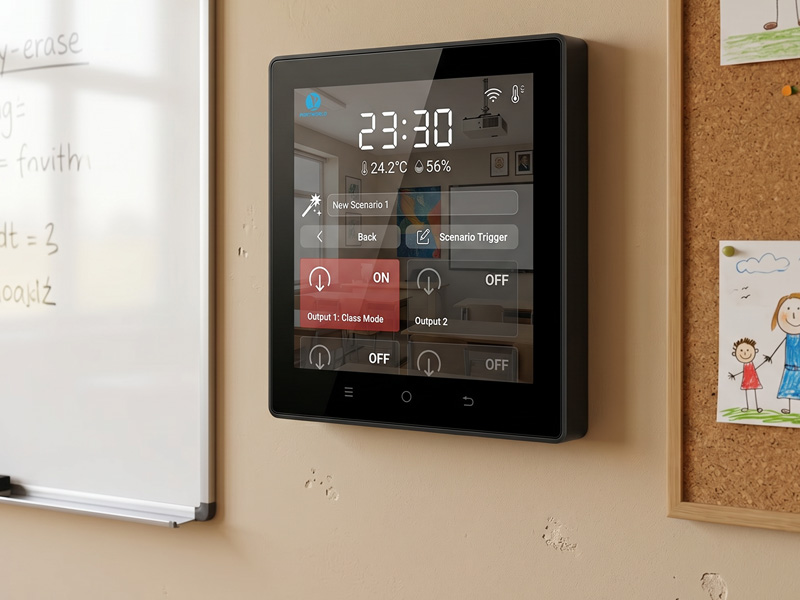
- A smart home control panel offers a unified interface for supported devices.
This arrangement lets you keep existing Zigbee equipment in service while adding Matter-compatible devices.
However, the bridge must support the applicable device types and functions. Some Zigbee features or devices may not be available through Matter.
6. What Must a Smart Home Control Panel Support for Matter and Zigbee?
Manufacturers developing smart home touchscreen panels should evaluate the hardware and software architecture as separate considerations.
- Matter Requirements
- A control system that supports Matter requires:
- A compatible Matter software stack.
- An appropriate IP network connection.
- Secure commissioning and device authentication.
- A compatible controller or bridge architecture.
- Hardware suited to the chosen transport.
For Matter over Wi-Fi or Ethernet, the device must provide suitable IP connectivity and software support.
For Matter over Thread, the system must include a Thread radio and an appropriate Thread network architecture. A Thread Border Router is needed to connect Thread devices to the broader IP network.
Zigbee Requirements
A Zigbee control system typically requires:
- A compatible IEEE 802.15.4 radio.
- Zigbee coordinator or gateway capabilities.
- Zigbee firmware and a protocol stack.
- Device pairing and network management features.
- Support for the necessary Zigbee clusters and device types.
A touchscreen panel equipped with Wi-Fi and Bluetooth does not inherently support Zigbee or Thread. Additional radio hardware or an external gateway may be required.
7. Can an ESP32-S3 Smart Home Control Panel Support Matter or Zigbee?
The answer depends on the specific ESP32 platform.
The ESP32-S3 is well suited to embedded smart home interfaces, Wi-Fi connectivity, Bluetooth communication, and custom control applications.
For example, Portworld’s YC-SM43P is built around an ESP32-S3 processor and offers:
- 4-inch capacitive touchscreen.
- 480 × 480 resolution.
- 8MB PSRAM and 16MB Flash.
- LVGL graphical interface.
- Wi-Fi and Bluetooth connectivity.
- Ethernet, PoE, and RS485 options, depending on configuration.
With custom firmware and communication software, it can serve as a smart home control interface.
However, the ESP32-S3 does not include a native IEEE 802.15.4 radio. Consequently, its built-in wireless interfaces alone cannot support operation as a Zigbee coordinator or Thread Border Router.
For Matter applications, it may be used in a compatible Matter-over-Wi-Fi setup, provided the software and implementation are suitable.
Projects that require native Zigbee or Thread connectivity may be better served by a platform with IEEE 802.15.4 support, such as the ESP32-C6 or ESP32-H2, or by adding an external radio module.
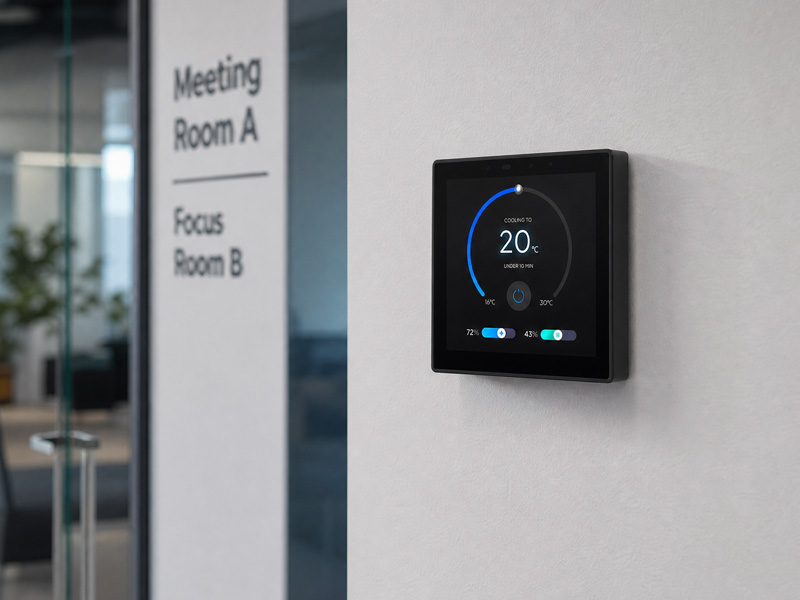
smart home control panel
8. How Portworld Supports Smart Home Control Panel Development
Smart home projects vary in their requirements for wireless connectivity, touchscreen interfaces, processor platforms, and automation integration.
Portworld develops embedded smart home control panels for residential automation, hotels, apartments, and commercial buildings.
Its product range includes Android- and Linux-based RK3566 panels, as well as ESP32-S3 embedded touchscreen solutions.
For OEM and ODM projects, Portworld can provide support with:
- Hardware platform selection and customization.
- PCB/PCBA design and embedded motherboard development.
- Wi-Fi, Bluetooth, Ethernet, PoE, and RS485 configurations.
- Customized Android, Linux, and ESP32 firmware.
- LVGL and touchscreen UI/UX development.
- Integration of Matter, Zigbee, Modbus, MQTT, and gateways based on project requirements.
- Logo design, packaging, SDKs, and technical documentation.
- Prototype development and mass production.
For customers developing Matter- or Zigbee-based smart home products, it is important to define the required radio hardware, software stack, gateway architecture, and target device compatibility before finalizing the product design.
9. Final Verdict: Matter or Zigbee?
Which technology is best for smart home automation?
Choose Matter when:
- Cross-platform interoperability is a priority.
- You are developing new smart home products.
- You want devices to work across multiple ecosystems.
- Your system uses Wi-Fi, Thread, or Ethernet.
Choose Zigbee when:
- You already have a Zigbee network in place.
- Your project relies on numerous low-power wireless sensors.
- You need to support existing Zigbee equipment.
- You want to create a dedicated wireless mesh network.
Consider using both when:
- You need to support existing Zigbee devices alongside newer Matter products.
- You are developing a multi-protocol smart home gateway.
- Your customers use a range of automation ecosystems.
Matter and Zigbee both have a role in modern smart home automation. Instead of viewing them as competing technologies, system designers should consider how they can complement one another in a flexible smart home architecture.
For OEM buyers and smart home product developers, selecting suitable control panel hardware and an integration architecture is as important as choosing a communication protocol.