
RK3568 SBC vs. Raspberry Pi 5: Which Fits Your Industrial Project?
Selecting a single-board computer for an industrial project requires more than comparing processor speeds and memory capacity. An embedded platform must provide the necessary peripherals, communicate reliably with external equipment, support the appropriate operating system, and meet the final product’s mechanical and electrical requirements.
Two platforms to consider are an RK3568-based single-board computer (SBC) and the Raspberry Pi 5.
The Raspberry Pi 5 is widely used for Linux development, prototyping, education, and general-purpose computing. Developed by Rockchip, the RK3568 is a quad-core ARM processor intended for embedded applications that may need flexible hardware integration, multimedia processing, and industrial connectivity.
Which platform is better suited to an industrial project?
The right choice depends on the application. This guide compares the platforms’ hardware architectures, connectivity, software support, industrial integration requirements, and long-term development considerations. It also introduces Portworld’s PortPi 3A, an RK3568-based SBC option for embedded product development.
1. RK3568 SBC vs. Raspberry Pi 5: Hardware Overview
Their processor architectures are the first key distinction.
An RK3568-based SBC is powered by Rockchip’s RK3568, which includes four ARM Cortex-A55 CPU cores. The Raspberry Pi 5 features Broadcom’s BCM2712 processor, equipped with four Cortex-A76 CPU cores.
The Cortex-A76 delivers greater general-purpose CPU performance. By contrast, the RK3568 is designed for embedded computing and combines an integrated NPU for acceleration with a versatile range of multimedia and peripheral interfaces.
| Specification | RK3568 SBC | Raspberry Pi 5 |
|---|---|---|
| Processor | Rockchip RK3568 | Broadcom BCM2712 |
| CPU | Quad-core Cortex-A55 | Quad-core Cortex-A76 |
| Maximum CPU Frequency | Up to 2.0 GHz | Up to 2.4 GHz |
| GPU | ARM Mali-G52 2EE | VideoCore VII |
| NPU | Up to 1 TOPS INT8 | No integrated dedicated NPU |
| Video Decoding | Up to 4K H.265/H.264/VP9 | Up to 4Kp60 HEVC |
| Video Encoding | Up to 1080p60 H.264/H.265 | No equivalent general-purpose hardware encoder specification |
| Memory | DDR3/DDR4/LPDDR3/LPDDR4/LPDDR4X, depending on board design | LPDDR4X |
| Display | HDMI 2.0, eDP, MIPI-DSI and other options, depending on board | Dual micro-HDMI |
| Expansion | PCIe, SATA, USB and other interfaces at SoC level | PCIe 2.0 ×1, USB 3.0 and USB 2.0 |
| Operating Systems | Linux, Ubuntu, Debian, Android, depending on BSP | Raspberry Pi OS and other compatible Linux systems |
Note: This comparison focuses on the processor and platform; it does not guarantee that every RK3568 SBC provides access to all RK3568 SoC interfaces. Actual specifications vary by board manufacturer and hardware configuration. PortPi 3A has its own interface setup.
The key distinction is that Raspberry Pi 5 features a more powerful CPU architecture, whereas RK3568 includes an integrated NPU and offers different hardware integration options.
For industrial applications, assess these differences together with peripheral needs, software compatibility, and the final product design.
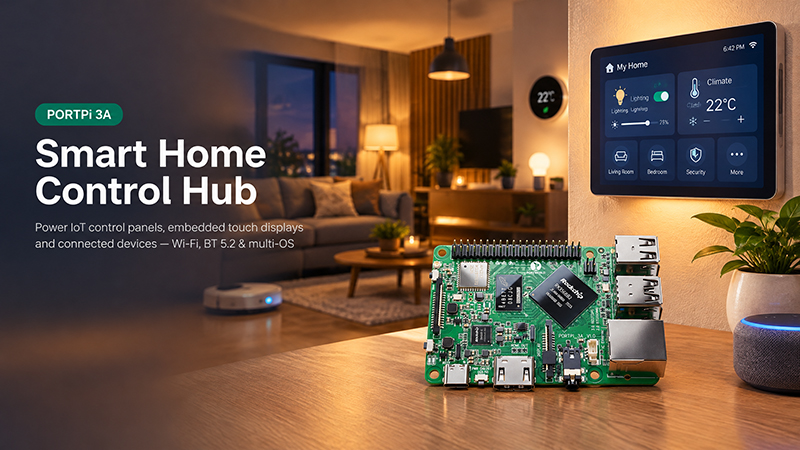
PortPi 3A smart home control hub
2. CPU Performance: Is Raspberry Pi 5 Faster?
When CPU performance is the primary selection criterion, Raspberry Pi 5 has the advantage.
Its BCM2712 processor features four Cortex-A76 cores with speeds of up to 2.4 GHz. By comparison, RK3568 has four Cortex-A55 cores running at up to 2.0 GHz.
Cortex-A76 is a higher-performance CPU architecture, generally better suited to demanding general-purpose computing, intensive application processing, and desktop-style workloads.
However, RK3568 can provide adequate computing resources for many dedicated embedded applications.
Consider an industrial touchscreen terminal. Its typical tasks may include:
- Displaying machine status and operating parameters
- Running a touchscreen interface
- Communicating with external controllers
- Collecting sensor data
- Managing network connections
- Executing application logic
- These tasks do not necessarily demand the highest available CPU performance.
For a dedicated industrial controller or embedded terminal, the key consideration may instead be whether the processor and board offer the right balance of performance, interfaces, and software support.
Choose Raspberry Pi 5 when general-purpose CPU performance is a priority. Consider RK3568 when workloads are moderate and hardware integration is more important to the project.
3. NPU and AI Processing: What Can the RK3568 Handle?
Industrial equipment is increasingly adopting intelligent capabilities, including visual inspection, object recognition, and automated monitoring.
As a result, AI acceleration is another factor to consider when choosing an embedded platform.
The RK3568 includes an NPU rated at up to 1 TOPS for INT8 operations, supporting selected neural network workloads. Through its supported software development environment, it can accelerate compatible AI models in hardware.
Potential applications include:
- Basic object detection
- Image classification
- Intelligent monitoring
- Camera-based device recognition
- Edge AI demonstrations
- Lightweight machine vision applications
The standard Raspberry Pi 5 configuration does not include a dedicated NPU.
It can nevertheless run AI applications on its CPU, use GPU-supported software, or connect compatible external accelerators through suitable interfaces.
However, having an NPU does not by itself determine application performance. Inference results also depend on factors such as model compatibility, quantization, runtime support, memory bandwidth, and software optimization.
For demanding industrial machine vision or AI workloads involving multiple cameras, the RK3568’s 1 TOPS NPU may not provide enough performance. A more capable platform, such as the RK3576 or RK3588, may be a better choice.
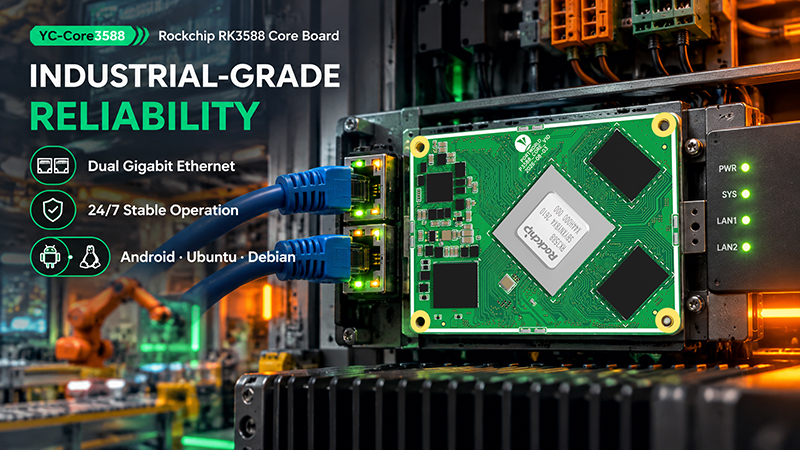
RK3588 core board
4. Industrial Connectivity: The Importance of Interface Selection
For industrial embedded devices, connectivity can matter more than raw CPU performance.
A typical industrial system may need to communicate with:
- PLCs and industrial controllers
- Sensors and measurement equipment
- Barcode scanners
- Touchscreens
- Cameras
- Network switches
- External storage devices
- Serial communication modules
Both the RK3568 and Raspberry Pi 5 provide useful connectivity options, but their hardware architectures and board implementations differ.
RK3568: A Flexible Embedded Interface Architecture
At the SoC level, RK3568 supports a wide range of interfaces, including:
- PCIe
- SATA
- USB 3.0 and USB 2.0
- Dual Gigabit Ethernet MAC
- HDMI 2.0
- eDP
- MIPI-DSI
- MIPI-CSI
- UART
- SPI
- I2C
- CAN
This interface selection makes RK3568 well suited to customized embedded hardware designs.
For instance, an industrial gateway may require Ethernet connectivity, serial communication, external storage, and connections for multiple peripheral devices.
A custom RK3568 motherboard can be designed to meet these requirements, subject to pin availability, routing resources, and software driver support.
Raspberry Pi 5: Convenient Standard Interfaces
Raspberry Pi 5 offers a broad range of standard interfaces:
- 40-pin GPIO header
- Two USB 3.0 ports
- Two USB 2.0 ports
- Gigabit Ethernet
- Dual micro-HDMI
- PCIe 2.0 ×1
- Two 4-lane MIPI camera/display transceivers
- Dual-band Wi-Fi
- Bluetooth 5.0
Its standard GPIO header and extensive ecosystem of accessories support convenient development and prototyping.
However, industrial applications may need extra interface boards, adapters, or custom hardware to connect to equipment that uses specialized communication protocols.
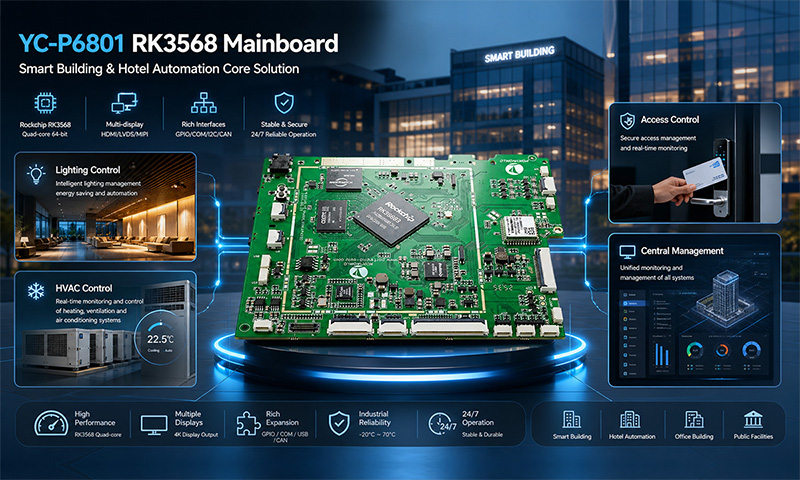
YC-P6802 RK3568 Mainboard
A Practical Example: RS485 and CAN Communications
Imagine developing a control terminal for industrial equipment.
The system must:
- Display operational information on a touchscreen.
- Gather sensor data via RS485.
- Communicate with a PLC.
- Transmit equipment status to a remote management system.
Do not assume that either processor includes a ready-to-use RS485 connector merely because its SoC supports UART or other communication interfaces.
RS485 requires a suitable transceiver and a properly designed hardware implementation. CAN likewise requires an appropriate controller and transceiver.
A customized RK3568 motherboard can integrate these interfaces into its hardware design. For Raspberry Pi 5, developers can add compatible expansion boards or external modules.
The right choice depends on whether you prefer a standard development ecosystem or hardware tailored specifically to your equipment.
5. Operating Systems: Android, Linux, and Industrial Software
Software compatibility is another important factor to consider.
Raspberry Pi 5: A Familiar Linux Development Environment
Raspberry Pi 5 is supported by a well-established software ecosystem.
Raspberry Pi OS offers developers a familiar environment, backed by extensive documentation and community resources.
It is especially well suited to:
- Python applications
- Linux-based IoT projects
- Web dashboards
- Device monitoring
- Development tools
- General-purpose automation
For teams already working with Raspberry Pi libraries and software, Raspberry Pi 5 can help minimize the initial development effort.
RK3568: Flexible Embedded OS Support
RK3568 supports embedded Linux and Android, depending on the board’s BSP and software configuration.
Common options include:
- Linux
- Ubuntu
- Debian
- Android
This flexibility can benefit the development of purpose-built commercial products.
For instance, an industrial touchscreen device may need to run an Android application, whereas an industrial gateway may use a customized Linux environment.
Developers can tailor the system to the product’s requirements, including:
- Boot configuration
- Kernel and device tree
- Display drivers
- Touchscreen drivers
- Network configuration
- Peripheral drivers
- Application startup behavior
Software support varies among board manufacturers. Before selecting an RK3568 SBC, verify the availability of BSP packages, SDK documentation, kernel versions, and long-term maintenance support.
If your team relies on Raspberry Pi-specific software, the Raspberry Pi 5 may be easier to integrate. For Android or a customized embedded Linux system, an RK3568-based platform may provide greater flexibility.
6. Display and Multimedia Capabilities
Industrial products increasingly feature touchscreens that make equipment easier to operate and monitor.
Display requirements can vary in resolution, panel size, brightness, and interface type.
At the processor level, the RK3568 supports several display interfaces, including HDMI 2.0, eDP, MIPI-DSI, and LVDS-related configurations, depending on the implementation.
It also supports:
- 4K H.265/H.264/VP9 video decoding
- 1080p60 H.264/H.265 video encoding
- An 8MP ISP with HDR and 3D noise reduction
- These features suit embedded terminals, multimedia devices, and camera-based systems.
- The Raspberry Pi 5 supports dual 4Kp60 HDMI output and 4Kp60 HEVC decoding.
- Either platform may be suitable for standard industrial dashboards and monitoring interfaces.
However, if your project needs a particular industrial LCD panel, MIPI-DSI connection, LVDS interface, or customized touchscreen setup, verify the board-level display connections before choosing a platform.
7. Industrial Project Requirements: What Should You Assess?
A development board that performs well in a laboratory may not necessarily be appropriate for an industrial product.
Industrial deployments bring additional requirements.
1. Operating Temperature
Check the specified operating-temperature range for the entire board, not only the processor.
The published operating-temperature range for Raspberry Pi 5 is 0°C to 70°C. An RK3568-based board may support a different range, depending on its components and design.
If your product will operate in a factory, outdoor cabinet, or equipment enclosure, thermal validation is essential.
2. Power Supply
Industrial equipment may use 12V or 24V DC power, while development boards often require a different input voltage.
Confirm whether the board accepts the required input voltage directly or requires an external DC-DC converter.
Also consider power stability, surge protection, grounding, and recovery after power loss.
3. Mechanical Integration
The board must fit within the finished enclosure.
Key considerations include:
- PCB dimensions
- Mounting-hole locations
- Connector placement
- Cable access
- Heat dissipation
- EMI and EMC requirements
A standard SBC may need additional structural design work to fit into a purpose-built industrial device.
4. Long-Term Supply
Commercial products may need to be manufactured repeatedly over several years.
Before selecting a platform, assess:
- Component availability
- Memory and storage options
- Board revision control
- Manufacturing capacity
- Technical support
- Product lifecycle planning
- 5. Software Maintenance
A production system requires more than an operating system that boots successfully.
Plan for kernel maintenance, security updates, driver support, application recovery, remote updates, and system monitoring.
These considerations are especially important when deploying multiple devices across factories or customer sites.
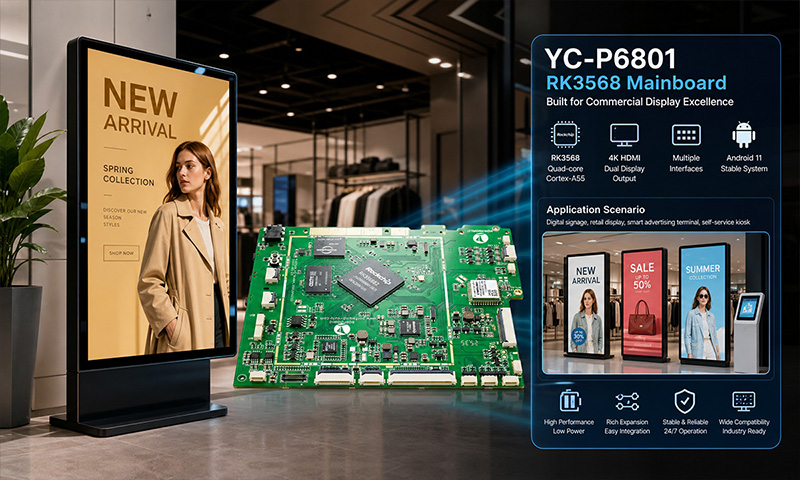
YC-P6802 RK3568 Mainboard
8. RK3568 SBC vs. Raspberry Pi 5: Which Is Better for Different Industrial Applications?
The following table provides a practical selection guide.
| Industrial Application | Recommended Platform | Main Reason |
|---|---|---|
| Industrial touchscreen HMI | Both | Depends on display and peripheral integration |
| Basic machine monitoring | Both | Moderate computing requirements |
| Industrial IoT gateway | RK3568-based customized board | Flexible hardware integration |
| Serial communication terminal | RK3568-based customized board | UART and external transceiver integration |
| Linux development and prototyping | Raspberry Pi 5 | Mature development ecosystem |
| Android-based industrial terminal | RK3568 | Android BSP availability, depending on board |
| Standard digital signage | Both | Depends on display and playback requirements |
| Basic edge AI application | RK3568 | Integrated 1 TOPS NPU |
| Complex machine vision | Neither by default | Consider a higher-performance AI platform |
| Customized commercial embedded product | RK3568-based solution | Carrier board and hardware customization options |
The recommendation is not definitive. An RK3568 SBC may suit one industrial project, while another RK3568 board may lack the required interfaces or operating temperature range.
Compare full board specifications rather than choosing based on the processor name alone.
9. PortPi 3A: An RK3568 SBC for Embedded Product Development
For developers seeking an alternative to conventional development boards, Portworld offers the PortPi 3A Single-Board Computer, powered by the Rockchip RK3568 processor.
Designed for embedded development and product integration, the PortPi 3A supports multiple operating systems and project-specific hardware customization.
- Key Features of PortPi 3A
- Rockchip RK3568 quad-core Cortex-A55 processor
- Support for Android, Ubuntu, Debian, and Buildroot, depending on configuration
- Wi-Fi and Bluetooth 5.2
- Gigabit Ethernet
- HDMI display output
- USB connectivity
- Flexible RAM and storage options
- Customizable interfaces and I/O to meet project requirements
- These features make the PortPi 3A suitable for a variety of embedded applications.
Where Can PortPi 3A Be Used?
Industrial HMI Terminals
PortPi 3A can power embedded touchscreen interfaces, equipment monitoring systems, and local application controls.
Choose the display and touch interfaces to match the final hardware configuration.
Smart Equipment and Appliances
Coffee machines, vending machines, and other intelligent devices may require an embedded computing platform to manage user interfaces, device logic, and network communications.
PortPi 3A can be tailored to these applications through hardware and software integration.
Smart Home Control Systems
For smart home terminals and gateway devices, PortPi 3A offers an Android/Linux computing platform with network connectivity and display output.
Digital Signage Players
PortPi 3A can power compact advertising players and information terminals that need local content playback and network communication.
Optional 10.1-Inch HDMI Touchscreen Kit
Portworld also provides an optional 10.1-inch HDMI touchscreen monitor kit for use with compatible PortPi 3A projects.
The kit can help developers create a complete demonstration system or incorporate a display into an embedded product.
Please note that HDMI transmits video, while touch input requires a separate compatible connection, such as USB, depending on the monitor’s configuration.
10. Why Consider Hardware Customization for Industrial Projects?
A standard development board is often adequate during the initial stages of software development. However, a commercial industrial product may require a different hardware configuration.
For example, a machine controller may need:
- A dedicated touchscreen connector
- RS485 communication
- Additional USB ports
- Customized Ethernet connectivity
- A specific power input
- A compact PCB layout
- A customized enclosure
- Adding several expansion boards and adapters can make a system more complex.
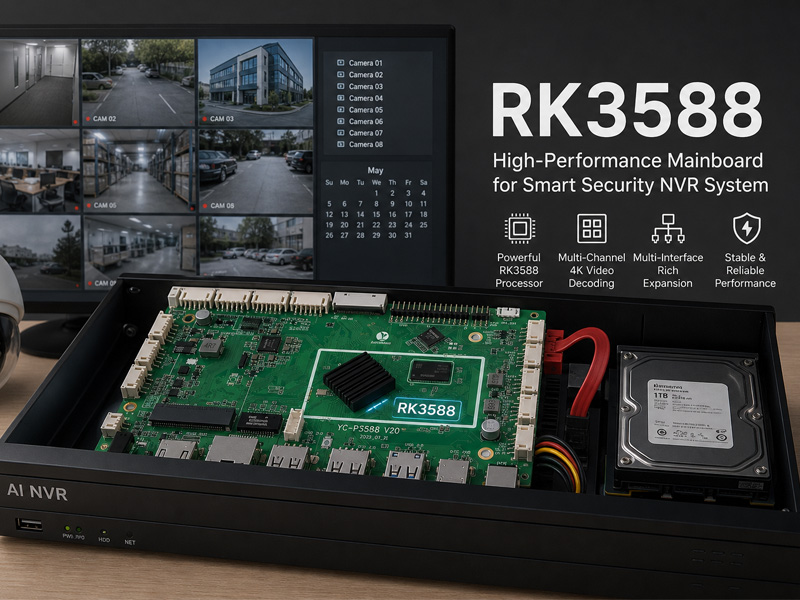
Smart Motherboard
A customized embedded motherboard or carrier board can bring the required functions together in a hardware design better suited to the product.
Portworld offers embedded hardware development and OEM/ODM services, including:
- PCB and PCBA design
- Motherboard and carrier board customization
- RAM and storage configuration
- Interface and I/O customization
- Android and Linux system adaptation
- Display and touchscreen integration
- Hardware and software debugging
- Product branding and manufacturing support
With more than 18 years of embedded hardware development experience, Portworld supports customers from prototype development through mass production.
For projects requiring a customized RK3568 platform, the engineering team can assess the hardware requirements and determine whether the PortPi 3A or a customized board is the better fit.
11. Final Decision: RK3568 SBC or Raspberry Pi 5?
The right choice depends on the priorities of your industrial project.
Choose Raspberry Pi 5 if:
CPU performance is your top priority.
Your team already works with Raspberry Pi OS and its software ecosystem.
You want a convenient platform for development and prototyping.
Your project can use its standard interfaces and compatible expansion accessories.
Consider an RK3568 SBC if:
- Your application requires moderate computing power.
- You need an integrated NPU for supported, lightweight AI tasks.
- Android or a customized Linux distribution is part of your software plan.
- You require hardware integration designed for industrial equipment.
- You plan to develop a dedicated embedded product and need OEM/ODM support.
- Neither platform is inherently industrial-grade solely because of its processor.
The entire system must be validated for operating temperature, power stability, electromagnetic compatibility, mechanical design, software maintenance, and production requirements.
For developers creating dedicated industrial equipment, the best platform is the one that satisfies the application’s actual requirements while keeping hardware integration and long-term maintenance manageable.

