What Can Be Customized in an OEM Industrial Panel PC?
An industrial panel PC is seldom a universal solution. A machine manufacturer might require a specific screen dimension to accommodate an equipment enclosure, additional serial ports for communication with a PLC, or a tailored operating system that directly launches into a proprietary human-machine interface (HMI). While standard products can serve as a foundation, OEM customization enables manufacturers to modify both hardware and software to meet the specific demands of an application.
For manufacturers of industrial equipment, system integrators, and providers of automation solutions, it is crucial to comprehend the extent of customization available prior to selecting a supplier. An appropriate OEM partner should be capable of assessing the entire system—from the touchscreen and embedded motherboard to interfaces, mechanical design, software, and long-term production needs.
Portworld offers industrial touchscreen monitors, embedded panel PCs, motherboards, and OEM/ODM customization services. Depending on the project, these capabilities can assist customers in developing industrial computing products that align with their equipment design, application specifications, and production strategies.
2. Processor, Memory, and Storage
The computing platform plays a crucial role in determining the performance of an industrial panel PC in executing applications and interfacing with connected devices. OEM customization may include the selection of an appropriate processor platform, memory size, type of storage, and options for expansion.
For basic HMI applications, equipment monitoring, or data collection tasks, an energy-efficient ARM platform might deliver adequate performance. Conversely, more complex applications that utilize sophisticated Windows software, require advanced visualization, or demand intensive computing resources may necessitate an x86-based platform or a more powerful embedded processor.
The choice should be guided by the actual workload rather than solely by processor specifications.
Key considerations include:
- Processor architecture: ARM or x86, depending on application compatibility and performance needs.
- Memory: The capacity required for the operating system, HMI software, data processing, and background services.
- Storage: The necessary capacity, write endurance, and data retention requirements.
- Graphics capability: The ability to support the desired display resolution, number of displays, and visual workload.
- Expansion: The need for additional storage, wireless modules, or specialized interfaces.
Portworld provides embedded computing platforms in conjunction with industrial touchscreen solutions. Their motherboard lineup features the YC-P3566, which utilizes the Rockchip RK3566, and the YC-P3576, based on the Rockchip RK3576. These platforms are potentially suitable for embedded applications that prioritize ARM processing, support for Linux or Android, and specific application integration.

Industrial Panel PCs
For OEM clients, early selection of the computing platform is crucial as it influences the display interface, thermal design, available I/O, software environment, and the overall cost of the product.
3. Operating System and Software Customization
Merely customizing hardware is insufficient if the panel PC is intended to operate a particular industrial application. Therefore, discussions regarding operating system and software requirements should take place prior to finalizing the hardware design.
Depending on the chosen platform, OEM projects may encompass Android, Linux, Ubuntu, Debian, or Windows. The available operating systems differ based on processor architecture and product configuration, necessitating verification of compatibility for the specific model.
Software customization may encompass:
- Customization of the operating system image
- Integration of the board support package (BSP)
- Adaptation of device drivers
- Provision of SDK and development documentation
- Integration of touchscreen and peripherals
- Automatic startup of applications
- Branding of boot logos and interfaces
- Configuration of networks and device management
- Deployment of applications and system configuration
For instance, an industrial panel PC utilized in a packaging machine might need to boot directly into the manufacturer’s HMI software upon power-up. A building automation terminal could necessitate a tailored Linux environment equipped with services for retrieving equipment data and facilitating communication via Ethernet or RS485.
Portworld offers software adaptation along with BSP/SDK-related assistance for the platforms it supports. The scope of this support should be determined based on the chosen motherboard, operating system, application dependencies, and development responsibilities.
Should your software rely on a particular Windows application or an x86-exclusive driver, it is essential to verify compatibility prior to selecting an ARM-based design. Migrating applications can significantly increase both development time and costs.
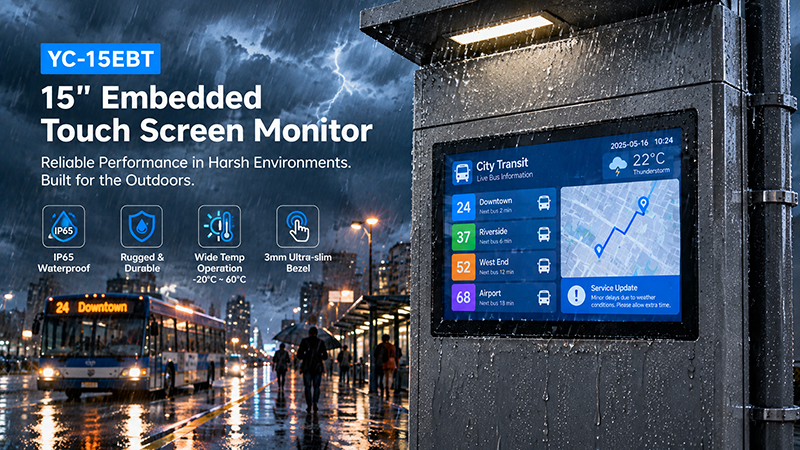
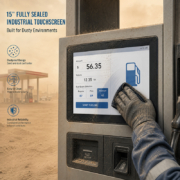
YC-15EBT touch screen solutions
4. Communication Interfaces and I/O
Industrial panel PCs frequently act as the communication hub between operators and machinery. Standard I/O configurations may not fulfill all project specifications, especially when the panel PC needs to connect with legacy controllers, specialized sensors, or various industrial networks.
Customization of OEM interfaces may involve the selection or arrangement of:
- Ethernet and additional LAN ports
- USB ports
- RS232 and RS485 serial interfaces
- GPIO for digital signals
- Wi-Fi and Bluetooth
- Optional cellular connectivity, where applicable
- Audio, display output, or other application-specific interfaces
The specific options available are contingent upon the motherboard, carrier board, enclosure, and electrical design.
Take, for instance, a panel PC utilized in a water-treatment facility. It may require RS485 for Modbus RTU communication with meters and controllers, Ethernet for network monitoring, and USB for maintenance or data export. Conversely, a machine-control application might necessitate a different assortment of serial ports and GPIO signals.
Portworld’s embedded computing offerings encompass platforms tailored for integration within connected industrial systems. In projects with distinct interface requirements, OEM/ODM engineering may entail the selection of motherboards, development of carrier boards, customization of PCBs/PCBAs, placement of connectors, and configuration of software.
When drafting an OEM specification, it is essential to determine the number of ports, their electrical standards, types of connectors, isolation needs, and communication protocols. A connector that appears suitable does not automatically guarantee compatible electrical signaling.
5. Enclosure, Mounting, and Mechanical Design
The mechanical design of an industrial panel PC significantly influences installation, heat dissipation, durability, and ease of service. OEM clients frequently require the device to conform to specific machines, cabinets, walls, or operator stations.
Depending on the project and product platform, mechanical customization may include:
- Front-panel dimensions and bezel design
- Enclosure material and surface finish
- Mounting methods, such as panel, wall, or VESA mounting
- Connector positioning and cable routing
- Custom cutouts and mounting holes
- Branding, labels, and logo placement
- Sealing and front-panel protection
- Structures for heat dissipation.
For example, a panel PC installed in a machine door may require a specific cutout and front-panel appearance. A device installed inside a compact enclosure may need a carefully designed thermal path, particularly if it operates continuously or uses a high-performance processor.
Industrial protection requirements should be defined precisely. An IP rating applies to the tested enclosure configuration and does not automatically guarantee protection for every connector, cable, or mounting arrangement. If the device will be exposed to dust, water, cleaning procedures, or vibration, validate the complete installed assembly.
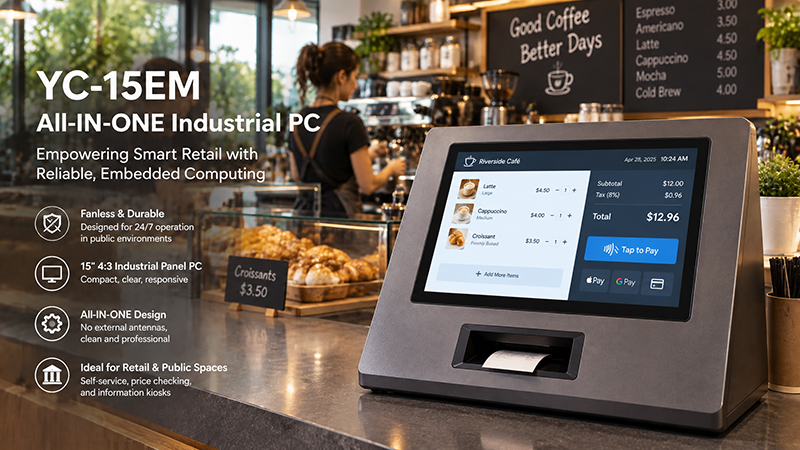
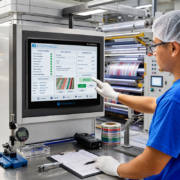
YC-15EM touch screen solution
Portworld’s industrial embedded touchscreen products include metal-enclosure designs and embedded monitor formats. Its OEM/ODM services can support mechanical adaptation and product integration, subject to the feasibility and validation requirements of the project.
6. Power Supply and Thermal Design
The power and thermal specifications are intricately linked to the processor, display brightness, enclosure design, and the operating environment.
An OEM industrial panel PC may require a specific DC input voltage, a designated power connector, or a power configuration that is compatible with the host machine. Certain projects might also gain advantages from Power over Ethernet (PoE), assuming that both the hardware and the chosen PoE standard can accommodate the necessary power requirements.
Thermal customization could entail opting for a lower-power processor, modifying the enclosure design, enhancing heat conduction, or assessing the suitability of active versus passive cooling solutions.
In the case of a fanless control terminal situated in a dusty factory, passive cooling can minimize the number of moving parts and ease maintenance tasks. Nevertheless, fanless operation is only suitable when the processor’s heat output, enclosure, ambient temperature, and sustained workload have been thoroughly assessed.
Before finalizing the design, please verify the following:
- Input voltage and power budget
- Peak and continuous system consumption
- Display backlight power requirements
- Expected ambient operating temperature
- Heat dissipation and enclosure temperature
- Whether the device is required to operate continuously
- Any necessary PoE support and power classification
A tailored power and thermal design can assist in avoiding instability, unanticipated shutdowns, and performance degradation during prolonged operation.
7. Branding, Packaging, and Product Identity
For OEM clients, a panel PC frequently constitutes a component of a broader product marketed under their own brand. The hardware may need to conform to an established visual identity and packaging standards.
Typical customization options encompass logo placement, boot screens, product labels, model numbers, exterior finishes, packaging design, and documentation. Depending on the software platform, clients may also request a branded interface or preinstalled application.
These aspects are especially crucial for manufacturers creating a series of industrial machines or implementing the same control terminal across various customer locations.
Portworld provides branding and packaging customization as part of its OEM/ODM services. Customers are advised to specify their artwork, labeling, packaging, and software-branding needs early in the process to ensure these elements are incorporated into sampling and production validation.
While branding modifications are typically less complex than comprehensive hardware redesigns, they still require careful assessment for durability, regulatory labeling, and uniformity across production batches.
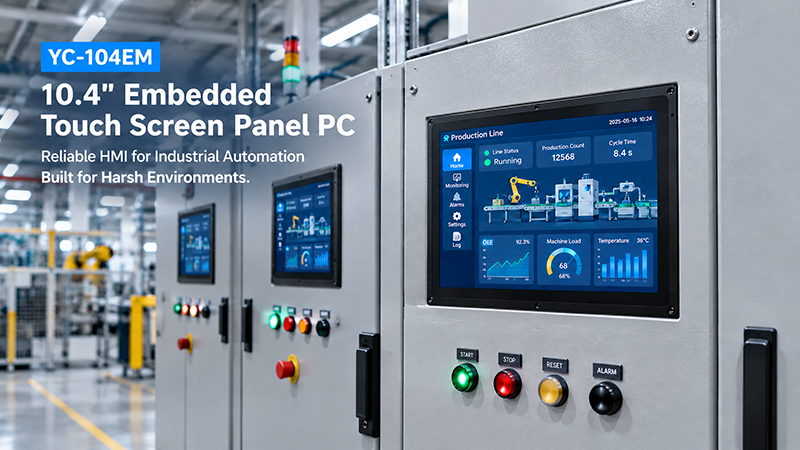
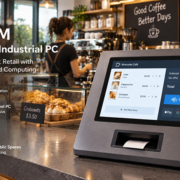
YC-104EM touch screen solutions
8. Certifications, Testing, and Quality Requirements
Customization should continue beyond the initial prototype activation. An industrial panel PC must be assessed in relation to its intended operational environment and the regulatory standards of the target market.
Depending on the product and its destination, projects may necessitate electromagnetic compatibility (EMC) testing, electrical safety assessments, environmental validation, or other relevant certifications. It should not be assumed that existing certificates automatically apply to a modified configuration.
Testing may encompass:
- Functional verification of display, touch, and I/O
- Serial and network communication assessments
- Thermal testing under prolonged workloads
- Power-on and restart evaluations
- Touchscreen validation
- Vibration or shock testing as applicable
- Enclosure and ingress-protection validation when necessary
- Verification of the final software image
What Should You Prepare Before Requesting an OEM Quote?
A detailed project brief helps the manufacturer assess feasibility and provide a more accurate quotation. Instead of requesting a generic customized panel PC, specify the functions and constraints that the finished product must satisfy.
| Requirement | Information to provide |
|---|---|
| Display | Screen size, resolution, brightness, touch type |
| Computing platform | ARM or x86 preference, processing workload, memory and storage |
| Operating system | Android, Linux, Ubuntu, Debian, Windows, or another supported environment |
| Interfaces | Ethernet, USB, RS232, RS485, GPIO, wireless connectivity |
| Mechanical design | Dimensions, mounting method, enclosure material, connector placement |
| Power and cooling | Input voltage, power budget, ambient temperature, fanless requirements |
| Software | HMI application, drivers, startup behavior, SDK/BSP needs |
| Environment | Indoor or outdoor installation, dust, moisture, vibration, temperature |
| Compliance | Target markets and applicable certification requirements |
| Production | Sample quantity, forecast volume, target launch date, expected product lifetime |
How Portworld Assists OEM Industrial Panel PC Initiatives
Portworld offers a variety of industrial touchscreen monitors, embedded panel PCs, motherboards, and system-on-module solutions tailored for equipment manufacturers and system integrators. Their extensive product lineup serves as a foundation for projects that necessitate various screen sizes, computing platforms, operating systems, and integration methods.
Depending on the chosen platform and the project’s requirements, Portworld’s OEM/ODM services may encompass:
- Integration of industrial touchscreen and embedded computing
- Selection and customization of motherboards
- Development of PCB/PCBA
- Customization of displays, interfaces, and mechanical components
- Adaptation of Android or Linux-based software on compatible platforms
- Support for BSP/SDK and application configuration
- Branding, labeling, and packaging services
- Coordination of product sampling and production
For instance, a manufacturer creating a specialized machine HMI might require a 10.1-inch touchscreen, an ARM motherboard, RS485 communication capabilities, a tailored Linux image, and an enclosure designed to fit their equipment. Conversely, another project might demand a larger embedded panel PC that is compatible with Windows and features a different I/O configuration.