High-Brightness Outdoor Digital Signage Displays: How to Improve Outdoor Advertising Visibility
Outdoor advertising continues to serve as a significant marketing channel for enterprises seeking to engage customers across shopping districts, transportation hubs, commercial buildings, and public spaces. Nevertheless, the deployment of advertising materials in outdoor environments introduces operational challenges that indoor digital signage systems typically do not encounter. Exposure to direct sunlight, fluctuating meteorological conditions, ambient illumination, and extended operational periods can substantially compromise the visibility and dependability of display systems.
For organizations investing in outdoor digital advertising infrastructure, the selection of a display unit with adequate luminosity represents a critical consideration in ensuring the delivery of legible, visually compelling, and commercially effective advertising content.
The Significance of High Brightness in Outdoor Digital Signage Applications
Ambient illumination constitutes one of the most substantial obstacles confronting outdoor display installations. A display that demonstrates satisfactory brightness and clarity within an indoor shopping environment may experience significant image degradation when positioned adjacent to a retail storefront or situated in an open public area subject to direct solar exposure.
A high-brightness outdoor digital signage system facilitates sustained visibility performance under conditions of elevated ambient lighting. Through enhancement of the contrast differential between displayed content and environmental light sources, such systems enable photographic imagery, promotional communications, video content, and brand messaging to maintain prominence and legibility throughout operational hours.
Brightness specifications necessarily vary according to the particular installation context. A display positioned beneath a sheltered entrance structure may require different technical parameters than a unit deployed in a sun-exposed outdoor advertising location. Organizations should consequently conduct a comprehensive assessment of prevailing lighting conditions, anticipated viewing distances, screen dimensions, and installation orientation prior to display system selection.
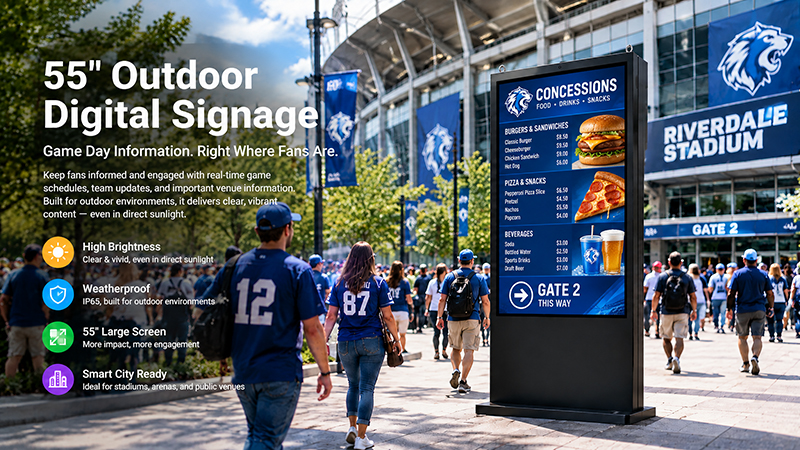
55 inch digital signage display
Key Factors in Selecting an Outdoor Advertising Display
While luminosity plays a significant role, it should not serve as the sole criterion when evaluating outdoor digital signage solutions. An effective system must also align with the environmental conditions and operational demands of the advertising initiative.
Visual Clarity and Display Luminosity
Brightness levels, pixel density, color contrast, and angular visibility all influence the overall viewing quality. In areas experiencing intense solar radiation, organizations should assess the display’s maximum brightness specification and verify its suitability for the planned deployment location.
Environmental Resilience and Weather Resistance
Outdoor displays face exposure to precipitation, particulate matter, thermal fluctuations, and various climatic conditions. Based on the specific installation context, an appropriately rated protective housing can shield the display against moisture and particle infiltration. Structural safeguards and material composition warrant careful evaluation for installations in high-traffic environments.
Thermal Operating Parameters and Temperature Control
Elevated environmental temperatures combined with solar exposure can elevate the internal operating temperature of a display unit. Consequently, heat dissipation represents a critical component of outdoor display engineering. Prospective purchasers should examine the permissible operating temperature range and thermal management systems to confirm compatibility with the anticipated climate conditions.
Content Administration and Network Integration
Contemporary outdoor advertising extends beyond mere display technology. Organizations may require the capability to modify campaigns from remote locations, arrange time-sensitive promotional materials, oversee numerous display units, or connect signage infrastructure with established content management platforms. During the initial planning phase, network connectivity capabilities and operating system compatibility must be thoroughly assessed.
Deployment and Upkeep
Wall-affixed, independent, and interactive kiosk-format displays necessitate distinct installation procedures. Prior to finalizing a purchase, organizations must verify available mounting configurations, electrical supply requirements, conduit management, accessibility for servicing, and anticipated operational conditions.
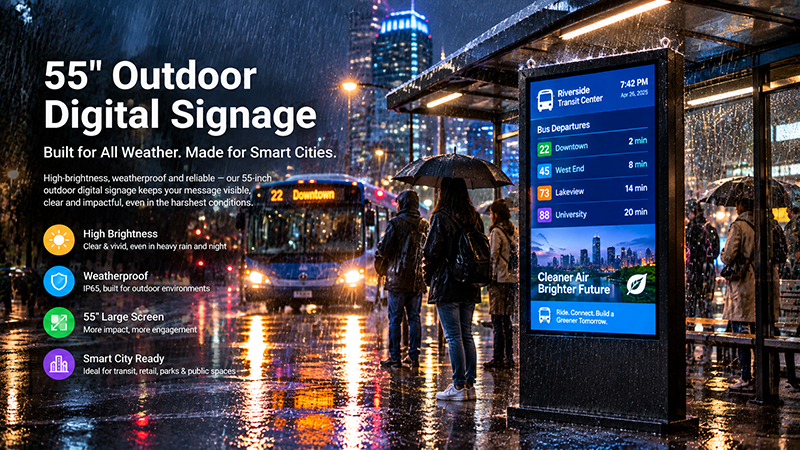
55 inch digital signage display
Utilizations of High-Brightness Outdoor Digital Signage
High-brightness digital signage accommodates an extensive spectrum of commercial and consumer-oriented applications.
At retail establishments and commercial shopping districts, outdoor displays can showcase seasonal campaigns, new product introductions, and promotional offerings to engage potential customers. Food service establishments can leverage digital displays to present menu selections, time-restricted promotions, and organizational messaging. Transit facilities and community spaces can employ digital signage for public announcements, navigational guidance, and educational materials.
Outdoor promotional networks can similarly capitalize on adaptive content distribution, enabling administrators to revise marketing initiatives without necessitating the replacement of conventional printed media. For real estate developers and facility administrators, digital signage represents an adaptable solution for engaging clientele and marketing tenant enterprises.
Each application presents distinct requirements. A display positioned beneath a canopy may emphasize visual quality and aesthetic appeal, whereas a screen deployed in an entirely unprotected environment may demand enhanced environmental resilience and more deliberate thermal management.
Why Evaluate a Tailored Outdoor Digital Signage Solution?
Off-the-shelf displays frequently fail to satisfy all project specifications. Advertising operators, equipment manufacturers, and system integrators may require particular screen dimensions, luminosity specifications, housing configurations, support frameworks, or platform settings.
A tailored solution enables these specifications to be incorporated during the design phase rather than resolved through post-installation adjustments. Depending on the initiative, customization may encompass display parameters, integrated components, platform setup, data transmission capabilities, corporate identity, and structural engineering.
Portworld delivers digital display and embedded hardware solutions, offering OEM and ODM services for enterprises creating commercial display systems and application-specific installations. Clients can evaluate their planned installation context, display proportions, luminosity needs, operating platform, data transmission requirements, and anticipated manufacturing scale to establish an appropriate specification.
For outdoor promotional initiatives, the optimal specification should be determined based on genuine deployment circumstances. Luminosity, IP classification, operating range, housing structure, and mounting technique should be assessed comprehensively rather than evaluated as separate considerations.
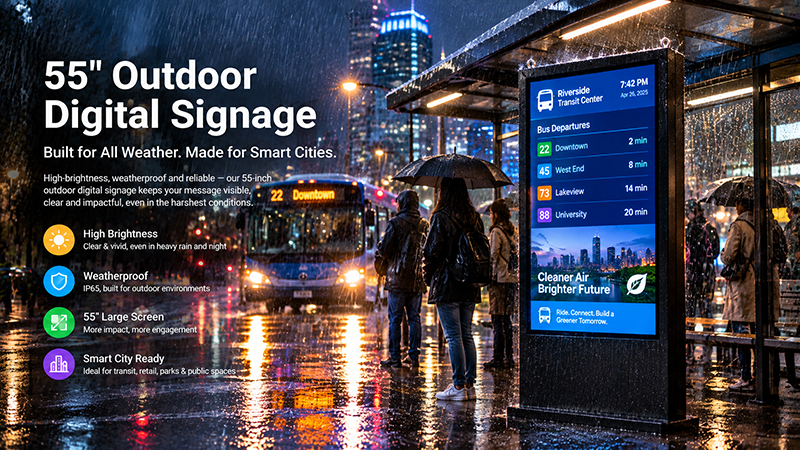
55 inch outdoor digital signage display
Portworld: Outdoor Digital Signage Solutions for Commercial Enterprises
Portworld provides tailored digital signage solutions designed to meet the diverse advertising display requirements of commercial organizations. Project discussions can encompass display technical specifications, hardware architecture, system integration capabilities, and brand representation considerations.
Regardless of whether the objective involves implementing advertising displays across multiple retail establishments, establishing a branded commercial display system, or incorporating digital signage technology into a comprehensive project framework, establishing the operational environment parameters and technical specifications at an early stage can facilitate streamlined product selection and facilitate effective customization.