
How to Choose an RK3588 Core Board for an Edge AI Computing Project
Edge AI is changing how intelligent devices process information. Instead of sending every image, video stream, or sensor reading to a remote cloud server, modern embedded systems can analyze data locally and respond in real time. This is particularly important for industrial inspection, autonomous robots, smart cameras, machine vision, and intelligent automation equipment.
However, building an edge AI device requires more than selecting a processor with sufficient computing power. Developers must consider AI inference performance, memory capacity, camera interfaces, peripheral connectivity, software compatibility, thermal management, and long-term product availability.
The Rockchip RK3588 is an attractive platform for these applications because it combines an eight-core CPU, a Mali-G610 MP4 GPU, and an integrated NPU rated at up to 6 TOPS. For companies developing commercial AI hardware, an RK3588 core board can shorten hardware development and provide a foundation for a customized embedded computing system.
Portworld offers the YC-Core3588 Core Board as part of its embedded computing portfolio, alongside motherboard design, PCBA development, software customization, and OEM/ODM services. Understanding how to evaluate these options can help businesses select a board that meets both their technical requirements and production goals.
1. Match the RK3588 Computing Platform to Your AI Application
The first step is to identify the workload the device must handle. An AI inspection camera, for example, may need to detect defects on a production line, while an autonomous robot may need to process multiple camera streams, recognize obstacles, and communicate with other control systems simultaneously.
The RK3588 combines four Cortex-A76 performance cores with four Cortex-A55 efficiency cores. Its integrated NPU can accelerate supported neural-network inference workloads, while the GPU and multimedia processing capabilities support graphics and video-related tasks.
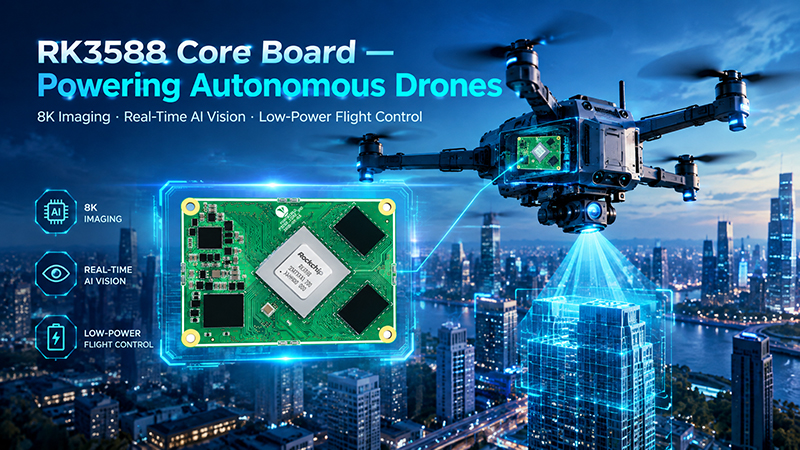
RK3588 Drone Application Scene 1
This combination makes the platform worth evaluating for:
- Industrial machine vision and defect detection
- AI-powered inspection robots
- Smart cameras and multi-channel video analytics
- Autonomous delivery and service robots
- Intelligent kiosks and interactive terminals
- Edge gateways that combine AI processing with device communication
Nevertheless, a 6-TOPS NPU rating does not guarantee a particular inference speed. Real-world performance depends on the model architecture, quantization, supported operators, memory usage, camera pipeline, and thermal conditions.
Before choosing a board, define the AI models you plan to deploy, the number of concurrent inference tasks, the required frame rate, and the acceptable response time. If the system must also run a graphical interface, decode video, store data, or manage several network connections, include those workloads in your evaluation.
For projects that need a ready-made starting point, Portworld’s YC-Core3588 Core Board provides an RK3588-based hardware option to evaluate for edge AI and embedded computing applications. The required memory configuration, exposed interfaces, operating system, and carrier-board compatibility should be confirmed against the specific project.
2. Choose Memory and Storage Based on the Complete System
AI applications consume more than the memory needed for model inference. The operating system, application processes, image buffers, video streams, model files, and local data storage all contribute to the system’s resource requirements.
A compact edge AI device running one optimized model may not need the same memory configuration as a robot processing several video streams while running navigation software and a graphical control interface.
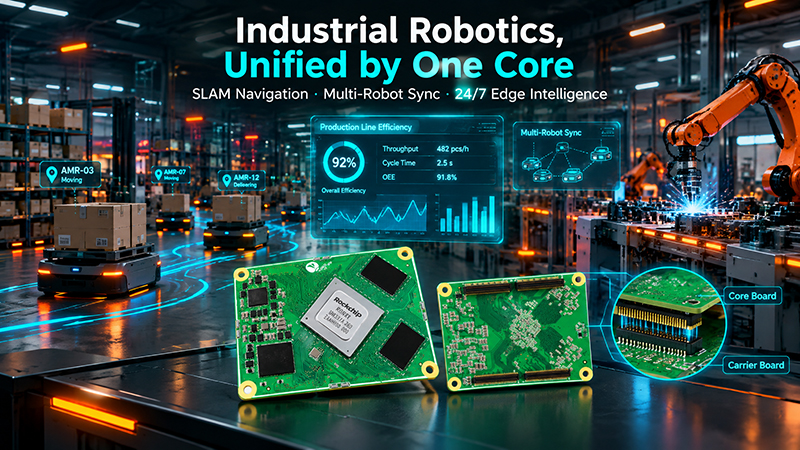
RK3588 Robot Application Scene 2
When evaluating an RK3588 core board, consider:
RAM capacity: Allow enough memory for the AI runtime, application software, and simultaneous data-processing tasks.
Memory bandwidth: Consider how efficiently image data and intermediate tensors can move between the CPU, GPU, NPU, and system memory.
eMMC capacity: Reserve space for the operating system, AI models, application updates, and system logs.
Expansion options: Determine whether additional storage is required for local image or video recording.
Portworld’s embedded motherboard and system-on-module offerings support project-specific hardware evaluation and customization. For an RK3588-based product, the memory and storage configuration should be selected according to the intended workload, available board variants, and expected production requirements.
For volume projects, it is worth validating the selected configuration with representative workloads before finalizing the hardware. This helps avoid unnecessary cost while reducing the risk of memory limitations after deployment.
3. Check Camera, Display, and Expansion Interfaces
For many edge AI systems, interface compatibility is as important as raw computing performance. A machine vision device needs compatible camera connections, while a robot may require multiple network ports, USB peripherals, serial interfaces, and expansion connections.
The RK3588 platform supports a range of high-speed and peripheral interfaces. However, the interfaces exposed by a finished core board depend on the module design and the carrier board used in the final product.
Before selecting a board, check the following:
Camera connectivity: Confirm the number and type of camera interfaces, supported sensor configurations, and connector layout. Do not assume every RK3588 board supports the same camera count or simultaneous operating modes.
Display output: If the device needs a local touchscreen, operator panel, or multiple displays, verify the available display interfaces and supported concurrent configurations.
High-speed expansion: PCIe and USB interfaces may be important for storage, networking, or compatible expansion modules. Confirm which signals are actually available on the selected board.
Industrial communication: UART, RS232, RS485, GPIO, and other interfaces may be required for PLCs, sensors, motor controllers, or legacy industrial equipment. Their availability depends on the board and carrier-board design.
Network connectivity: Check the number and speed of Ethernet ports, along with any requirements for Wi-Fi or other communication modules.
Portworld provides hardware design and PCBA customization services for embedded products. Its hardware development capabilities include schematic and PCB design, signal-integrity considerations, and configurable I/O options such as RJ45, RS485, PoE, USB, HDMI, and GPIO, subject to the requirements and feasibility of the project.
This is particularly useful when an off-the-shelf core board does not expose the exact interfaces required by a machine vision system, industrial gateway, or robotics platform. Rather than adapting the entire product around a fixed interface layout, the project can evaluate a suitable carrier-board or PCBA design.
4. Evaluate AI Software, NPU Support, and Development Resources
Selecting a powerful processor is only part of building a usable edge AI product. The software environment determines how efficiently the hardware can be integrated into the final application.
For RK3588 projects, developers should evaluate the availability and compatibility of the operating system image, kernel, drivers, NPU runtime, model-conversion tools, and example applications. Rockchip’s RKNN toolchain is commonly used to prepare supported neural-network models for compatible Rockchip NPUs.
If the AI model is developed with PyTorch or TensorFlow, confirm the conversion workflow and supported operators before committing to the hardware. Some models may require graph changes or quantization, and performance should be measured using the converted model on the actual target board.
Software planning should also cover the rest of the device. A commercial edge AI product may need camera drivers, display support, network services, serial communication, automatic application startup, remote updates, and system monitoring.
Portworld offers BSP/SDK support and operating-system customization for embedded hardware projects. Depending on the selected platform and project scope, software work can include adapting Android or Linux-based systems, integrating drivers and peripherals, and supporting application development.
For a project based on the YC-Core3588, confirm the available BSP, SDK, NPU runtime, sample code, and supported OS versions with Portworld’s engineering team before development begins. The precise software package and level of customization should be agreed upon for the selected hardware configuration.
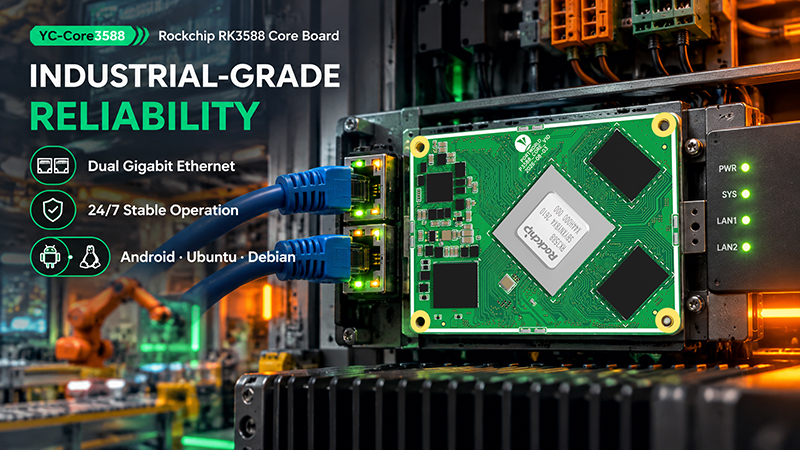
RK3588 core board
5. Decide Whether You Need a Core Board, a Customized Mainboard, or a Complete AI Device
A core board is not always the final hardware form a project needs. The right development approach depends on how much of the hardware design has already been completed and how specialized the finished product must be.
A standard RK3588 core board is a practical starting point when its available interfaces, dimensions, and software support already fit the application. It can help teams begin software development and prototype testing without designing every part of the computing platform from scratch.
A customized carrier board or PCBA is more suitable when the product needs a specific connector arrangement, additional peripheral circuits, a tailored power design, or a unique mechanical layout.
A custom embedded mainboard may prove suitable when a project necessitates closer coordination among the processor, memory, power distribution circuitry, input/output systems, and physical enclosure. While this methodology demands supplementary engineering efforts and comprehensive validation procedures, it can achieve superior alignment with high-volume manufacturing or specialized application-oriented products.
For initiatives requiring capabilities beyond a standalone RK3588 module, Portworld maintains an RK3588 and NVIDIA Jetson Orin NX carrier-board solution within its embedded computing offerings. This alternative presents an additional hardware selection for projects assessing diverse computing platforms or integration methodologies. The specific processing architecture, compatible modules, and interface specifications should be verified according to the particular product requirements.
Portworld’s OEM/ODM services facilitate the development progression from initial hardware specifications and circuit board design through prototype assessment, software implementation, and manufacturing readiness. Such support can prove instrumental for organizations requiring a purpose-built edge artificial intelligence apparatus rather than a development platform intended exclusively for research laboratory applications.
6. Establish Power Management, Thermal Regulation, and Structural Assembly Considerations at the Outset
Artificial intelligence inference operations, visual data processing, and persistent video streaming applications can impose continuous operational stress on an embedded computing system. A circuit board demonstrating satisfactory performance during abbreviated performance testing may exhibit divergent behavior when positioned within a confined housing and subjected to prolonged continuous operation.
Before finalizing the design, review the board’s power requirements, cooling provisions, mounting method, connector placement, and operating environment.
For a robot, the design may need to balance computing performance with limited battery capacity and available space. An industrial inspection system may prioritize stable continuous operation and effective heat dissipation. A fanless edge gateway may require careful thermal design to maintain performance without active cooling.
Portworld’s hardware development services can help address application-specific PCB layouts and mechanical integration requirements. For a customized RK3588 product, thermal management and power design should be evaluated alongside the carrier-board layout rather than treated as final-stage adjustments.
Where the device will operate in factories, vehicles, or outdoor installations, the complete product should also be evaluated against the required temperature range, vibration conditions, electromagnetic compatibility, and applicable certifications. These characteristics must be verified for the final hardware and enclosure.
7. Evaluate OEM/ODM Customization and Long-Term Production Capabilities
For commercial applications, the board supplier’s technical expertise and production capabilities warrant consideration alongside processor performance specifications. While prototypes may demonstrate satisfactory functionality, commercial products require managed hardware iterations, component consistency, comprehensive documentation, rigorous testing protocols, and a well-defined supply chain strategy.
Portworld delivers OEM/ODM hardware customization services, PCBA engineering, software BSP/SDK development, and flexible CKD/SKD manufacturing solutions. The company’s engineering and manufacturing infrastructure is structured to facilitate project progression from initial hardware conception through full-scale production.
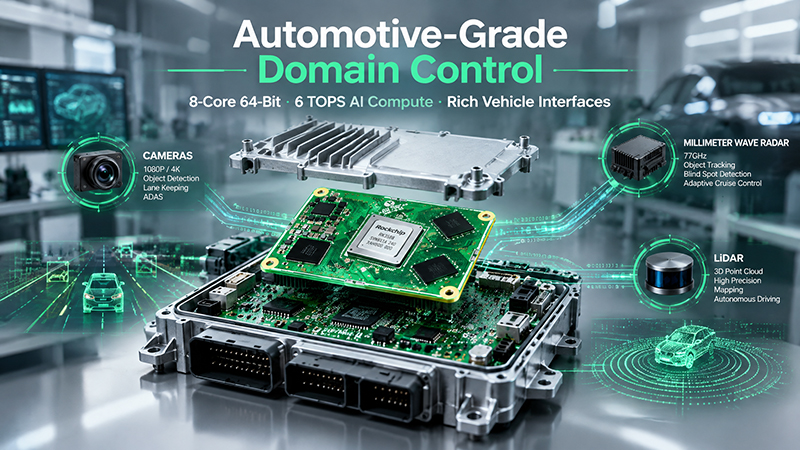
RK3588 Intelligent Driving Scene 2
For an RK3588 edge AI application, customization planning may encompass:
- Evaluating suitable core board and memory specifications
- Developing a carrier board or specialized PCBA configuration
- Incorporating camera, display, network, and industrial connectivity solutions
- Optimizing Android or Linux software implementations
- Deploying application-specific software and accessory components
- Assessing packaging, brand identity, and product specifications
- Establishing prototype validation, production quality assurance, and scalable manufacturing procedures
Portworld operates manufacturing facilities spanning 30,000 square meters and reports achieving a first-pass yield rate exceeding 98.5%. While these company-provided metrics offer valuable insight into manufacturing performance, project-specific quality standards, validation methodologies, and production arrangements should be independently verified and confirmed.
For enterprises developing AI robotic systems, industrial inspection apparatus, or intelligent terminal devices, engaging with a supplier capable of orchestrating hardware integration, software development, and manufacturing operations may substantially diminish integration complexity across disparate vendor ecosystems.
8. A Comprehensive Checklist for Evaluating an RK3588 Core Board
Prior to procuring evaluation units or commencing proprietary design initiatives, establish documentation for the subsequent specifications:
- AI performance: Model architecture, inference precision, camera quantity, frame rate, and latency requirements.
- Memory and storage: RAM specifications, eMMC capacity, data persistence, and firmware update protocols.
- Interfaces: Camera interfaces, display outputs, USB connectivity, PCIe expansion, Ethernet, serial protocols, and GPIO functionality.
- Software resources: Operating system distributions, Board Support Package, Software Development Kit, NPU runtime environment, device drivers, and model conversion procedures.
- Power and cooling: Power supply specifications, sustained operational load, thermal management, and physical enclosure limitations.
- Mechanical design: Board form factor, connector specifications, mounting solutions, and carrier board compatibility.
- Customization: Necessary PCBA modifications, software integration requirements, brand customization, and peripheral device support.
- Production readiness: Technical documentation, sample evaluation protocols, quality assurance procedures, version control management, and supply chain continuity.
The optimal RK3588 core board selection is not determined by maximum memory capacity or interface quantity alone. Rather, it represents the solution that aligns with the application’s AI computational demands, software ecosystem requirements, spatial constraints, and manufacturing objectives.
For companies seeking an RK3588-based edge AI platform, Portworld’s YC-Core3588 Core Board provides a starting point for evaluation. When a standard board is not sufficient, Portworld can also discuss customized PCBA and carrier-board development, BSP/SDK support, OS adaptation, and OEM/ODM manufacturing.
Choosing the right board is the beginning of the project. Building a reliable commercial product requires the hardware, software, interfaces, thermal design, and production plan to work together.

