How Is SMT Assembly Used in Smart Control Panel Production?
Intelligent Smart control panels are establishing themselves as a fundamental interface within contemporary automation infrastructure, encompassing the following applications:
- Intelligent residential environments
- Intelligent hospitality facilities
- Intelligent workplace settings
- Industrial Human-Machine Interface systems
- Structural automation solutions
At the core of each intelligent control panel resides a PCBA (Printed Circuit Board Assembly) that consolidates the central processing unit, data storage, communication protocols, electrical distribution circuits, and visual presentation mechanisms.
Among the most critical manufacturing methodologies employed in constructing these PCBAs is SMT assembly (Surface Mount Technology).
Therefore, in what manner is SMT assembly implemented within intelligent control panel manufacturing?
SMT assembly constitutes the mechanized procedure of positioning and bonding electronic components directly to the PCB surface, permitting manufacturers to fabricate compact, dependable, and superior-performing intelligent control panel infrastructure.
1. What Is SMT Assembly?
Surface Mount Technology (SMT) represents a contemporary electronic manufacturing approach wherein components are affixed directly to the printed circuit board (PCB) surface, departing from conventional through-hole mounting techniques.
In contrast to legacy assembly methodologies, SMT facilitates:
- Reduced PCB dimensions
- Increased component density
- Accelerated production timelines
- Enhanced dependability
- Automated assembly processes
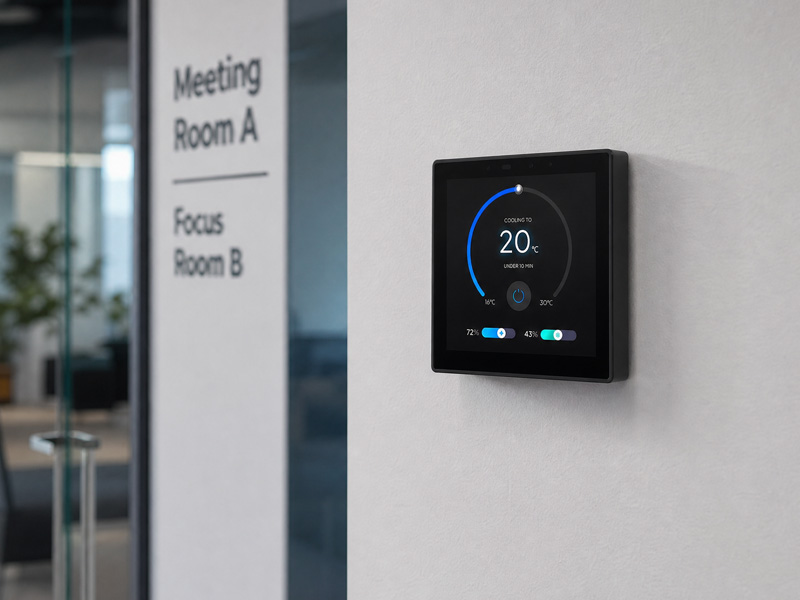
smart home control panel
A standard SMT production facility encompasses:
PCB Preparation
↓
Solder Paste Printing
↓
Component Placement
↓
Reflow Soldering
↓
AOI Inspection
↓
Testing
↓
Finished PCBA
2. What Makes SMT Essential for Intelligent Control Panel Systems?
Intelligent control panels necessitate the integration of numerous electronic components within a constrained physical footprint.
A standard intelligent panel printed circuit board assembly comprises:
- Central processing units
- Memory and data storage systems
- Electrical power regulation circuits
- Wireless connectivity modules
- Network interface controllers
- Display input processors
- Detection and measurement devices
- Data transmission pathways
Surface mount technology enables the consolidation of all these components into a space-efficient PCB configuration.
Illustration:
┌─────────────────────┐
│ Touch Display │
│ │
│ ┌───────────────┐ │
│ │ PCBA │ │
│ │ CPU │ │
│ │ Memory │ │
│ │ WiFi Module │ │
│ │ RS485 Circuit │ │
│ └───────────────┘ │
└─────────────────────┘
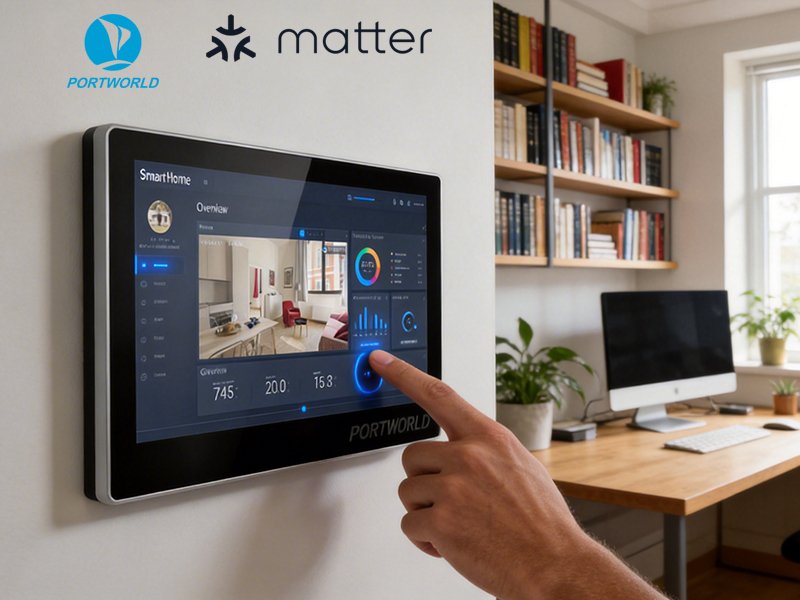
smart home control panel
3. Surface Mount Technology Process in Smart Control Panel Manufacturing
Step 1: Printed Circuit Board Design and Preparation
Prior to Surface Mount Technology assembly commencing, engineering professionals develop the printed circuit board in accordance with specified product requirements.
The printed circuit board design encompasses:
- Processor configuration and placement
- Display interface specifications
- Communication circuit architecture
- Electrical power supply design
- Component positioning and allocation
For illustrative purposes:
- An intelligent residential control panel may necessitate:
- RK3566 microprocessor unit
- Wireless connectivity module (WiFi/Bluetooth)
- Ethernet communication interface
- RS485 serial communication protocol
Step 2: Solder Paste Application
The initial Surface Mount Technology procedure involves depositing solder paste onto the printed circuit board.
A precision stencil is positioned atop the printed circuit board, and solder paste is applied to designated contact pads.
The solder paste establishes the electrical and mechanical connection between:
- Printed circuit board contact pads
- Electronic circuit components
Step 3: Automated Component Installation
Following solder paste application, an automated pick-and-place machine deposits components onto the PCB.
The machine installs:
Processor Components
Examples:
- Rockchip RK3566
- RK3568
- ESP32-S3
- Memory Components
Including:
- RAM
- eMMC
- Flash storage
- Communication Components
Such as:
- WiFi chips
- Bluetooth modules
- Ethernet PHY
- Passive Components
Including:
- Resistors
- Capacitors
- Inductors
Advanced placement systems can position thousands of components hourly with exceptional precision.
Step 4: Thermal Reflow Soldering
Following component installation, the PCB undergoes processing in a reflow oven.
Throughout this operation:
- The PCB undergoes progressive heating
- Solder paste liquefies
- Components establish connections with PCB pads
- The board returns to ambient temperature
This procedure establishes robust electrical and mechanical bonds.
Step 5: AOI Inspection
Automated Optical Inspection (AOI) is employed to assess the quality of Surface Mount Technology (SMT) assemblies.
The inspection system identifies:
- Absent components
- Improper component positioning
- Soldering irregularities
- Component orientation misalignment
This verification process guarantees that all smart panel printed circuit board assemblies (PCBAs) conform to established quality specifications.
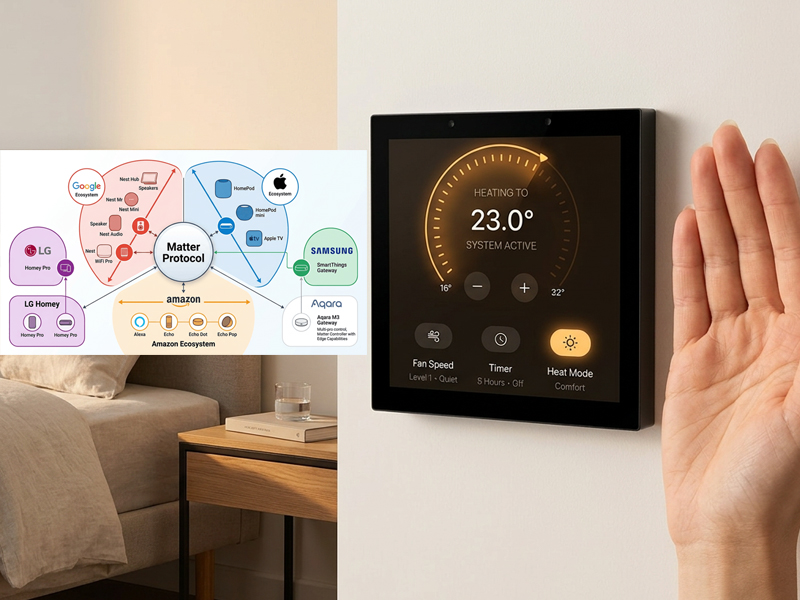
smart home control panel
Step 6: Functional Testing
Following SMT assembly completion, the PCBA is subjected to comprehensive functional evaluation.
The testing protocol encompasses:
Power Testing
Assessment of:
- Voltage output levels
- Electrical current consumption
- Power supply stability
- Communication Testing
Validation of:
- WiFi connectivity
- Bluetooth functionality
- Ethernet connectivity
- RS485 protocol operation
- Display and Touch Interface Testing
Evaluation of:
- LCD display connectivity
- Touch input responsiveness
- Multi-touch capability functionality
4. Surface Mount Technology Components Utilized in Intelligent Control Panel Systems
Central Processing Unit
The central processing unit serves as the command center for the entire system architecture.
Common Examples:
- Rockchip RK3566/RK3568
- ESP32-S3
- ARM Cortex processors
Data Storage Solutions
Utilized for:
- Operating system installation
- Application software
- User-generated information
Typical Examples:
- Dynamic Random Access Memory (DDR RAM)
- Embedded MultiMediaCard (eMMC)
- Flash memory
Communication Interface Circuits
Facilitate connectivity through:
- Wireless Fidelity (WiFi)
- Bluetooth technology
- Zigbee protocol
- Ethernet connectivity
- RS485 serial communication
Electrical Power Management Components
Comprise:
- Voltage regulation modules
- Battery charging integrated circuits
- Electrical safety protection mechanisms
4. Surface Mount Technology Components Utilized in Intelligent Control Panel Systems
Central Processing Unit
The central processing unit serves as the command center for the entire system architecture.
Common Examples:
- Rockchip RK3566/RK3568
- ESP32-S3
- ARM Cortex processors
- Data Storage Solutions
Utilized for:
- Operating system installation
- Application software
- User-generated information
Typical Examples:
- Dynamic Random Access Memory (DDR RAM)
- Embedded MultiMediaCard (eMMC)
- Flash memory
Communication Interface Circuits
Facilitate connectivity through:
- Wireless Fidelity (WiFi)
- Bluetooth technology
- Zigbee protocol
- Ethernet connectivity
- RS485 serial communication
Electrical Power Management Components
Comprise:
- Voltage regulation modules
- Battery charging integrated circuits
- Electrical safety protection mechanisms
6. Surface Mount Technology Assembly for Diverse Intelligent Control Panel Configurations
ESP32-Based Intelligent Control Panels
Primary use cases:
- Intelligent switching systems
- Internet of Things management devices
- Residential automation solutions
Surface Mount Technology incorporates:
- ESP32 microprocessor
- Sensory components
- Wireless communication modules
- Capacitive input interfaces
Reference implementation:
Portworld YC-SM43P
Key specifications:
- ESP32-S3 microprocessor unit
- LVGL graphical interface
- WiFi and Bluetooth connectivity
- RS485 serial communication capability
- Android-Based Intelligent Control Panels
Applications include:
- Residential automation systems
- Hospitality management solutions
- Commercial office environments
Surface Mount Technology assembly comprises:
- ARM-based processor
- Storage components
- Ethernet connectivity
- Display management circuitry
Reference implementation:
Portworld YC-SM10P
Key specifications:
- RK3566 processor architecture
- Android operating system
- Ethernet connectivity with Power over Ethernet
- RS485 serial communication interface
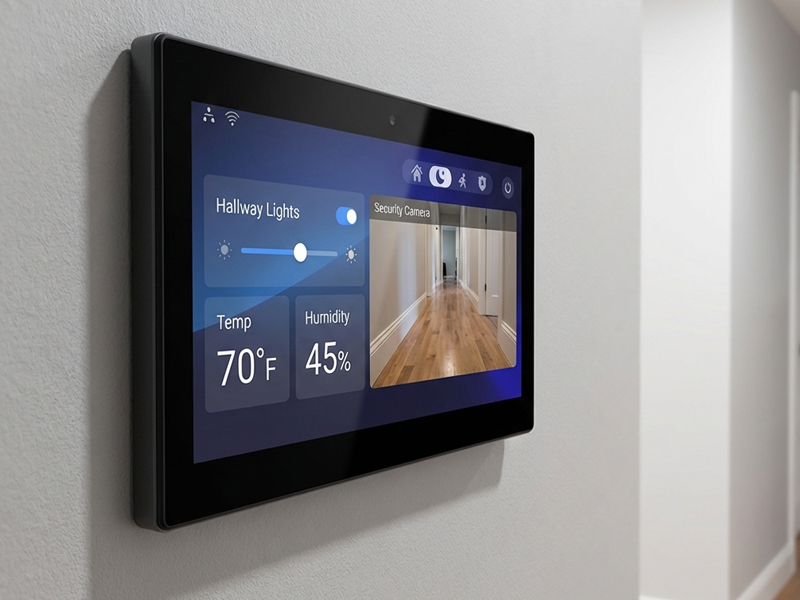
smart home control panel-1
7. Surface Mount Technology Quality Assurance in Intelligent Panel Manufacturing
Industrial manufacturers implement comprehensive quality assurance protocols:
Incoming Material Assessment
Evaluation of:
- Integrated circuit performance standards
- Component technical specifications
- Printed circuit board integrity
- Surface Mount Technology Process Control
Supervision of:
- Soldering thermal conditions
- Component positioning precision
- Equipment operational parameters
- Final Assembly Verification
Comprising:
- Operational functionality assessment
- Accelerated life cycle testing
- Data transmission capability verification
Surface mount technology assembly constitutes a fundamental component in intelligent control panel manufacturing, facilitating manufacturers to develop miniaturized, high-performance, and dependable printed circuit board assemblies.
Via mechanized manufacturing techniques including:
- Solder paste application
- Electronic component positioning
- Thermal reflow bonding
- Automated optical quality inspection
- Operational performance validation
Surface mount technology enables the fabrication of sophisticated intelligent control panels incorporating advanced processing units, interactive display systems, and diverse wireless connectivity protocols.