Digital Signage Display with Ethernet and WiFi
In contemporary commercial settings, digital signage displays have emerged as a vital communication infrastructure for enterprises. Spanning retail establishments, shopping centers, transportation hubs, medical facilities, intelligent building systems, and manufacturing operations, organizations require displays capable of transmitting instantaneous information, facilitating remote content administration, and ensuring consistent operational performance.
To facilitate streamlined content administration and dependable network communication, digital signage displays equipped with Ethernet and WiFi connectivity have established themselves as a predominant industry solution. Through the integration of both hardwired and wireless network capabilities, these displays afford adaptable deployment alternatives and consistent functionality across diverse operational contexts.
The Significance of Connectivity in Digital Signage Display Systems
A digital signage display functions as considerably more than a presentation medium for video or photographic content. Contemporary signage infrastructure necessitates perpetual data exchange with content management systems, distributed computing platforms, and interconnected devices.
Network connectivity facilitates organizations to:
- Modify promotional content from remote locations
- Assess display operational status
- Organize sequential promotional initiatives
- Administer numerous display units concurrently
- Interface with intelligent technological systems
Without robust network connectivity, the administration of an expansive digital signage infrastructure presents substantial operational and financial challenges.
Ethernet versus WiFi for Digital Signage Displays
Both Ethernet and WiFi facilitate network connectivity; however, each demonstrates suitability for distinct operational contexts.
Ethernet Connectivity
Ethernet employs a hardwired network connection, typically facilitated through an RJ45 port.
Key advantages encompass:
Reliable Data Transmission
Ethernet delivers dependable connectivity characterized by minimal signal interference, rendering it particularly advantageous for settings demanding uninterrupted functionality.
Typical Use Cases:
- Airport terminals
- Medical facilities
- Financial institutions
- Intelligent building systems
- Manufacturing environments
Optimal for Extensive Installations
In scenarios involving numerous display units, wired infrastructure facilitates streamlined centralized administration and consistent data communication.

Stretch Bar Monitor
Compatibility with PoE Technology
Certain digital signage displays incorporate Power over Ethernet (PoE) capability, enabling simultaneous transmission of electrical power and data through a unified cable infrastructure.
Corresponding Advantages:
- Streamlined deployment procedures
- Minimized cabling infrastructure
- Enhanced serviceability
Wireless Network Connectivity
WiFi delivers wireless network access without the necessity of supplementary cabling infrastructure.
Key Benefits Include:
Adaptable Installation Capabilities
WiFi proves particularly advantageous in environments where conventional network cabling installation presents significant challenges.
Typical Applications:
- Retail establishments
- Food service venues
- Hospitality facilities
- Exhibition spaces
Rapid Implementation
Organizations can deploy display systems expeditiously without requiring alterations to existing structural or technological systems.
Applicability to Mobile Solutions
Wireless network connectivity offers substantial value for:
- Interim promotional display systems
- Event-specific information presentation screens
- Portable interactive information terminals
Advantages of Digital Signage Displays Equipped with Ethernet and WiFi Connectivity
1. Centralized Remote Content Administration
Through Ethernet or WiFi connectivity, system administrators possess the capability to oversee and manage displays from any geographic location.
Key operational capabilities encompass:
- Transmitting video content and photographic materials
- Refreshing promotional messaging
- Organizing content sequences and timing
- Administering multiple facility locations
As an illustrative case, a large retail organization can implement promotional updates simultaneously across numerous retail outlets utilizing a cloud-based content management system.
2. Instantaneous Data and Information Dissemination
Network-enabled digital signage displays possess the functionality to present current, time-sensitive information including:
- Official public communications
- Transit and travel schedules
- Meteorological data
- Financial market information
- Critical safety and emergency alerts
These capabilities render them particularly valuable for institutional and commercial settings.
3. Enhanced Operational Oversight and Diagnostics
Network-integrated displays can transmit comprehensive operational metrics and status information.
Administrators are able to assess:
- Connectivity status and availability
- Network link integrity
- Data storage utilization
- Operating system and firmware versions
- Overall system functionality and performance
This capability facilitates decreased operational expenses and strengthens overall system dependability.

Casino Digital Signage
4. Seamless Compatibility With Interconnected Technology Ecosystems
Ethernet and WiFi infrastructure enable digital signage displays to establish connections with complementary technological systems and platforms.
Compatible integration options encompass:
- Cloud-based content management systems
- Internet of Things infrastructure
- Intelligent building automation systems
- Retail operations and point-of-sale systems
- Security and entry management systems
Supplementary communication standards may incorporate:
- MQTT
- Modbus
- BACnet
- KNX
- Matter
Hardware Platforms for Networked Digital Signage Displays
Professional digital signage displays necessitate robust embedded hardware infrastructure to facilitate multimedia content delivery and network connectivity.
Prevalent processor options include:
- Rockchip RK3566
- Rockchip RK3568
- Rockchip RK3576
- Rockchip RK3588
These platforms deliver support for:
- 4K video playback
- AI processing
- Multiple display configurations
- Touchscreen functionality
- Industrial-grade applications
Operating Systems for Ethernet and WiFi Digital Signage
Various implementation scenarios demand distinct software solutions.
Android Digital Signage
Key Benefits:
- Streamlined application distribution
- Extensive developer community resources
- Compatibility with enterprise-level CMS platforms
Optimal Applications:
- Retail promotional displays
- Interactive information kiosks
- Intelligent display systems
Linux / Debian Digital Signage
Key Benefits:
- Comprehensive customization flexibility
- Enhanced embedded system management
- Extended operational longevity
Optimal Applications:
- Industrial environments
- Building automation systems
- Bespoke implementations
Yocto Linux
Key Benefits:
- Completely tailored embedded operating system
- Performance optimization capabilities
- Secure system implementation
Optimal Applications:
- Enterprise-scale commercial deployments
- Purpose-built hardware configurations

55 inch Wall-Mounted Signage Display
Hardware Platforms for Networked Digital Signage Displays
Professional digital signage displays necessitate robust embedded hardware infrastructure to facilitate multimedia content delivery and network connectivity.
Prevalent processor options include:
- Rockchip RK3566
- Rockchip RK3568
- Rockchip RK3576
- Rockchip RK3588
These platforms deliver support for:
- 4K video playback
- AI processing
- Multiple display configurations
- Touchscreen functionality
- Industrial-grade applications
Operating Systems for Ethernet and WiFi Digital Signage
Various implementation scenarios demand distinct software solutions.
Key Benefits:
- Streamlined application distribution
- Extensive developer community resources
- Compatibility with enterprise-level CMS platforms
Optimal Applications:
- Retail promotional displays
- Interactive information kiosks
- Intelligent display systems
Linux / Debian Digital Signage
Key Benefits:
- Comprehensive customization flexibility
- Enhanced embedded system management
- Extended operational longevity
Optimal Applications:
- Industrial environments
- Building automation systems
- Bespoke implementations
Yocto Linux
Key Benefits:
- Completely tailored embedded operating system
- Performance optimization capabilities
- Secure system implementation
Optimal Applications:
- Enterprise-scale commercial deployments
- Purpose-built hardware configurations
Portworld Digital Signage Displays with Ethernet and WiFi Connectivity
Portworld delivers tailored digital signage solutions featuring adaptable network connectivity options designed for commercial and industrial environments.
Primary Features:
- Ethernet and WiFi connectivity options
- RJ45 network interface capability
- Optional Power over Ethernet support
- Android, Linux, and Debian operating system compatibility
- RK3566, RK3568, RK3576, and RK3588 processor platforms
- Customizable touchscreen functionality
- Remote Content Management System integration
- Display sizes ranging from 10.1 inches to 65 inches
- Comprehensive OEM and ODM customization services
Industrial and Commercial Applications:
- Retail promotional displays
- Intelligent building access terminals
- Operational industrial dashboards
- Hospitality information systems
- Public transportation information displays
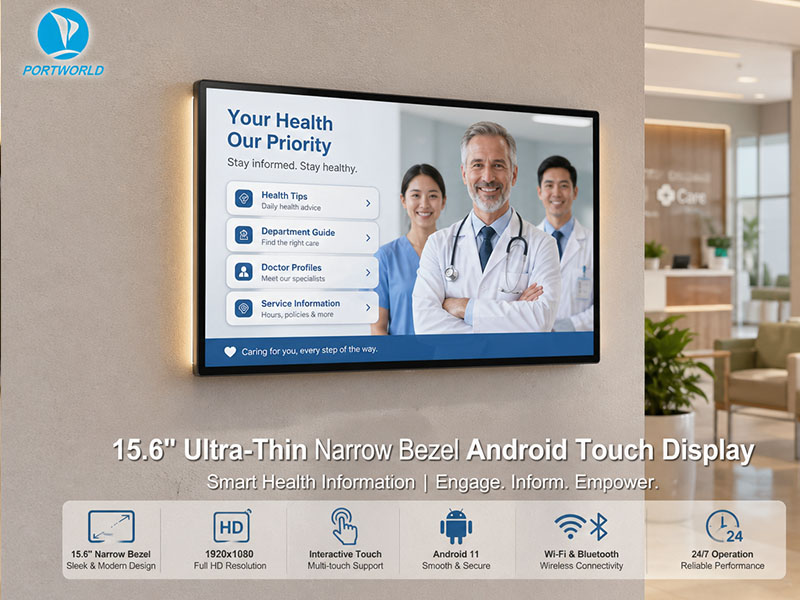
Wall-Mounted Digital Signage
Comprehensive OEM and ODM Customization Services
Portworld accommodates diverse project specifications through the following customization capabilities:
Hardware Customization Services
- Display dimension modifications
- Custom protective enclosure design
- Custom motherboard engineering
- Network connectivity module integration
Software Customization Services
- Android and Linux firmware development
- Board Support Package development
- User interface customization
- Third-party application integration
System Integration Services
- Cloud-based Content Management System connectivity
- Internet of Things protocol implementation
- Intelligent building system solutions
A digital signage display with Ethernet and WiFi provides the flexibility, reliability, and connectivity required for modern commercial communication systems.
Ethernet ensures stable network performance for fixed installations, while WiFi enables flexible deployment in changing environments. Together, they create a powerful platform for remote management, real-time updates, and smart application integration.