Zigbee, Matter, Thread, and Wi-Fi: A Smart Home Comparison Guide
Smart homes use a range of communication technologies to connect lighting, switches, sensors, thermostats, smart locks, curtains, appliances, and control panels. Four technologies commonly come up when designing a smart home system: Zigbee, Matter, Thread, and Wi-Fi.
Although they are often mentioned together, these technologies do not all serve the same function. Zigbee and Thread support low-power wireless communication between devices. Wi-Fi connects devices through an existing IP network. Matter, by contrast, is an application-layer standard intended to improve interoperability among smart home products made by different manufacturers.
Knowing how these technologies differ can help homeowners, system integrators, developers, and smart home manufacturers choose the most suitable connectivity solution for each device.
1. What Is Zigbee?
Zigbee is a low-power wireless communication standard commonly used in smart home automation. It uses IEEE 802.15.4 radio technology and typically operates on the 2.4 GHz band.
Zigbee devices can create a mesh network in which compatible mains-powered devices relay messages, helping extend coverage. Battery-operated sensors usually function as end devices to preserve energy.
Key Advantages of Zigbee
Low power consumption: Well suited to battery-powered sensors, buttons, and switches.
Mesh networking: Devices can pass communications through other network nodes to increase coverage.
Broad device ecosystem: Commonly supported by smart lighting, sensors, switches, and home automation products.
Reduced Wi-Fi device load: Zigbee products use a Zigbee network instead of connecting individually to the home Wi-Fi network.
Potential for local automation: Compatible hubs can run automations locally, reducing reliance on cloud services.
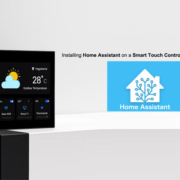
4 inch smart home control panel0
Typical Zigbee Applications
Zigbee is frequently used for:
- Smart lighting and dimmers
- Door and window sensors
- Motion and occupancy sensors
- Smart switches and plugs
- Temperature and humidity sensors
- Curtain and blind controllers
A Zigbee network generally needs a coordinator or compatible hub to manage the network and connect it to a smart home control system.
2. What Is Matter?
Matter is a smart home connectivity and application standard designed to improve interoperability among devices and ecosystems. It enables compatible smart home products to communicate through a shared application-level framework.
Matter runs over Wi-Fi, Ethernet, or Thread. It is not an independent wireless radio technology—a key distinction when comparing it with Zigbee, Thread, and Wi-Fi.
Matter is intended to streamline device setup, enhance cross-platform compatibility, and reduce fragmentation across smart home ecosystems.
Key Advantages of Matter
Cross-platform interoperability: Compatible devices can work across multiple supported smart home ecosystems.
Simplified commissioning: Standardized setup procedures make it easier to add compatible devices.
IP-based connectivity: Matter uses IP networking over supported transport technologies.
Local communication: Depending on the ecosystem and device implementation, many control operations can take place locally.
Flexible connectivity: Depending on their design, devices can connect through Wi-Fi, Ethernet, or Thread.
Common Matter Applications
Matter is becoming increasingly important for:
- Smart lighting
- Smart plugs and switches
- Thermostats
- Door locks
- Sensors
- Smart appliances
- Smart home control interfaces
For manufacturers, Matter can make it easier to integrate products across multiple ecosystems. However, development still requires careful consideration of certification, device type, controller support, and available features.
3. What Is Thread?
Thread is a low-power, IPv6-based wireless mesh networking technology created for connected devices. It uses IEEE 802.15.4 radio technology and typically operates in the 2.4 GHz frequency band.
Designed to enable reliable, energy-efficient communication between devices, Thread uses a mesh architecture that lets supported devices communicate through nearby network nodes. This can enhance both coverage and network resilience.
Thread is frequently associated with Matter, as Matter over Thread is a common connectivity option for battery-powered smart home devices.
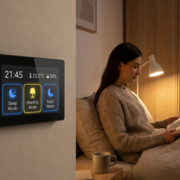
4 inch smart home control panel
Key Advantages of Thread
Low power consumption: Designed for small connected devices with limited energy needs.
Mesh networking: Compatible nodes can help extend network coverage.
IPv6 connectivity: Thread devices communicate using IP-based networking.
Self-healing capabilities: The network can respond to certain changes in nodes or connections.
Scalable network design: Well suited to expanding smart home installations.
Typical Thread Applications
Thread is particularly suitable for:
- Battery-powered sensors
- Smart locks
- Smart switches
- Smart plugs
- Thermostats
- Matter-compatible lighting and control devices
Thread networks generally need a Thread Border Router to connect the Thread mesh to other IP networks. A compatible smart speaker, hub, or smart home controller may perform this function.
4. What Is Wi-Fi?
Wi-Fi is among the most widely recognized wireless communication technologies. Many homes already have a Wi-Fi router or access point, allowing smart devices to connect conveniently to the existing network.
Wi-Fi is especially appropriate for devices that need higher data throughput, communicate frequently, or require direct access to an IP network.
Key Advantages of Wi-Fi
Existing infrastructure: Most homes already have routers and wireless access points.
High data throughput: Well suited to devices that transmit images, audio, video, or larger volumes of data.
Direct IP connectivity: Devices can communicate over the home network.
Easy integration with network services: Supports apps, cloud services, local dashboards, and remote management.
No dedicated low-power mesh coordinator needed for basic Wi-Fi connectivity: Devices connect to the existing wireless network, though ecosystem controllers may still be required for automation.
Typical Wi-Fi Applications
Wi-Fi is often used for:
- Smart cameras and video doorbells
- Smart TVs and media devices
- Smart appliances
- Wi-Fi smart plugs
- Smart home control panels
- Home automation gateways
- Devices that require frequent data communication
However, Wi-Fi typically uses more power than low-power wireless technologies. As a result, it is less suitable for small, battery-operated sensors designed for long operating life.
5. Zigbee vs. Matter vs. Thread vs. Wi-Fi
The following table summarizes their major differences.
| Feature | Zigbee | Matter | Thread | Wi-Fi |
|---|---|---|---|---|
| Technology type | Wireless protocol | Application-layer standard | Low-power mesh networking | Wireless networking |
| Main purpose | Device communication and automation | Interoperability and device control | Reliable low-power IP mesh | Network connectivity and data transfer |
| Radio technology | IEEE 802.15.4 | Wi-Fi, Thread, Ethernet | IEEE 802.15.4 | IEEE 802.11 |
| Frequency | Usually 2.4 GHz | Depends on transport | Usually 2.4 GHz | 2.4 / 5 GHz, depending on device |
| Network topology | Mesh | Depends on underlying network | Mesh | Typically infrastructure-based star; Wi-Fi mesh systems can extend coverage |
| Power consumption | Low | Depends on transport | Low | Generally higher |
| Battery devices | Excellent | Good with Thread | Excellent | Usually less suitable |
| Hub / infrastructure | Zigbee coordinator or hub | Matter controller | Thread Border Router | Wi-Fi router/access point |
| Internet required for local communication | Not inherently | Not inherently | Not inherently | Not inherently |
| Typical applications | Sensors, lighting, switches | Cross-platform smart devices | Sensors, locks, plugs | Cameras, displays, appliances |
| Main strength | Mature low-power ecosystem | Interoperability | IP-based low-power mesh | Bandwidth and existing infrastructure |
One key point: Matter is not directly comparable to the other three technologies as a radio protocol. A device may use Matter over Wi-Fi or Matter over Thread. Its transport technology largely determines its networking behavior, power use, and connectivity needs.
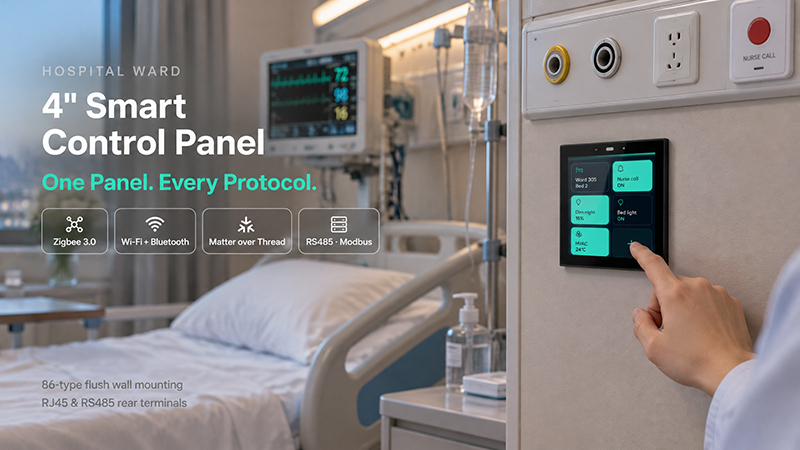
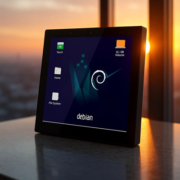
4 inch smart home ocntrl panel
6. Zigbee vs. Thread: How Do They Differ?
Zigbee and Thread share some underlying radio technology, but their network architectures and protocol stacks are different.
Both support low-power wireless communication and mesh networking. However, Thread is based on IP, whereas Zigbee uses its own networking stack.
Zigbee
Zigbee has an established ecosystem offering a wide range of sensors, lighting products, switches, and other smart home accessories. It is a practical option for existing smart home setups and projects that already use Zigbee hubs.
Thread
Thread uses IPv6 and is designed to make connections between low-power devices and IP-based systems simpler. It is particularly relevant to newer products that support Matter.
Which Should You Choose?
Choose Zigbee when:
- You already have a Zigbee hub or coordinator.
- Your project needs a wide selection of existing Zigbee accessories.
- You need affordable, low-power devices.
- Your ecosystem has reliable support for Zigbee devices.
Choose Thread when:
- You are developing new products compatible with Matter.
- IP-based networking is important to your system design.
- Your target ecosystem supports Thread and includes a compatible Border Router.
- You want to create a modern, low-power mesh network.
Neither technology is best in every situation. Base your choice on compatibility with your controller, device availability, firmware support, and deployment requirements.
7. Matter and Wi-Fi: Competing Technologies?
Matter and Wi-Fi are not competitors in the conventional sense; they operate at different layers of a smart home’s communication architecture.
Wi-Fi provides wireless network connectivity, while Matter offers a standardized, application-level communication framework for compatible smart home devices.
For instance, a smart home device may connect to the home network over Wi-Fi and use Matter to communicate with compatible controllers and ecosystems.
Matter over Wi-Fi
Matter over Wi-Fi is well suited to devices that already support Wi-Fi or need comparatively high bandwidth.
Examples include:
- Smart appliances
- Smart plugs
- Some lighting products
- Connected home displays
- Devices that communicate more frequently
- Matter over Thread
Matter over Thread is often a better choice for low-power devices.
Examples include:
- Battery-powered sensors
- Smart locks
- Smart switches
- Temperature sensors
- Low-power lighting controls
This combination enables Matter’s standardized device-control framework to run over a low-power mesh network.
8. Which Smart Home Protocol Is Best for Different Applications?
Smart home devices have varying communication needs, so using a single protocol for every device is rarely the most practical solution.
Smart Lighting
Zigbee and Matter over Thread are well suited to lighting systems with numerous lights, switches, and control devices.
Wi-Fi lighting can be a good fit for smaller installations or products that already rely on Wi-Fi.
Smart Sensors
Door, motion, temperature, and occupancy sensors generally send only small amounts of data.
Zigbee and Thread are strong choices because their energy-efficient designs support battery-powered devices.
Smart Cameras
Wi-Fi or Ethernet is generally better suited to cameras, since transmitting video requires much more bandwidth than communicating basic sensor data.
Smart Locks
Smart locks may use Zigbee, Thread, or supported Matter connectivity options. When choosing, consider security needs, battery life, ecosystem compatibility, and local control.
Smart Home Control Panels
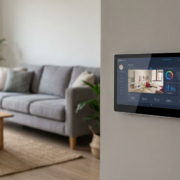
Smart home control panels can provide a central interface for managing lighting, HVAC, curtains, security systems, and other connected devices.
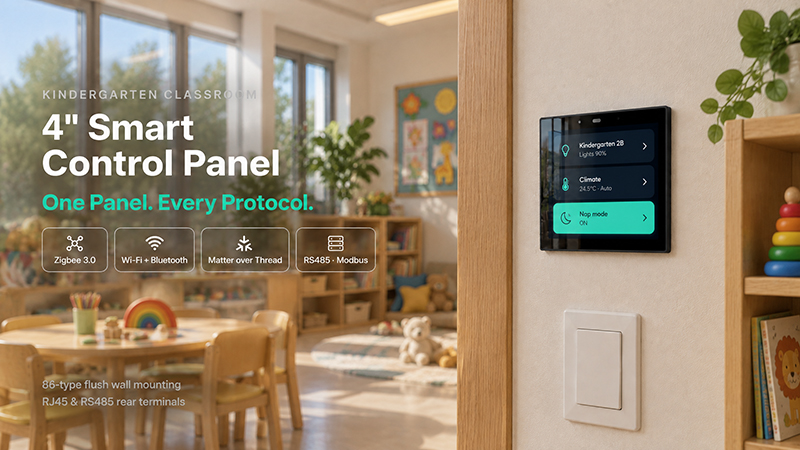
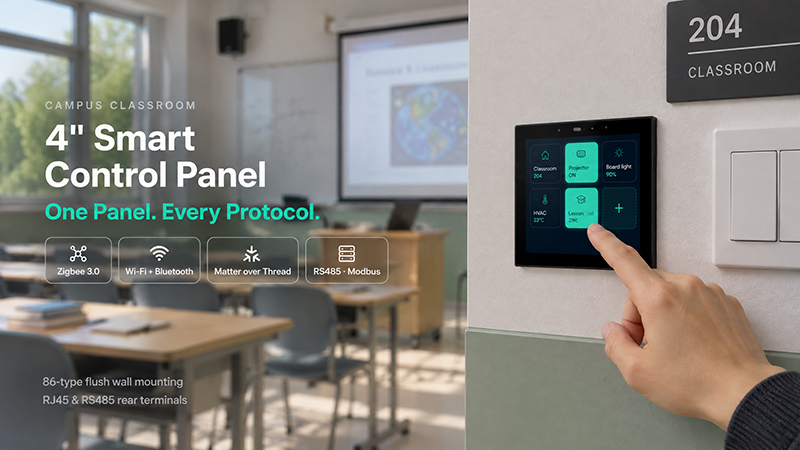
Depending on the system’s design, a panel may connect to IP networks over Wi-Fi or Ethernet and support Zigbee, Thread, Matter, KNX, MQTT, Modbus, or other technologies through built-in interfaces, software, gateways, or external controllers.
For a wall-mounted panel, a reliable connection, responsive interface, continued software support, and compatibility with the intended automation platform are often more important than choosing a particular wireless protocol.
9. Selecting the Appropriate Smart Home Communication Technology
When planning a smart home system, evaluate the following considerations.
1. Device Power Requirements
Battery-operated sensors typically benefit from energy-efficient technologies such as Zigbee or Thread. Wi-Fi is generally better suited to mains-powered devices that require greater communication capacity.
2. Network Coverage
Mesh technologies can expand coverage by relaying signals through compatible devices. Actual performance, however, depends on device placement, radio interference, the number of routers or relay-capable nodes, and the building’s construction.
3. Compatibility
Confirm that each device is supported by your controller, smart home platform, gateway, or mobile app.
Matter may enhance compatibility across platforms, but support for individual device categories and features should still be checked.
4. Data Throughput
Sensors and switches typically need little bandwidth. Cameras, media equipment, and connected displays may require Wi-Fi or Ethernet.
5. Local Control and Cloud Reliance
For essential automation, determine whether devices will continue to function locally if the internet connection is unavailable.
Local control can improve response times and lessen reliance on cloud services. However, its availability depends on the device, hub, and software platform.
6. Expandability
A smart home system may begin with lighting and switches but later expand to HVAC, security, energy management, and whole-home automation.
Selecting a controller and hardware platform that supports future integrations can reduce redesign costs.
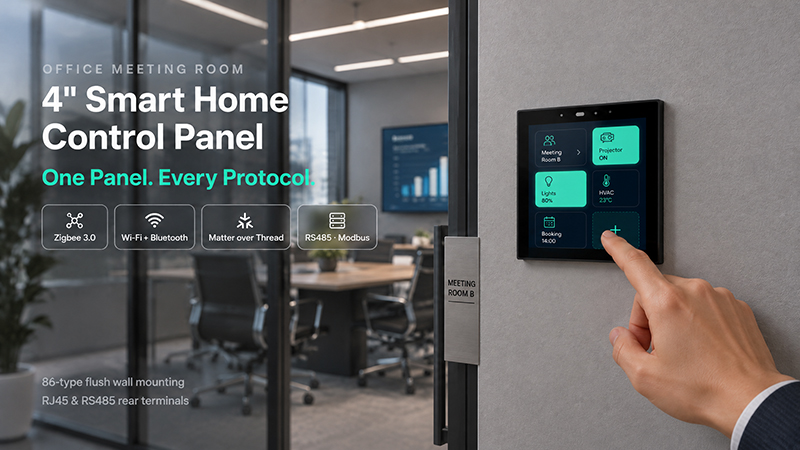
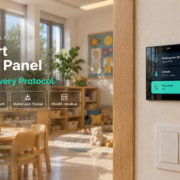
4 inch smart home control panel
10. Smart Home Control Panels for Multi-Protocol Systems
As smart home systems grow more sophisticated, users need a central interface to manage devices and automation across multiple technologies.
A smart home control panel can offer a wall-mounted touchscreen for managing:
- Lighting and scenes
- HVAC systems and thermostats
- Curtains and blinds
- Security systems and sensor status
- Energy monitoring dashboards
- Room-specific automation
- Smart home system integration
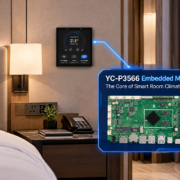
For system integrators and smart home product manufacturers, selecting a control panel requires considering more than screen size. Hardware performance, connectivity, operating system, interface customization, mounting design, power options, and software integration all influence the finished product.
Portworld offers smart home control panels and embedded hardware solutions for smart building and home automation projects.
Depending on the model and configuration, solutions may support Android or Linux, Ethernet, PoE, RS485, Zigbee-related integration, and custom software development.
Portworld also provides OEM/ODM services for projects that need customized hardware, PCB/PCBA development, UI branding, firmware adaptation, protocol integration, and mass production.
For developers creating smart home controllers, gateways, wall panels, and connected devices, a customizable embedded hardware platform can speed product development and simplify deployment.