RK3566 vs. RK3568: Which Offers Better Value?
When selecting a Rockchip processor for an embedded product, choosing higher specifications does not necessarily deliver better value. The ideal platform offers sufficient processing power, connectivity, and expansion options without increasing hardware costs unnecessarily.
The RK3566 and RK3568 are widely used quad-core ARM platforms in smart home devices, industrial HMI systems, commercial displays, and embedded computing products. They share several key features, including a Cortex-A55 CPU architecture, Mali-G52 graphics, and an integrated NPU. However, differences in display support and peripheral connectivity may affect the design of the finished product.
Is the RK3568 worth the extra investment, or will the RK3566 meet your project’s needs?
Let’s compare their specifications, real-world applications, and overall development value.
1. RK3566 vs. RK3568: Key Specifications
Both processors are part of Rockchip’s RK35 series and are designed for embedded applications that require a balance of processing performance, multimedia capabilities, and power efficiency.
Here is a comparison of their major features.
| Specification | RK3566 | RK3568 |
|---|---|---|
| CPU | Quad-core Cortex-A55 | Quad-core Cortex-A55 |
| GPU | Mali-G52 2EE | Mali-G52 2EE |
| NPU | Up to 1 TOPS | Up to 1 TOPS |
| Memory support | DDR3/DDR4/LPDDR3/LPDDR4/LPDDR4X | DDR3/DDR4/LPDDR3/LPDDR4/LPDDR4X, with ECC support |
| Video decoding | Up to 4K@60fps | Up to 4K@60fps |
| Video encoding | Up to 1080p@60fps | Up to 1080p@60fps |
| ISP | 8MP | 8MP, with HDR and 3DNR |
| Display capability | Single display engine | Multiple display engine, up to 3 screens |
| Ethernet | Single GMAC | Dual GMAC |
| PCIe | PCIe 2.1 | PCIe 3.0 and PCIe 2.1 |
| SATA | Supported through shared interfaces | Up to 3 SATA 3.0 interfaces through shared SerDes resources |
| Operating systems | Android / Linux | Android / Linux |
Note: These are SoC-level capabilities, not guaranteed interfaces on every finished motherboard. Actual configurations depend on the PCB design, pin multiplexing, shared interfaces, memory implementation, and software support.
The most important takeaway is that RK3568 is not a completely different performance class. Both platforms share a similar CPU and GPU foundation. The RK3568’s main advantage is its broader connectivity and more flexible display architecture.
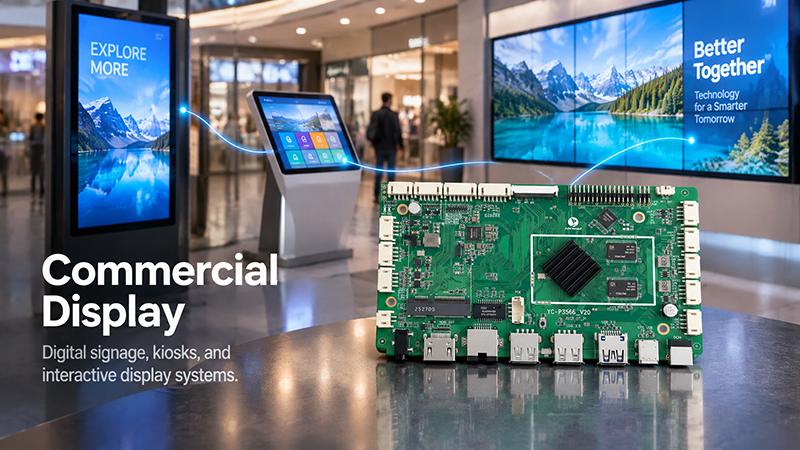
YC-P3566 RK3566 Motherboard Commercial Display
Source: Rockchip’s official RK3566 product information and RK3568 brief datasheet.
GPU Performance
Both processors feature the Mali-G52 2EE GPU.
This graphics architecture supports typical embedded graphics workloads, including:
- 2D and 3D interface rendering
- Android user interfaces
- Touchscreen animations
- Multimedia display
- GPU-accelerated graphics applications
For products with a standard touchscreen interface, such as a smart thermostat, room controller, or industrial HMI, the GPU is unlikely to be the deciding factor between these platforms.
Verdict: The RK3566 and RK3568 offer comparable performance for general CPU and GPU workloads. The RK3568’s main advantage lies in its broader system-level capabilities, not a substantial upgrade to its CPU or graphics architecture.
3. NPU and AI Processing: Is One Better?
Both the RK3566 and RK3568 feature an NPU offering up to 1 TOPS of INT8 inference performance.
They can support some lightweight edge AI applications, as long as the model is compatible with the available runtime and has been correctly converted and optimized.
Possible use cases include:
- Basic image classification
- Object detection using lightweight models
- Smart camera analytics
- Simple visual recognition
- Local AI-assisted control functions
However, an NPU rated at 1 TOPS is not intended for demanding AI tasks, such as running large language models or complex, real-time computer vision pipelines.
Either processor may be adequate for smart building terminals, industrial control panels, and entry-level devices with AI capabilities.
If your project needs substantially greater AI processing power, consider a more capable platform, such as the RK3576 or RK3588.
Verdict: Based on the official 1 TOPS INT8 specifications, neither the RK3566 nor the RK3568 offers a clear NPU advantage. Select one based on your other system requirements.
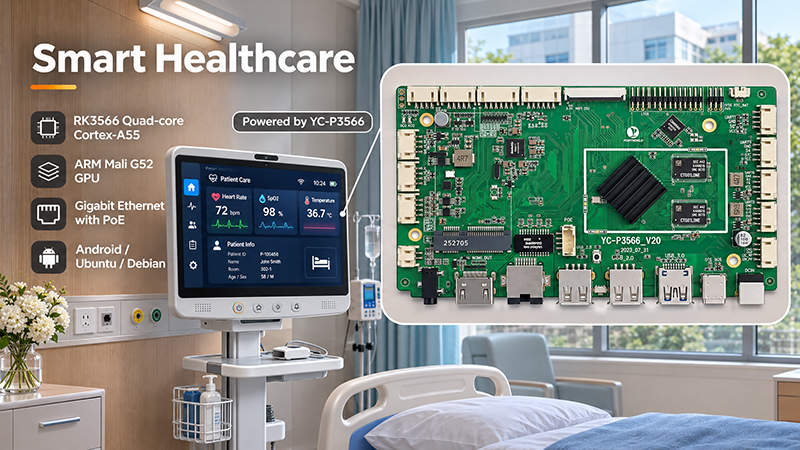
YC-P3566 rk3566 motherboard Smart Healthcare
4. Display Capabilities: RK3568’s Advantage
Display requirements are among the key differences between the two platforms.
RK3566: Designed for Single-Display Products
RK3566 is built around a single-display engine and supports the following display interfaces:
- HDMI 2.0
- eDP
- MIPI-DSI
- LVDS
- RGB
- EBC
This makes it a suitable choice for a range of products with one primary display, such as:
- Smart home control panels
- Industrial HMI terminals
- Smart appliance interfaces
- Commercial advertising players
- Touchscreen information terminals
For products that use a single touchscreen and do not need multiple independent display outputs, RK3566 can be a cost-effective solution.
RK3568: A More Flexible Multi-Display Architecture
RK3568 features a multi-display engine capable of supporting up to three screens at the SoC level.
Supported display interfaces include:
- HDMI 2.0
- eDP 1.3
- Dual MIPI-DSI
- LVDS
- RGB
- EBC
This capability makes RK3568 a strong choice for projects that require multiple display outputs or flexible display integration.
Potential applications include:
- Multi-screen industrial control systems
- Commercial display terminals
- Building management interfaces
- Smart information kiosks
- Embedded systems with separate operator and monitoring screens
However, SoC-level support for three screens does not guarantee that every RK3568 motherboard can directly drive three independent displays. The number of displays that can operate simultaneously depends on display routing, interface combinations, PCB design, and BSP support.
Verdict: RK3566 is often sufficient for products that need only one display. When multiple independent screens are part of the product specification, RK3568 provides a clear architectural advantage.
5. Connectivity and Expansion: RK3568 Offers Greater Flexibility
When developing industrial embedded products, connectivity can be more important than CPU performance.
For instance, an industrial gateway may require several Ethernet connections, storage expansion, USB peripherals, and links to external controllers.
In these applications, RK3568 provides greater flexibility.
Ethernet
RK3566 features one Gigabit Ethernet MAC interface.
RK3568 features two Gigabit Ethernet MAC interfaces, enabling designers to build systems with separate network connections.
Potential applications include:
- Industrial network gateways
- Network-connected control terminals
- Smart building gateways
- Systems that separate internal and external networks
- Embedded network appliances
The number of available Ethernet ports in a finished product depends on the motherboard’s PHY and connector design.
PCIe and Storage Expansion
RK3568 supports PCIe 3.0 with configurable lane arrangements, as well as additional shared high-speed interfaces.
Its connectivity architecture also supports up to three SATA 3.0 interfaces through shared SerDes resources.
These features are beneficial for products requiring additional storage, network expansion, or other high-speed peripherals.
RK3566 also supports PCIe 2.1 and SATA-related expansion using shared interface resources, but offers a more limited expansion architecture.
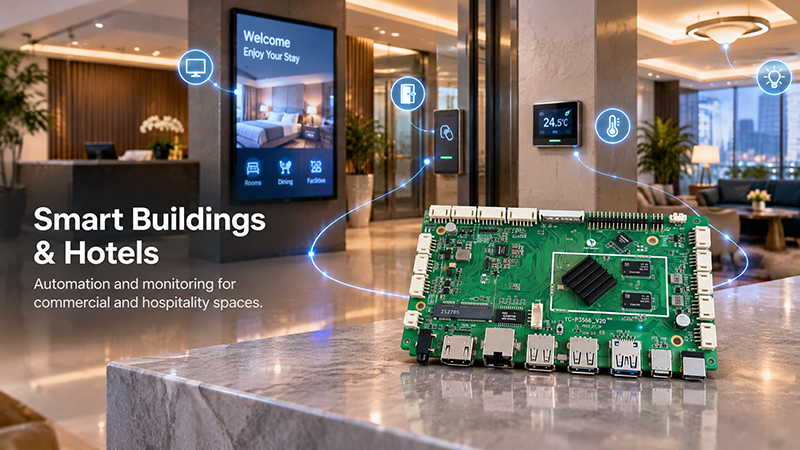
YC-P3566 rk3566 motherboard Smart Buildings Hotels
USB and Peripheral Connectivity
Both platforms support USB connections for external peripherals.
RK3568 provides a more extensive high-speed interface configuration, making it advantageous for products that connect multiple peripherals or need additional USB 3.0 capability.
For industrial products, confirm the availability of USB, UART, RS485, RS232, CAN, and other interfaces using the selected motherboard schematic and pin configuration.
Verdict: RK3568 is generally preferable for communication-intensive products and systems that require greater expansion flexibility. RK3566 is adequate when interface requirements are relatively simple.
6. RK3566 vs. RK3568: Which Applications Provide Better Value?
The ideal processor depends on the product’s real-world workload and hardware needs.
The following examples illustrate common use cases.
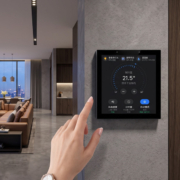
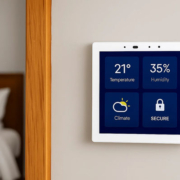
- Smart Home Control Panels
- Recommended platform: RK3566
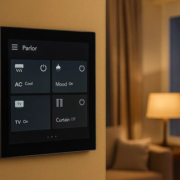
- Modern wall-mounted smart home touchscreen control panel for residential lighting and HVAC
A typical smart home control panel uses a touchscreen to manage lighting, curtains, HVAC, room settings, and connected devices.
Most models have a single display and do not need extensive high-speed expansion.
RK3566 offers adequate computing performance for these applications while helping manufacturers keep hardware costs in check.
For products requiring multiple displays or more complex network integration, RK3568 may be a suitable option.
Industrial HMI Systems
Industrial HMI applications differ considerably in complexity.
A conventional machine-control panel with a single touchscreen and several serial interfaces may be well suited to RK3566.
By contrast, an HMI system requiring multiple display outputs, dual Ethernet, or additional high-speed expansion may benefit from RK3568.
Make the selection according to the actual interface requirements and display architecture.
Smart Building Gateways
Smart building gateways frequently link multiple subsystems, including lighting, HVAC, access control, and energy monitoring.
Dual Ethernet is valuable for segmenting networks or connecting separate areas of a building’s infrastructure.
RK3568 also provides greater flexibility for expanding storage and integrating peripherals.
Commercial Digital Signage
For a conventional single-screen advertising player, RK3566 offers the multimedia and display capabilities required.
RK3568 is a strong option when a product needs multiple independent screens or additional network connectivity.
Both platforms support 4K-class video decoding with supported formats and configurations.
7. Cost Comparison: Is RK3568 Worth the Additional Investment?
The answer depends on the complete motherboard design, not just the processor price.
RK3566 may provide better value for projects requiring:
- One display output
- Standard Ethernet connectivity
- Basic USB and serial interfaces
- Android or Linux application support
- Moderate multimedia processing
- A cost-conscious hardware design
RK3568 may warrant its additional design or component costs for projects requiring:
- Multiple independent display outputs
- Dual Gigabit Ethernet
- PCIe 3.0 expansion
- More flexible high-speed connectivity
- Additional storage interfaces
- A more complex embedded-system architecture
There is no standard price difference between RK3566 and RK3568 motherboards. The final cost also depends on RAM, eMMC capacity, PCB layer count, connectors, wireless modules, power design, and production volume.
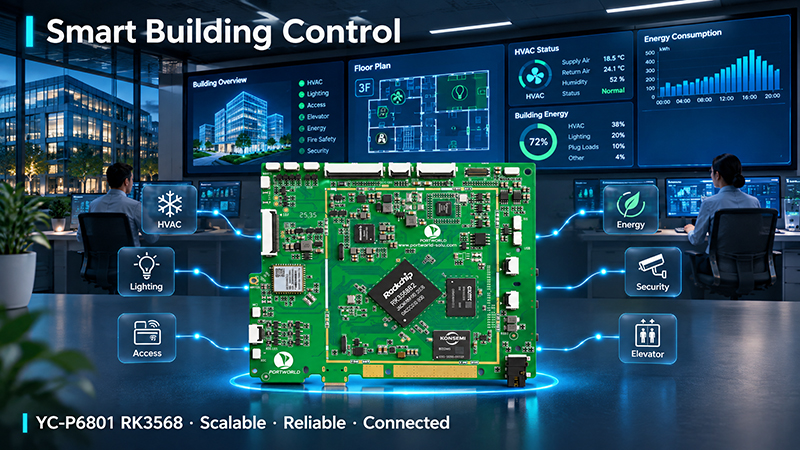
YC-P6801 Smart Building Control
A practical way to assess value is to consider the total system cost:
Total system cost = Motherboard + Peripheral components + Power design + Software development + Integration and validation
For example, choosing RK3566 may reduce the initial hardware cost, but if the project later needs additional network controllers or display-expansion hardware, the overall system may become more complicated.
Conversely, choosing RK3568 for a simple single-screen product may add capabilities that the application never uses.
The best-value platform is the one that meets the product requirements with an appropriate margin, without unnecessary hardware complexity.
8. Portworld RK3566 and RK3568 Motherboard Solutions
For manufacturers of embedded products, choosing a processor is just the initial step. The motherboard must also meet requirements for memory, storage, interfaces, operating systems, and mechanical design.
Portworld provides Rockchip-based motherboard solutions for smart home devices, industrial control systems, and commercial embedded products.
YC-P3566 RK3566 Motherboard
Built around the Rockchip RK3566 processor, the YC-P3566 is designed for embedded applications that need efficient computing performance and flexible integration.
Key features include:
- Quad-core Cortex-A55 processor
- Mali-G52 GPU
- 1 TOPS NPU
- 2GB RAM, with 4GB and 8GB options
- Gigabit Ethernet, with PoE support in the specified configuration
- SDK and development support
The board may be suitable for smart home control panels, embedded touchscreen terminals, and other single-display products.
YC-P6801 RK3568 Motherboard
Built on the Rockchip RK3568 platform, the YC-P6801 is designed for embedded applications that need greater flexibility in system integration.
Key features include:
- Rockchip RK3568 processor
- Integrated NPU delivering up to 1 TOPS INT8 performance
- Customizable hardware configuration
- Support for CKD/SKD and PCBA development
- Hardware and software customization options
The YC-P6801 is suitable for projects involving customized embedded computing hardware, industrial control integration, and application-specific motherboard development.
Portworld also provides the YC-P6802 RK3568 motherboard for projects with different hardware and interface requirements.
Confirm the precise RAM, storage, Ethernet, display, and peripheral configurations against the selected product revision.
9. How to Make the Final Decision
Before selecting RK3566 or RK3568, evaluate the following questions:
| Selection factor | Choose RK3566 when… | Choose RK3568 when… |
|---|---|---|
| Display | One primary screen is enough | Multiple independent displays are required |
| Ethernet | One network connection is sufficient | Dual Ethernet is needed |
| Expansion | Basic peripheral connections are enough | More high-speed expansion is required |
| Storage | Standard embedded storage is sufficient | Additional SATA or PCIe expansion is needed |
| Application | Smart panels and standard HMI | Gateways and more complex embedded systems |
| Cost | Hardware cost is a major priority | Additional connectivity justifies the investment |
Choosing the RK3568 solely because it provides more interfaces is unnecessary. When an application does not require those features, the RK3566 may offer greater overall value.
However, when multiple displays, dual Ethernet, or PCIe 3.0 are essential, selecting the RK3568 from the outset can reduce the need for extra controllers and hardware redesign.
The RK3566 and RK3568 share a similar computing foundation: quad-core Cortex-A55 CPUs, Mali-G52 graphics, and 1 TOPS of NPU performance. Their key differences are in display architecture, network connectivity, and expansion capabilities.
The RK3566 delivers better value for cost-sensitive embedded products with standard single-display and connectivity needs. The RK3568 is better suited to systems requiring multiple displays, dual Ethernet, or more flexible high-speed expansion.
For manufacturers developing smart home panels, industrial HMI systems, building automation gateways, and commercial embedded devices, Portworld offers RK3566 and RK3568 motherboard options, as well as OEM/ODM development, PCB customization, operating system integration, and engineering support.