
System on Module vs. Custom Mainboard: Development Trade-Offs
When developing an embedded product, an early hardware decision is whether to use a System on Module (SoM) or create a fully customized mainboard.
Both options can deliver the processing performance, connectivity, and hardware interfaces an embedded system needs. However, they vary considerably in design complexity, development time, customization, production costs, and ongoing maintenance.
A SoM brings essential computing components together in a compact module, enabling developers to build products on an established hardware platform. By contrast, a custom mainboard combines the processor, memory, power management, and peripheral circuitry on a PCB tailored to the application.
For companies creating industrial HMI systems, smart home control panels, robotics platforms, AI devices, and commercial terminals, this architectural choice can shape the entire product development process.
Which approach is best?
The right choice depends on product requirements, production volume, engineering resources, and the anticipated product lifecycle.
This article compares SoM and custom mainboard development, outlines the benefits and limitations of each, and examines how to choose the most suitable solution for an embedded project.
1. What Is a System on Module (SoM)?
A System on Module (SoM) is a compact computing platform that combines the core components needed to run an embedded system.
Depending on its design, a typical SoM may contain:
- An application processor or SoC
- RAM
- eMMC or other onboard storage
- Power management components
- Clock and support circuitry
- A board-to-board connector
Rather than build the entire computing platform from the ground up, developers can use an existing SoM and connect it to a carrier board.
The carrier board supplies the interfaces and additional circuitry required by the finished product, including USB, Ethernet, display connectors, camera interfaces, GPIO, UART, and other peripherals.

NVIDIA Jetson Orin NX/Nano AI Edge Computing Carrier Board
How Does a SoM-Based System Operate?
A typical SoM architecture has two main components:
- 1. SoM: Supplies the core computing platform, including the processor, memory, and other integrated components.
- 2. Carrier Board: Connects the SoM to external devices and provides application-specific interfaces, power inputs, and peripheral circuitry.
For example, an industrial HMI manufacturer might choose an RK3576 SoM and design a carrier board to support the required touchscreen, Ethernet, USB, and serial communication interfaces.
The computing module can remain largely the same, while the carrier board is modified to accommodate different product configurations.
This modular approach reduces the high-speed, processor-level circuit design required for each new product.
Portworld SoM Solutions
Portworld supplies embedded computing modules tailored to a range of application needs, including:
RK3576 SoM: A compact 38 × 38 mm module with an octa-core CPU, an NPU delivering up to 6 TOPS, 4GB of LPDDR4 memory, and a 240-pin board-to-board connector.
RK3588 Core Board: A high-performance computing module with an octa-core CPU, an NPU delivering up to 6 TOPS, support for 8K video in supported configurations, and a 400-pin board-to-board connector.
These modules offer a foundation for developing embedded AI devices, industrial computing systems, robotics platforms, and intelligent terminals.
2. What Is a Custom Mainboard?
A custom mainboard is a PCB developed for a specific embedded product or application.
Unlike a modular design, a custom mainboard places the primary computing components and application-specific circuitry directly on a single PCB.
A typical custom mainboard may include:
- Application processor or SoC
- RAM and storage
- Power management ICs
- Display and camera interfaces
- Ethernet and USB circuits
- UART, RS485, RS232, and other communication interfaces
- Audio circuits
- GPIO and sensor connections
- Power input and protection circuits
The precise configuration varies according to the product.
For example, a manufacturer creating a wall-mounted smart home control panel may need a custom mainboard that integrates a processor, memory, touchscreen interface, PoE power, RS485 communication, audio, and wireless connectivity.
A custom mainboard lets the engineering team position components and design circuits to meet the final product’s enclosure, display, electrical, and functional requirements.
Why Choose a Custom Mainboard?
Its primary advantage is design flexibility.
Rather than adapting a standard module and carrier board, developers can optimize the entire PCB for the intended application.
This can offer benefits such as:
- Greater flexibility in component placement
- Tailored combinations of interfaces
- PCB dimensions optimized for the product
- Fewer unnecessary connectors
- Power management suited to the application
- Improved mechanical integration
- Potential BOM cost savings at production scale
However, developing a custom mainboard demands additional engineering effort, particularly when integrating high-speed memory, processor interfaces, power management, and complex PCB layouts.

NVIDIA Jetson Orin NX/Nano AI Edge Computing Carrier Board
3. SoM vs. Custom Mainboard: Key Differences
Both architectures can support commercial embedded products, but their development approaches are different.
| Comparison Factor | System on Module | Custom Mainboard |
|---|---|---|
| Hardware architecture | Modular computing platform plus carrier board | Integrated application-specific PCB |
| Processor integration | Provided by the module | Designed into the mainboard |
| Memory integration | Usually included on the module | Selected and integrated during board design |
| PCB development | Mainly carrier board design | Complete mainboard development |
| Development complexity | Generally lower | Generally higher |
| Development time | Often shorter | Usually longer |
| Customization | Mainly carrier board and system integration | Extensive hardware-level customization |
| Initial engineering cost | Often lower | Often higher |
| Component placement | Limited by module design | More flexible |
| Upgrade strategy | Module can potentially be replaced | May require a new mainboard revision |
| Production optimization | Requires module and carrier board cost evaluation | Greater opportunity for integrated BOM optimization |
| Maintenance | Module and carrier board can be evaluated separately | More tightly integrated hardware |
The main difference is that a SoM keeps the computing platform separate from application-specific hardware, whereas a custom mainboard combines both in a single integrated design.
Neither option is inherently superior. The best choice depends on the product’s requirements.
4. Development Time: Which Option Can Bring Your Product to Market Faster?
Development time is often a major consideration in embedded hardware projects.
SoM: Reuse an Existing Computing Platform
A SoM already integrates the processor, memory, and key supporting circuits.
Developers can focus on designing the carrier board and integrating functions specific to the application.
This can reduce the work involved in:
- Processor schematic design
- DDR memory routing
- High-speed signal integrity optimization
- Power sequencing design
- Core hardware validation
For example, a company developing an industrial touchscreen terminal may already have a preferred processor platform.
By using an existing RK3576 SoM, the engineering team can concentrate on display integration, communication interfaces, enclosure design, and application software.
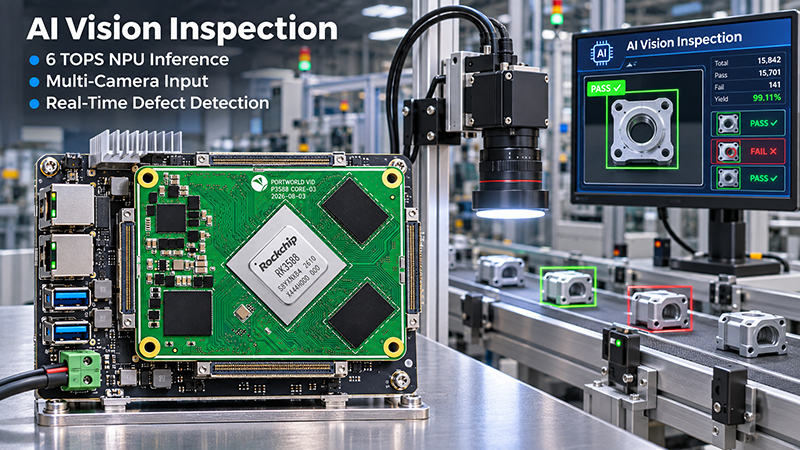
YC-Core3588 AI visual inspection
This approach can speed up the development of early prototypes.
Custom Mainboard: More Work Before Validation
Developing a custom mainboard requires the engineering team to design and verify the entire hardware platform.
Depending on the processor and the product’s complexity, this work may include:
- Processor selection
- Hardware architecture planning
- Schematic design
- PCB layout and routing
- High-speed signal validation
- Power supply and thermal testing
- Prototype manufacturing
- Hardware debugging and revision
This approach typically demands greater engineering resources and a longer validation schedule.
However, it may be worthwhile when a product has specialized hardware requirements that cannot be efficiently met with a standard SoM and carrier board.
Development takeaway: If your main goal is to get an embedded product prototype working quickly, a SoM is often the more efficient starting point. If your product calls for a highly integrated hardware architecture, developing a custom mainboard may be the better choice.
5. Hardware Customization: Flexibility Versus Integration
Customization is the area where the two architectures differ most noticeably.
- SoM: Customize the Carrier Board
- A SoM offers a comparatively stable computing foundation.
- Developers can tailor the carrier board to meet different application needs.
- For example, one SoM can be used across several products, each with a distinct carrier board design:
- An industrial HMI featuring Ethernet, RS485, and touchscreen connections
- A robotics controller with camera and sensor interfaces
- A smart terminal with display, audio, and wireless connectivity
- An edge computing device with extra network and storage interfaces
This approach allows the same computing module to be reused in multiple products.
However, developers are limited to the module’s available interfaces, pin assignments, power capabilities, and software support.
If the module does not expose a necessary signal, adding it may be difficult or impossible without modifying the module itself.
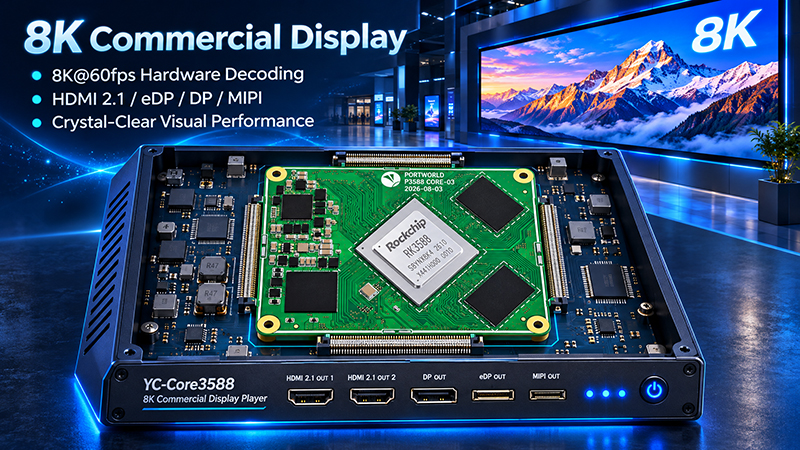
YC-Core3588 core board 8K
Custom Mainboard: Tailored to the Product
A custom mainboard provides greater control over the product’s overall hardware architecture.
Developers can specify:
- Processor and memory configuration
- PCB dimensions and shape
- Connector locations
- Power input design
- Peripheral interface combinations
- Component placement
- External device integration
This flexibility can be especially useful for products with unusual mechanical constraints or specialized electrical interfaces.
For instance, a compact smart appliance may need a mainboard that fits within a narrow enclosure and connects directly to a display, control buttons, sensors, audio components, and communication circuits.
A customized PCB can bring these functions together in a single application-specific design.
However, increased flexibility also brings greater responsibility for hardware design, testing, and production validation.
6. Cost Considerations: Initial Investment vs. Mass Production
Cost is not merely a matter of comparing the unit prices of the two board options.
Developers should assess the total cost of the hardware architecture across the product lifecycle.
- SoM Cost Structure
- A SoM-based design typically involves:
- SoM procurement costs
- Carrier board PCB and component costs
- Assembly expenses
- Connectors and mechanical integration
- System testing and validation
Initial engineering costs are often lower because the core computing hardware has already been developed.
However, the module adds a distinct component cost, and the carrier board still needs to be designed and manufactured.
- Custom Mainboard Cost Structure
- A custom mainboard may require:
- Processor and memory components
- Power management components
- PCB manufacturing
- SMT assembly
- Hardware engineering
- Prototype and validation expenses
- Software and driver development
Initial development costs are generally higher because a larger portion of the hardware platform must be designed and validated.
However, an optimized custom board may lower component counts, connector requirements, PCB complexity, or assembly costs.
Which Option Is More Cost-Effective?
- Consider two distinct scenarios.
- Scenario A: Low-volume embedded product
- A manufacturer plans to produce a few hundred industrial terminals.
- A SoM may be more economical because it lowers upfront engineering costs and speeds up product development.
- Scenario B: High-volume commercial product
- A manufacturer plans to produce tens of thousands of identical smart appliance controllers.
A custom mainboard may offer greater potential for integrating components and optimizing the bill of materials (BOM).
However, the outcome depends on the SoM price, custom PCB design expenses, component sourcing, production yield, and the product’s expected lifetime.
The best approach is to compare total development and manufacturing costs, rather than considering only the board purchase price.
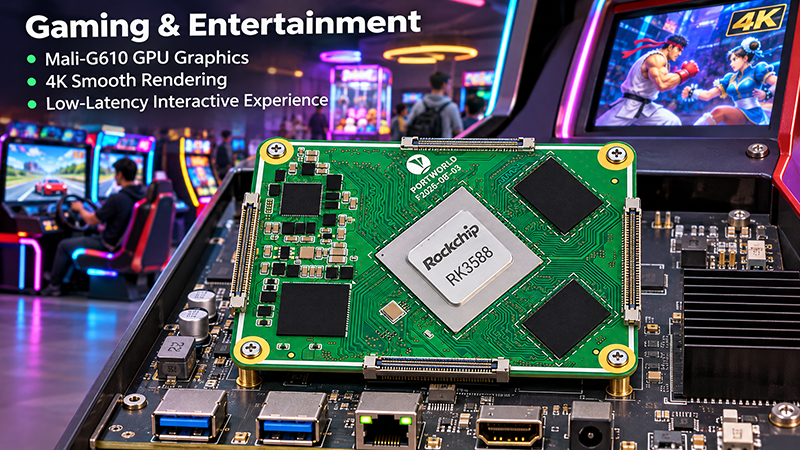
YC-Core3588 Game and entertainment application scenarios
7. Software Development and Maintenance
Hardware architecture also influences software development.
A SoM typically includes an established software foundation, such as a board support package (BSP), bootloader configuration, operating system support, and hardware drivers.
This foundation can accelerate the initial stages of development.
However, developers must still tailor the software to match the carrier board’s specific hardware configuration.
For instance, display panels, touch controllers, GPIO connections, and communication peripherals may require device tree updates or integration of additional drivers.
A custom mainboard may demand more extensive software adaptation due to its unique hardware configuration.
The engineering team must verify that:
- Bootloader settings correspond to the hardware
- Memory configuration is accurate
- Device trees represent the actual interfaces
- Display and touchscreen drivers function correctly
- Power management features are supported
- Communication peripherals operate reliably
- Software maintenance should also be taken into account.
A SoM-based architecture can simplify processor-platform upgrades, since the module may be replaced while preserving much of the carrier board design, provided the replacement is electrically and mechanically compatible.
A custom mainboard may require more extensive hardware and software modifications when the processor or memory architecture changes.
For products with long lifecycles, either approach requires a clear strategy for BSP maintenance and component lifecycle management.
8. Thermal Design, Power Consumption, and Reliability
Thermal management and power design are critical for products that operate continuously or in demanding conditions.
SoM Design Considerations
A SoM comes with an established component layout and power architecture.
Developers should assess:
- Module power requirements
- Heat dissipation near the processor
- Power distribution across the carrier board
- Available space for cooling and airflow
- Connector current limits
- Thermal performance within the final enclosure
The module’s reference design and technical documentation can guide system integration.
Custom Mainboard Design Considerations
A custom mainboard offers greater flexibility to optimize power distribution and component placement.
However, the engineering team must manage:
- Power supply architecture
- Voltage regulation
- Processor power sequencing
- Memory power requirements
- PCB thermal properties
- EMC and signal integrity
- Protection from electrical disturbances
For industrial applications, reliability testing should mirror the installation environment and anticipated operating conditions.
Neither architecture inherently delivers greater reliability. The outcome depends on component quality, PCB layout, manufacturing methods, thermal management, and system validation.
9. When Should You Choose a SoM?
A System on Module is often the better option when development efficiency and platform reuse are priorities.
Consider a SoM if:
- You need to reduce hardware development time.
- Your project calls for a proven processor and memory platform.
- You want to simplify high-speed PCB design.
- Your product can use the interfaces already available on the module.
- You intend to develop several products based on the same computing platform.
- Your initial production volume is relatively low or uncertain.
- You want engineering resources focused on the application instead of processor-level design.
Example: Industrial Edge AI Terminal
Consider a manufacturer developing an industrial terminal equipped with a touchscreen, camera, Ethernet, and on-device AI inference.
A suitable SoM can serve as the central computing platform, while a custom carrier board adds the necessary display, camera, networking, and peripheral connections.
This approach lets the manufacturer concentrate on application software and product integration, rather than building the entire processor platform from the ground up.
For such a project, the Portworld RK3576 SoM or RK3588 Core Board could be considered, depending on CPU performance needs, AI workload, display configuration, and interface availability.
10. When Should You Choose a Custom Mainboard?
A custom mainboard is often a better choice when a finished product has specialized hardware needs or is intended for large-scale production.
Consider developing a custom mainboard if:
- The product needs distinctive PCB dimensions or mechanical layouts.
- A particular combination of interfaces is required.
- Standard SoM interfaces do not satisfy your requirements.
- Integrating components is important for reducing product size.
- You need greater control over the power architecture.
- You anticipate significant production volumes.
- You have adequate engineering resources to develop the complete hardware system.
Example: Custom Smart Home Control Panel
A smart home control panel may need to bring together:
- A touchscreen display
- PoE power input
- RS485 communications
- Audio input and output
- Wireless connectivity
- Sensor interfaces
- Custom mounting and enclosure specifications
A custom mainboard can incorporate these features to meet the product’s precise mechanical and electrical requirements.
For manufacturers creating a purpose-built product instead of a general-purpose computing platform, this degree of integration can offer substantial design flexibility.
11. Can You Combine SoM and Custom Mainboard Development?
Yes. These approaches are not mutually exclusive.
A common strategy is to start with a SoM and, over time, develop a more integrated hardware solution.
For example:
Stage 1: Prototype Development
Use an existing SoM with a development carrier board to assess the processor, operating system, display, peripherals, and application software.
Stage 2: Product Engineering
Create a custom carrier board that incorporates the required interfaces and fits within the product enclosure.
Stage 3: Production Optimization
After product requirements and production volumes become clear, determine whether a more integrated custom mainboard could lower BOM costs, streamline assembly, or improve mechanical integration.
Stage 4: Mass Production
Complete hardware validation, software adaptation, manufacturing documentation, and production testing.
This phased approach enables companies to validate the application before investing in a fully customized hardware platform.
However, transitioning from a SoM-based design to a custom mainboard involves more than changing the PCB layout. Processor integration, memory routing, power design, boot configuration, and software validation may all need to be reviewed again.
12. Portworld: SoM and Custom Mainboard Development Solutions
Selecting the right hardware architecture is just the first step in an embedded product project.
Portworld offers embedded computing modules and hardware customization services to meet a range of development needs.
Portworld RK3576 SoM
The RK3576 SoM is a compact embedded computing module developed for intelligent devices and edge AI applications.
Key specifications include:
- Rockchip RK3576 octa-core processor
- 4 × Cortex-A72 cores, up to 2.2GHz
- 4 × Cortex-A53 cores, up to 1.8GHz
- Integrated NPU delivering up to 6 TOPS
- Mali-G52 MC3 GPU
- 4GB onboard LPDDR4 memory
- 38 × 38 mm module dimensions
- 240-pin board-to-board connector
- Linux, Ubuntu, and Android support, subject to BSP availability
Potential applications include robotics, industrial HMI, edge AI terminals, machine vision, and other embedded computing projects.
Portworld RK3588 Core Board
For applications that demand greater CPU and graphics performance, the RK3588 Core Board provides an alternative computing platform.
Key specifications include:
- Rockchip RK3588 octa-core processor
- 4 × Cortex-A76 cores running at up to 2.3GHz
- 4 × Cortex-A55 cores running at up to 1.8GHz
- Integrated NPU delivering up to 6 TOPS
- Mali-G610 MP4 GPU
- 8K video support with compatible configurations
- 400-pin board-to-board connector
PCIe, SATA, USB, and multi-display support, depending on the module and carrier board implementation
Support for Android, Ubuntu, and Debian
The board is suited to evaluating high-performance embedded applications, such as robotics, industrial vision, intelligent terminals, and edge computing systems.
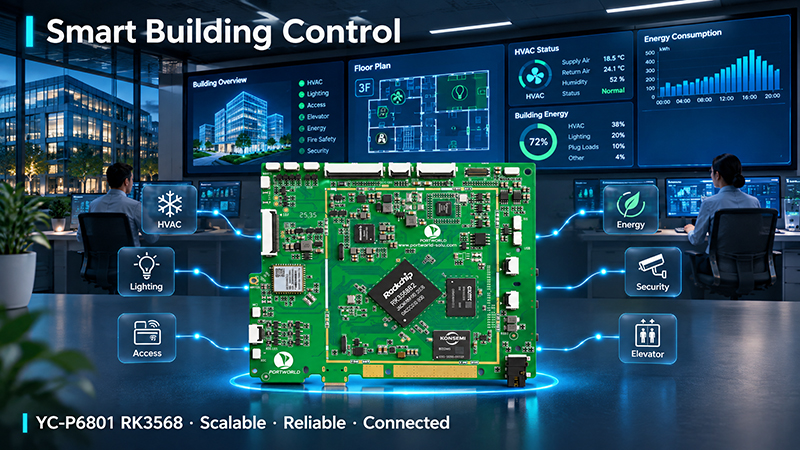
YC-P6801 Smart Building Control
Custom Mainboard and PCBA Development
For projects that need a fully tailored hardware architecture, Portworld offers support with:
- Processor and platform selection
- Mainboard schematic design
- PCB layout and development
- PCBA customization
- RAM and storage configuration
- Display and touchscreen integration
- Integration of Ethernet, USB, UART, RS485, and other interfaces
- Android and Linux system adaptation
- SDK and technical documentation
- Prototype development and mass production support
Whether you select a SoM-based architecture or a custom mainboard, Portworld can assess your hardware requirements and develop a solution tailored to your target application.
13. SoM vs. Custom Mainboard: Final Decision Checklist
Before selecting your hardware architecture, consider the following questions:
| Decision factor | Choose SoM when… | Choose Custom Mainboard when… |
|---|---|---|
| Development time | You need a faster starting point | You can invest in a longer development cycle |
| Engineering resources | You want to reduce processor-level design work | You have resources for full hardware development |
| Customization | Existing module interfaces are sufficient | You need a highly specific hardware layout |
| PCB design | A carrier board meets your requirements | Full PCB integration is necessary |
| Initial cost | Lower upfront engineering investment matters | Long-term integration optimization matters |
| Production volume | Volumes are low, medium, or uncertain | Large-scale production justifies NRE investment |
| Product design | Modular architecture is acceptable | Compact, application-specific integration is essential |
| Maintenance | Module-level replacement is useful | A fully integrated hardware platform is preferred |
The decision should be based on the complete product lifecycle, not just the first prototype.
System-on-Module (SoM) and custom mainboard development represent two distinct approaches to creating embedded computing products.
A SoM provides a ready-made computing platform that can simplify development, speed up prototyping, and enable hardware reuse across multiple products.
A custom mainboard gives developers more control over hardware integration, PCB dimensions, interface combinations, and production optimization. However, it also demands greater engineering effort and thorough validation.
For many embedded projects, beginning with a SoM and transitioning to a customized hardware design as requirements become clearer can be an effective development strategy.
Portworld offers modular computing solutions, including the RK3576 SoM and RK3588 Core Board, as well as custom mainboard development services for embedded products.
