What Should an OEM Buyer Know Before Ordering Smart Home Control Panels?
For smart home brands, distributors, and system integrators, selecting the right touchscreen control panel manufacturer is essential to developing a competitive product portfolio.
A smart home control panel may appear to be a straightforward touchscreen device, but its performance relies on several interconnected elements: the processor, memory, display, operating system, communication interfaces, firmware, and integration software.
For OEM buyers, choosing a product solely on its appearance or price may create issues later, particularly if the panel must support specific smart home ecosystems, automation protocols, or building management systems.
Before placing an OEM order, buyers should assess the following eight areas.
1. Define Your Application and Product Requirements First
Begin by identifying where and how the smart home control panel will be used.
Applications vary, and each may call for a different hardware configuration and set of software capabilities.
For example:
| Application | Typical Requirements |
|---|---|
| Residential smart home | Lighting, curtains, HVAC, scene control |
| Hotel room control | Lighting, air conditioning, room status |
| Smart apartment | Centralized device and room management |
| Commercial building | HVAC, lighting, energy monitoring |
| Meeting room | Room booking, scheduling, environmental control |
| Building automation | KNX, Modbus, RS485, Ethernet integration |
OEM purchasers should identify the intended use before choosing a product.
Consider the following questions:
- Will the panel control a single room or several areas?
- Must it operate as a standalone controller or as a gateway interface?
- Will it connect to third-party automation systems?
- Does the application require continuous 24/7 operation?
- Will it be installed in residential, hotel, or commercial settings?
Clearly defined application requirements help manufacturers recommend appropriate hardware without proposing unnecessary specifications.
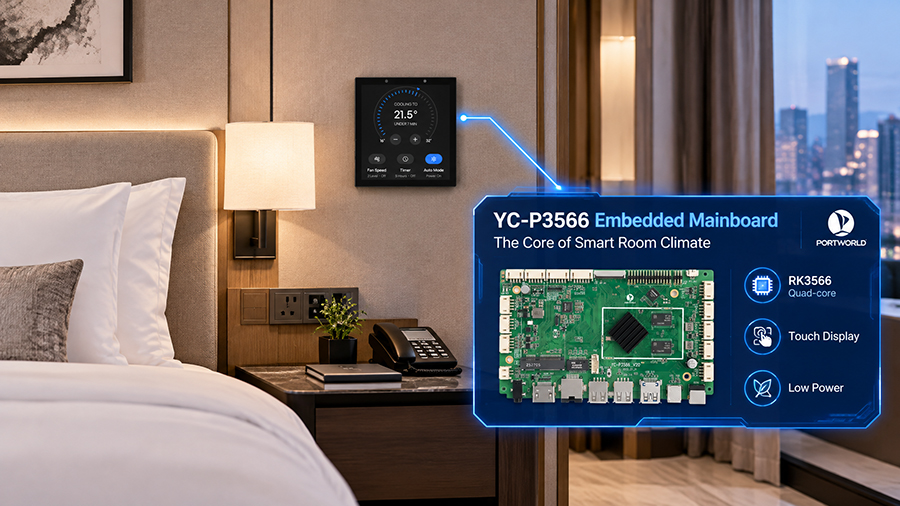
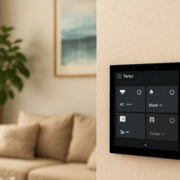
YC-P3566-smart home control panel
2. Choose the Right Screen Size and Display Configuration
Screen size directly affects usability, installation space, product appearance, and cost.
Smart home control panels commonly use compact displays for room-level control and larger touchscreens for centralized automation interfaces.
| Screen Size | Typical Application |
|---|---|
| 4-inch | Compact wall-mounted room control |
| 5–5.5-inch | Residential smart home interfaces |
| 7–8-inch | Multi-function room control |
| 10-inch | Centralized smart home dashboards |
| 10–15.6-inch | Commercial and building management interfaces |
OEM buyers should also assess:
- Resolution and aspect ratio.
- Brightness and viewing angles.
- Capacitive touch responsiveness.
- Cover glass and surface finish.
- Display orientation.
- Wall-mounting dimensions.
- Bezel design and enclosure materials.
For example, Portworld’s YC-SM41P features a compact 4-inch, 480 × 480 touchscreen suited to room-level control, while the YC-SM10P provides a 10-inch, 1280 × 800 display for larger control interfaces.
Selecting the right display is not simply a matter of choosing the largest screen. The key is to match the interface to the actual user experience and installation environment.
3. Choose the Right Processor and Operating System
The processor and operating system determine which applications a panel can run, the complexity of its user interface, and the extent to which it can be customized.
Two common development options are Android- or Linux-based panels and ESP32-based embedded panels.
Android and Linux Platforms
These platforms are well suited to smart home control panels that need to run more complex applications, provide advanced graphical interfaces, support network connectivity, or integrate third-party software.
Portworld offers models based on the RK3566 processor, including the YC-SM41P and YC-SM10P.
Depending on the configuration, these panels support Android or Linux development environments, making them suitable for customized smart home applications.
ESP32 Platforms
ESP32-based panels are better suited to embedded control tasks with clearly defined functions and lightweight graphical interfaces.
For example, the Portworld YC-SM43P is powered by an ESP32-S3 processor and features LVGL, 8MB of PSRAM, and 16MB of Flash.
It supports custom firmware development and is suitable for applications involving sensors, RS485 communication, and embedded control interfaces.
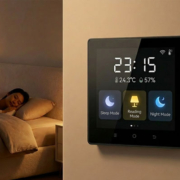
smart control panel factory-1
| Consideration | Android/Linux | ESP32 |
|---|---|---|
| Application complexity | Medium to high | Low to medium |
| Third-party applications | Depends on OS and compatibility | Requires firmware development |
| UI development | Android UI or Linux graphics frameworks | LVGL and embedded UI |
| Memory requirements | Generally higher | Generally lower |
| Customization | Application, OS, BSP | Firmware and embedded software |
| Typical use | Advanced smart home interfaces | Dedicated control interfaces |
OEM buyers should choose a platform based on the functionality they require, rather than processor performance alone.
4. Verify Communication Protocols and Hardware Interfaces
A key consideration is whether the control panel can communicate with the devices in the target smart home system.
Common communication technologies include:
- KNX: Widely used in building automation to control lighting, HVAC, and other building functions.
- RS485: A physical communication interface often used with Modbus RTU.
- Modbus TCP: A communication protocol that operates over Ethernet networks.
- Zigbee: A wireless technology for compatible smart home devices.
- Wi-Fi: Network connectivity for cloud services and IP-based devices.
- Bluetooth: Wireless connectivity for communication and device configuration.
- MQTT: A messaging protocol frequently used for communication between IoT devices.
- Matter: An application-layer smart home standard that operates over supported IP networks.
- However, buyers should distinguish hardware interfaces from software protocol support.
For instance, the presence of an RS485 port does not guarantee that Modbus communication software is installed. Likewise, Wi-Fi connectivity does not inherently include MQTT, Matter, or Home Assistant integration.
Before placing an order, ask the manufacturer:
- Which communication interfaces are built into the hardware?
- Which protocols does the current firmware support?
- Which integrations will require additional development?
- Can the panel communicate with our existing gateways and controllers?
- Are SDKs, APIs, and technical documentation available?
- Asking these questions can help prevent costly integration issues during deployment.
- 5. Understand OEM and ODM Customization Options
- OEM buyers do not all require the same degree of customization.
Some customers simply need their logo and packaging applied to an existing product. Others require a fully customized control panel with different hardware, software, and mechanical designs.
It is helpful to understand the distinction between OEM and ODM services.
OEM customization generally means adapting an existing product to meet a customer’s branding and requirements.
Common services include:
- Custom logos and startup screens.
- Tailored UI/UX.
- Model numbers and product identification.
- Packaging and labeling.
- Preinstalled applications.
- Customized system settings.
ODM development includes extensive product customization and may involve developing entirely new products.
This can include:
- PCB and PCBA design.
- Processor and memory selection.
- Display and touch-screen customization.
- Enclosure and mechanical design.
- Android/Linux BSP customization.
- Embedded firmware development.
- Communication protocol integration.
Buyers planning long-term product lines should determine which customization services the manufacturer can provide in-house.
6. Assess the Manufacturer’s Production and Quality Capabilities
An impressive prototype does not guarantee that a manufacturer can maintain consistent quality during mass production.
Before placing a large order, OEM buyers should assess the supplier’s manufacturing capabilities.
Key factors to consider include:
- Manufacturing capacity: Can the supplier handle your anticipated monthly or annual order volume?
- Quality control: Does the factory inspect incoming materials and conduct production testing, aging tests, and final product inspections?
- Production consistency: Can the supplier maintain uniform specifications across production batches?
- Component sourcing: Does the manufacturer have a dependable supply chain for processors, memory, displays, and other essential components?
- Engineering support: Can the engineering team troubleshoot hardware, software, and integration issues?
Portworld, also known as Sunworld Technology Limited, brings more than 18 years of experience in embedded touchscreen solutions. The company has over 300 employees and approximately 30,000 m² of manufacturing space.
Its manufacturing capabilities include smart home control panels, advertising players, motherboards, and industrial touch displays.
For OEM buyers, choosing a manufacturer with both product development and production expertise can streamline communication throughout a project.
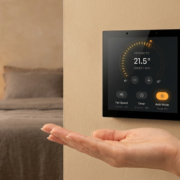
smart home control panel
7. Request Samples and Test Them Before Mass Production
A product specification sheet is no substitute for testing in real-world conditions.
Before committing to a large OEM order, buyers should request engineering samples and assess them in their intended applications.
A practical testing checklist includes:
- Touchscreen responsiveness.
- Display brightness and viewing angles.
- Processor performance.
- Wi-Fi and Ethernet connectivity.
- RS485 and other communication interfaces.
- Compatibility with target automation devices.
- Performance of customized applications.
- Power consumption and thermal behavior.
- Wall-mounting and installation compatibility.
- Continuous operation and system stability.
For projects that rely on specific protocols, buyers should verify communication with the intended devices. For instance, when a panel will control Modbus HVAC equipment, test the actual register map, read and write operations, communication settings, and error recovery. Do not approve a product solely on the manufacturer’s claim that it supports a particular interface.
8. Confirm MOQ, Lead Time, Pricing, and After-Sales Support
Commercial conditions are just as important as technical specifications.
Before ordering, OEM buyers should clarify:
| Item | What to Confirm |
|---|---|
| MOQ | Minimum order quantity for standard and customized models |
| Sample cost | Engineering sample pricing and development fees |
| Lead time | Sample development and mass production schedules |
| Pricing | Hardware, software, tooling, and customization costs |
| Warranty | Warranty period and coverage |
| Spare parts | Availability of replacement components |
| Software support | Firmware updates, SDKs, and technical documentation |
| Supply continuity | Component availability and long-term production planning |
It is also important to confirm whether the quoted price covers software customization, logo printing, packaging, and other engineering services.
A low upfront unit price may not result in the lowest overall project cost if it entails additional expenses for development, integration, or maintenance.
9. Why Choose Portworld for OEM Smart Home Control Panels?
Portworld supplies smart home touchscreen control panels and embedded hardware solutions for brands, distributors, system integrators, and automation companies.
Its product range includes compact ESP32-based panels, RK3566 Android/Linux touchscreen panels, and larger interfaces for smart building control.
In addition to standard products, Portworld offers OEM/ODM services throughout the entire development process:
- Hardware platform selection and customization.
- PCB/PCBA and motherboard development.
- Customization of Android, Linux, and embedded firmware.
- Touchscreen UI/UX design and brand integration.
- Integration of KNX, Zigbee, Modbus, MQTT, and other protocols based on project requirements.
- PoE, Ethernet, RS485, and other interface configurations.
- SDKs, documentation, and technical support.
- Customized packaging and mass production.
Whether you require a compact 4-inch room control panel, a 10-inch centralized touchscreen, or a tailored embedded smart home interface, Portworld can support your project from initial requirements through production.