
System on Module vs. Single Board Computer: Which Should You Choose?
When designing an embedded product, a key choice is whether to use a System on Module (SoM) or a Single Board Computer (SBC). Both deliver computing capabilities for embedded applications, but differ in their hardware architecture, customization options, integration, and development needs.
The platform you select can influence product dimensions, development expenses, time to market, and long-term manufacturing.
1. What Is a System on Module (SoM)?
A System on Module is a compact computing unit that brings together essential components—including the processor, RAM, storage, and power circuitry—on a small board.
It is intended to operate with a separate carrier board, which supplies the interfaces and connections needed for the finished product.
Key characteristics:
- A compact computing module.
- Integrated processor, memory, and storage.
- Requires a compatible carrier board.
- Supports flexible interfaces and hardware customization.
- Designed for embedded products and custom hardware applications.
For instance, Portworld’s YC-P3566 and YC-P3576 SoMs are built around Rockchip processors and can be integrated into customized carrier boards for a range of embedded applications.
2. What Is a Single Board Computer (SBC)?
A Single Board Computer combines its primary computing components and commonly used interfaces on a complete PCB.
Unlike a SoM, an SBC generally operates without a separate carrier board for basic functions. Developers can connect peripherals directly to its available ports and connectors.
Key characteristics:
- CPU, memory, and storage are integrated onto a single board.
- Standard interfaces are readily accessible.
- Enables faster initial development and prototyping.
- Requires less supplementary hardware design.
- Well suited to development kits, edge devices, and general-purpose embedded computing.
Portworld’s PortPi 3A, powered by the Rockchip RK3568, is an example of a single-board computer designed for embedded development and customized computing applications.
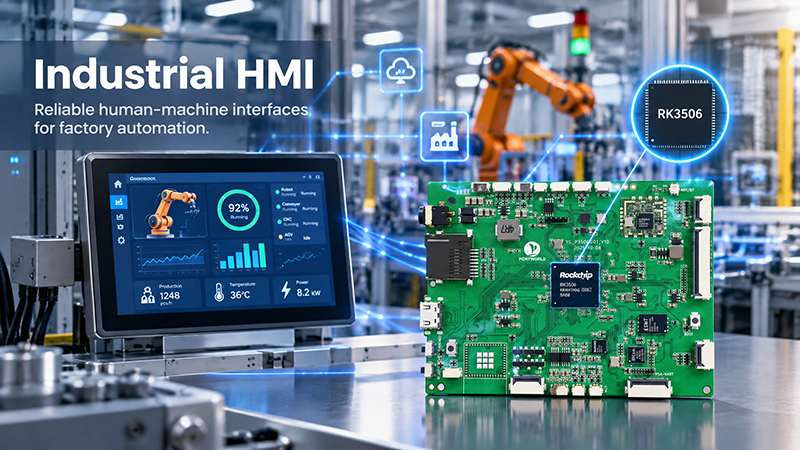
P3506 Industrial HMI 6
3. SoM vs. SBC: Key Differences
| Comparison | System on Module | Single Board Computer |
|---|---|---|
| Hardware structure | Computing module | Complete computer board |
| Carrier board | Required | Usually not required |
| Customization | High | Depends on board design |
| Hardware development | Requires carrier board design | Less additional design |
| Integration | Designed for custom products | Ready-to-use platform |
| Product size | Can be optimized through carrier design | Limited by existing PCB layout |
| Initial development | More engineering work | Generally faster |
| Best suited for | OEM/ODM embedded products | Prototyping and standard applications |
The key distinction is that a SoM keeps the computing platform separate from application-specific hardware, whereas an SBC integrates both on a single board.
4. When Should You Choose a SoM?
A System on Module is well suited to products that require a custom PCB, particular interfaces, or a compact mechanical design.
Consider a SoM if:
- You are developing a commercial product intended for mass production.
- Your project needs customized interfaces or connectors.
- PCB size and component placement are critical.
- You need to incorporate the computing platform into your own hardware.
- You want flexibility in memory, storage, and peripheral options.
Typical applications include:
- Industrial IoT gateways.
- Smart home control panels.
- AI-powered robots.
- Industrial touch displays.
- Medical and commercial terminals.

RK3588 Core Board- Drone Application Scene
5. When Is an SBC the Right Choice?
An SBC is often the more practical option when you need a ready-to-use computing platform and do not want to design a separate carrier board.
Consider an SBC if:
- You need to create a prototype quickly.
- Standard interfaces satisfy your requirements.
- You are working on an educational or maker project.
- You want to minimize initial hardware development.
- Your product can accommodate the board’s existing dimensions and layout.
Typical applications:
- Embedded Linux development.
- IoT development kits.
- Smart display prototypes.
- Edge computing devices.
- STEM education projects.
6. How to Select the Right Computing Platform
Before choosing a SoM or SBC, assess the following five factors:
- 1. Application requirements: Identify the CPU, GPU, NPU, and multimedia performance your application needs.
- 2. Hardware interfaces: Verify support for Ethernet, USB, HDMI, RS485, CAN, GPIO, and other required connections.
- 3. Mechanical design: Account for board size, mounting requirements, cooling, and enclosure constraints.
- 4. Development budget: Weigh upfront engineering expenses against long-term manufacturing costs.
- 5. Production plans: Evaluate anticipated volumes, component availability, customization needs, and product lifecycle.
A SoM may provide greater flexibility for projects requiring a custom hardware design. An SBC may be more efficient when rapid development and standard connectivity are priorities.
7. Portworld SoM and SBC Solutions
Portworld offers embedded computing platforms for industrial, commercial, and AIoT applications.
YC-P3576 System on Module
Based on the Rockchip RK3576, featuring an octa-core CPU, up to 6 TOPS NPU, and support for Android and Linux-based systems. Suitable for AI edge computing and advanced embedded applications.
YC-P3566 System on Module
Based on Rockchip RK3566 with Cortex-A55 processing, flexible memory configurations, and Gigabit Ethernet support. Suitable for industrial control and smart embedded devices.
PortPi 3A Single Board Computer
Based on Rockchip RK3568, providing an integrated computing platform for embedded development, IoT projects, and industrial applications.
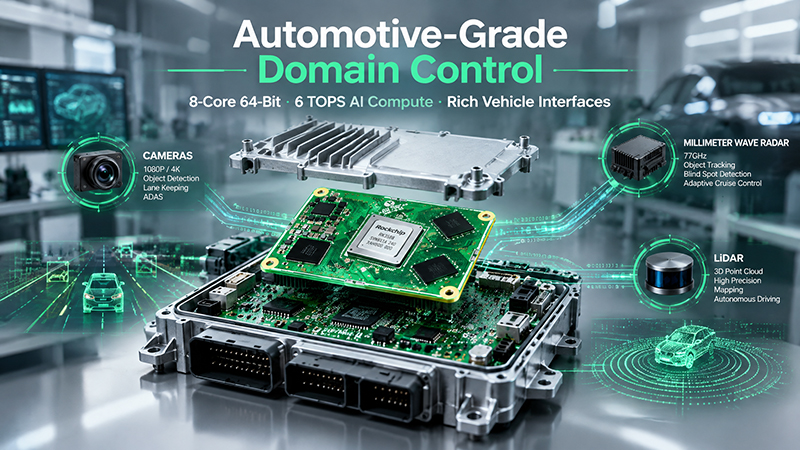
RK3588 Intelligent Driving Scene 2
Beyond standard computing boards, Portworld provides OEM/ODM services, including:
- Custom carrier board and PCB/PCBA design.
- Tailored RAM, storage, and interface configurations.
- Android and Linux operating system adaptation.
- BSP, SDK, and technical documentation.
- Hardware integration, prototyping, and large-scale production.
There is no single best choice between a System on Module and a Single Board Computer. The right option depends on your product design, customization needs, development resources, and manufacturing objectives.
A SoM is typically better suited to customized embedded products that require a dedicated carrier board. An SBC is often preferable for rapid prototyping and applications that support standard hardware interfaces.
For a custom embedded computing project, Portworld can help you assess the right platform and develop a solution from hardware design through mass production.


