Stretched Bar LCD Displays: Applications and Selection Guide
As digital signage and embedded display technologies advance, businesses increasingly need screens designed for specialized spaces. Traditional LCD displays are effective for general advertising and information, but their rectangular format may not suit narrow shelves, equipment panels, transport interiors, or architectural structures.
Stretched bar LCD displays provide an alternative. Their elongated form and ultra-wide aspect ratios enable manufacturers and system integrators to present digital information in locations where conventional screens may not be practical.
These displays are used in a growing range of applications, including retail shelf advertising, passenger information systems, and industrial equipment. Selecting the appropriate model requires careful attention to screen dimensions, resolution, brightness, interfaces, installation needs, and content management.
1. What Are Stretched Bar LCD Displays?
A stretched bar LCD display is an elongated LCD panel with a significantly wider aspect ratio than a conventional screen. Standard LCD displays typically use formats such as 16:9, 16:10, or 4:3, whereas stretched bar displays may feature ratios including 32:9, 16:3, or other formats tailored to specific applications.
Their slim form makes them well suited to installations with limited horizontal or vertical space.
Unlike conventional monitors, which offer a relatively balanced viewing area, bar-type displays are designed to show content in a long, continuous strip. Depending on the model, they can present text, images, animations, promotional material, and real-time information.
Common characteristics include:
- Ultra-wide or customized aspect ratios
- Slim screen profiles for space-constrained installations
- Resolutions designed for specific applications
- Options for varying brightness levels
- Compatibility with embedded controllers or external media players
- Customized mounting and enclosure configurations
Some stretched displays are manufactured specifically for elongated formats, while others are produced through specialized panel processing. Available sizes, resolutions, and interfaces vary by manufacturer and product design.
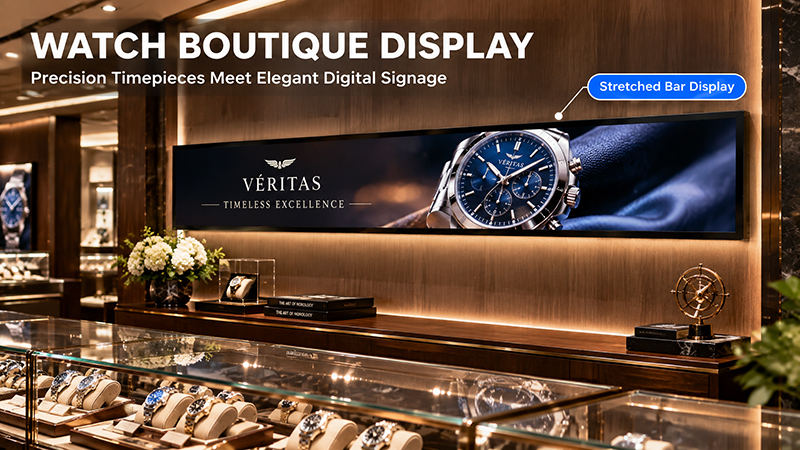
Stretched bar LCD displays8
2. Key Applications of Stretched Bar LCD Displays
A major benefit of stretched bar displays is that they fit into locations where a conventional monitor may not. Their distinctive form factor serves a range of purposes across different industries.
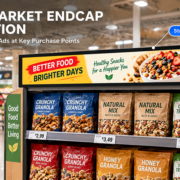
Retail Shelf-Edge Advertising
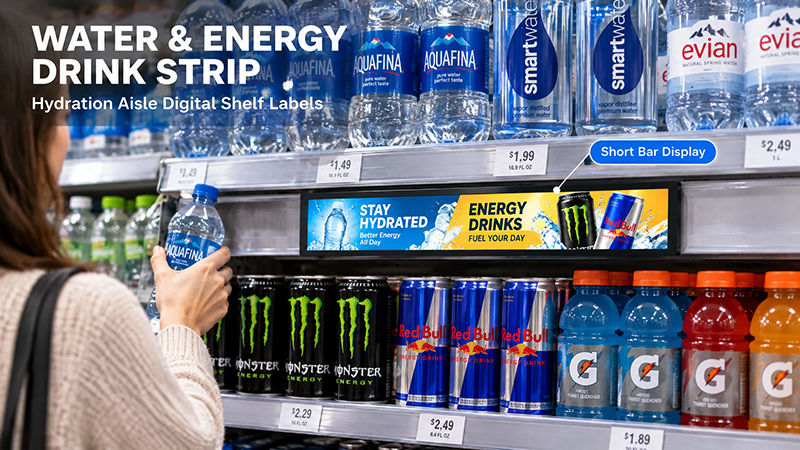
Retail is among the most familiar settings for stretched bar LCD displays.
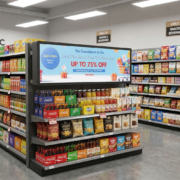
Supermarkets, convenience stores, and specialty shops can place slim screens along shelves to show product names, special offers, prices, and category details.
Unlike printed shelf labels, digital screens can present more engaging promotional content and, when connected to compatible systems, enable remote updates.
Common uses include:
- Product advertising and promotion
- Digital pricing and product details
- Brand communications
- Category labeling
- Seasonal campaign messages
For retail installations, the screen must suit the shelf design while preserving clear views of the products. Consider brightness, viewing angles, display dimensions, and the legibility of on-screen content.
It is also important to distinguish LCD shelf-edge displays from electronic paper labels. LCD screens are better suited to colorful visual content and animation, while electronic paper is commonly used for low-power price and product information.
Transportation Information Systems
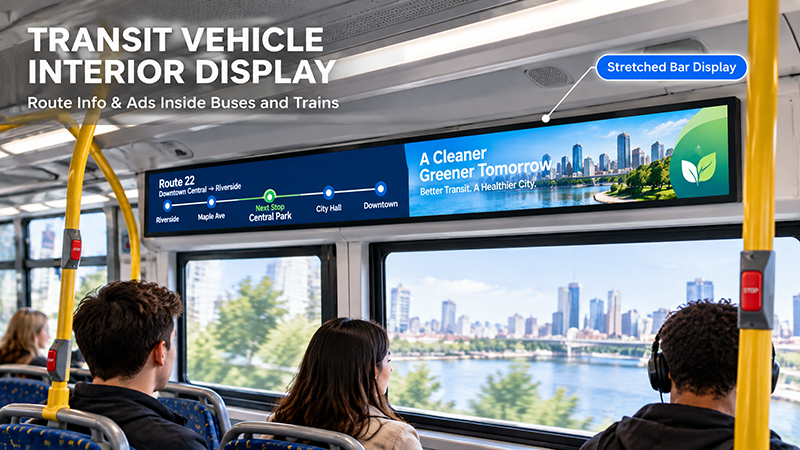
Buses, trains, metro systems, and airports frequently need to display information in narrow spaces above doors, along vehicle interiors, or near passenger seating areas.
Stretched bar displays can present route details, upcoming stops, arrival announcements, service notices, and advertising.
In transportation settings, reliability and readability are critical. Displays may run for long periods and need to be visible to passengers from different locations.
Project specifications should address:
- Brightness in varying ambient light
- Wide viewing angles
- Reliable power and signal connections
- Requirements for continuous operation
- Secure mechanical mounting
- Content updates and playback recovery
For displays installed inside moving vehicles, vibration resistance and other environmental requirements should also be taken into account.
Elevator and Building Information Displays
Elevators and commercial buildings often offer limited space for information displays. A stretched bar LCD can be installed above elevator doors, inside elevator cabins, or in narrow wall openings.
Common content includes floor numbers, building announcements, emergency instructions, promotional messages, and service notices.
In office buildings, hotels, and shopping centers, these displays can complement larger digital signage networks by delivering information at key points of interaction.
Key selection factors include display dimensions, viewing distance, mounting requirements, brightness, and connectivity with the building’s information system.
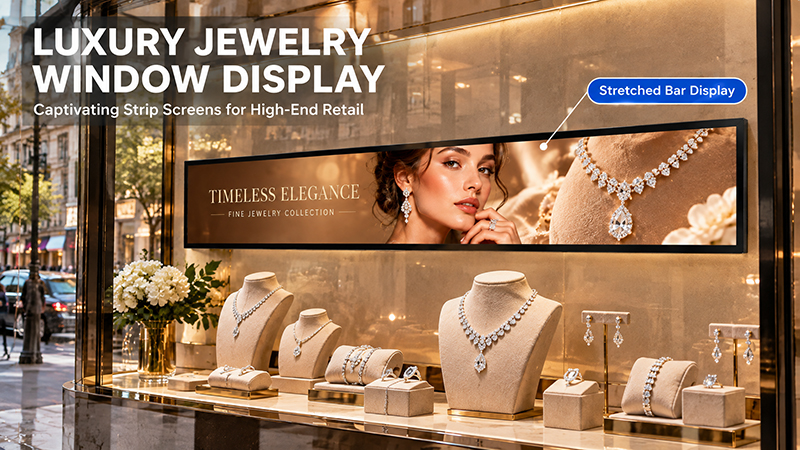
Stretched bar LCD displays7
Industrial Equipment and Machine Interfaces
Industrial equipment manufacturers can integrate stretched bar displays into machine fronts and control panels to provide graphical information.
Rather than depending solely on indicator lights or small character displays, equipment can use a continuous graphical interface to show operating status, production details, alerts, and process data.
Potential applications include:
- Production line status monitoring
- Machine operating information
- Equipment warnings and notifications
- Temperature and process readings
- Industrial automation interfaces
For these applications, panel compatibility is only one design consideration. Engineers should also assess operating temperature, electrical interfaces, mounting dimensions, power requirements, and whether the host controller can support the chosen resolution.
Restaurant Menu Boards and Commercial Advertising
ultra wide stretched LCD digital menu board
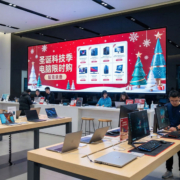
Restaurants, cafés, and retail counters can use stretched displays to feature brief promotions, product highlights, menu categories, and announcements.
Their long horizontal format can fit above a service counter or below a larger menu display. It can also function as an additional information strip alongside conventional digital signage.
Content should be tailored to the narrow screen. Short headlines, prices, product images, and scrolling messages typically work better than adapting a standard full-screen advertisement to an elongated format.
3. How to Choose the Appropriate Screen Size and Aspect Ratio
Screen dimensions are among the most critical specifications for a stretched bar LCD project.
Unlike conventional monitors, stretched displays should not be chosen solely by their diagonal measurement. Their precise width and height, active display area, and mounting dimensions are often more important.
Begin by measuring the available installation opening. Allow sufficient space for the bezel, mounting brackets, cables, connectors, and ventilation.
Common stretched formats include 3:1, 4:1, 16:3, and other ultra-wide configurations. The best aspect ratio depends on the application and the panel options available.
- Available width and height: Confirm the physical opening and allowable tolerances.
- Active display area: Make sure the visible screen area is large enough for the intended content.
- Aspect ratio: Match the panel shape to the product or installation design.
- Orientation: Confirm whether the display will be installed horizontally or vertically.
- Viewing distance: Determine how large text and other visual elements need to be.
For OEM projects, it is advisable to request a dimension drawing before finalizing the enclosure design.
4. Select the Right Resolution and Brightness
The resolution of a stretched display should suit its physical dimensions and intended content.
For instance, some commercial bar displays have resolutions such as 1920 × 360 or 1920 × 540. Other uses may call for narrower or more customized pixel formats. These are examples, not universal standards; the appropriate resolution depends on the panel.
Resolution and content clarity
A higher horizontal pixel count can support detailed information across a long screen. However, resolution must be considered alongside screen height and viewing distance.
With limited vertical resolution, small text and intricate graphics may be hard to read. Design the content layout to match the panel’s native resolution.
Brightness and ambient lighting
Required brightness varies according to the installation environment.
Standard indoor brightness may be sufficient for retail shelves in typical indoor settings.
Bright shopping areas may call for higher brightness levels.
Transportation settings may require additional attention to changing lighting conditions.
Installations exposed to sunlight may need high-brightness panels paired with an appropriate thermal design.
Anti-glare treatments can help minimize reflections, but performance should be evaluated under the actual lighting conditions and viewing angle at the installation site.
Higher brightness is not always preferable. It can raise power consumption and heat output, so the panel and enclosure should be assessed as a complete system.
Stretched bar LCD displays0
5. Confirm Display Interface and Controller Compatibility
A stretched LCD panel requires a compatible driver board or host system to display content properly.
Depending on the panel design, available interfaces may include LVDS, MIPI, RGB, or other display connections. The chosen interface must be supported by the controller and meet the panel’s electrical and timing requirements.
For embedded applications, buyers should verify:
- LCD interface and connector type
- Native resolution and timing specifications
- FPC orientation and connector location
- Driver board compatibility
- Power input requirements
- Supported operating system
- External video input requirements, if applicable
When connecting the display to an Android or Linux motherboard, confirm that the system supports the panel’s resolution and display interface.
For advertising applications, check whether the controller offers automatic startup, scheduled playback, local storage, and network-based content updates.
A compatible connector by itself does not ensure proper display output. Panel timing, resolution, firmware, and driver configuration must also be verified.
6. Plan Content Management and Software Integration
Content for stretched-bar LCD displays should be created to suit their unusual aspect ratios.
When shown on an ultra-wide panel, standard 16:9 video may look distorted, be cropped, or leave unused areas on the screen. For optimal results, design content at the panel’s native resolution.
A practical content layout may include:
- Product name and price
- Brand logo and promotional message
- Product image or brief animation
- Scrolling announcements
- Real-time status information
For single-device applications, content can be stored locally and played using a compatible media application.
For deployments involving multiple devices, a content management system (CMS) can provide centralized control. Depending on the software platform, available features may include remote content uploads, scheduling, device grouping, playback monitoring, and remote maintenance.
Consider hardware and software requirements together. A stretched panel used for basic information display may require only a simple controller, whereas a networked advertising system may need an Android or Linux platform with greater processing capacity and additional connectivity resources.
7. Consider Touchscreen and Mechanical Customization
Not every stretched-bar LCD requires touchscreen functionality. For shelf advertising, transportation information, and passive announcements, a non-touch display is often adequate.
Interactive applications, however, may benefit from touch integration. Examples include self-service equipment, product-selection terminals, and industrial control interfaces.
Available touch technologies include projected capacitive (PCAP) and infrared (IR). The right option depends on panel dimensions, cover glass, interaction needs, and enclosure design.
Mechanical customization is just as important. A stretched display may need to fit directly into a shelf, machine, elevator panel, or purpose-built commercial fixture.
OEM projects should specify:
- Enclosure dimensions and material
- Mounting holes and brackets
- Bezel and cover-glass design
- Cable routing and connector access
- Heat dissipation
- Touch integration, if needed
- Maintenance and replacement access
For custom installations, review drawings and samples before tooling or mass production.
8. Assess Reliability and Long-Term Availability
Stretched bar displays are frequently incorporated into products designed for prolonged use. Reliability should therefore be addressed from the outset of a project.
Key considerations include panel availability, backlight performance, operating temperature, power stability, and component consistency.
For commercial applications, verify the anticipated daily operating hours and determine whether the display must support continuous operation.
Industrial and transportation applications may require additional testing to assess vibration, temperature fluctuations, electrical interference, and mechanical durability.
Before moving to mass production, test samples in realistic conditions. Assess display clarity, content playback, signal stability, startup behavior, thermal performance, and installation compatibility.
For repeat orders, retain approved hardware specifications, firmware versions, mechanical drawings, and sample standards. Doing so helps minimize variation between production batches.
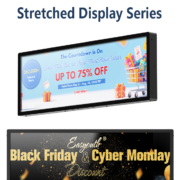
Stretched Display Series
9. Portworld OEM/ODM Support for Embedded Display Projects
Developing a stretched-bar LCD product involves more than selecting an appropriate panel. The display, controller, motherboard, enclosure, power system, and software must function together as an integrated solution.
Portworld offers embedded display and hardware solutions for commercial and industrial uses, including digital signage, touchscreen displays, industrial touch panels, and custom motherboard solutions.
For projects with specific display requirements, Portworld can provide OEM/ODM development support in areas including:
- Display and hardware configuration
- Embedded motherboard selection
- Customization of Android, Linux, Ubuntu, and Debian
- Touchscreen integration
- Interface and connectivity configuration
- Enclosure and mechanical design
- Application preinstallation and automatic startup
- SDK and technical documentation
- Prototype development and mass production
For stretched bar LCD applications, the panel’s native resolution, interface, dimensions, and driver compatibility should be confirmed during the initial engineering stage.
The final configuration depends on the application, available panel options, mechanical requirements, and production volume. Early communication between the display supplier and embedded hardware manufacturer can help avoid compatibility problems during development.
Stretched bar LCD displays provide a practical solution for applications where conventional rectangular screens cannot fit the available space. Their elongated format makes them useful for retail shelf advertising, transportation information, elevator displays, industrial equipment, and commercial menu systems.