
How to Choose a 10.1-Inch L-Shaped Advertising Display
As businesses seek more adaptable ways to market products and services, compact digital signage is gaining traction in restaurants, retail shops, hotels, and reception areas. The 10.1-inch L-shaped advertising display is a popular choice, combining a small footprint and angled viewing position with a design that fits naturally on desks, counters, and tables.
Selecting the right model, however, requires more than comparing screen prices. Image quality, Android performance, connectivity, enclosure design, and content management all contribute to the overall user experience.
1. Assess the Installation Environment
Begin by identifying where the display will be installed. A 10.1-inch L-shaped screen is often used on restaurant counters, hotel reception desks, retail checkout counters, and service desks.
Its angled design improves visibility when the screen sits on a flat surface. Before choosing a model, assess the counter space, viewing distance, screen orientation, and whether customers or staff will use the display.
The base should be sufficiently stable to keep the unit from shifting or tipping during everyday use.
2. Assess Display Quality and Touch Options
Display quality has a direct impact on how advertisements, product images, and promotional videos are presented.
Compare the following key specifications:
- Resolution: Select a resolution that ensures text, images, and videos appear clearly.
- Brightness: Confirm the screen remains easy to read in the lighting conditions where it will be installed.
- Viewing angle: A broad viewing angle allows customers to see the content from various positions.
- Touchscreen: Choose a touch or non-touch model according to whether users need to interact with the display.
Non-touch models work well for automated advertising playback. Touchscreen models can offer interactive menus, product browsing, and service information when used with suitable software.
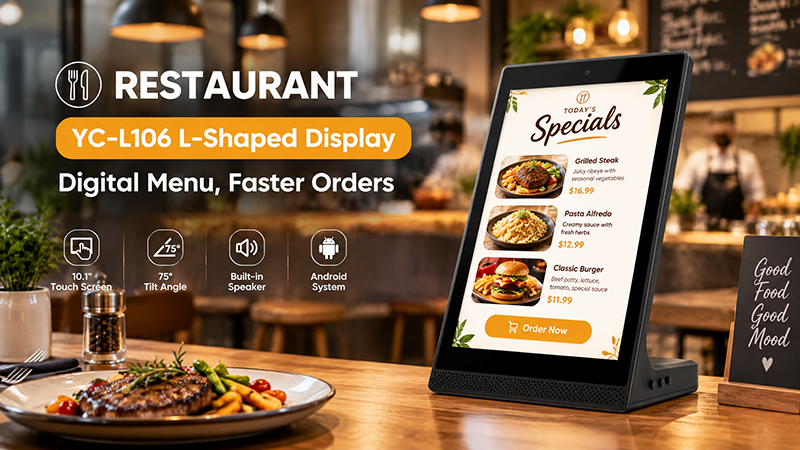
YC-L106 Restaurant Banner
3. Assess Android Hardware Performance
For advertising displays powered by Android, the processor, memory, and storage directly affect the smooth operation of applications and multimedia content.
When comparing device configurations, evaluate:
- Processor capability and video-decoding support
- RAM available for advertising applications
- Internal storage capacity for media files and software
- Android version and compatibility with required applications
- Long-term hardware availability
A moderate hardware configuration may be adequate for basic advertising playback. Interactive applications and more demanding multimedia content may require a more powerful platform.
Also confirm whether the manufacturer can customize the Android system, install specified applications, and configure automatic startup.
4. Verify Connectivity and Content Management
A commercial advertising display should make it easy to update content.
Wi-Fi supports wireless content delivery and remote management. Ethernet is an option when a more reliable wired connection is preferred. USB can also support local file transfers and maintenance.
For displays deployed across multiple locations, confirm whether the device integrates with a content management system (CMS).
Depending on the software platform, a CMS may offer:
- Remote content updates
- Advertising playlists and scheduling
- Centralized device management
- Online status monitoring
These capabilities depend on the CMS and its compatibility with the Android hardware. They are not included automatically with every Android display.
5. Consider Design and Customization Carefully
The L-shaped enclosure is a key product component. It affects the screen angle, footprint, appearance, and overall stability.
For OEM projects, buyers may also require custom logo printing, enclosure colors, packaging, power options, or software branding.
Before placing an order, verify the product dimensions, base design, cable routing, materials, and heat dissipation. These factors can significantly affect performance in real-world deployments.
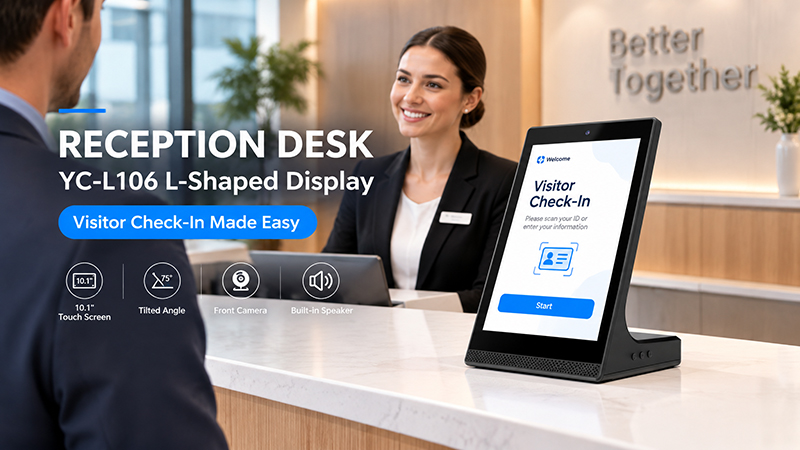
YC-L106 Reception Desk Banner
6. Partner with an OEM/ODM Manufacturer
Businesses developing their own advertising display products can work with an OEM/ODM manufacturer to integrate the required screen, Android motherboard, enclosure, and software into a complete solution.
Portworld offers customization support for commercial display and embedded hardware projects, including:
- Screen and hardware configuration
- Android motherboard and system customization
- Touchscreen integration
- Customized enclosure and logo
- Application preinstallation and auto-start
- SDK and technical documentation
- OEM/ODM production and packaging
The configuration can be tailored to the application, target market, and order requirements.
- Is a 10.1-inch L-shaped advertising display a good choice for restaurants?
- Yes. It can sit on counters or tabletops and present menus, promotions, product images, and service information.
- Should I select a touchscreen or a non-touch model?
- Choose a non-touchscreen model for automated advertising playback. Opt for a touchscreen when customers need to browse menus, catalogs, or other applications.
- Can advertising content be updated remotely?
- Yes, provided the Android device is connected to a compatible content management system (CMS) or remote management application.
- Can the display be customized to reflect my brand?
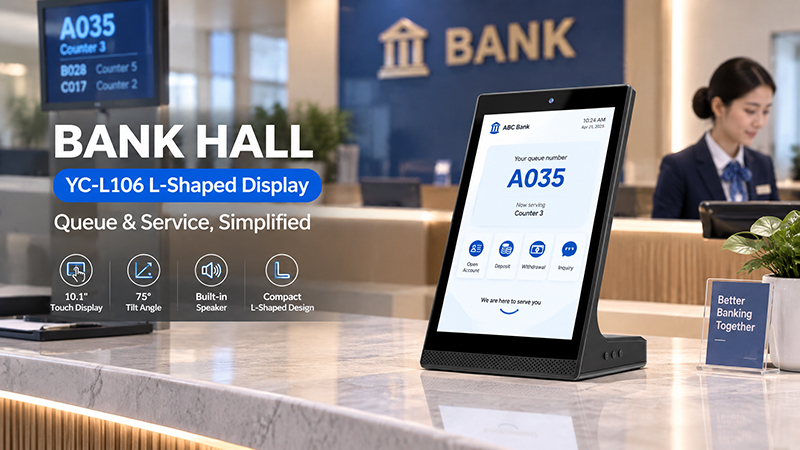
YC-L106 Bank Hall Banner
OEM/ODM options may cover the enclosure, logo, Android system, software, packaging, and hardware configuration.
A suitable 10.1-inch L-shaped advertising display should offer the right balance of screen quality, Android performance, connectivity, physical design, and content management capabilities.
Before ordering, identify the intended application and confirm the hardware and software specifications with the manufacturer. With Portworld’s OEM/ODM support, businesses can develop a customized tabletop advertising display tailored to their branding and deployment requirements.

