What Is a PoE Digital Signage Display? Benefits and Use Cases
As digital signage becomes more prevalent in retail environments, offices, hotels, healthcare institutions, and commercial properties, the flexibility of installation has emerged as a crucial factor. Companies are now required to consider not only screen dimensions and image clarity but also aspects such as power supply, network connectivity, cable management, maintenance, and the overall expense of deploying multiple displays.
Power over Ethernet (PoE) provides an effective solution to streamline these installations. By supplying both electrical power and network connectivity via a single Ethernet cable, PoE can minimize the number of cables needed at the display site, thereby facilitating easier installation and management of certain digital signage systems.
But what precisely constitutes a PoE digital signage display? How does it function, and in what scenarios is it preferable to opt for one over a traditional display that utilizes a separate power adapter?
What Is a PoE Digital Signage Display?
A PoE digital signage display refers to a commercial display or integrated signage system that is engineered to receive electrical power through an Ethernet connection that simultaneously transmits network data.
In a standard digital signage setup, a display or media player typically requires both a dedicated power cable and an Ethernet cable. However, with a compatible PoE system, both functionalities can be managed through a single Ethernet connection, thereby simplifying cable organization.
A standard PoE digital signage configuration consists of three primary components:
- 1. PoE-enabled display or media player: This device must feature a compatible PoE power input or utilize an appropriate PoE receiver module.
- 2. PoE network switch or injector: This equipment delivers power through the Ethernet cable while also providing the necessary network connection.
- 3. Ethernet cabling: A suitable cable connects the powered device to the PoE source.
The specific arrangement may vary based on the product design. Some displays incorporate PoE circuitry directly within the device, whereas others rely on an external receiver or a dedicated PoE expansion board.
It is crucial to differentiate between a display that natively supports PoE and one that simply possesses an Ethernet port. A standard RJ45 network connection does not inherently indicate that the device is capable of receiving power via Ethernet.

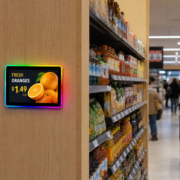
YC-L106 Retail Store Banner
How Does PoE Function in Digital Signage?
PoE technology enables compatible network devices to transmit both power and data through Ethernet cabling. The network connection facilitates data transfer between the display and the local network, while the PoE source provides electrical power to the compatible receiving device.
In the context of a digital signage setup, the procedure is quite simple.
Initially, the display or media player is linked to a compatible PoE switch or injector. The PoE equipment identifies and delivers power in accordance with the applicable PoE standard. Subsequently, the device powers on and connects to the network, enabling it to access content or interact with a content management system (CMS), assuming that the necessary software and network configurations are established.
For instance, a hotel might deploy small information displays outside meeting rooms. Rather than installing a separate power outlet next to each display, the installation team can utilize an appropriate PoE network infrastructure to power compatible devices and link them to the hotel’s network.
Nevertheless, it is essential to verify the power budget prior to deployment. The PoE source must comply with the required standard and supply adequate power for the receiving device, taking into account any additional power requirements from peripherals.
Key Advantages of PoE Digital Signage Displays
1. Streamlined Cable Installation
A significant benefit of Power over Ethernet (PoE) is its capability to transmit both power and data through a single Ethernet cable.
In traditional setups, each display typically necessitates both a power source and a network connection, leading to increased cable clutter and complicating the installation process, especially when screens are mounted on walls, situated in tight spaces, or distributed across multiple rooms.
PoE minimizes the number of cables required for each compatible device, which is particularly advantageous for information displays located in corridors, meeting rooms, reception areas, and retail settings where a tidy installation is essential.
Reducing the number of individual power connections can also facilitate installation planning, although the project may still need appropriate cable pathways, network infrastructure, and electrical work for the PoE devices.

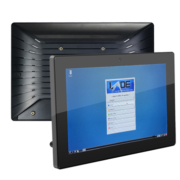
YC-102P digital signage display
2. Enhanced Flexibility in Display Location
PoE allows for easier installation of compatible displays in areas where it would be impractical to add a dedicated power outlet.
This includes applications such as meeting-room booking panels, wall-mounted information screens, reception displays, and compact digital signage units positioned near entrances or service counters.
The Ethernet cable must adhere to the specified cable-length limitations, and the network infrastructure should be accessible at the installation site. However, Power over Ethernet (PoE) offers enhanced flexibility when designing a distributed signage network.
For organizations implementing numerous small displays throughout a facility, this flexibility can significantly impact installation planning.
3. Tidier and More Organized Installations
Exposed power adapters and multiple cables can render commercial installations unsightly. Additionally, they may pose challenges in concealing them when displays are affixed to glass partitions, narrow wall sections, or other areas with limited space.
By integrating power and data transmission into a single cable, PoE contributes to a neater installation with fewer connections adjacent to the display.
This is especially advantageous in contemporary offices, hotels, showrooms, and smart buildings where displays are integral to the overall interior design.
The final outcome is contingent upon the enclosure, mounting technique, and cable-routing strategy. While PoE streamlines the connection process, it does not negate the necessity for meticulous installation planning.
4. Centralized Power Infrastructure
Utilizing a compatible PoE switch allows for the provision of power to multiple displays from a centralized network location, rather than relying on individual local adapters.
This approach can facilitate the organization of power distribution throughout a building. Depending on the design of the network equipment and devices, a centralized infrastructure may also streamline troubleshooting and power cycling processes.
For instance, a business that operates several information displays within an office can manage network connections from a central equipment cabinet, eliminating the need for separate power adapters at each display.
It is important to note that centralized power does not inherently enable complete remote device management. Features such as remote rebooting, monitoring, and content scheduling are contingent upon the PoE switch, display hardware, operating system, and management software.
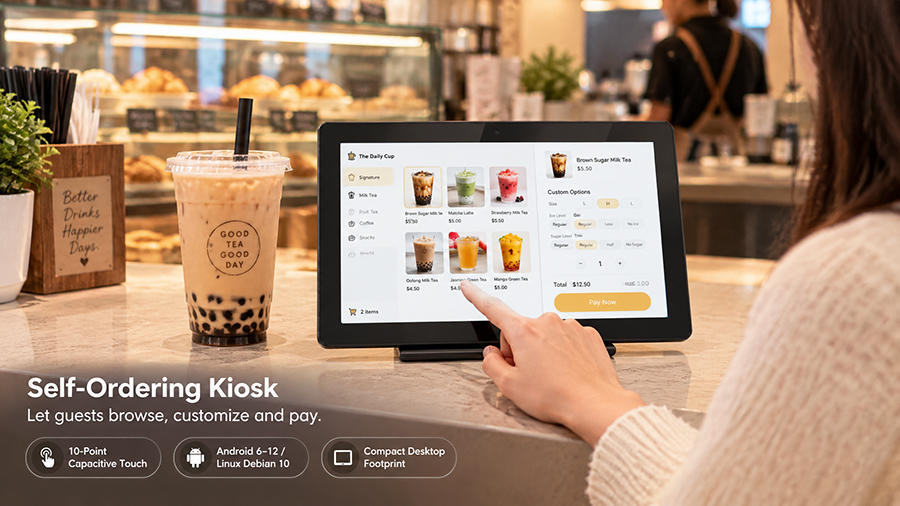
YC-102P digital signage display
5. Potentially Lower Installation and Maintenance Costs
Power over Ethernet (PoE) can lead to a reduction in certain installation costs by decreasing the need for separate power connections and simplifying cable routing. Additionally, it may lessen the quantity of individual power adapters that must be installed and maintained.
Nonetheless, the overall cost benefits are project-dependent. A PoE installation might necessitate compatible switches, enhanced power Ethernet infrastructure, receiver modules, or further cabling work.
For smaller deployments, traditional power adapters might be more cost-effective. Conversely, for larger setups featuring numerous compatible displays, a streamlined infrastructure could offer enhanced long-term value.
An accurate comparison must take into account the expenses associated with the displays, PoE equipment, cabling, installation labor, power consumption, and ongoing maintenance.
Typical Applications for PoE Digital Signage Displays
PoE is especially appealing for compact displays and distributed devices that require network connectivity along with relatively low power needs. However, it may not be the optimal solution for all commercial screens, particularly larger displays that have significant power requirements.
Meeting Room Booking Panels
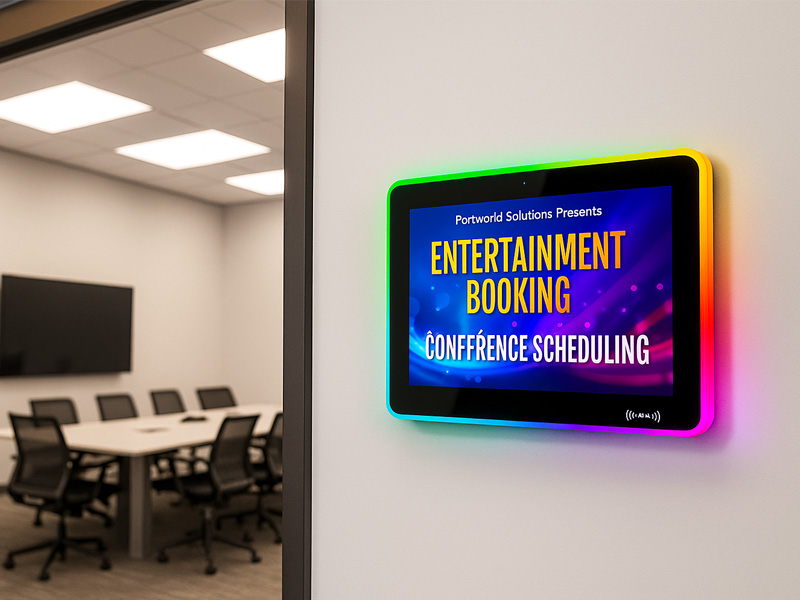
Meeting rooms frequently utilize small screens positioned outside the door to indicate room availability, meeting agendas, and booking details.
Power over Ethernet (PoE) can facilitate installation since the panel requires both network access and electrical power. A single Ethernet cable may suffice for a compatible device, thereby simplifying the deployment of panels across an office.
In these scenarios, the primary requirements generally encompass dependable network connectivity, an appropriate screen size, legible text, and compatibility with the organization’s room-booking software.
Hotel and Hospitality Information Displays
Hotels may employ compact screens to convey room details, event schedules, service instructions, or directional guidance.
PoE can assist in streamlining installations in corridors, meeting spaces, reception areas, and other sites where the addition of power outlets may pose challenges.
For hospitality initiatives, considerations should include display design, mounting alternatives, centralized content updates, and compatibility with the chosen software platform.
Retail and Point-of-Service Displays
Retailers can utilize smaller digital signage screens to convey product details, promotional content, service alerts, and assist customers in navigation.
Power over Ethernet (PoE) can be advantageous when multiple displays are positioned across counters, shelves, or service zones. It aids in minimizing cable clutter and streamlining the installation of compatible devices.
Nevertheless, high-brightness promotional displays and large-format advertising screens might demand more power than a conventional PoE connection can supply. In such cases, an independent power source or a higher-capacity PoE solution could be more suitable.
Healthcare Information Displays
Healthcare institutions may implement compact screens for identifying rooms, providing appointment details, updating queues, and facilitating general wayfinding.
PoE can assist in simplifying the installation of networked displays in hallways, consultation areas, and administrative offices.
The system must still adhere to the facility’s standards for network security, access control, sanitation, and software integration. Any display utilized for presenting sensitive information must also adopt a suitable strategy for privacy and user permissions.
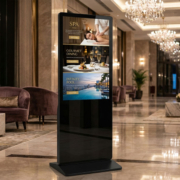
Advertising Digital Signage
Smart Buildings and Information Networks
Power over Ethernet (PoE) proves advantageous in structures where numerous network-connected devices are dispersed throughout the premises.
Compact information displays can utilize a shared network infrastructure with other compatible devices, contingent upon the network design and power allocation. This approach can streamline the deployment strategy for room panels, building directories, and internal information displays.
In the context of a larger smart-building initiative, it is crucial to ascertain whether the displays necessitate solely network connectivity and power or if they must also interface with room-booking systems, building management software, or other platforms.
PoE vs. Traditional Power: Which Is Superior for Digital Signage?
Both PoE and traditional power supplies offer distinct benefits. The optimal choice is contingent upon the display’s power requirements, the installation environment, and the existing network infrastructure.
| Factor | PoE Digital Signage | Traditional Power Supply |
|---|---|---|
| Power and data cabling | Can use one Ethernet cable for both | Usually requires separate power and network connections when both are needed |
| Installation | Can simplify compatible installations | May require a nearby outlet or separate power wiring |
| Centralized power | Supported through compatible PoE infrastructure | Usually managed through local power connections |
| Power capacity | Limited by the supported PoE standard and equipment | Depends on the power adapter or electrical supply |
| Device compatibility | Requires a compatible PoE input or receiver | Supports devices designed for the specified power input |
| Initial infrastructure cost | May require PoE switches, injectors, or receiver modules | May use existing outlets and standard adapters |
| Best fit | Compact networked displays and distributed devices | Devices with higher power demands or installations with existing power access |
Power over Ethernet (PoE) is frequently a viable choice for small embedded displays; however, for larger advertising screens, high-brightness displays, and systems that utilize power-hungry peripherals, a traditional power supply may prove to be more practical.
The objective is not to implement PoE wherever feasible, but rather to select a power architecture that fulfills the device’s requirements while ensuring that installation and maintenance remain manageable.
How to Select the Appropriate PoE Digital Signage Display
Prior to choosing a PoE display, consider the following technical aspects.
1. Assess the Required PoE Standard and Power Budget
PoE standards offer varying power levels. The commonly referenced IEEE standards include:
- IEEE 802.3af (PoE): Delivers up to 15.4 W from the power sourcing equipment, with a maximum of 12.95 W accessible at the powered device under the conditions specified by the standard.
- IEEE 802.3at (PoE+): Provides up to 30 W from the power sourcing equipment, with up to 25.5 W available at the powered device.
- IEEE 802.3bt: Offers higher power levels, with the amount of power available contingent upon the type and implementation.
- It is important to note that the power accessible at the device is less than the power supplied by the source due to cable losses. Additionally, the chosen switch or injector must possess a sufficient total power budget to accommodate all connected devices.
- Always verify the specified input requirements of the display, the supported PoE standard, and the maximum power consumption. Do not presume that a device is compatible with PoE+ or IEEE 802.3bt solely based on the presence of an Ethernet port.
2. Choose the Appropriate Screen Size and Brightness
The screen size and brightness must correspond to the viewing distance, installation location, and surrounding lighting conditions.
Compact displays may be suitable for small room panels and information screens, whereas larger screens with enhanced brightness are necessary for retail promotions or public-facing advertisements.
Increased brightness, larger displays, and additional hardware features can lead to higher power consumption. These considerations are essential when determining the appropriateness of PoE.
For large-format or high-brightness digital signage, utilizing a dedicated power supply may offer a more effective solution.
3. Confirm Network and Software Compatibility
The hardware must be compatible with the network interfaces required by the application. If the display necessitates a wired connection to a CMS, ensure that the Ethernet interface, operating system, and signage software are compatible.
For Android digital signage, check the target Android version, processor platform, available memory, and necessary application functionalities.
If the display requires remote content publishing, automatic startup, or device monitoring, verify that these features are supported by the specific hardware and software combination.
4. Assess the Enclosure and Mounting Method
The enclosure should be designed to fit the display, mainboard, PoE circuitry, connectors, and necessary thermal management systems.
In the case of wall-mounted installations, it is important to take into account the mounting holes, cable access, enclosure depth, and the servicing process of the device post-installation.
For environments with high demands, additional factors such as temperature range, ingress protection, and impact resistance must be evaluated independently. The presence of PoE capability does not automatically imply that a display is appropriate for outdoor or industrial applications.
5. Evaluate Customization and Long-Term Supply
Should your project necessitate a particular screen size, connector arrangement, mounting framework, operating system, or application startup behavior, a standard product may not fulfill all specifications.
An OEM/ODM manufacturer can assist in determining whether the design can be modified using an existing platform or if further hardware development is necessary.
Portworld provides embedded motherboards, touchscreen display solutions, and OEM/ODM customization services. For projects involving PoE, clients can discuss their requirements regarding power input, Ethernet connectivity, mainboard configuration, interfaces, system software, and mechanical design.
The final configuration must be confirmed through sample testing prior to proceeding with mass production.
YC-LE156
15.6″ Meeting Room Display Panels
How Portworld Can Assist with PoE Digital Signage Initiatives
PoE digital signage entails more than merely a network connector. The display, power circuitry, embedded motherboard, operating system, and enclosure must be meticulously designed or chosen to function cohesively.
Portworld offers commercial display solutions, embedded hardware platforms, and customization services tailored for businesses engaged in the development of digital signage and touchscreen devices.
Based on the specific project requirements, Portworld can engage in discussions regarding:
- Selection of embedded motherboards and System on Modules (SoMs).
- Ethernet connectivity and compatible Power over Ethernet (PoE) power configurations.
- Display dimensions, resolution, and touch capabilities.
- Configuration of Android or Linux systems on compatible platforms.
- Preinstallation of applications and automatic startup processes.
- Development of custom interfaces, PCB/PCBA, and integration of enclosures.
- Branding, packaging, and OEM/ODM manufacturing services.
For instance, a client creating a compact information panel for meeting rooms may emphasize the need for PoE, Ethernet connectivity, a touchscreen interface, and a bespoke application. Conversely, another client constructing a larger advertising display might require a dedicated power supply due to its increased power demands.
Assessing the intended application initially is crucial in determining the suitability of PoE and the appropriate hardware configuration to be developed.