Core Board vs. Single Board Computer: Which Should You Choose?
When creating an embedded computing product, one of the initial hardware decisions involves choosing between a core board and a single board computer (SBC). Both options can deliver the necessary processing power for embedded Linux, edge AI, industrial automation, smart terminals, and IoT applications. Nonetheless, they vary in terms of hardware integration, customization options, development complexity, and their appropriateness for mass production.
For companies engaged in the development of commercial hardware, the optimal choice is influenced by factors beyond just processor performance. It also encompasses considerations such as product dimensions, interface specifications, manufacturing expenses, software integration, and long-term supply strategies.
What Is a Core Board?
A core board, often referred to as a compute module or system-on-module (SoM), consolidates the primary computing elements into a compact module. Depending on the specific platform, these elements generally consist of the processor, memory, and associated power-management circuitry.
The core board interfaces with a distinct carrier board, which supplies application-specific connections such as Ethernet, USB, serial ports, display connectors, camera interfaces, and industrial communication links.
This modular design distinguishes the computing platform from the peripheral design of the product. Engineers can utilize the same core board across various products while creating different carrier boards tailored for specific applications.
Core boards are especially advantageous when a product necessitates a tailored PCB layout, specific interfaces, compact dimensions, or a unique mechanical structure. They can also facilitate future product development when multiple devices utilize the same computing platform.
For instance, Portworld’s core board solutions based on RK3566 and RK3576 can be assessed for applications such as smart terminals, industrial controllers, AIoT devices, and edge computing products. More advanced platforms like RK3588-based modules may be suitable for tasks involving computer vision, multimedia processing, and edge AI.
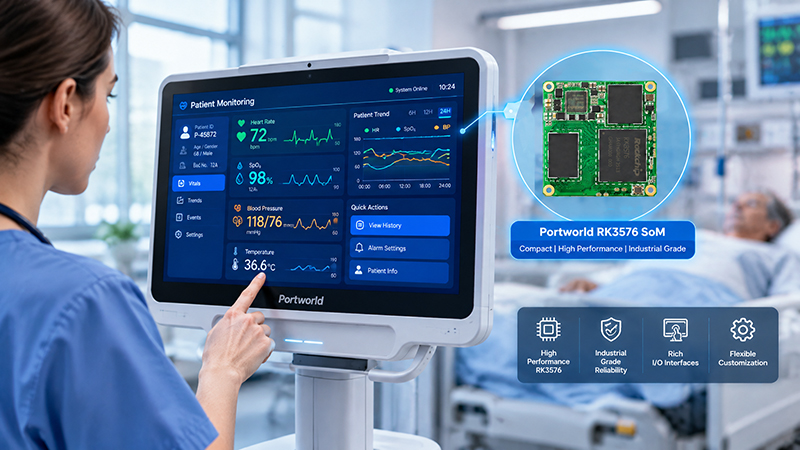
RK3576 SoM Commercial Display Medical Smart Terminal
What Is a Single Board Computer?
A single board computer consolidates the essential computing components and numerous peripheral interfaces onto a single PCB. Depending on the specific model, it may offer Ethernet, USB, display outputs, storage connections, and other necessary interfaces for development.
In contrast to a core board, a single board computer typically does not necessitate a separate carrier board for its standard supported interfaces. Developers can directly connect compatible peripherals and commence software development with reduced initial hardware design efforts.
An SBC is frequently a suitable option for developing proof-of-concept projects, educational initiatives, Linux application development, IoT gateways, and products that have interface requirements closely aligned with the existing configuration of the board.
For instance, the PortPi 3A, which is built on the Rockchip RK3568 platform, can be assessed for applications in embedded computing, maker development, smart education, and IoT projects. Utilizing an existing board allows developers to validate application software and system architecture prior to determining if a custom hardware design is warranted.
Core Board vs. Single Board Computer: Key Differences
The primary difference lies in the separation between the computing module and the surrounding hardware. A core board offers a modular computing foundation that necessitates a compatible carrier board, whereas an SBC consolidates the computing platform and its standard interfaces onto a single PCB.

RK3576 SoM Intelligent Transportation In-Vehicle Infotainment
| Comparison | Core Board / SoM | Single Board Computer |
| Hardware architecture | Computing module plus carrier board | Computing components and standard interfaces on one board |
| Initial development | Requires carrier-board integration | Usually faster to get started |
| Interface customization | High flexibility through carrier-board design | Limited by the existing PCB unless redesigned |
| PCB development | Application-specific carrier board required | May not need a new PCB |
| Product integration | Suitable for tailored commercial hardware | Suitable when existing interfaces meet requirements |
| Development effort | More hardware engineering and validation | Generally less initial hardware design work |
| Best suited for | Custom products and scalable hardware platforms | Prototyping, development, and standard-interface applications |
The distinctions mentioned are architectural in nature rather than absolute. Certain SBCs offer extensive customization options, whereas some core boards necessitate significant integration and validation efforts. The actual costs and complexity of development are influenced by factors such as the processor platform, interface requirements, software support, and production volume.
When Should You Opt for a Core Board?
A core board is frequently the preferable choice when the final product requires hardware that significantly deviates from a conventional development board.
For instance, consider a smart security terminal that necessitates multiple camera interfaces, dedicated serial communication, a custom power supply, and a compact enclosure. An off-the-shelf SBC may not deliver the necessary combination of interfaces or the preferred PCB dimensions. A core board, when combined with a purpose-built carrier board, enables the hardware architecture to be tailored to these specifications.
This strategy can also be advantageous for industrial automation controllers, smart home gateways, medical service terminals, robotics, and AI edge devices.
Additionally, a core board may be a sensible choice when multiple products utilize the same processor platform but require different peripheral configurations. The computing module can remain uniform while each product employs a distinct carrier board.
Nevertheless, opting for a core board does not inherently mean lower costs. The carrier board incurs extra expenses related to engineering, PCB manufacturing, testing, and integration. Teams should assess the overall product cost instead of merely comparing the module price to that of a complete SBC.
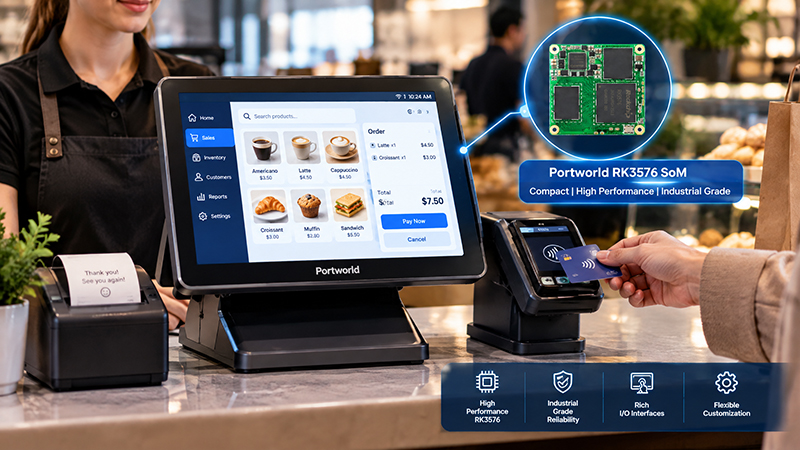
RK3576 SoM Retail POS terminal
When Should You Opt for a Single Board Computer?
An SBC is typically the more effective choice when rapid software development is necessary, and the board already includes the interfaces required for your project.
For instance, an engineering team creating a Linux-based IoT gateway can utilize a suitable SBC to evaluate networking, data processing, communication protocols, and application services. A smart education initiative might employ an SBC for programming tasks, robotics projects, or embedded systems education.
The PortPi 3A is one platform worth considering for these applications. Its RK3568 processor serves as a robust foundation for embedded computing tasks, while the actual interfaces and supported operating systems of the board should be verified against the project specifications.
An SBC may also be suitable for lower-volume commercial products where the existing board fits within the enclosure and satisfies the necessary electrical, thermal, and environmental requirements.
Prior to finalizing production, ensure to verify product availability, operating system support, peripheral compatibility, mounting specifications, and the manufacturer’s long-term supply commitments.
How Processor Performance Influences Your Decision
The choice between a core board and a single-board computer (SBC) is not merely a matter of selecting low versus high performance. Both architectures can accommodate powerful processors. The crucial consideration is whether the computing platform aligns with your application’s needs and if its hardware can be seamlessly integrated into the final product.
For Linux-based control systems, platforms like the RK3566 or RK3568 may suffice, depending on the specific workload. However, for more intensive applications that involve AI inference, computer vision, or multiple display pipelines, it may be beneficial to consider platforms based on the RK3576 or RK3588.
Portworld provides a range of embedded computing platforms utilizing various Rockchip processor families, including both core board and motherboard solutions. When choosing a platform, developers should evaluate CPU performance, NPU capabilities, memory capacity, storage options, display support, interfaces, thermal design, and compatibility with operating systems collectively.
In the context of AI applications, it is important to note that the processor’s stated NPU performance does not solely dictate real-world outcomes. Factors such as model compatibility, software frameworks, memory bandwidth, image-processing needs, and workload optimization are also critical.
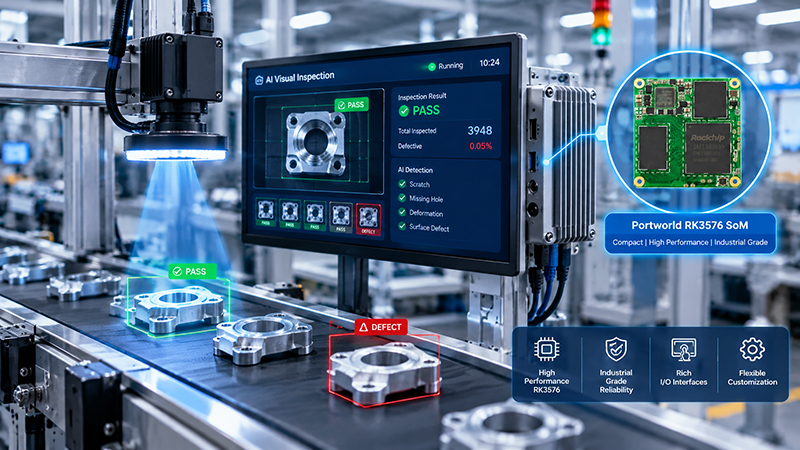
RK3576 SoMEdge AI Production Line Landscape Quality Inspection
What is OEM/ODM Customization?
For manufacturers of commercial hardware, the choice often goes beyond simply selecting an existing board. The final product may necessitate custom connectors, additional serial ports, specialized power inputs, an alternative display interface, a compact PCB layout, or a tailored operating system image specific to the application.
This is where a knowledgeable embedded hardware partner can provide assistance.
Portworld offers OEM/ODM services for embedded computing initiatives, which encompass motherboard and PCBA customization, carrier-board development, operating system adaptation, and hardware integration tailored to project specifications. Depending on the chosen platform and the agreed-upon development scope, projects can progress from initial requirements and prototype validation to pilot production and mass manufacturing.
A core board often serves as a robust foundation when significant carrier-board customization is required. An SBC may prove to be more efficient when the existing hardware aligns with the product specifications. In certain projects, the optimal strategy is to start with an SBC for software validation and then transition to a customized carrier board for the final production version.