What Are the Advantages of Android Smart Home Control Panels?
As intelligent residential systems advance, homeowners, property developers, and smart building integrators are seeking more user-friendly approaches to regulate lighting, window coverings, climate control, security systems, and other networked devices. Conventional switches and specialized control units can manage individual operations, yet a touchscreen interface panel can consolidate multiple controls into a unified platform.
Within the range of accessible embedded systems, Android has emerged as a compelling choice for intelligent home control panel creation. Its robust application framework, advanced graphical capabilities, and extensive software adaptability render it well-suited for applications spanning from compact room management systems to expansive, integrated home automation interfaces.
For intelligent home manufacturers and system integrators, recognizing the benefits of Android can facilitate the determination of whether this platform represents an optimal selection for a forthcoming control panel initiative.
1. Sophisticated and Engaging User Interface
Among the principal strengths of Android-based intelligent home control panels lies the capacity to develop contemporary, aesthetically compelling user interfaces.
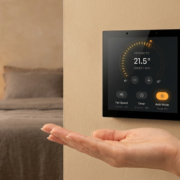
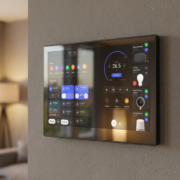
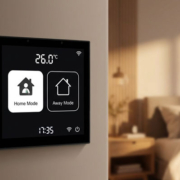
In contrast to conventional button-operated controllers, an Android touchscreen interface can present illumination configurations, ambient temperature readings, window covering status, device operational states, security particulars, and supplementary capabilities within a consolidated display. Development professionals can tailor the visual arrangement, graphical elements, transition effects, and menu structure to correspond with the product’s aesthetic direction and target demographic requirements.
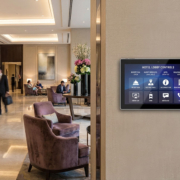
For instance, a wall-mounted interface in a smart home ecosystem may present distinct control panels for the living room, bedroom, kitchen, and bathroom. Users can modify lighting intensity, modify climate control parameters, or execute a preset configuration through several simple interactions.
Android proves particularly advantageous when the implementation demands a refined user interface with multiple pages, interactive elements, and continuous software enhancements.
2. Adaptable Application Development
Android delivers a mature development framework, incorporating programming languages including Java and Kotlin, supplemented by appropriate multi-platform solutions.
This enables manufacturers and application developers to construct tailored smart home solutions aligned with the product’s particular specifications. A control interface can execute a specialized home automation platform, present a personalized control interface, or incorporate compatible external applications.
Developers possess the capability to personalize the system launcher, initial display, operational parameters, and application installation procedures, contingent upon the device specifications and operating system configuration.
For enterprises creating proprietary smart home systems, this adaptability facilitates the creation of a distinctive user experience without necessitating the development of all application components independently.
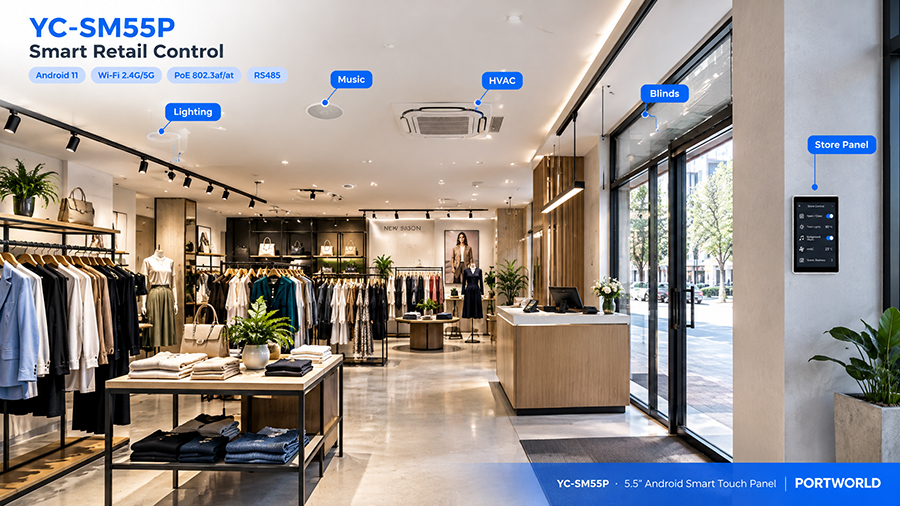
YC-SM55P smart home control panel
3. Unified Management of Multiple Smart Home Devices
An Android-based smart home control panel delivers a consolidated interface for overseeing various categories of interconnected devices.
Subject to the capabilities of the hardware, software, and system architecture, these may encompass:
- Lighting and dimming systems.
- Motorized curtains and blinds.
- Air conditioning and HVAC controls.
- Smart locks and security systems.
- Scene automation and scheduled operations.
- Compatible sensors and environmental monitoring devices.
For instance, a user could execute a “Movie Mode” scene that simultaneously dims the lights, closes the curtains, and modifies the room environment through a single command.
It is essential to acknowledge that Android does not inherently support compatibility with all smart home protocols. KNX, Zigbee, RS485, MQTT, and comparable integrations necessitate the requisite interfaces, software libraries, gateways, or compatible automation platforms.
4. Compatibility with Diverse Screen Dimensions and Device Specifications
Android’s deployment capability extends across numerous embedded hardware platforms and varying display dimensions, positioning it as an ideal solution for multiple smart home product classifications.
Smaller panels function effectively as room-level management systems, whereas larger touchscreen displays enable comprehensive dashboards and unified control capabilities.
As an illustration, Portworld provides multiple Android-compatible smart home panel solutions:
YC-SM41P: A 4-inch touchscreen interface designed for limited room-control implementations.
YC-P5: A 5-inch circular touchscreen interface intended for applications demanding an unconventional design approach.
YC-SM55P: A 5.5-inch touchscreen interface engineered for compact wall-integrated applications.
YC-SM10P: A 10-inch touchscreen interface delivering expanded display capabilities for comprehensive control systems.
Processor specifications, memory capacity, operating system iterations, and connectivity options differ according to model designation and setup parameters. Hardware procurement decisions should align with the application’s computational demands, visual presentation requirements, and communication infrastructure needs.
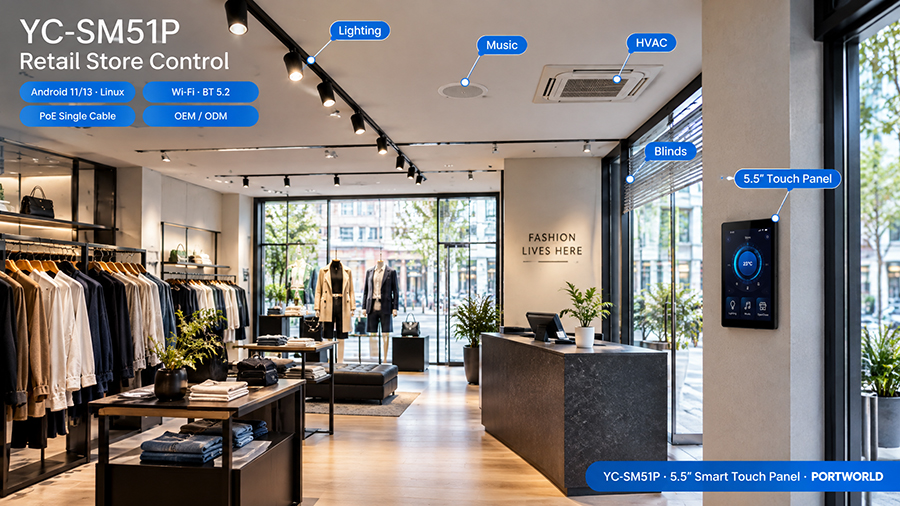
YC-SM51P 5.5 inch Smart Touch Panel
5. Integration with Networked Devices and Building Systems
Android control panels establish connections to networked devices and automation platforms through supported communication interfaces and software integrations.
Ethernet and Wi-Fi facilitate network connectivity, whereas Bluetooth enables support for compatible peripherals and device configuration. Supplementary interfaces, including RS485 or KNX-related hardware, may be incorporated when necessitated by the specific installation requirements.
In smart building applications, the control panel functions as a user-accessible interface for a comprehensive automation system. The automation logic may execute on a central controller, gateway, or alternative system component, while the Android panel presents device states and transmits user commands.
This architectural approach enables the panel to deliver a uniform interface without necessarily executing every automation function on the local device.
6. Simplified Software Customization and Product Differentiation
For smart home manufacturers, a control panel represents more than merely a hardware product. Its user interface and software experience constitute significant components of brand identity.
Android facilitates manufacturer customization of visual design, application layout, boot animation, default launcher, device settings, and other compatible software components.
An Original Equipment Manufacturer (OEM) or Original Design Manufacturer (ODM) initiative may encompass the following elements:Proprietary user interface designs and graphical symbols.Tailored boot sequences and application initialization procedures.Factory-installed software packages.Modified Android operating system distributions.Integration with proprietary smart home management platforms.Localized language preferences and geographic configuration options.These capabilities enable manufacturers to create differentiated products across diverse markets or customer demographics while leveraging a common underlying hardware architecture.The degree of system modification is contingent upon availability of source code access, vendor Board Support Package (BSP) resources, underlying hardware specifications, and the mutually established project parameters.
7. Multimedia Capabilities and Sophisticated User Interaction
When compared to conventional embedded control systems, Android presents significant advantages for smart home control panels requiring multimedia functionality or an advanced software ecosystem.Contingent upon the specific hardware platform, the control panel may provide:
Video-based intercom systems.Audio alert mechanisms and compatible voice-activated control technologies.Real-time video streams from integrated devices.Comprehensive graphical user dashboards.Supplementary applications for residential services or facility administration.
For instance, an intelligent residential control panel may integrate lighting and climate management systems with video communication capabilities and surveillance monitoring features.
These functionalities necessitate appropriate computational capacity, storage resources, visual display capabilities, acoustic equipment, imaging device connections where applicable, and appropriate software solutions. Such components should be incorporated into the foundational hardware design specifications rather than presumed to be inherently present on all Android control panels.
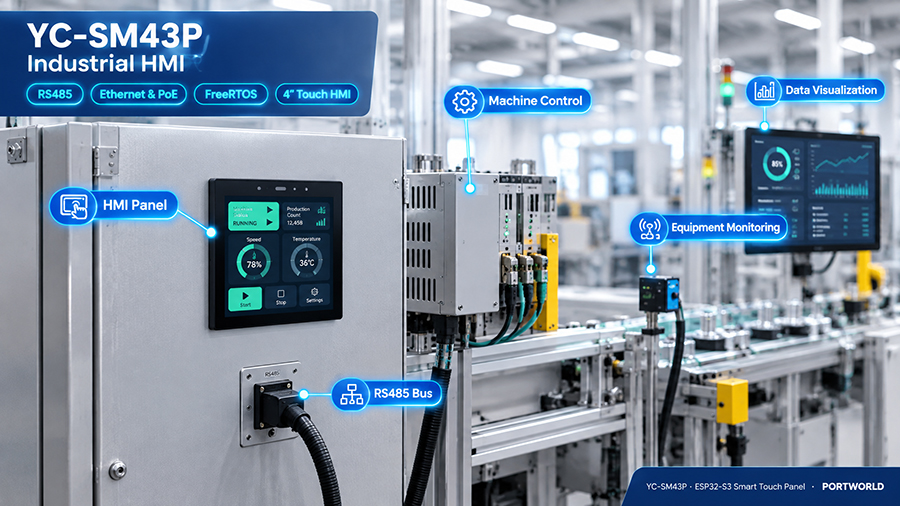
YC-SM43P ESP32 4″ Smart Touch Panel
8. Original Equipment Manufacturer and Original Design Manufacturer Development Prospects
Android represents a viable solution for numerous OEM and ODM smart home control panel initiatives because it provides a mature application infrastructure and facilitates multiple degrees of product modification.
An organization can commence with an established panel solution and modify the user interface, corporate identity, and supported operational parameters. Undertakings with more specialized needs can investigate supplementary hardware or platform-level modifications.
Portworld facilitates smart home control panel initiatives encompassing integrated hardware systems, display incorporation, platform customization, system connectivity, and user experience design, contingent upon the chosen technology platform and project specifications.
As an illustration, a residential automation manufacturer creating an eight-inch wall-integrated management system may leverage an existing Android-compatible solution, personalize its software and user interface, and confirm interoperability with the intended control system prior to commercial manufacturing.
This methodology can minimize the necessity to construct all hardware and software elements from inception. Nevertheless, the precise implementation schedule and financial requirements are contingent upon the degree of customization demanded.
9. What Factors Should Be Evaluated Prior to Selecting Android?
While Android presents numerous benefits, it does not necessarily represent the optimal solution for every smart home control panel implementation.
Android platforms typically demand adequate RAM capacity, storage space, and computational processing capabilities. Development teams must additionally assess touchscreen driver functionality, graphics acceleration performance, device compatibility, system reliability, and the availability of security update protocols.
For a straightforward control panel that executes a single streamlined interface and demands comprehensive system-level control, Linux or a microcontroller-based solution may prove more suitable.
Prior to selecting Android, thoroughly examine the necessary applications, visual display performance, communication standards, energy consumption requirements, software support strategy, and anticipated operational lifespan.
Android-based smart home control panels provide numerous significant benefits, including sophisticated touchscreen interfaces, adaptable software development capabilities, unified management of connected devices, compatibility with various screen dimensions, seamless network connectivity, extensive software personalization options, and rich multimedia features.
These capabilities establish Android as an appropriate technology foundation for smart home solutions requiring advanced functionality beyond simple on-off controls and leveraging an engaging, software-centric interaction model.
For smart home manufacturers and system integrators, optimal outcomes are achieved by aligning the Android platform with specific use case requirements, procuring appropriate hardware components, and conducting thorough validation of system interoperability during the initial development phase.
Portworld supplies Android-enabled smart home control panel solutions and comprehensive OEM/ODM customization services to enable organizations to engineer products precisely aligned with their intended applications and target markets.