Can a Digital Signage Display Use an Embedded Motherboard
Digital signage displays have evolved significantly beyond their traditional role of displaying advertisements and promotional content. Contemporary systems are capable of delivering interactive experiences, processing real-time data updates, enabling self-service functionality, facilitating remote administration, and seamlessly integrating with enterprise infrastructure. To enable these advanced capabilities, numerous digital signage solutions employ an embedded motherboard as their foundational computing architecture.
Can a digital signage display utilize an embedded motherboard? The answer is affirmative. An embedded motherboard functions as the primary computational engine within a digital signage display, delivering the necessary processing capabilities, operating system environment, network connectivity, and hardware interfaces required to execute applications effectively. The optimal configuration selection depends upon the display’s designated application, software prerequisites, display panel characteristics, and anticipated environmental conditions.
For organizations and integrators engaged in manufacturing specialized commercial display systems, comprehending the interaction between the motherboard and display hardware components constitutes a critical element of product development strategy.
What Role Does an Embedded Motherboard Perform in a Digital Signage Display?
An embedded motherboard represents a miniaturized computing platform engineered for incorporation into sophisticated electronic systems. In contrast to conventional personal computer motherboards, it is typically chosen to align with particular product specifications, accounting for dimensional constraints, energy efficiency, available connectivity options, operating system compatibility, and extended operational lifespan requirements.
Within a digital signage display, the motherboard functions as the system’s computational foundation. It executes application processes, decompresses multimedia content, operates the operating system, orchestrates network operations, and facilitates connections between the display and auxiliary equipment.
The system’s capabilities are contingent upon the motherboard and display architecture and may encompass the following features:
- Video and image playback functionality for promotional and informational display applications.
- Touchscreen capabilities enabling self-service kiosk operations and interactive signage solutions.
- Network connectivity infrastructure facilitating remote content distribution and centralized device administration.
- Multiple interface options including USB, serial, Ethernet, and additional connectivity standards for peripheral and external equipment integration.
Proprietary applications executing on Android or Linux-based operating environments.
The precise functional capabilities are determined by the processor specifications, memory capacity, graphics and video processing capabilities, available interface options, software compatibility, and display controller architecture.
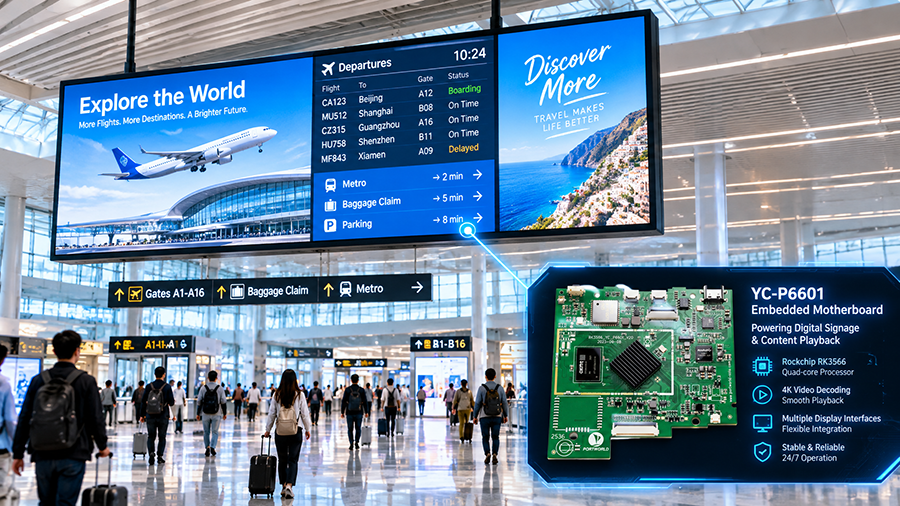
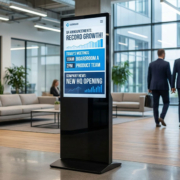
YC-P6601 digital signage display
Advantages of Implementing an Embedded Motherboard Versus Utilizing a Standalone Computer System:
For numerous commercial display implementations, embedding the computational infrastructure directly within the product can streamline the comprehensive system architecture.
Enhanced system integration. An embedded motherboard can be incorporated within the display housing, minimizing the requirement for an independent computing device and associated external wiring infrastructure. This approach proves particularly advantageous for wall-affixed promotional displays, interactive terminal stations, and space-constrained commercial applications.
Specialized hardware configuration. Manufacturers possess the capability to select an appropriate board aligned with the requisite display interfaces, computational performance demands, memory requirements, storage capacity, networking capabilities, and peripheral connectivity specifications. This methodology enables organizations to eliminate expenditures on unnecessary features while guaranteeing that critical operational requirements are fulfilled.
Operating system adaptability. Contingent upon the chosen platform architecture, an embedded system can execute Android, Linux, or alternative compatible operating systems. This flexibility provides product development teams with multiple alternatives when implementing promotional software, tactile user interfaces, content administration platforms, and supplementary enterprise-specific applications.
Opportunities for Customized Manufacturing. In OEM and ODM initiatives, the motherboard, enclosure, display panel, and software can be engineered according to a unified product specification. This approach proves especially advantageous when creating a proprietary display intended for consistent implementation across numerous facilities.
Nevertheless, an embedded motherboard is not universally the optimal solution for all applications. Certain displays may leverage external media players or pre-existing computing systems. The selection process must account for system architecture complexity, maintenance considerations, operational space constraints, budgetary limitations, and software integration compatibility.
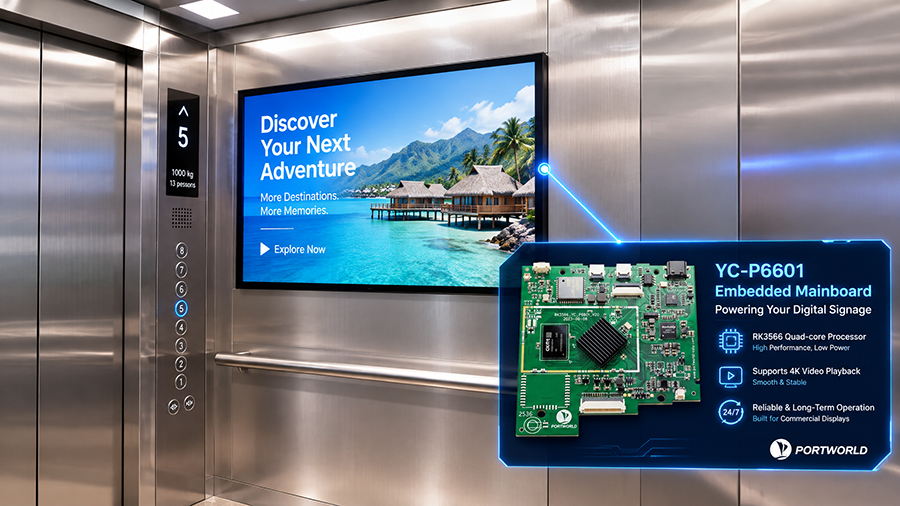
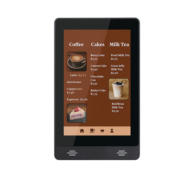
YC-P6601 digital signage display
Which Embedded Motherboard Is Appropriate for a Digital Signage Display?
The processor architecture should be determined based on the application’s genuine computational demands rather than the display dimensions exclusively.
For conventional promotional displays that distribute pre-recorded videos, photographic content, and internet-based materials, an appropriate entry-level or intermediate embedded platform may prove adequate. Dynamic interactive signage, multi-display configurations, and implementations requiring sophisticated graphics rendering or on-device artificial intelligence capabilities may necessitate a higher-performance processor and expanded memory capacity.
As an illustration, Rockchip-based embedded systems merit thorough examination for Android and Linux enterprise display applications, contingent upon the mandated software framework and required hardware connectivity options.
Portworld’s embedded hardware portfolio encompasses boards including the YC-P3566, which utilizes the Rockchip RK3566 processor, and the P3576, which leverages the Rockchip RK3576 platform. These boards warrant consideration for appropriate embedded display applications following verification of display interface requirements, operating system compatibility, performance specifications, and mechanical integration parameters.
For applications demanding elevated computational capabilities, a higher-performance platform may be warranted. Nevertheless, AI processing functionality is only essential when the application necessitates local inference, computer vision analysis, or comparable computational workloads; standard advertising content distribution does not inherently require an AI processor.
Prior to board selection, developers must validate the following criteria:
- Processor and memory: Can the system execute the intended application and process the required media formats?
- Display output: Does the board provide compatibility with the panel’s requisite interface and resolution specifications?
- Operating system: Is the necessary Android or Linux version accessible and compatible with the application requirements?
- Connectivity: Are Ethernet, Wi-Fi, USB, serial ports, or other essential interfaces provided?
- Power and thermal design: Can the board function reliably within the display enclosure parameters and specified temperature operating range?
- Software development support: Are the requisite drivers, SDKs, technical documentation, and system customization capabilities available?
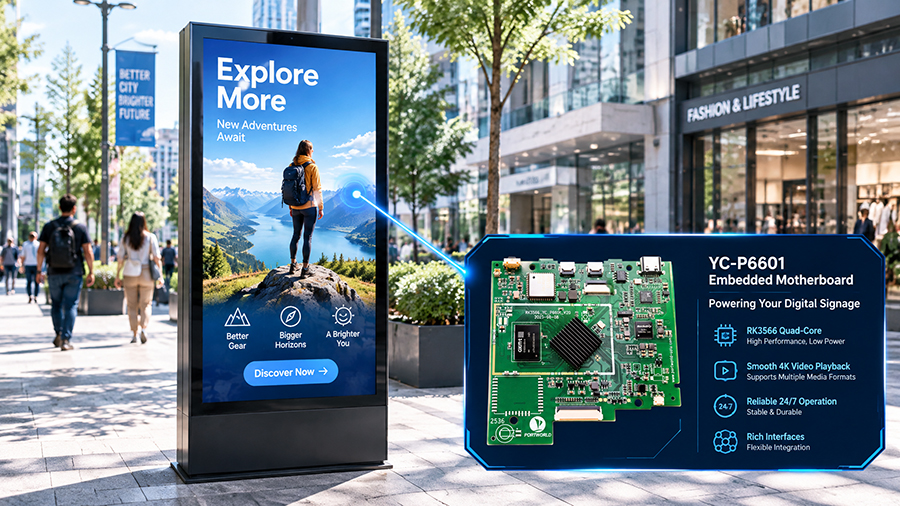
YC-P6601 digital signage display
The processor board and display panel must be evaluated as an integrated system. A processor board demonstrating adequate computing performance may prove unsuitable if it lacks the necessary display interface or requisite software support compatibility.
An embedded motherboard’s integration into a digital signage display extends beyond mere physical installation within the housing. The computing platform must establish functional communication with the display panel, touch interface controller, power management system, and any supplementary external devices.
The methodology for display connectivity is contingent upon the underlying hardware architecture. Prevalent panel connection standards encompass LVDS, eDP, and MIPI DSI, whereas HDMI may be employed in configurations designed to accommodate an independent display connection. Given that not all motherboards support every available interface, compatibility verification must be conducted prior to component procurement.
In touchscreen implementations, the touch interface controller similarly requires a compatible connection pathway to the computing platform, typically facilitated through USB or I²C protocols, contingent upon the specific design requirements. Supplementary devices may encompass imaging systems, audio output devices, audio input devices, optical scanning equipment, payment processing terminals, or measurement instruments.
Power allocation and thermal regulation represent considerations of equivalent significance. The computing platform, display panel, illumination system, and interfaced peripherals must obtain suitable electrical supply, and thermal energy produced within the enclosure must be appropriately dissipated under the specified operational parameters.
For bespoke applications, establishing the comprehensive hardware configuration prior to enclosure finalization constitutes optimal practice. This approach mitigates the probability of interface incompatibilities, installation complications, or expensive modifications necessitated during the manufacturing phase.
Embedded motherboards are capable of supporting a diverse array of digital signage applications when the appropriate hardware and software components are carefully selected to align with the specific operational requirements.
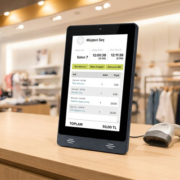
Within retail settings, these systems can execute advertising distribution software, merchandise information platforms, and dynamic promotional interfaces. In food service establishments, an integrated computational infrastructure can facilitate self-service ordering interfaces and customer-accessible transaction terminals, provided that compatibility exists with the ordering infrastructure and connected devices.
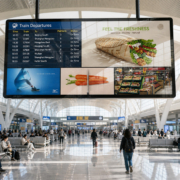
Commercial facilities such as hotels and office complexes may deploy embedded systems for informational displays, conference room control systems, and interactive navigation aids. Public transportation hubs and gathering spaces can utilize them for timetable displays, system notifications, and information dissemination services.
More sophisticated implementations may integrate digital signage capabilities with on-site data analysis, machine vision technology, or edge-based artificial intelligence. Such deployments necessitate thorough evaluation of computational capacity, imaging sensor connectivity, application frameworks, and heat management considerations.
The fundamental principle is that the embedded motherboard must be chosen based on the specific computational demands of the application. Although a basic promotional display and an artificial intelligence-powered interactive information station may feature comparable display dimensions, they typically demand substantially different computing architectures.
Embedded motherboards are indeed suitable for customized hardware initiatives, as their specifications can be tailored to align with particular product requirements.
Customization possibilities vary based on manufacturer expertise and the chosen platform, and may encompass memory and storage specifications, interface configuration, housing integration, operating system optimization, pre-loaded applications, corporate identification, and technical documentation.
Consider a manufacturer producing a branded wall-mounted digital advertising system that requires particular display resolution, Ethernet communication capabilities, automated application initialization, and compatibility with an established content management infrastructure. Similarly, a point-of-sale terminal application might demand supplementary USB ports and interoperability with auxiliary devices.
These specifications warrant thorough evaluation prior to initiating mass manufacturing. A prototype phase enables validation of visual output, tactile responsiveness, software compatibility, communication protocols, heat dissipation characteristics, and structural alignment. Following successful validation, the hardware and software specifications should be comprehensively documented to facilitate uniformity throughout successive production runs.
The practicality, implementation duration, production threshold requirements, and financial implications of customization are contingent upon the selected motherboard model, scope of modifications, component sourcing constraints, and intended manufacturing scale.
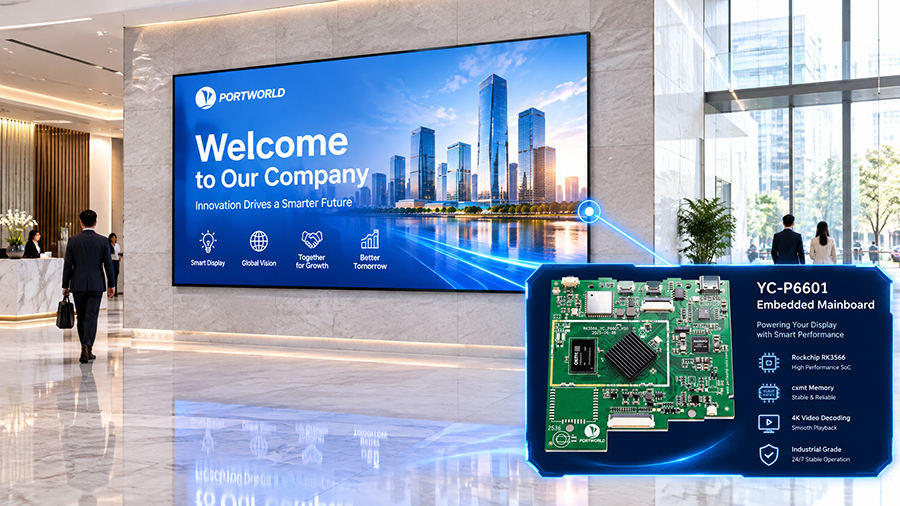
YC-P6601 digital signage display5
Portworld: Embedded Motherboards and Customized Digital Signage Solutions
Portworld, which operates under Sunworld Technology Limited, possesses over 18 years of specialized expertise in touchscreen and embedded hardware technologies. The organization’s comprehensive product range encompasses digital signage displays, point-of-sale touch displays, industrial-grade touch displays, system-on-modules, and embedded motherboards.
For organizations seeking to develop customized digital signage products, Portworld provides comprehensive support in evaluating appropriate hardware platforms while considering display specifications and software requirements. The motherboard offerings feature Rockchip-based architectures, including the YC-P3566 and P3576 models, whereas the digital signage portfolio comprises solutions designed for commercial advertising, retail point-of-sale applications, and interactive touch display systems.
Depending on specific project requirements, OEM/ODM partnerships may encompass motherboard selection, hardware configuration specifications, operating system customization, application integration, enclosure design requirements, and corporate branding considerations.
The optimal solution selection depends upon multiple factors including the display panel specifications, target resolution parameters, application processing demands, connectivity requirements, installation environment conditions, and anticipated production volume. Establishing these specifications at an early stage facilitates determination of whether an existing motherboard and display combination meets requirements or whether supplementary development efforts are necessary.
An embedded motherboard serves as a robust computing foundation for digital signage displays, facilitating media playback, interactive functionality, network communication, and software integration within a unified system.
The critical initial phase involves aligning the motherboard specifications with the intended application requirements. Processor capabilities, display connectivity options, operating system compatibility, interface availability, thermal management considerations, and ongoing support obligations collectively determine the optimal selection.
For enterprises manufacturing commercial displays in volume, partnering with a vendor possessing expertise in both embedded systems and display technology integration can streamline development processes and establish a standardized, reproducible manufacturing workflow.
Should you be undertaking a specialized digital signage initiative, we encourage you to reach out to Portworld to evaluate your display specifications, embedded motherboard alternatives, software infrastructure, and manufacturing or design partnership requirements.